Dung Beetle Facts: The Insect Guided by the Milky Way
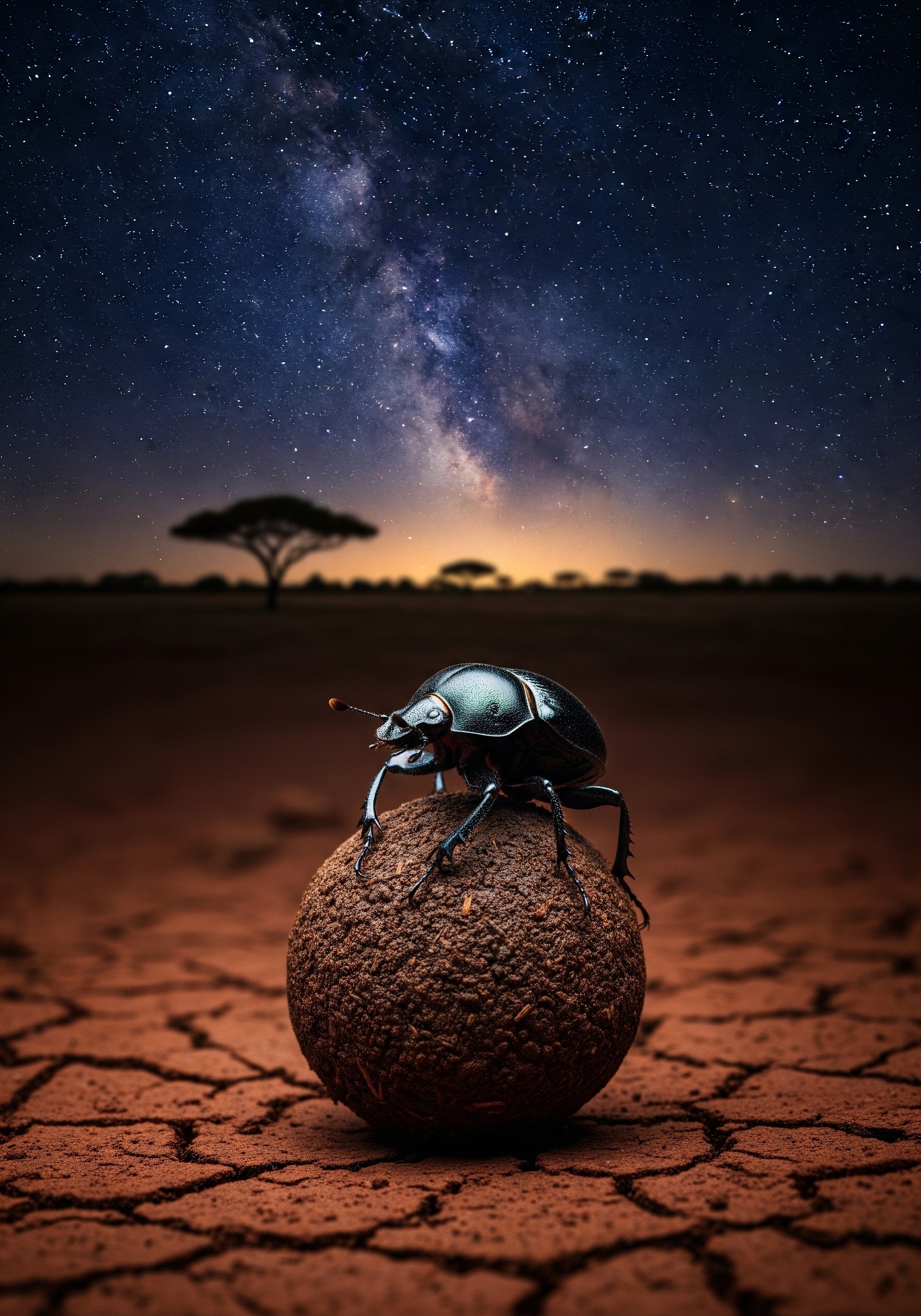
If you came here for dung beetle facts, start with this one: on a moonless night in a South African game reserve, a beetle the size of a thumbnail rolls a perfect ball of fresh dung in a perfectly straight line — and the only thing guiding it is the faint stripe of the Milky Way overhead.
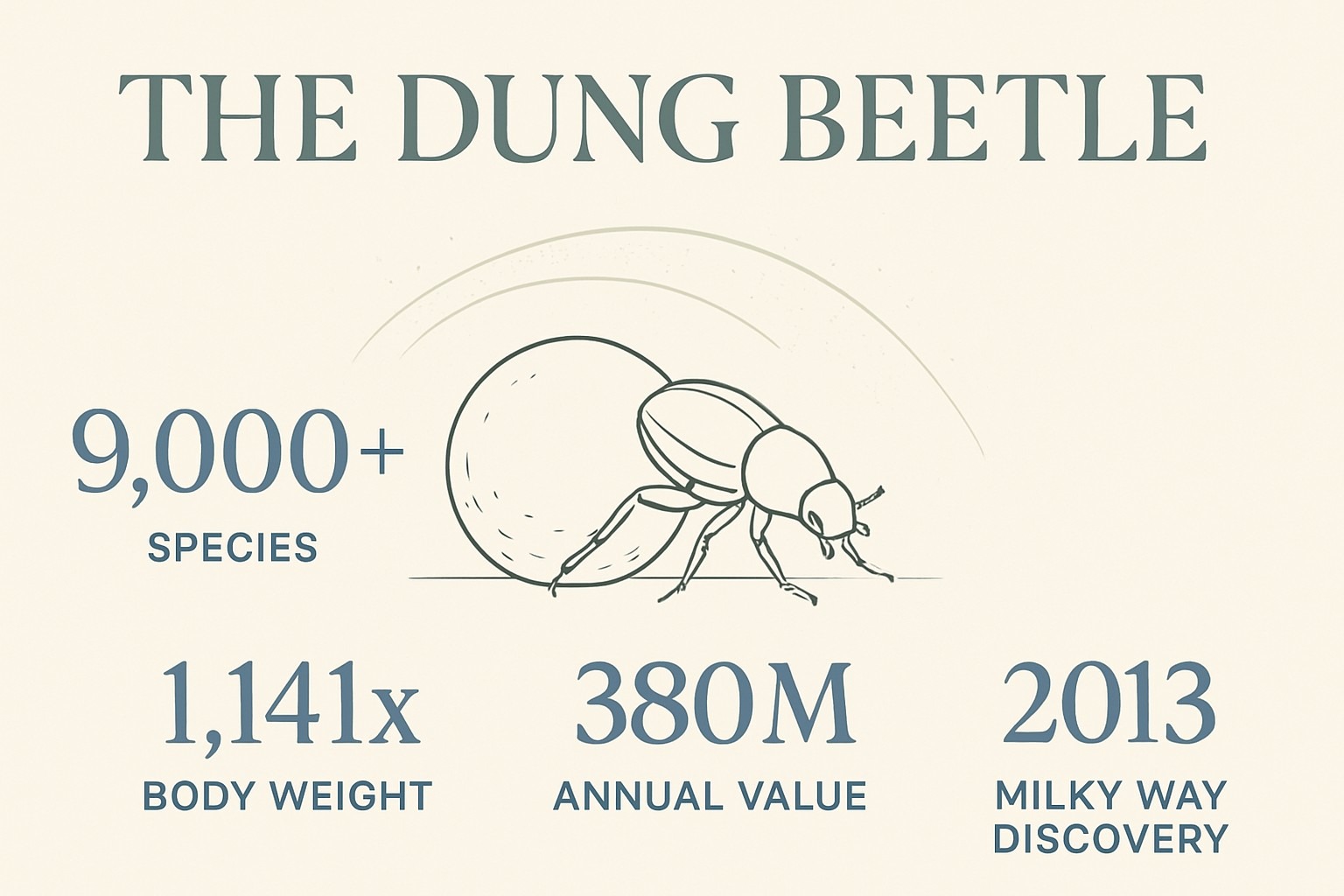
Key Facts
- There are more than 9,000 described species of dung beetle worldwide, found on every continent except Antarctica.
- The horned dung beetle Onthophagus taurus can pull 1,141 times its own body weight — the most powerful insect ever measured, relative to size.
- In 2013, biologists led by Marie Dacke at Lund University showed that the African beetle Scarabaeus satyrus orients itself by the Milky Way — the first animal in the kingdom known to do so.
- Australian cattle ranches were drowning in untouched cow pats until the 1965–1985 CSIRO project released 1.7 million imported dung beetles to clean them up.
- The U.S. cattle industry saves an estimated $380 million a year thanks to wild dung beetles burying pasture manure for free.
In short: Dung beetles are the planet’s most efficient small-scale waste managers — and its only known galactic navigators. Their quiet work recycles enormous volumes of manure every year, and their biology has rewritten what scientists thought small brains could do.
Key Facts
- There are more than 9,000 described species of dung beetle worldwide, found on every continent except Antarctica.
- The horned dung beetle Onthophagus taurus can pull 1,141 times its own body weight, the most powerful insect ever measured relative to size.
- In 2013, biologists led by Marie Dacke at Lund University showed that the African beetle Scarabaeus satyrus orients itself by the Milky Way, the first animal known to do so.
- Australian cattle ranches were drowning in untouched cow pats until the 1965-1985 CSIRO project released 1.7 million imported dung beetles to clean them up.
- The U.S. cattle industry saves an estimated $380 million a year thanks to wild dung beetles burying pasture manure for free.
In short: Dung beetles are the planet’s most efficient small-scale waste managers and its only known galactic navigators. Their quiet work recycles enormous volumes of manure every year, saving the U.S. cattle industry an estimated $380 million annually. Their biology, from Milky Way navigation to record-breaking strength, has rewritten what scientists thought small brains and bodies could do.
A Galaxy in Their Eyes
The headline finding came out of South Africa in January 2013. A team led by sensory biologist Marie Dacke at Lund University, working with the African nocturnal species Scarabaeus satyrus, fitted beetles with tiny cardboard caps that blocked their view of the sky. With the sky covered, the beetles wandered in circles. Uncovered, they marched in straight lines — even on moonless nights when only the Milky Way was visible. The study, published in Current Biology, was the first hard evidence of any animal using our galaxy as a compass.
The mechanism is elegant and small-brained. The beetles do not see individual stars — their compound eyes can’t resolve them. Instead they read the brightness gradient of the Milky Way’s long band itself, comparing the bright galactic centre to dimmer arms. Before rolling, the beetle climbs on top of its ball and does a quick rotation — a “dance” — to take what Dacke later described as a celestial snapshot. Then it sets off, holding that bearing for the rest of the journey.
Turns out the why is just as good as the how. Around a fresh pile hundreds of beetles fight over the same shrinking pool of dung. The fastest way out is a straight line — any curve sends you back into the brawl. A galaxy makes a very good ruler.
Rollers, Tunnellers, and Dwellers: Three Ways to Handle a Pile
Not every dung beetle rolls. Entomologists sort the family into three behavioural guilds, each solving the same problem — get dung underground before it dries, before flies lay eggs in it, and before a rival arrives — in a completely different way.
| Guild | Strategy | Example species |
|---|---|---|
| Rollers | Sculpt a ball at the pile, push it metres away, then bury it. | Scarabaeus sacer (Egypt), S. satyrus (Africa) |
| Tunnellers | Dig straight down beneath the pile and drag dung underground. | Onthophagus taurus, Euoniticellus intermedius |
| Dwellers | Live and breed inside the pat itself; never bury anything. | Various Aphodiinae |
Rollers are the showmen and the species every photographer chases — but tunnellers are quietly the workhorses of farmland soil. Dwellers, often overlooked, dominate cool temperate climates where rolling a ball through wet grass would simply cost too much energy.
{IMAGE_2}
Pound for Pound, the Strongest Animal Alive
The strongest creature on Earth is not the elephant. It is a thumbnail-sized beetle from a Mediterranean cow pasture.
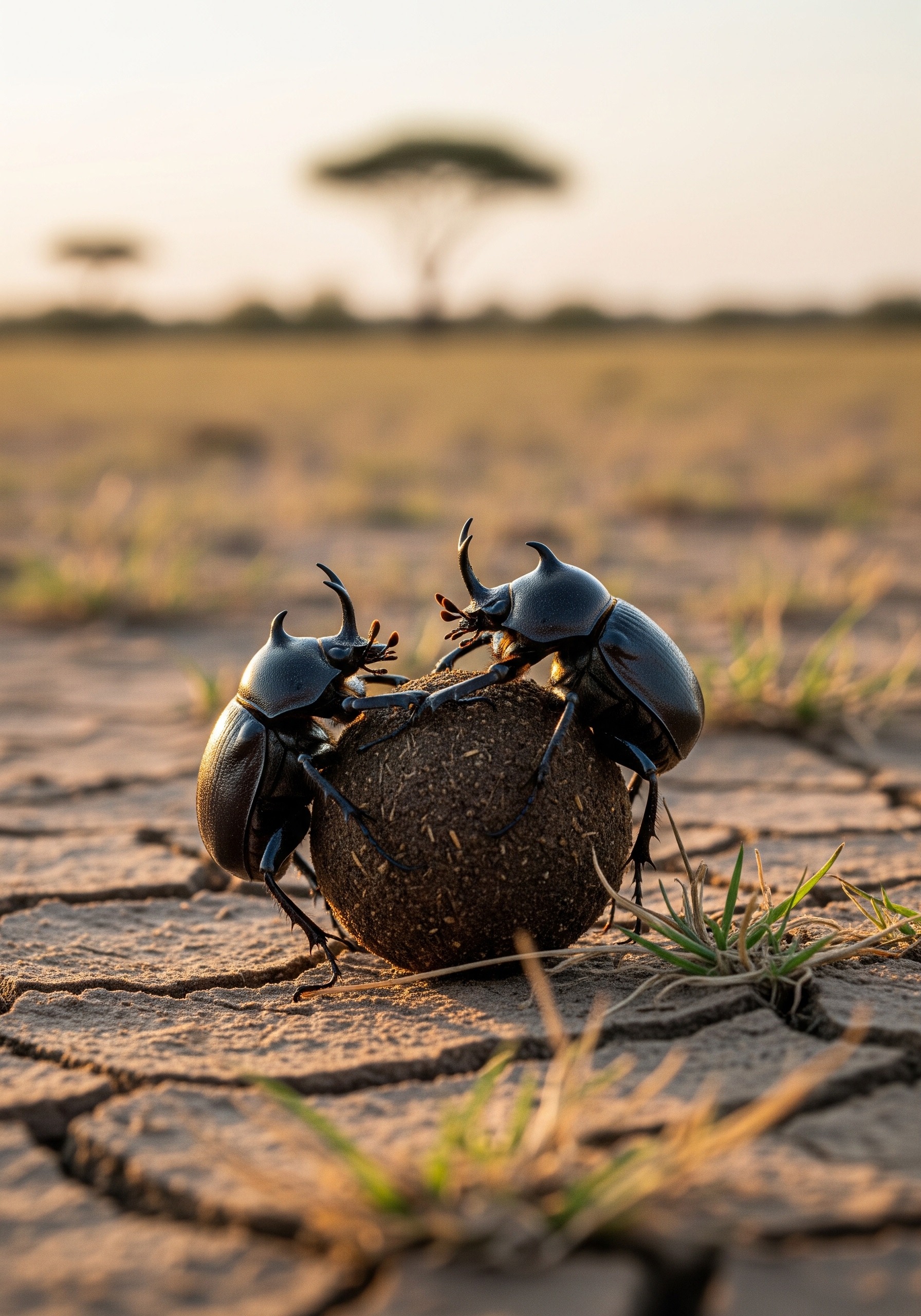
In a 2010 paper in Proceedings of the Royal Society B, biologists Rob Knell of Queen Mary University of London and Leigh Simmons of the University of Western Australia measured what a male horned dung beetle (Onthophagus taurus) could pull while defending a tunnel from a rival male. The answer: 1,141 times its own body weight. A 70-kilogram human at the same ratio would be towing about 80 tonnes — six packed double-decker buses on one rope.
The numbers behind the legend
- 1,141× body weight — strongest pulling force ever measured in an insect (O. taurus, Knell & Simmons, 2010).
- 250× body mass — dung that some species can bury in a single night.
- 9,000+ described species worldwide; the subfamily Scarabaeinae alone holds more than 5,000.
- ~$380 million — estimated annual saving to U.S. cattle ranchers from free pasture cleaning.
- 1.7 million — beetles released into Australia between 1968 and 1984 to clean up cow pats.
The strength is not vanity. Males battle inside narrow tunnels for access to females; whichever beetle can shove the other backwards wins the mating. Evolution has been optimising that shove for tens of millions of years.
The Beetle Egypt Turned Into a God
Long before science noticed the dung beetle’s compass, a civilisation built a religion around it. The ancient Egyptians watched scarabs roll their balls across the sand and saw, in miniature, the sun being rolled across the sky. They named the beetle-headed god Khepri — the morning sun, the principle of becoming — and they noticed something stranger still: young beetles seemed to emerge, fully formed, from the dung ball itself, as if from nothing.
(They were almost right. The female lays a single egg deep inside a sealed brood ball; weeks later, a finished adult chews its way out. To an observer in 2000 BC, that looked exactly like spontaneous creation.)
Carved scarab amulets became the most common protective object in dynastic Egypt — pressed into mummy wrappings, set into rings, inscribed on the underside with a name or a short prayer. The British Museum, the Louvre and the Cairo Museum together hold tens of thousands. Few insects in human history have been given quite so much rank.
How a Hungarian Scientist Saved Australia From Its Own Cows
By the 1950s Australia had a problem of almost biblical scale: tens of millions of cattle producing as many as a dozen dung pats per animal per day, with nothing on the continent willing to bury them. Pastures were going dead under crusts of manure. Bush flies, which breed in cow dung, hit plague densities every summer — the constant face-swatting of the outback even entered Australian folklore as “the Aussie salute”.
Australia’s native dung beetles had evolved alongside kangaroos and wombats. Their dung is small, dry, fibrous. The native beetles wanted nothing to do with the wet, fly-blown pads of imported European cattle.
Enter George Bornemissza, a Hungarian-born entomologist who joined the CSIRO after fleeing post-war Europe. Walking through a paddock soon after arriving in 1951, he noticed the appalling state of Australian pasture and proposed an unlikely fix: import African and Mediterranean dung beetles that had co-evolved with hoofed mammals and let them do the cleaning for free. The Australian Dung Beetle Project ran from 1965 to 1985. CSIRO eventually imported and released 43 species; 23 established successful breeding populations. Bush fly numbers dropped by roughly 90% in regions where the new beetles took hold. Bornemissza was awarded the Medal of the Order of Australia in 2001; he died in 2014, aged 90.
It remains one of the most successful — and least loud — biological control programs of the 20th century.
The Real Reason Dung Beetles Matter
Strip away the navigation papers and the Egyptian gods, and the day-job is unglamorous: dung beetles bury other animals’ waste. But the scale of that quiet work is extraordinary. USDA Agricultural Research Service economists estimate dung beetles save the United States cattle industry roughly $380 million a year by clearing pasture, controlling flies, killing parasitic worms, and pulling nitrogen and carbon back down into the soil.
In tropical rainforests they double as seed dispersers — they bury seeds passed by monkeys and birds in droppings, planting the next generation of trees as a side effect of cleaning up. Ecologists now use dung beetle diversity as a real-time biosensor for forest health: when beetle species drop out, the forest is in trouble.
And that, honestly, is the most interesting thing about them — not the dung, but how much of the natural world quietly depends on them doing it.
From Brood Ball to Beetle: A Short Life Cycle
Female dung beetles are exceptional mothers by insect standards. After mating, the female (often with the male’s help) sculpts a portion of fresh dung into a smooth, near-spherical brood ball and buries it. She lays a single egg in a chamber inside, then seals it.
What happens next is fast. The egg hatches in a few days. The C-shaped grub eats outwards through its dung pantry, multiplying its weight roughly twenty-five-fold before pupating. Inside the pupal case — usually one to two weeks — it rebuilds itself into an adult: hardened cuticle, fitted wings, segmented legs. Then it chews its way out and surfaces to look for its first pile. Most species cycle once a year; a few tropical ones manage two or three.
Seven Dung Beetle Facts Worth Remembering
So which of these dung beetle facts actually stay with you?
- They are the only animal known to navigate by the entire Milky Way galaxy (Dacke et al., 2013).
- Onthophagus taurus can pull 1,141 times its own body weight.
- Some species bury 250 times their body mass in dung in a single night.
- The ancient Egyptian god of the morning sun, Khepri, is a dung beetle.
- Australia imported 1.7 million beetles between 1968 and 1984 to fix its cow problem.
- U.S. ranchers get roughly $380 million in free labour from wild dung beetles every year.
- The first thing a roller does on top of its ball is a small rotational “dance” — locking in a celestial bearing.
Frequently Asked Questions
Q: How do dung beetles navigate in a straight line?
A: By day they use the sun’s position; by night they use polarised moonlight or, when there is no moon, the bright band of the Milky Way. They take a celestial “snapshot” before rolling and hold that bearing.
Q: What do dung beetles actually eat?
A: Adults drink the moist, microbe-rich liquid in fresh dung. Larvae eat the drier, fibrous material packed around them in the brood ball. Most species specialise on herbivore dung, which is richer in plant fibre and easier to digest.
Q: Are dung beetles really the strongest animal on Earth?
A: Pound for pound, yes. The male horned dung beetle (Onthophagus taurus) holds the documented record at 1,141 times its body weight pulled — Knell and Simmons, 2010, Queen Mary University of London and the University of Western Australia.
Q: Are dung beetles endangered?
A: Globally no, but local populations are falling sharply in places where ivermectin and similar livestock dewormers leave residues in dung that kill beetle larvae. Pesticide use and habitat loss are the two largest pressures the Xerces Society currently flags.
Sources
- Dacke, M. et al. (2013). “Dung beetles use the Milky Way for orientation.” Current Biology, 23(4).
- Knell, R. J. and Simmons, L. W. (2010). Pulling-force measurements on Onthophagus taurus, Proceedings of the Royal Society B.
- CSIRO Australian Dung Beetle Project archive and the National Museum of Australia.
- USDA Agricultural Research Service — pasture ecosystem-service estimates.
- The Xerces Society for Invertebrate Conservation — dung beetle ecology briefings.
Stand in any cattle pasture at dusk, anywhere from Texas to Tanzania, and there is a fair chance that — unseen, under your feet — a small armoured insect is checking the sky, fixing a bearing on a galaxy, and getting on with the most ancient cleaning job on Earth.
Illustrations are AI-generated. Article fact-checked and human-edited. Our editorial standards.