Pufferfish vs. Porcupinefish: One Carries a Deadly Secret
Pufferfish tetrodotoxin defense is lethal enough to kill thirty adult humans — housed inside a fish that won’t bite you, won’t chase you, won’t even seem to notice you. The paradox is this: its spiny cousin, the porcupinefish, looks far more dangerous. And yet between the two, it’s the unremarkable-looking one carrying a weapon with no antidote.
In the warm, shallow reef waters of the Indo-Pacific and beyond, these two fish are routinely mistaken for each other. Both inflate. Both look ridiculous doing it. Both deter predators in dramatic, unmistakable fashion. But one plays a mechanical game — grow the spines, puff up, hope for the best. The other has quietly weaponized its own biology at a molecular level, turning its flesh into a death sentence. The question is: why does one need a chemical arsenal when the other’s spines seem to work just fine?
Key Facts
- Pufferfish (family Tetraodontidae) and porcupinefish (family Diodontidae) both belong to the order Tetraodontiformes but evolved different defenses.
- Tetrodotoxin (TTX) blocks voltage-gated sodium channels in nerve cells, causing muscle paralysis and respiratory failure, with no antidote available.
- Tetrodotoxin is approximately 1,200 times more toxic than cyanide by weight, and a single large pufferfish carries enough TTX to kill approximately 30 adult humans.
- Pufferfish accumulate TTX from bacteria — primarily species of Pseudoalteromonas, Vibrio, and Shewanella — found in their prey, as demonstrated by researchers at Nagasaki University in the 1990s.
- Licensed Japanese fugu chefs spend 3 to 5 years training, and licensed restaurants serve approximately 10 million fugu meals per year; National Geographic reported dozens of fugu-related deaths in Japan between 2000 and 2020.
In short: Pufferfish (Tetraodontidae) accumulate tetrodotoxin from bacteria-bearing prey; a single fish carries enough TTX to kill roughly 30 adults — 1,200× cyanide’s toxicity. Porcupinefish (Diodontidae) instead rely on spines and inflation. Licensed Japanese fugu chefs train 3-5 years, and restaurants serve about 10 million fugu meals per year.
Two Fish, One Trick, Very Different Secrets
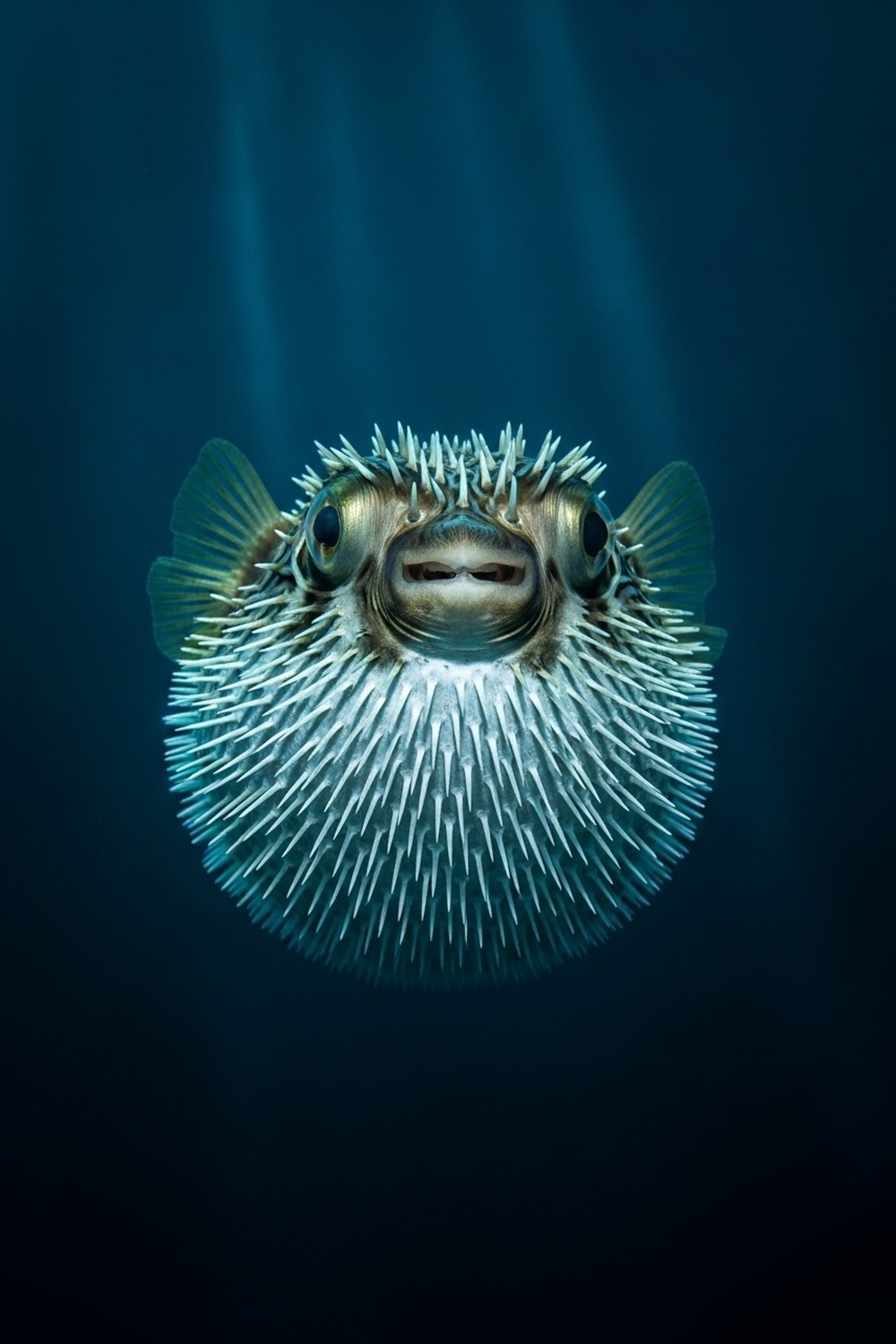
Pufferfish and porcupinefish belong to the same order — Tetraodontiformes — but they diverged into very different survival strategies long ago. Porcupinefish (family Diodontidae) are covered in long, fixed spines derived from modified scales. When threatened, they inflate their bodies using water, turning those spines outward into a globe of sharp points that’s almost impossible for most predators to swallow. Biologists at the Smithsonian Tropical Research Institute have documented porcupinefish using this inflation reflex within milliseconds of detecting a threat — a response so fast it barely registers as a decision. According to the order Tetraodontiformes, these fish share a common ancestor, yet their defenses evolved in dramatically different directions.
One branch leaned into physics. The other leaned into chemistry.
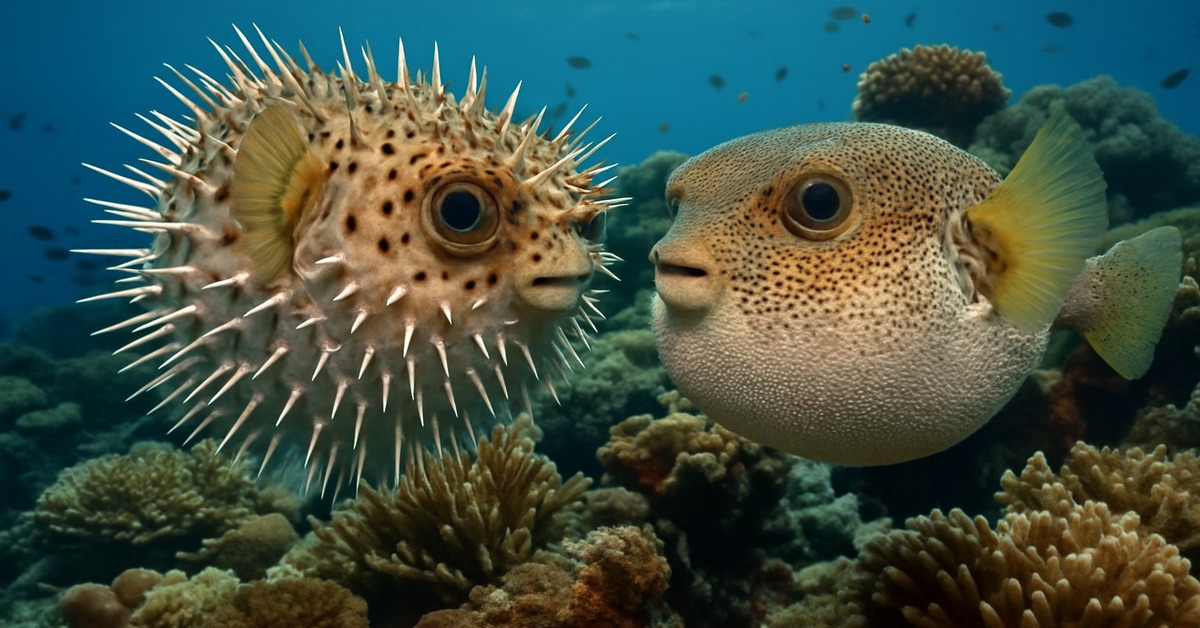
Pufferfish (family Tetraodontidae) share the inflation behavior, but their spines — where they exist at all — are shorter, less dramatic, and in many species barely visible when the fish is relaxed. Watch a pufferfish resting on a reef and you wouldn’t immediately see the weapon. That’s the point. The real arsenal isn’t structural. It’s metabolic, invisible, and utterly ruthless. A predator that swallows a porcupinefish gets a mouthful of pain. A predator that swallows a pufferfish gets something it can’t recover from.
Field guides and snorkeling tours frequently confuse the two species. Divers in the Maldives have reported approaching what they thought were harmless porcupinefish, only to learn later they’d been photographing highly toxic pufferfish. The physical resemblance is real. The biological difference is enormous.
The Poison That Doesn’t Come From the Fish
Here’s the thing — pufferfish don’t manufacture tetrodotoxin themselves. They accumulate it. The poison originates from bacteria — primarily species of Pseudoalteromonas, Vibrio, and Shewanella — that live in the marine environment and in the organisms pufferfish eat. Worms, crustaceans, starfish, and certain algae all carry trace amounts of the toxin, and as the pufferfish consumes them across its lifetime, tetrodotoxin concentrates in its liver, skin, ovaries, and intestines. Researchers at Nagasaki University in Japan studied this process extensively throughout the 1990s, demonstrating that pufferfish raised in captivity on a clean, controlled diet grew up essentially non-toxic. Much like the pygmy seahorse’s camouflage, which depends entirely on the coral it inhabits, the pufferfish’s deadliness is inseparable from its environment.
Why does this matter? Because it means the fish isn’t born dangerous — it becomes dangerous, shaped by every meal it’s ever eaten.
Tetrodotoxin — TTX — works by blocking voltage-gated sodium channels in nerve cells. Nerves fire by allowing sodium ions to flood through these channels, triggering an electrical signal. TTX locks those channels shut. Muscles can’t contract. The diaphragm stops. Breathing ceases. Death from respiratory failure can occur within hours of ingestion in severe cases, and there is no antidote. The only treatment is mechanical ventilation and time, keeping the victim alive while the body slowly metabolizes the poison. At a toxicity rating roughly 1,200 times that of cyanide by weight, a single large pufferfish carries enough tetrodotoxin to kill approximately 30 adult humans.
What’s remarkable is how selectively this toxin concentrates. The flesh — the muscle meat — is often relatively low in TTX compared to the liver and ovaries. Which is exactly why fugu, the Japanese delicacy made from pufferfish, is theoretically possible to prepare safely. Emphasis on theoretically.
When Deadly Becomes a Delicacy
Japan has served fugu for over a thousand years. The earliest written records of pufferfish consumption date to the Jomon period, though the fish’s dangerous reputation solidified during the Edo era, when the shogun Toyotomi Hideyoshi reportedly banned samurai from eating it after too many soldiers died. Today, preparing fugu is a licensed profession in Japan — chefs spend three to five years learning to remove the toxic organs without contaminating the edible flesh, operating under strict food safety law. Licensed restaurants serve approximately ten million fugu meals per year. Despite this, fatalities still occur, almost entirely from amateur preparation at home. According to reporting by National Geographic, between 2000 and 2020, Japan recorded dozens of fugu-related deaths, the majority in rural homes where the fish was caught and cooked without professional guidance.
The pufferfish tetrodotoxin defense doesn’t switch off just because a human decided the fish looked delicious.
Counterintuitively, fugu is not especially revered for its flavor. Many who’ve eaten it describe the taste as mild, almost understated — certainly not commensurate with the effort and risk involved. What diners seek is partly the texture, partly the prestige, and partly the residual tingle that low-level TTX exposure can cause on the lips and tongue — a reminder, however faint, that you’re eating something that could kill you. It’s culinary brinksmanship. The pufferfish tetrodotoxin defense, weaponized against predators for millions of years, has somehow become part of the human dining experience. Beyond Japan, pufferfish are eaten in parts of South Korea, China, and increasingly appear in black-market seafood networks in regions where their preparation is illegal. In 2023, health authorities in Thailand issued warnings after multiple hospitalizations from unlicensed pufferfish sales in coastal markets.
Pufferfish Tetrodotoxin Defense: What Evolution Actually Built
Producing a potent neurotoxin endogenously — building it from scratch inside your own cells — is metabolically expensive. It requires dedicated biochemical machinery, genetic encoding, and ongoing energy investment. Borrowing it from bacteria and dietary sources is, in a sense, more efficient: you get the defense without paying the full manufacturing cost. A 2016 study published in the journal Toxins, conducted by researchers at the University of Tokyo, found that TTX distribution within individual pufferfish varied significantly based on geographic range and local diet — meaning fish from toxin-rich feeding grounds were dramatically more dangerous than those from cleaner waters. The pufferfish tetrodotoxin defense is not uniform. It’s responsive. Dynamic. Shaped by where the fish lives and what it eats.
An evolutionary arrangement this opportunistic deserves more credit than it typically gets — there’s something almost elegant about a creature that outsources its most lethal feature to the ocean floor.
And the arms race it creates runs deeper than most people realize. Predators that regularly encounter toxic pufferfish — certain sea snakes, for example — have evolved partial resistance to TTX through mutations in their own sodium channels. Tiger keelback snakes in Japan don’t just tolerate pufferfish; they sequester the toxin and use it in their own defensive glands. The poison migrates up the food chain, changing the biology of everything it touches. Octopuses, some moray eels, and ribbon worms all carry TTX (researchers actually call this a toxin network), all traceable to the same bacterial origin. One toxin, distributed across dozens of species, maintained by a web of microbial chemistry that operates largely out of sight.
Researchers at Woods Hole Oceanographic Institution are currently mapping TTX distribution across marine ecosystems to understand how climate change and habitat degradation might alter bacterial communities — and therefore alter the toxicity of fish that depend on them. A warmer, more acidic ocean may not just bleach coral. It may change which fish are dangerous and how dangerous they are.
The Porcupinefish’s Honest Defense
Return, for a moment, to the porcupinefish. Its strategy is brutal in its simplicity. The spines — which can reach several centimeters in length on larger species — don’t inject venom, don’t carry toxins, and require nothing but the fish’s own body. No bacteria, no dietary accumulation, no invisible molecular mechanism. Just structure and physics. A fully inflated porcupinefish is a sphere of sharp, outward-facing points that can lodge in the throat of any predator reckless enough to attempt swallowing it. There are documented cases of sharks found dead with porcupinefish lodged in their throats — not because the fish fought back in any conventional sense, but because the inflation reflex works even post-mortem, and a dying porcupinefish can still become an impenetrable object.
But this mechanical strategy is, in some environments, less reliable. Spines can be seen. Predators learn to avoid inflated porcupinefish purely on visual cues — and in murky water, or at night, the warning can be missed until it’s too late for both parties. Chemical deterrence, by contrast, works in the dark. It works even after the fish is dead. TTX persists in tissue for days. A pufferfish carcass on the seafloor is still a toxin delivery system. Evolution, once again, found the longer game.
Marine biologists at the Australian Institute of Marine Science have observed that in reef systems where both species coexist, porcupinefish tend to be more active during daylight hours — when their visual deterrent works best — while pufferfish move more freely at dawn and dusk, seemingly less concerned with being seen. Whether that behavioral difference is directly linked to their respective defenses hasn’t been formally studied. But the pattern is hard to ignore.
Where to See This
- The Great Barrier Reef, Australia — both pufferfish and porcupinefish are common on shallow reef systems; best visibility between May and October during the dry season.
- Okinawa Churaumi Aquarium in Japan displays multiple pufferfish species with interpretive panels on tetrodotoxin and fugu culture — one of the most detailed public exhibits on TTX in the world.
- For readers who want to go deeper: Luiz Rocha’s reef fish research at the California Academy of Sciences documents Indo-Pacific species distribution, and the academy’s iNaturalist database allows you to map confirmed pufferfish sightings globally in real time.
By the Numbers
- 1,200× — the approximate toxicity of tetrodotoxin relative to cyanide by weight, according to pharmacological studies published in Toxicology Letters.
- 30 — the number of adult humans a single large pufferfish carries enough TTX to kill, based on lethal dose estimates from the U.S. National Institutes of Health.
- ~10 million — fugu meals served annually in licensed Japanese restaurants, according to Japan’s Fisheries Agency (2022 figures).
- 3–5 years — the minimum training period required before a Japanese chef receives a fugu preparation license from prefectural authorities.
- 0 — known antidotes for tetrodotoxin poisoning as of 2024; treatment remains entirely supportive, with no pharmacological reversal agent approved anywhere in the world.
Field Notes
- In 2011, researchers at Nagasaki University confirmed that captive-raised pufferfish fed a bacteria-free diet contained no detectable tetrodotoxin — definitively proving the toxin is dietary, not genetic. The same fish, transferred to a natural diet, began accumulating TTX within weeks.
- Porcupinefish spines aren’t just sharp — they’re hollow at the base and reinforced with a cross-hatched internal structure that makes them extremely difficult to break under compression, a structural feature that materials scientists at MIT have studied for potential applications in protective coatings.
- At least one population of rough-skinned newts in the Pacific Northwest carries tetrodotoxin concentrations comparable to pufferfish — scientists believe the same bacterial network may underpin both, suggesting TTX distribution in nature is far broader than most textbooks imply.
- Researchers still can’t fully explain why pufferfish don’t poison themselves. TTX blocks sodium channels, and pufferfish have sodium channels. Some studies suggest point mutations in their channel proteins confer partial resistance — but the degree of protection varies between individuals, and the exact mechanism remains unresolved as of 2024.
Frequently Asked Questions
Q: How does pufferfish tetrodotoxin defense actually kill a predator?
Tetrodotoxin binds to voltage-gated sodium channels in nerve cells and blocks them completely. Without sodium channel function, nerves can’t transmit signals, muscles can’t contract, and the diaphragm — the muscle that drives breathing — stops working. Death occurs from respiratory failure, typically within four to six hours of a significant exposure. There’s no antidote. Survival depends entirely on keeping the victim breathing artificially until the toxin clears the system.
Q: Can you really eat pufferfish safely?
Yes — but the margin for error is razor thin. The muscle flesh of a pufferfish contains relatively low concentrations of TTX compared to the liver, ovaries, and skin. Licensed fugu chefs in Japan are trained to remove the toxic organs without contaminating the edible tissue. The process works when done correctly. When it doesn’t — usually in home kitchens by unlicensed cooks — the results can be fatal. Roughly 30 to 50 fugu-related incidents are reported in Japan annually, with fatalities occurring most years.
Q: Aren’t pufferfish and porcupinefish basically the same animal?
This is the most common misconception. They’re related — both belong to the order Tetraodontiformes — but they’re in different families and their defenses are fundamentally different. Porcupinefish rely entirely on their long, rigid spines and inflation for protection. Pufferfish may have shorter or less prominent spines, but carry tetrodotoxin in their tissues. Visually, they look similar when inflated. Biologically, the difference between a mechanical deterrent and a lethal neurotoxin is about as large a gap as you’ll find in the animal kingdom.
Editor’s Take — Alex Morgan
What stays with me about the pufferfish isn’t the toxin number — 1,200 times more potent than cyanide — impressive as that is. It’s the fact that the fish doesn’t make it. It borrows it, patiently, from the world it swims through. Its danger is assembled piece by piece from bacteria, worms, and crustaceans over a lifetime. That means the ocean itself is the weapon. Degrade the ecosystem enough, and you don’t just lose fish. You lose the chemistry that makes them what they are. That’s a different kind of extinction story, and we haven’t started telling it properly yet.
Two fish. Same trick. One built a fortress of spines; the other became a slow, invisible poison assembled from the ocean floor up. The pufferfish tetrodotoxin defense isn’t just a biological curiosity — it’s a reminder that the deadliest things in nature rarely announce themselves. They wait. They accumulate. They rely on the patience of chemistry rather than the drama of armor. Somewhere on a reef right now, a small, round, slightly ridiculous-looking fish is drifting through warm water, carrying enough toxin to end a classroom full of lives — and it doesn’t even know it.
Illustrations are AI-generated. Article fact-checked and human-edited. Our editorial standards.