Which Animal Can Kill You the Fastest? The Honest Answer
The animal that can kill you the fastest is not the one with the longest fangs, the loudest reputation, or the meanest stare. It’s a transparent, brainless drifter the size of a basketball, with sixty tentacles trailing behind it like fishing line, and a sting that can stop a human heart in under two minutes.
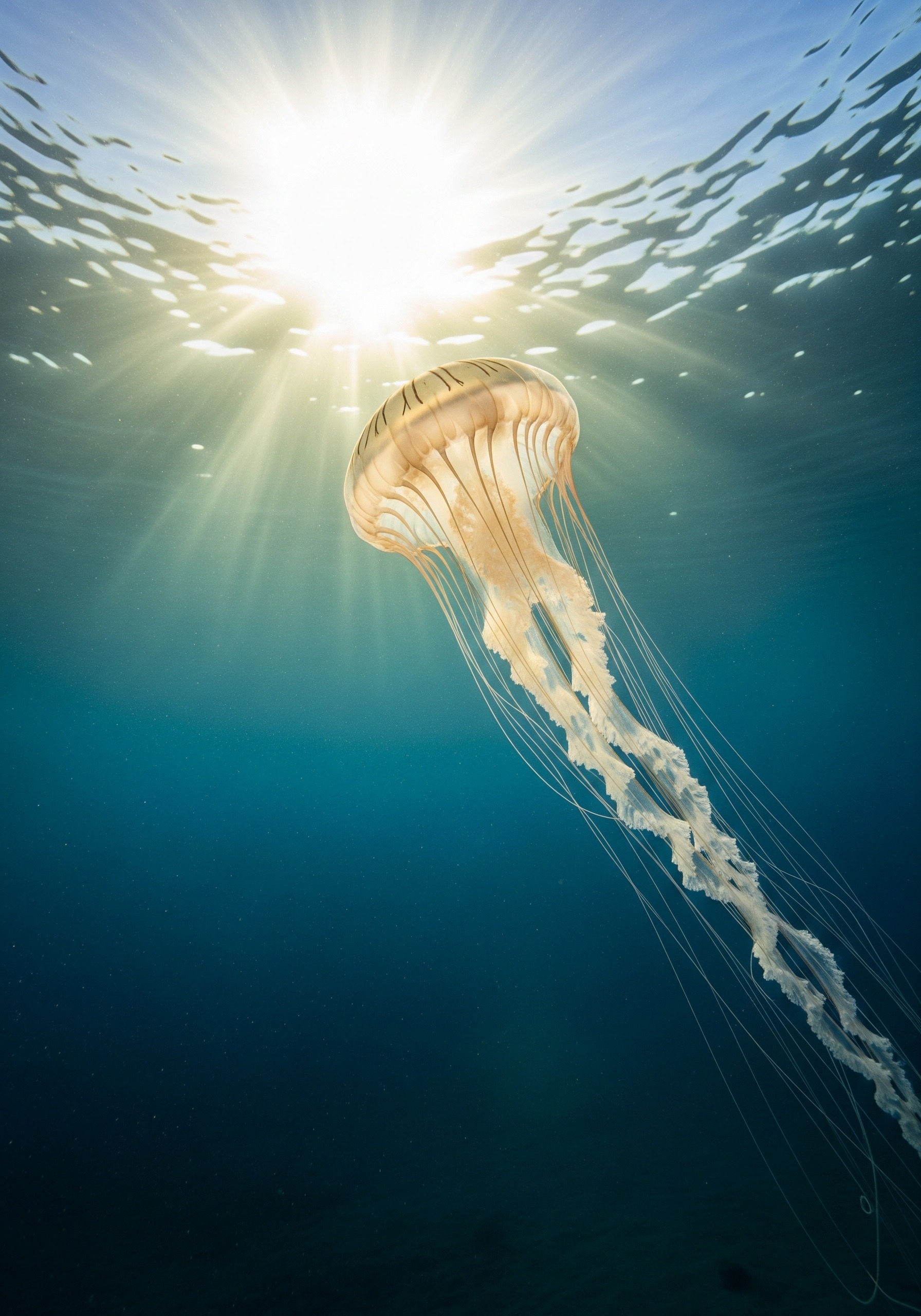
In short: By documented time-to-death, the Australian box jellyfish (Chironex fleckeri) wins. Severe stings can cause cardiac arrest in 2-5 minutes — faster than any snake bite, octopus nip, or cone-snail jab on record. The reason is biological, not just dose: its venom punches holes directly into heart muscle.
Key Facts
- The Australian box jellyfish (Chironex fleckeri) can trigger cardiac arrest in as little as 2-5 minutes in severe stings; researcher Jamie Seymour of James Cook University has been quoted saying it “can kill a human in one minute flat.”
- Inland taipan venom has the lowest LD50 of any land snake (~0.025 mg/kg in mice), but in untreated human cases death typically takes 30-45 minutes — still markedly slower than the jellyfish.
- The “cigarette snail” (Conus geographus) earned its nickname from legend, not the clinical record: documented fatalities ranged from roughly 2 to 5 hours.
- Box jellyfish venom contains proteins called porins that punch pores in cell membranes — including heart muscle cells — causing massive potassium leakage and immediate electrical collapse of the heart.
- Australia has recorded somewhere around 64-70 confirmed deaths from Chironex fleckeri since the 1880s. Children are disproportionately represented because they absorb a lethal dose from a much shorter contact line.
Key Facts
- The Australian box jellyfish (Chironex fleckeri) can trigger cardiac arrest in as little as 2 to 5 minutes in severe stings — faster than any snake bite or cone-snail jab on record.
- Box jellyfish venom contains proteins called porins that punch pores in cell membranes, including heart muscle cells, causing massive potassium leakage and electrical collapse of the heart.
- The inland taipan has the lowest LD50 of any land snake (about 0.025 mg/kg in mice), yet untreated human death typically takes 30 to 45 minutes — far slower than the jellyfish.
- The geography cone snail (Conus geographus) has documented fatalities ranging from roughly 2 to 5 hours, despite its ‘cigarette snail’ legend.
- Australia has recorded roughly 64 to 70 confirmed deaths from Chironex fleckeri since the 1880s, with children disproportionately affected; researcher Jamie Seymour of James Cook University documented the venom’s porin activity.
In short: By documented time-to-death, the Australian box jellyfish (Chironex fleckeri) is the fastest-killing animal, causing cardiac arrest in 2 to 5 minutes. Its venom contains porins that punch holes in heart-muscle cells, leaking potassium and stopping the heart — far faster than the inland taipan, cone snail or any famous venomous snake.
The honest answer: a jellyfish, not a snake

Ask the internet to name the deadliest animal on Earth and you’ll get back a parade of teeth, fangs, and scales. Black mambas. Inland taipans. King cobras. They are real, and they are dangerous. But the question here is narrower and more interesting: which animal can kill you the fastest?
That is a different contest, and once you start the stopwatch, the picture changes. A snakebite, even from the most venomous species on land, has a runway. Symptoms build. The body fights. Antivenom buys time. The geography cone snail — the one with the legend that it kills “in the time it takes to smoke a cigarette” — has a real-world record of one to five hours. These are deadly creatures with a long fuse.
The box jellyfish has no fuse. Its sting can stop the heart before a swimmer reaches shore.
How fast is “fast”? Setting the stopwatch honestly
“Fast” needs a definition before any list is worth reading. Some sources cite the absolute fastest documented case. Others cite the median, or the time without medical care, or the time in a small child versus a grown adult. These can differ by a factor of ten.
So here is the rule for what follows: the times below are time-from-envenomation to potential death without medical intervention, drawn from clinical case literature and the public record. Confirmed cases. Not legend.
{IMAGE_2}
The speed ranking — minutes to hours
The published evidence puts the fastest killers in a narrow band, and the box jellyfish sits clearly at the top. The famous names — the cobras, the spiders — actually run on a longer clock than their reputations suggest.
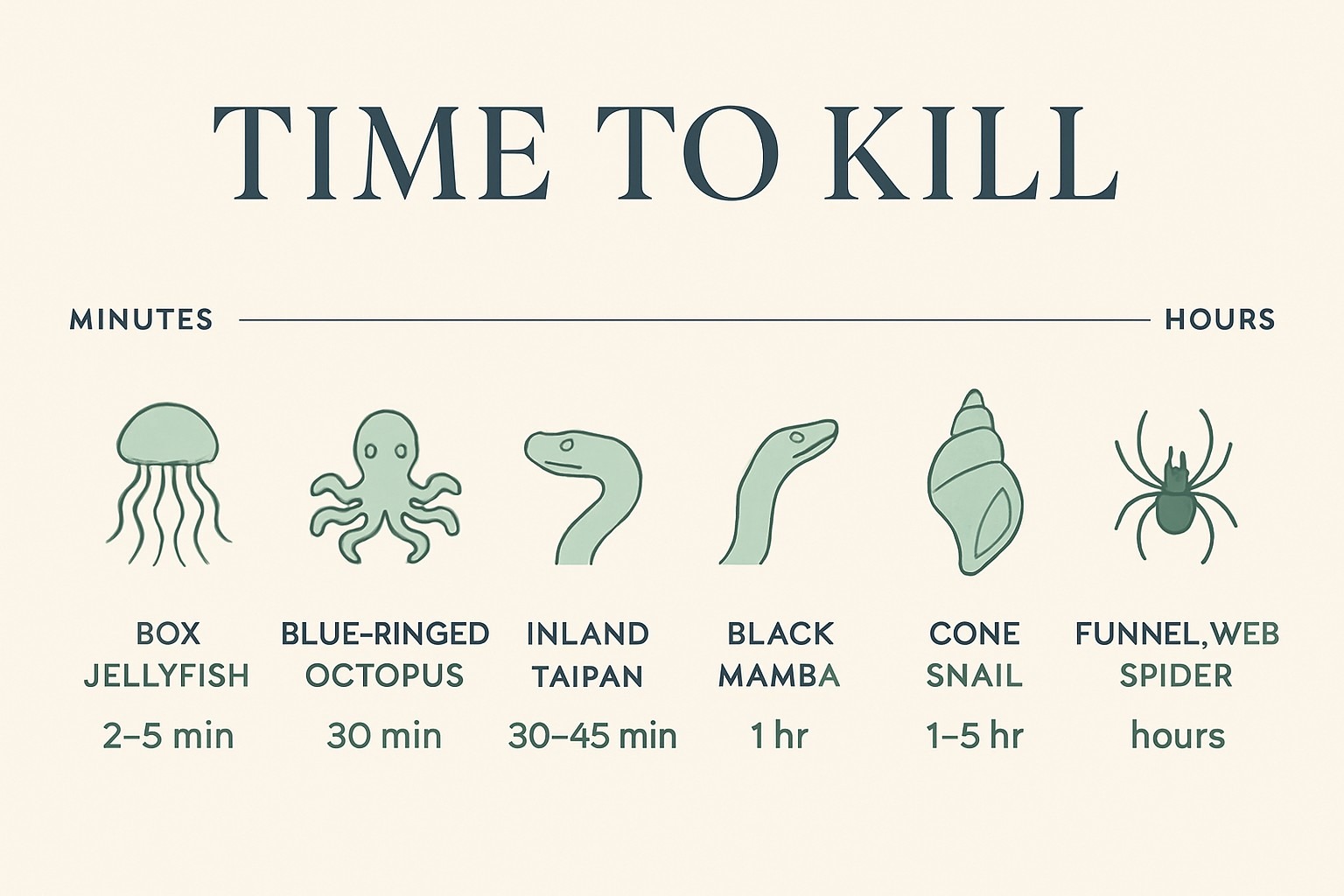
Fastest killers — documented time-to-death without medical care
- Australian box jellyfish (Chironex fleckeri) — 2 to 5 minutes (cardiac arrest)
- Blue-ringed octopus (Hapalochlaena) — respiratory failure within ~10 minutes; death within ~30 minutes
- Inland taipan (Oxyuranus microlepidotus) — 30 to 45 minutes
- Black mamba (Dendroaspis polylepis) — typically 30 minutes to several hours
- Geography cone snail (Conus geographus) — 1 to 5 hours in confirmed cases
- Sydney funnel-web spider (Atrax robustus) — usually hours; some severe cases under 90 minutes (no Australian fatalities since antivenom was introduced in 1981)
That is the leaderboard. The box jellyfish is not in the same room as the others.
Why the box jellyfish wins: a heart attack in a tentacle
The reason is mechanical. Most venoms have to be absorbed, distributed by the bloodstream, and act on a downstream target — paralysis, clotting, tissue damage. That takes time. Even minutes feel slow on a cellular scale, but to a human in trouble, those minutes are the window for survival.
Chironex fleckeri skips most of that window. Its tentacles carry thousands of stinging cells per square centimeter, and they fire in a fraction of a second on contact, injecting venom directly through the dermis into the bloodstream. Inside that venom is a class of proteins called porins. Porins do exactly what the name suggests: they assemble into pores in cell membranes, including the membranes of red blood cells and heart muscle cells.
Once the pores open, potassium pours out of the cells. A team including Nicki Konstantakopoulos and Jamie Seymour at James Cook University documented this porin activity in the venom and showed that potassium release happens within minutes of exposure. The downstream effect is a condition called hyperkalemia, and hyperkalemia is one of the things an emergency room dreads most: the heart’s electrical system simply stops keeping rhythm.
Here’s the part that should make you respect the animal. The venom doesn’t have to travel far to reach the heart. It enters through the skin, and cardiovascular collapse begins almost immediately. In a 2012 PLOS One study, a research team led by Angel Yanagihara at the University of Hawaii showed that the lethal hyperkalemia could be partially prevented in mice using zinc gluconate as a potential antidote — but it had to be administered quickly. In the real world, “quickly” usually isn’t possible.
The other contenders — and the myths around them
The inland taipan owns the title for “most toxic venom by laboratory LD50,” and that one statistic has done more damage to public understanding of snake risk than any other. The taipan lives in remote Australian flood plains, almost never encounters humans, and has caused zero confirmed deaths since proper antivenom became available. Lethal in theory; almost invisible in practice.
The geography cone snail is the snail with the nickname problem. “Cigarette snail” implies a smoke-break window before death. Look at the case files and that window is one to five hours, with around 36 confirmed human fatalities recorded over roughly three centuries. Still a terrifying creature — its venom is a designer cocktail of dozens of small peptides, each targeting a specific neural channel — but it is not a minute-killer.
The blue-ringed octopus is the closest legitimate challenger to the jellyfish on raw clock-time. Its venom contains tetrodotoxin, the same nerve toxin found in the pufferfish, and it can shut down a victim’s diaphragm within ten minutes. The catch is that the toxin doesn’t usually stop the heart directly. Death comes from respiratory paralysis. If somebody nearby knows mouth-to-mouth and keeps the victim breathing, full recovery is possible — and has happened. The blue-ringed octopus, remarkably, fits in the palm of your hand, which is exactly why so many bite victims didn’t realize what they were holding.
What “fastest” doesn’t mean
Speed of kill is not the same as risk to your life. The animals that actually take human lives by the millions are the slow killers: the disease vectors. Mosquitoes, by a wide margin, are the deadliest animal on Earth — not because they kill quickly, but because malaria does its patient work on roughly half a million people each year. Domestic dogs cause more rabies deaths than every venomous snake combined. Hippos and crocodiles outrank sharks in Africa by an order of magnitude.
The fastest killer is a different category — a question of pure biology, of how quickly a single dose of an animal’s chemistry can overwhelm a human body. By that measure, by the unforgiving stopwatch of cardiac arrest, the box jellyfish stands alone.
Turns out the worst monster wasn’t the biggest, the sharpest, or the scariest. It was the one most people couldn’t even see in the water.
The animal that can kill you the fastest — a verdict
If a single animal had to be named “the animal that can kill you the fastest,” the honest, evidence-based answer is the Australian box jellyfish. Severe envenomation by Chironex fleckeri can cause cardiac arrest in two to five minutes in adults and faster still in children, and that figure is supported by clinical case literature, marine biologists at James Cook University, and Australian lifeguards who have seen it firsthand. The reason it wins is not that its venom is the most toxic by milligrams per kilogram. The reason is that its venom attacks the heart muscle directly, without the delays that other toxins must wait through.
The good news, if there is good news, is that this animal does not live anywhere on Earth except the warm coastal waters of northern Australia, parts of Southeast Asia, and a handful of related Indo-Pacific regions. Stinger nets at popular beaches, immediate vinegar treatment to deactivate any unfired stinging cells still on the skin, and rapid CPR have all brought Australian fatalities down to a small number even as tourism has grown. Most years, no one dies. But the species hasn’t softened. It has only become better understood.
Frequently Asked Questions
Q: Is the box jellyfish really the deadliest animal in the world?
A: It depends on the question. By time-to-kill in a single sting, yes — its venom can cause cardiac arrest in under five minutes. By total annual human deaths, no. That title belongs to the mosquito, by way of the diseases it carries.
Q: What about the inland taipan — isn’t it the most venomous snake?
A: By laboratory LD50 measured in mice, yes. But it lives in remote outback regions and has not caused a confirmed human death in the modern antivenom era. Toxicity in a test tube and lethality in the real world are not the same thing.
Q: Why does cone snail venom act so slowly compared to its reputation?
A: The venom is a complex peptide cocktail evolved to paralyze small fish — its actual prey. In a human, the dose is small relative to body mass, and paralysis builds gradually over hours. The “cigarette snail” nickname is folklore, not clinical record; documented cases ran one to five hours before death.
Q: Has anyone ever survived a serious box jellyfish sting?
A: Yes. With immediate vinegar applied to deactivate the unfired stinging cells, prompt CPR, and access to box-jellyfish antivenom (developed in Australia in 1970), survival is possible even after severe stings. The challenge is always the time window.
Sources
- Wikipedia entry on Chironex fleckeri, summarizing peer-reviewed venom research and Australian fatality records since the 1880s
- Konstantakopoulos, Seymour and colleagues, Journal of Biological Chemistry, on Chironex fleckeri venom proteins and porin activity
- Yanagihara et al., PLOS One (2012), on hyperkalemia-induced cardiovascular collapse and zinc gluconate as a candidate antidote
- Wikipedia entry on the inland taipan (Oxyuranus microlepidotus), summarizing LD50 values and clinical envenomation timelines
- Wikipedia entry on Conus geographus, summarizing documented human fatalities from 1935 onward
The fastest killer on Earth doesn’t roar. It drifts. And by the time a swimmer feels the line of fire across the chest, the stopwatch is already running.
Illustrations are AI-generated. Article fact-checked and human-edited. Our editorial standards.