Pangolin Endangered: Why the World’s Most Trafficked Mammal
The pangolin is endangered in a way few animals manage to be: hunted by the ton, smuggled across continents in shipping containers, and most people have never knowingly seen one. All eight species — four in Asia, four in Africa — are now listed as threatened by the International Union for Conservation of Nature (IUCN), and they share a grim distinction. They are the most heavily trafficked wild mammals on the planet.
Key Facts
- All eight pangolin species are classified as threatened on the IUCN Red List; three of the four Asian species are listed as Critically Endangered.
- According to a 2025 CITES report, more than 500,000 pangolins were intercepted in seizures between 2016 and 2024, across 75 countries and 178 trade routes.
- Pangolins are estimated to account for around 20 percent of all illegal wildlife trade by volume.
- Their scales are made of keratin — chemically the same protein as human fingernails — with no medicinal effect demonstrated in peer-reviewed studies.
- In June 2025, the U.S. Fish and Wildlife Service proposed listing seven of the eight species as Endangered under the U.S. Endangered Species Act.
In short: Pangolins are endangered because demand from East and Southeast Asia for their meat and scales has driven industrial-scale poaching for at least two decades. CITES banned the international trade in 2017, but criminal networks have simply moved the supply chain — first within Asia, then south to Africa. Conservation works when it is enforced, and on pangolins, enforcement is still catching up.
Key Facts
- All eight pangolin species are classified as threatened on the IUCN Red List, and three of the four Asian species are listed as Critically Endangered.
- According to a 2025 CITES report, more than 500,000 pangolins were intercepted in seizures between 2016 and 2024, across 75 countries and 178 trade routes.
- Pangolins are estimated to account for around 20 percent of all illegal wildlife trade by volume, making them the most heavily trafficked wild mammals on Earth.
- Their scales are made of keratin, the same protein as human fingernails, with no medicinal effect demonstrated in peer-reviewed studies.
- A 2019 seizure in Singapore contained almost 12 tonnes of scales — about 20,000 pangolins — valued at $38.1 million; in June 2025 the U.S. Fish and Wildlife Service proposed listing seven of the eight species as Endangered.
In short: Pangolins are the world’s most trafficked wild mammals: all eight species are IUCN-threatened, and more than 500,000 were seized between 2016 and 2024 across 75 countries. Demand for their meat and keratin scales drives industrial poaching. CITES banned the trade in 2017, but criminal networks shifted the supply chain from Asia to Africa.
A Walking Pinecone with a Tongue Longer Than Its Body

Pangolins are the world’s only scaled mammals. The eight living species, grouped in the order Pholidota, evolved their keratin armour independently of any reptile — a striking case of convergent evolution. From a distance they look like a cross between an anteater and a fir cone. Up close, they are stranger still.
An adult pangolin can extend a sticky tongue more than 40 centimetres past its snout (in some species, longer than the animal’s body). The base of that tongue is anchored not in the throat, like ours, but deep in the chest cavity, near the last pair of ribs. They have no teeth. Their stomachs grind ants and termites with small keratinous spines and swallowed grit.
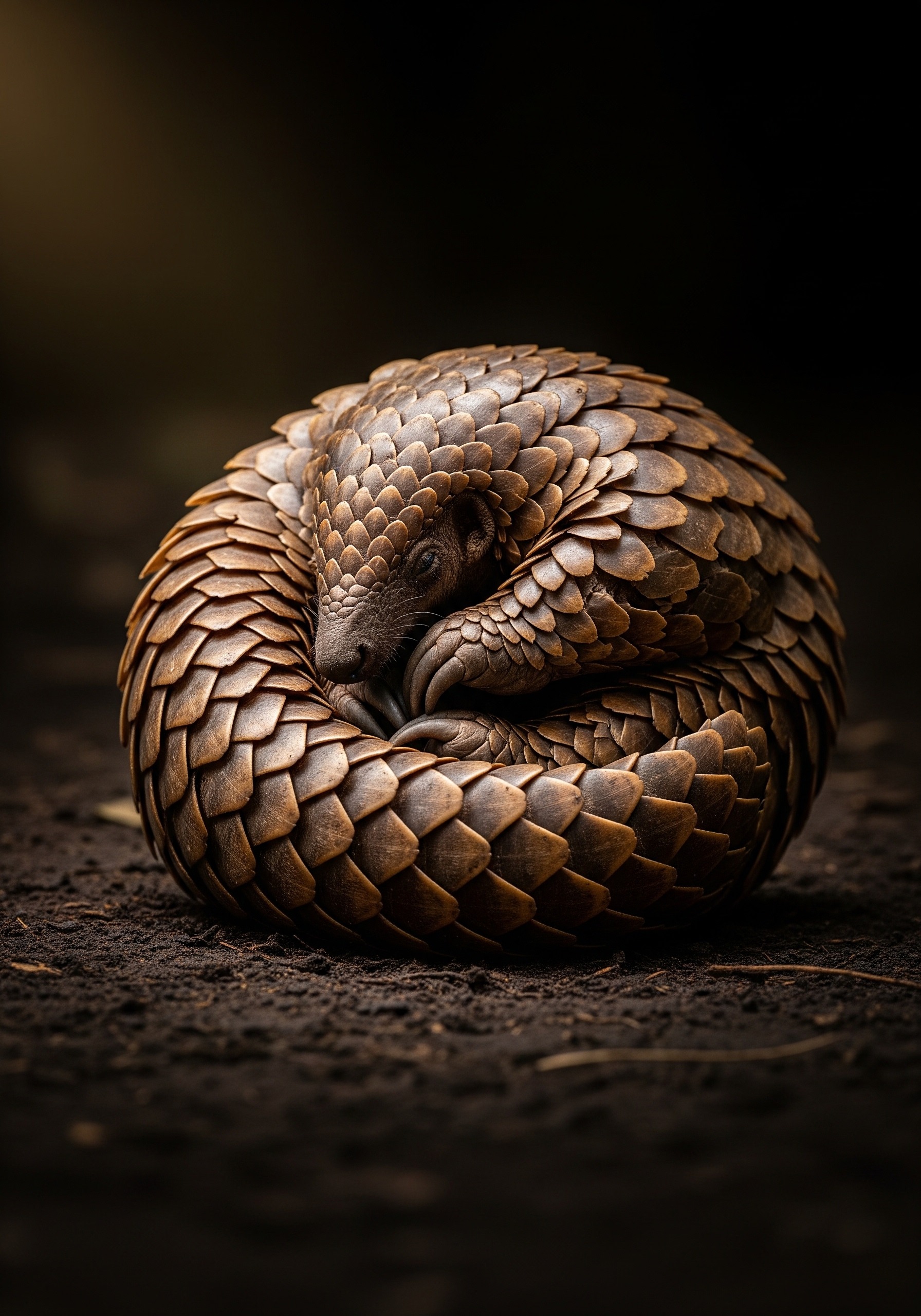
Its name comes from the Malay pengguling, meaning roughly “the one that rolls up.” Threatened, a pangolin tucks its head between its hind legs and folds its scaled tail over its body, presenting an armoured ball to the outside world. The defence is famously effective against leopards. It is, as we will see, catastrophic against humans with hands.
Pangolin Endangered Status: How Threatened Each of the Eight Species Is
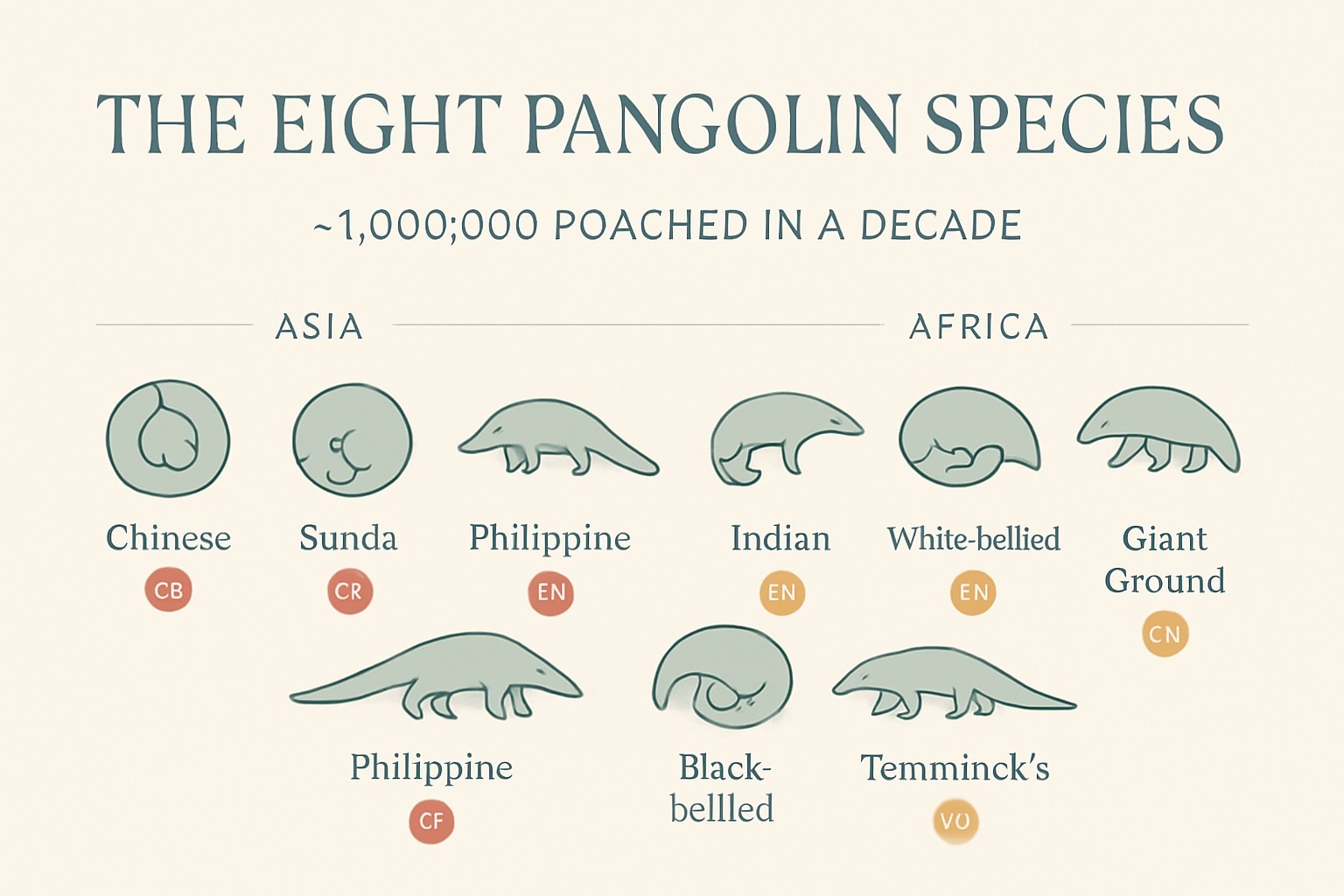
Pangolins split neatly between two continents, with four species in Asia and four in Africa. Their conservation status, set by the IUCN Pangolin Specialist Group, tracks decades of poaching pressure that hit the Asian populations first and is now reshaping Africa’s.
IUCN Red List status, by species (most recent assessments)
- Chinese pangolin (Manis pentadactyla) — Critically Endangered
- Sunda pangolin (Manis javanica) — Critically Endangered
- Philippine pangolin (Manis culionensis) — Critically Endangered
- Indian pangolin (Manis crassicaudata) — Endangered
- White-bellied pangolin (Phataginus tricuspis) — Endangered
- Giant ground pangolin (Smutsia gigantea) — Endangered
- Black-bellied pangolin (Phataginus tetradactyla) — Vulnerable
- Temminck’s ground pangolin (Smutsia temminckii) — Vulnerable
That distribution matters. Until roughly 2008, the great majority of trafficked pangolins were Asian. As local populations collapsed, traders pivoted to Africa, where pangolins were still relatively abundant. Two of the four African species — the giant ground pangolin and the white-bellied pangolin — have since been uplisted from Vulnerable to Endangered. A quiet acknowledgement, in IUCN language, that the substitution effect is now measurable.
Why Are Pangolins Hunted?
Two markets drive the slaughter. The first is traditional Chinese medicine (TCM), where ground pangolin scales are sold as a treatment for everything from poor lactation to rheumatism, asthma and skin disease. The second is luxury meat: in parts of Vietnam and southern China, a single pangolin can fetch around $150 per pound on the restaurant black market, served as a status dish to confirm a host’s wealth.
Each animal carries roughly 1,000 scales. A pangolin yields perhaps half a kilogram of scales by weight. A 2019 shipment intercepted in Singapore contained almost 12 tonnes of scales — about 20,000 pangolins reduced to a single 40-foot container, valued at $38.1 million. It was one of the largest seizures on record, and was matched in scale by another the same year.
There is a smaller third market in West and Central Africa, where pangolin meat is eaten locally as bushmeat and scales are traded into the international supply chain as a side product. A 2024 peer-reviewed study from southeast Nigeria found that local protein need, not Asian export demand, was the primary driver of hunting at the village level — a finding that complicates the standard “Asian demand” narrative and points to where intervention may have to start.
{IMAGE_2}
The Cruel Paradox of Pangolin Defence
A pangolin curled into a ball is mechanically impressive. The overlapping scales lock against each other with enough force that an adult leopard cannot pry them open. Lions sometimes bat the ball around for an hour and lose interest. The strategy worked, in evolutionary terms, for tens of millions of years.
How hard is it to catch a rolled-up pangolin? It isn’t. A poacher does not need a trap, a snare, or a gun. He picks the animal up, drops it into a sack, and walks away. The same behaviour that defeats every other predator on the savanna or in the forest renders the animal helpless against a child with a basket. This is the central, ugly irony of pangolin biology — and it explains why hunting yields per effort are extraordinarily high, and why no other large mammal can be poached at this volume by foot patrols alone.
In the long arc of natural history, it is a defence overtaken by a predator the lineage never evolved against. Conservation policy is essentially trying to substitute laws for the predator-detection their biology lacks.
Following the Pangolin Supply Chain
Modern pangolin trafficking is industrial, not artisanal. Scales move in tonne-scale consignments out of West and Central African ports — Lagos, Douala, Walvis Bay — concealed in containers of cashew nuts, timber, or frozen fish. They travel by sea to Southeast Asian transit hubs, particularly Vietnam and Hong Kong, and into mainland Chinese markets.
The numbers, when authorities catch a shipment, are startling. A CITES analysis released in 2025 catalogued seizures involving more than half a million pangolins between 2016 and 2024, across 75 countries and 178 distinct trade routes. The shipments are organised by many of the same syndicates that move ivory and rhino horn, and trafficking economists now treat pangolin scales as a kind of commodity-portfolio diversifier within the wider illegal wildlife trade.
According to Dan Challender of the University of Oxford, who re-founded the IUCN SSC Pangolin Specialist Group in 2012 and edited Pangolins: Science, Society and Conservation, the first major academic volume on the subject (Academic Press, 2020), the actual volume on the move is almost certainly larger than seizure data implies. Interceptions catch only a fraction of trafficked product, and the share that slips through cannot be reliably measured.
Why Pangolin Scales Don’t Actually Cure Anything
This is the part of the story most coverage skirts. Pangolin scales are keratin — the same fibrous structural protein that builds human hair, fingernails, rhinoceros horn, and the feathers of birds. There is nothing exotic in their molecular composition. Chewing your own fingernail delivers identical biochemistry, minus the trafficking chain.
No peer-reviewed clinical trial has demonstrated a specific therapeutic effect of pangolin scale powder for any of the conditions the trade markets it for. In 2020, the official Chinese Pharmacopoeia removed pangolin scales from its list of approved ingredients — a quiet but enormous policy concession, and one that has not yet filtered fully into commercial demand. The medicinal premise of the entire industry is, in the modern scientific sense, empty.
Turns out the most expensive thing in the supply chain is the belief that the contents matter.
What’s Being Done, and Why It Hasn’t Been Enough
On paper, the legal scaffolding looks impressive. At CITES CoP17 in Johannesburg in October 2016, all eight pangolin species were uplisted from Appendix II to Appendix I, the strictest category. The change took effect on 2 January 2017, banning all commercial international trade in wild-caught specimens. China followed in 2020 by elevating the native Chinese pangolin to its highest national protection class and removing scales from its official pharmacopoeia.
In June 2025, the U.S. Fish and Wildlife Service proposed listing seven pangolin species as Endangered under the U.S. Endangered Species Act — a step that would close remaining loopholes for products entering the U.S. market for boots, belts, and leather goods. The proposed rule is currently in public-comment review.
And yet seizures continue at multi-tonne scale every year. Compare this with the giant panda, whose downlisting from Endangered to Vulnerable in 2016 followed decades of focused state funding, habitat protection and global attention — a recovery story we examined in detail here. Pangolins have no comparable political constituency, no equivalent funding, and no cultural fame. Conservation policy got ahead of consumer behaviour, and the gap is still measured in tons of scales.
Frequently Asked Questions
Q: Are all pangolin species endangered?
A: All eight species are listed as threatened on the IUCN Red List. Three of the four Asian species — Chinese, Sunda and Philippine — are Critically Endangered, the Indian pangolin is Endangered, and the four African species are split between Endangered and Vulnerable, with populations declining everywhere.
Q: Why are pangolins the most trafficked mammal?
A: Demand for their scales in traditional Chinese medicine and for their meat as luxury food in parts of Vietnam and China sustains an industrial-scale illegal trade. Their habit of rolling into a defensive ball, while effective against natural predators, makes them trivially easy for human poachers to capture.
Q: Do pangolin scales actually have medicinal value?
A: No peer-reviewed clinical study has demonstrated a therapeutic effect. Pangolin scales are keratin — the same protein as human fingernails. China removed them from its official Pharmacopoeia in 2020.
Q: Is it legal to buy pangolin products?
A: Commercial international trade in all eight pangolin species has been banned under CITES since 2 January 2017. Any pangolin product crossing an international border is illegal, regardless of how it is labelled.
Sources
- IUCN Red List of Threatened Species and the IUCN SSC Pangolin Specialist Group
- CITES Secretariat seizure analyses and CoP17 Appendix I uplisting documents
- U.S. Fish and Wildlife Service, proposed rule on pangolin Endangered Species Act listing (June 2025)
- TRAFFIC, wildlife trade monitoring network reports on pangolin trafficking
- Challender, D. (ed.), Pangolins: Science, Society and Conservation, Academic Press, 2020
Pangolins are quiet animals, mostly nocturnal, mostly solitary, mostly seen by humans only when it is already too late for them. They are also, on every measurable axis, in serious trouble. Whether eight species are still here in 2050 depends less on what any one government does than on whether the belief that their scales are special finally breaks. The chemistry says it should.
Illustrations are AI-generated. Article fact-checked and human-edited. Our editorial standards.