Why Antarctica Only Lets 100 People Ashore at Once
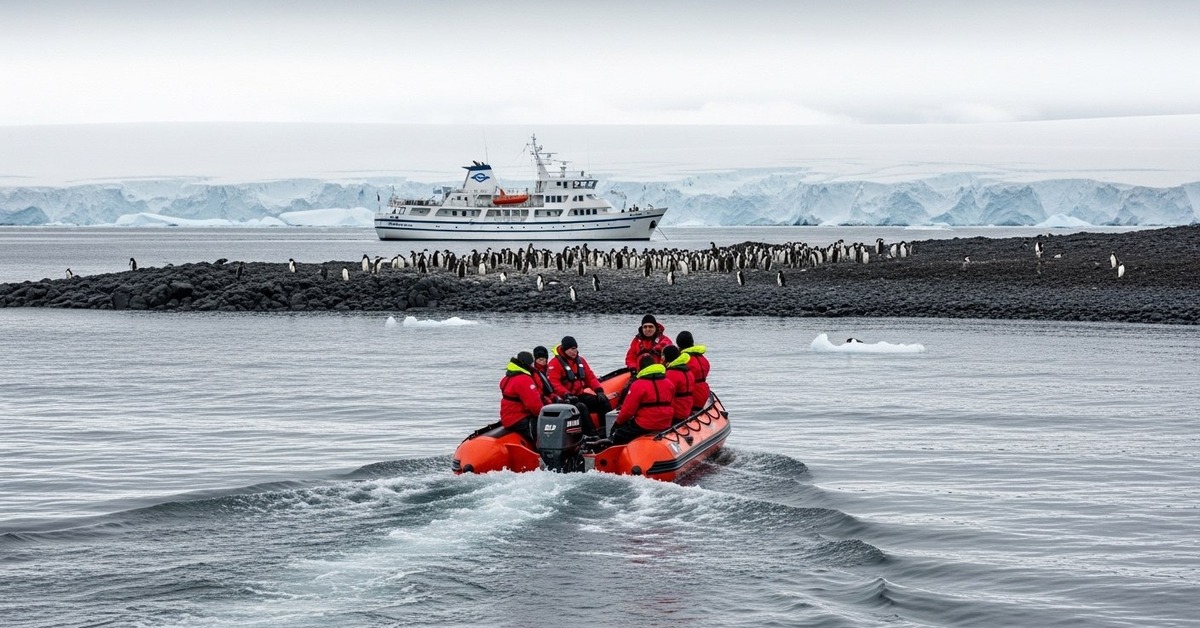
The ship sits offshore. Two hundred people on deck, watching. Down on the ice, exactly 100 are allowed to step ashore — and not one more. That’s not a guideline. That’s the rule for an entire continent.
It’s a binding protocol enforced by an international body that’s been governing polar expedition tourism since before most travelers had even heard the word “ecotourism.” And the reasons behind it are stranger, and more sobering, than you’d probably expect going in.
Key Facts
- IAATO, the International Association of Antarctica Tour Operators, was founded in 1991 by seven tour companies and now has over 100 member operators.
- Smaller vessels must keep groups to 100 people maximum at any landing site, with a guide-to-visitor ratio of at least 1:20, while ships over 500 passengers cannot land anyone.
- Approximately 100,000 tourists visited Antarctica in the 2022-23 season, up from just 6,700 in 1992-93, a nearly 15-fold rise.
- Certain Antarctic moss communities can take between 50 and 100 years to recover from a single physical disturbance.
- The Antarctic Treaty System was signed in 1959 by 12 nations and now carries 54 signatories.
In short: Antarctica tourism rules, enforced by IAATO since 1991, cap landings at 100 people per site, ban ships over 500 passengers from landing anyone, and require a 1:20 guide ratio. With roughly 100,000 visitors in 2022-23 and moss that takes 50 to 100 years to recover, the rules expose the gap between responsible and harmless travel.
Antarctica Tourism Rules That Actually Have Teeth
The governing body is called IAATO — the International Association of Antarctica Tour Operators — founded in 1991 by seven tour companies who recognized they were operating in a place with essentially no legal framework for tourism. Researcher and polar policy analyst Ricardo Roura has spent years documenting the environmental footprint of Antarctic visitors, noting that even well-intentioned tourism leaves compounding traces. IAATO now has over 100 member operators.
But who watches them?
Mostly themselves. That’s not as alarming as it sounds — compliance rates are high, and the rules are genuinely strict. Ships carrying more than 500 passengers are flatly banned from putting anyone ashore. Smaller vessels must keep groups to 100 people maximum at any landing site, with a guide-to-visitor ratio of at least 1:20.
Why the Ice Remembers Every Single Step
Antarctica doesn’t recover the way a forest does, or a beach, or even a desert. The continent sits in a deep freeze that slows biological processes to a crawl. A bootprint pressed into certain moss beds — and yes, there are mossy tundra patches in the Antarctic Peninsula — can remain visible for decades. Some researchers estimate that disturbed moss communities take 50 to 100 years to fully recover.
That’s not a metaphor. That’s the actual timeline.
So what does it mean when 100,000 tourists show up in a single season? It means the math gets uncomfortable fast. Every careful step, every “leave no trace” briefing, every biosecurity boot wash at the gangway — all of it helps, but none of it makes a visit truly invisible. You can visit Antarctica responsibly. You can’t visit it without consequence. Those are different things, and Antarctica is one of the few places on Earth that forces you to hold both thoughts at once.
The Drake Passage Is the Continent’s First Defense
Before anyone sets foot on the ice, they have to survive the crossing. The Drake Passage — roughly 800 kilometers of open Southern Ocean between the southern tip of South America and the Antarctic Peninsula — is one of the roughest stretches of water on the planet. Waves of 10 meters aren’t unusual. Some crossings are calm enough to feel almost pleasant. Others leave experienced sailors pale and silent for two days straight.
Sailors have a dark joke about this: you either get the “Drake Lake” or the “Drake Shake.” There’s no way to know which one’s coming until you’re already in it.
And somehow, around 100,000 people a year decide that’s a reasonable trade-off for a few hours on the seventh continent. Explore more about extreme natural environments and the humans who enter them at this-amazing-world.com.
The Numbers Behind Antarctica Tourism Rules Keep Growing
Polar tourism isn’t a niche hobby anymore. The 2022–23 Antarctic season recorded approximately 100,000 tourist visits — a number that would have seemed impossible, even absurd, when IAATO was founded in 1991 with just a handful of operators. Antarctica tourism rules were designed for a slower, smaller world. The infrastructure of enforcement hasn’t always kept pace with the acceleration of demand.
And demand is only going up.
Climate change is part of the feedback loop nobody likes to talk about. As polar landscapes become more visually dramatic and more accessible, more people want to see them before they change further. The very thing drawing tourists is being accelerated by the global systems that make mass tourism possible. That last part kept me reading for another hour — because it means the problem compounds itself.
That tension doesn’t have a clean resolution. Which is exactly what makes it worth sitting with.
Penguins Don’t Know You Mean Well
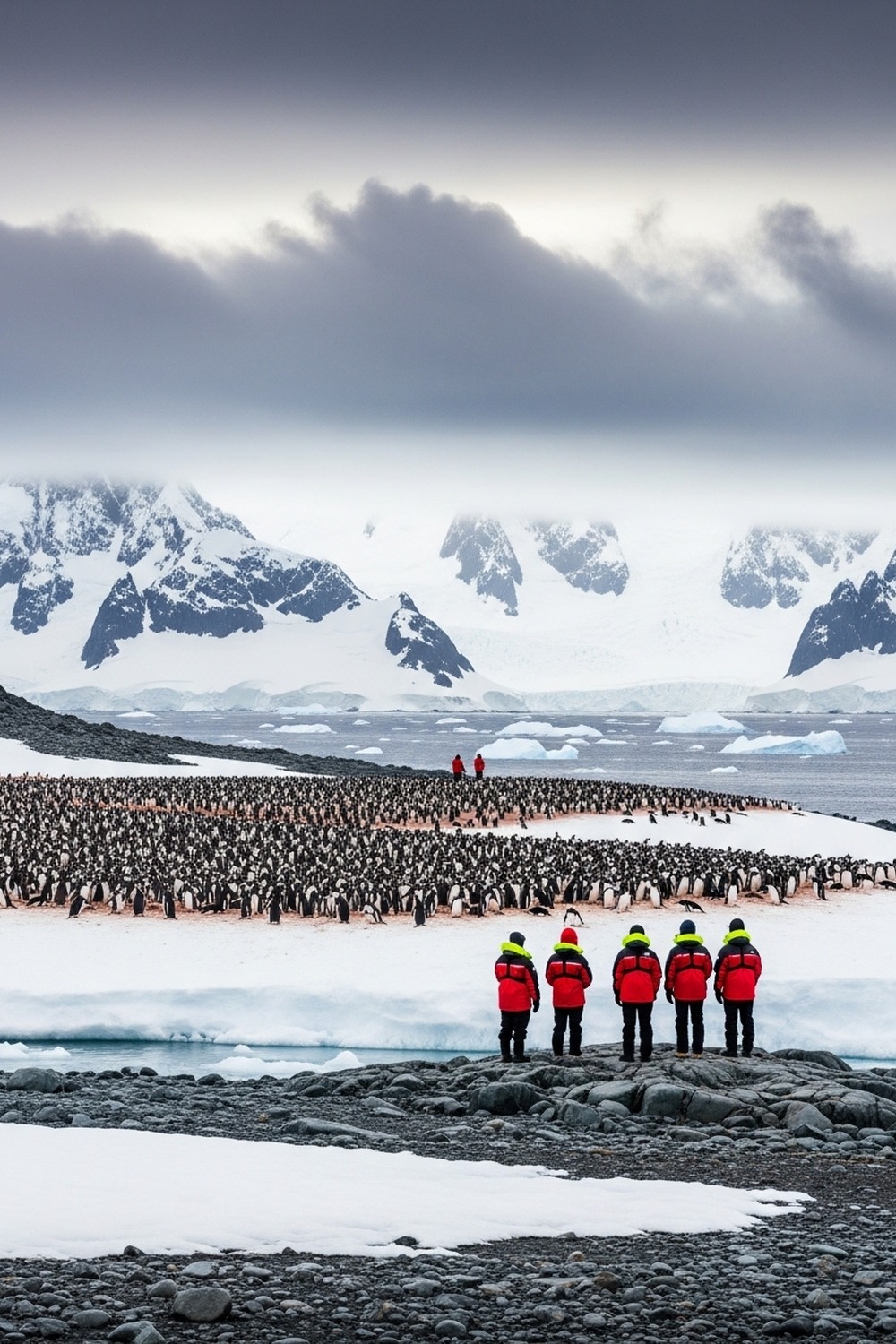
Turns out, penguin colonies are far more fragile than they look. A colony of several thousand birds can appear chaotic — noisy, crowded, apparently indifferent to human presence. But disturbance at the wrong moment in the breeding cycle can trigger nest abandonment. A Gentoo penguin that flushes off its nest because a group of tourists approached too quickly isn’t just inconvenienced. That egg or chick may not survive the exposure.
IAATO protocols include strict minimum approach distances — typically 5 meters — but the birds don’t always read the same script. Sometimes they walk toward you.
And that creates a strange ethical vertigo. You’re standing still, following every rule, and a penguin is voluntarily waddling up to your boot. Are you still the problem? Antarctic guides will tell you: yes, a little. Even passive presence reshapes animal behavior over time. The cumulative effect of a season’s worth of visitors — 100,000 people, all standing still and meaning well — is not nothing.
By the Numbers
- Approximately 100,000 tourists visited Antarctica in the 2022–23 season (IAATO, 2023), up from just 6,700 in the 1992–93 season. Nearly 15-fold in three decades — and the curve is still pointing up.
- 500-passenger threshold: ships above it can’t land anyone, period.
- Certain Antarctic moss communities can take between 50 and 100 years to recover from a single physical disturbance, making the continent one of the slowest-healing terrestrial environments on Earth.
- 800 kilometers wide, no landmass interrupting wind or waves for thousands of kilometers in any direction — the Drake Passage has the longest fetch of open ocean on the planet, and the conditions to match.
Field Notes
- Antarctica has no government, no permanent human population — governed by the Antarctic Treaty System, signed in 1959 by 12 nations and now carrying 54 signatories. Tourism exists in a legal space that is cooperative, not sovereign, which is either reassuring or unsettling depending on your faith in international goodwill.
- Boots disinfected before landing. Clothes vacuumed. Every time.
- The Antarctic Peninsula — where most tourism concentrates — has warmed by nearly 3°C over the past 50 years, one of the fastest-warming regions on Earth, which is partly why photographs from the 1980s already look like a different place.
Why This Story Is About More Than One Continent
Antarctica tourism rules are, in a way, a test case for every place on Earth that’s too fragile to absorb the love it receives. The Galápagos has its visitor caps. Machu Picchu has its timed entry slots. Certain caves in France have been closed entirely because human breath was degrading 30,000-year-old paintings. The pattern holds everywhere: the more extraordinary a place is, the more vulnerable it becomes the moment people find out about it.
Popularity and preservation are almost always in conflict.
What’s unusual about Antarctica is that the rules came early — before the damage became irreversible. IAATO was self-organized, self-enforced, and largely effective, which is either inspiring or terrifying depending on how much faith you have in voluntary compliance at scale. So far, it’s working. The question is whether it can hold as the numbers keep climbing, and as the thing everyone’s coming to see keeps quietly, measurably changing.
Here’s the thing you can’t really unknow once you’ve read far enough into this: you can follow every rule, take nothing, leave only footprints — and still be part of a system that wears a wild place down over time. Antarctica isn’t asking you not to come. It’s asking you to come knowing that. The gap between “responsible” and “harmless” is real, and this continent makes it impossible to look away from. There’s more at this-amazing-world.com — and the next one is even stranger.
Frequently Asked Questions
Q: Who enforces Antarctica tourism rules?
The rules are enforced by IAATO, the International Association of Antarctica Tour Operators, founded in 1991 by seven tour companies and now numbering over 100 member operators. Enforcement is largely self-regulated, but compliance rates are high and the rules are strict. Ships carrying more than 500 passengers cannot land anyone, smaller vessels must keep groups to 100 people maximum per landing site, and a guide-to-visitor ratio of at least 1:20 is required. Antarctica itself has no government, operating under the 1959 Antarctic Treaty System.
Q: Why are only 100 people allowed ashore at a time?
Antarctica recovers extremely slowly because its deep freeze slows biological processes to a crawl. Certain moss communities can take between 50 and 100 years to fully recover from a single physical disturbance, and bootprints in moss beds can remain visible for decades. With approximately 100,000 tourists arriving in the 2022-23 season, the 100-person landing cap limits cumulative damage to one of the slowest-healing terrestrial environments on Earth, where even careful visitors leave compounding traces.
Q: How many tourists visit Antarctica each year?
Roughly 100,000 tourists visited Antarctica in the 2022-23 season, according to IAATO 2023 figures. That represents a nearly 15-fold increase from the 6,700 visitors recorded in the 1992-93 season, and the trend is still climbing. Climate change drives part of the demand, as more dramatic and accessible polar landscapes attract people wanting to see them before they change further, creating a feedback loop where the very systems enabling mass tourism accelerate the changes drawing visitors.
Q: What is the Drake Passage?
The Drake Passage is roughly 800 kilometers of open Southern Ocean between the southern tip of South America and the Antarctic Peninsula, and one of the roughest stretches of water on the planet. It has the longest fetch of open ocean on Earth, with no landmass interrupting wind or waves for thousands of kilometers. Waves of 10 meters are not unusual. Sailors joke that you either get the calm ‘Drake Lake’ or the violent ‘Drake Shake,’ with no way to know which until you are already crossing.
Illustrations are AI-generated. Article fact-checked and human-edited. Our editorial standards.