The Araripe Manakin: Earth’s Rarest Bird Has One Home
Somewhere in northeastern Brazil, a bird exists that science didn’t know about until 1998. The Araripe Manakin occupies a forest so small — fewer than 28 square kilometres — that its entire global population could fit in the space of a few city blocks. Fewer than 1,000 individuals. One species. One address on Earth, and that address is disappearing.
The forest feeding this bird isn’t a range or a region. It’s a ribbon of humidity at the foot of a plateau, kept alive by freshwater springs seeping from sandstone. Sugar cane farms are creeping in. Resort developments are advancing. And the water system that sustains both the forest and the region’s municipalities is pulling harder every year on the very springs the bird depends on. Here’s the thing: the question isn’t whether the Araripe Manakin is in danger anymore. It’s whether the people trying to save it are running out of time.
Key Facts
- The Araripe Manakin (Antilophia bokermanni) was formally described in 1998 in the journal Ararajuba by Eduardo Camargo and Jose Maria Cardoso da Silva.
- Its entire known range covers fewer than 28 square kilometres at the base of the Araripe Plateau in northeastern Brazil.
- The estimated global population is between 250 and 800 individuals, with the lower figure considered more reliable (BirdLife International, 2023).
- Over 70% of the original gallery forest habitat had been cleared or degraded by 2008, per SAVE Brasil and BirdLife International survey data.
- Approximately 300 hectares of degraded habitat were replanted between 2007 and 2015, roughly 10% of the estimated original range.
In short: The Araripe Manakin Brazil story is one of extreme rarity: a bird described only in 1998, surviving in fewer than 28 square kilometres of spring-fed gallery forest at the Araripe Plateau. Fewer than 800 individuals remain, threatened by habitat loss, water diversion, and a projected drying Caatinga climate.
The Bird Science Almost Missed Entirely
1998. Two ornithologists — Eduardo Camargo and José Maria Cardoso da Silva — formally described a species that had, in a very real sense, been hiding behind geography. The Araripe Manakin (Antilophia bokermanni) was named for the Araripe Plateau — the chapada — that dominates the Ceará-Pernambuco border in Brazil’s semi-arid northeast. But the bird doesn’t live on the plateau itself. It lives at the base of it, in a ribbon of gallery forest fed by freshwater springs seeping from the plateau’s sandstone edge.
The formal description landed in the ornithological journal Ararajuba, barely noticed outside specialist circles. This wasn’t a bird from a remote jungle or an uncharted island. It was sitting in an accessible corner of Brazil’s most densely populated region, simply overlooked because the forest around it was considered unremarkable. The Museu de Zoologia da Universidade de São Paulo co-authored the description.
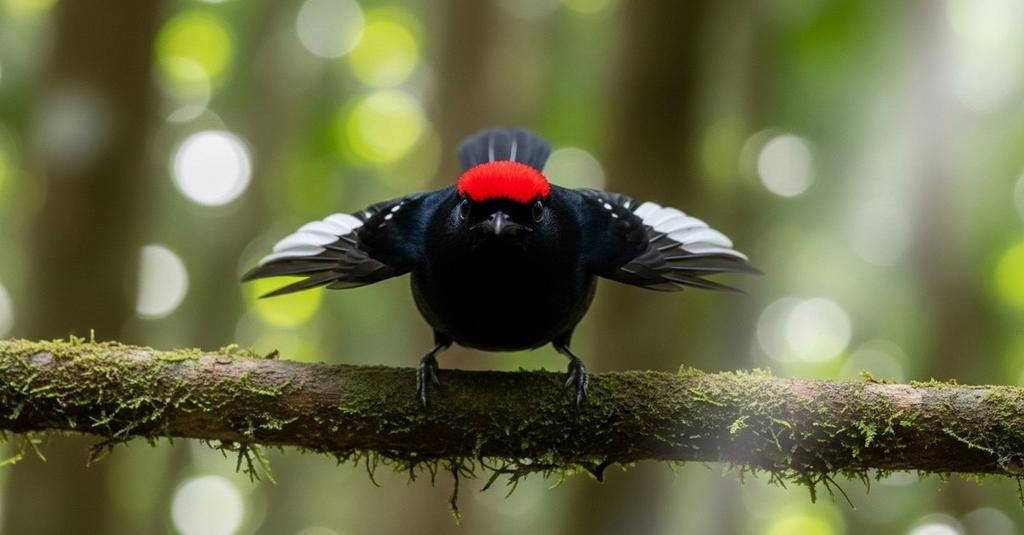
Belonging to the manakin family — Pipridae — a group of small Neotropical birds famous for their elaborate courtship displays, the Araripe Manakin is unusual even among its relatives. Its closest relative, the Antilophia galeata (the helmeted manakin), ranges widely across central Brazil’s cerrado. The Araripe bird doesn’t range anywhere. It’s geographically marooned by the surrounding Caatinga — the thorny, drought-adapted shrubland that covers much of Brazil’s northeast. The humid forest at the plateau’s base is an ecological island, and the Araripe Manakin is its most visible prisoner.
What the field surveys confirmed was grim. Between 1999 and 2002, the Brazilian conservation organisation SAVE Brasil conducted point counts across the bird’s known range. Every individual they recorded was within the same few square kilometres. There was nowhere else to go. The population was not just small, it was geographically fixed.
A Dance That Exists Nowhere Else
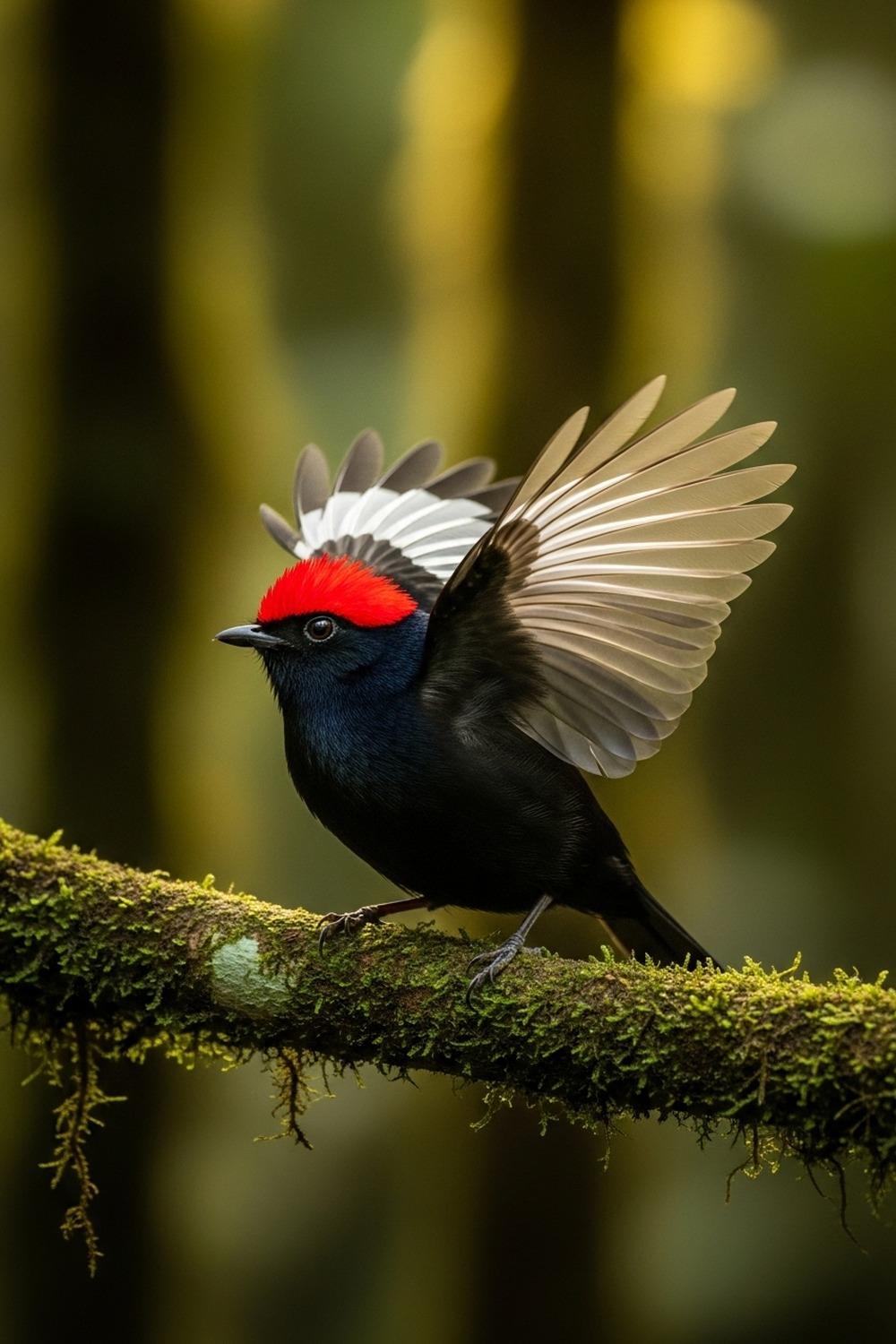
Why does the courtship display matter so much in understanding this bird? Because it reveals exactly how much the Araripe Manakin has evolved for this one place and no other. Watch a male court a female and you’ll understand why Brazilian birdwatchers call it the soldadinho-do-Araripe — the little soldier of the Araripe. The crimson cap, white wings, and jet-black body give him the look of a uniform. During display, he spreads those white wings and vibrates them, hovering in front of the female in a kind of luminous shimmer, the green canopy making his colours look almost painted on.
It’s the kind of behaviour that rewards very close attention. The kind you only see in one place in the world. The extraordinary specificity of this bird — its looks, its dance, its home — makes it comparable to other hyper-localised species whose survival depends on a single ecosystem surviving intact. The Sunda flying lemur, for instance, is another creature whose survival is tied to a specific forest type — lose the forest, lose the animal. The pattern repeats across the tropics with grim consistency. And for each one, the stakes are absolute.
Males establish display perches within the dense understorey near the springs — specific branches they return to repeatedly. Females are cryptically coloured in olive-green and visit these perches to assess potential mates. Breeding season runs roughly from September through January, when rainfall keeps the springs running and the forest humid enough for nesting. A study published in 2006 by researchers at the Universidade Estadual de Feira de Santana found that nest sites were almost exclusively within 200 metres of active spring outlets.
Remove the springs, and nesting habitat effectively disappears. That dependency isn’t just biological trivia — it’s a vulnerability built into the bird’s skeleton.
One Forest, Vanishing Fast
The Chapada do Araripe sits within Brazil’s semi-arid northeast, a region that has faced relentless agricultural and demographic pressure for more than a century. The humid gallery forest at the plateau’s base — known locally as matas ciliares — once stretched more continuously along the escarpment. By 2008, surveys coordinated by SAVE Brasil and BirdLife International estimated that over 70% of the original habitat had already been cleared or degraded.
Sugar cane cultivation chewed into the forest edge. Cattle grazing compressed what remained. The town of Crato expanded. The resort community of Caldas Novas followed. According to National Geographic’s species profile, the Araripe Manakin’s entire known range covers fewer than 28 square kilometres — a patch smaller than many city parks. That number hasn’t grown. In some years, it has shrunk.
The problem gets more tangled when you add water into it. The springs sustaining this forest are also the primary water source for several local municipalities. Diverting those springs for human use doesn’t just reduce stream flow — it dries out the understorey, changes the microclimate, and shifts the vegetation community away from the humid conditions the Araripe Manakin requires. This is a collision between conservation and human need that has no easy answer. You can’t simply tell communities to stop using their water supply. But the bird can’t survive without the springs running clean and continuous.
Deforestation in Brazil’s Caatinga biome accelerated between 2010 and 2020, even as the Amazon received most of the international attention.
The Araripe Manakin’s forest was losing ground during a decade when most of the world wasn’t looking.
Can the Araripe Manakin Actually Be Saved?
In 2005, the Brazilian government designated the Área de Proteção Ambiental da Chapada do Araripe — a federal protected area covering the plateau and its escarpment. Protected area designation and actual habitat protection are two very different things in practice, though. A study published in 2010 in the journal Bird Conservation International by researchers including ornithologist Glaucia Del-Rio analysed population trends using point count surveys across the bird’s range. The total population was somewhere between 250 and 800 individuals, with the lower estimates considered more realistic. That’s not a number that leaves room for anything resembling complacency.
SAVE Brasil, working with BirdLife International from the early 2000s onwards, developed a long-term action plan. Habitat restoration came first — replanting riparian forest strips along degraded sections of the escarpment. Community engagement programmes followed, giving local landowners financial and technical incentives to maintain forest cover on their properties. Between 2007 and 2015, the programme restored approximately 300 hectares of degraded habitat. Three hundred hectares sounds substantial until you remember that the original range was already less than 2,800 hectares in total. Every restored patch matters disproportionately when the entire range fits on a single map.
Local bird guides in Crato and nearby Barbalha have emerged as unexpected allies. Birdwatching tourism — still modest by international standards — has created a small but real economic argument for keeping the forest standing. When a single bird species becomes a tourist draw, its value to a landowner shifts from abstract to tangible. That’s not a solution. But it’s leverage.
What Happens When a Species Has No Backup
Most endangered species have some geographic redundancy built in. A population here, a fragmented population there, a reserve that might function as a corridor between fragments. The Araripe Manakin has none of this. Its entire global population occupies a strip of forest that wouldn’t stretch across London, let alone a continent. For comparison, the Kakapo — another critically endangered bird — has populations managed across three separate islands in New Zealand as a hedge against catastrophic loss. The Araripe Manakin has no such insurance policy.
A single severe drought could collapse a population that’s already operating at the margins. A disease outbreak moving through the escarpment. A wildfire in the wrong season. Any one of these events could eliminate breeding for an entire generation. But here’s what keeps me up about this: Watching a species operate without any biological redundancy, with every survival strategy concentrated in a single place, you stop calling it conservation and start calling it hospice care.
Climate modelling by researchers at Brazil’s Instituto Nacional de Pesquisas Espaciais (INPE), published in 2018, projected that the Caatinga biome would experience significant aridification over the coming decades under current emissions trajectories. For a bird dependent on spring-fed humid forest in the middle of one of Brazil’s driest regions, that projection isn’t background context. It’s an existential variable.
Warmer, drier conditions would reduce spring flow, shrink the forest’s humid microclimate, and push the vegetation community toward conditions the Araripe Manakin can’t tolerate. The bird didn’t evolve to adapt to a drier world. It evolved to exploit a very specific wet one.
Stand at the base of the Chapada do Araripe on a January morning, when the springs are running at their highest and the forest smells of wet earth and flowering bromeliads, and you can hear the males calling — a sharp, insistent whistle cutting through the understorey. There’s something almost defiant about it.
Where to See This
- The Parque das Fontes and the escarpment forests near the town of Crato, in Ceará state, northeastern Brazil, are the most reliable sites; the best window for birdwatching is September through December when males are most active at display perches.
- SAVE Brasil (savebrasil.org.br) leads the primary conservation programme for this species and maintains updated field information and volunteer opportunities for researchers and naturalists.
- The BirdLife International Araripe Manakin species factsheet is the most current and rigorously sourced public document on population status, threats, and conservation actions — worth reading before any visit.
By the Numbers
- Estimated global population: 250–800 individuals, with current assessments favouring the lower end (BirdLife International, 2023).
- Known range: fewer than 28 km², the smallest confirmed range of any bird species in the Americas.
- Habitat lost: over 70% of original gallery forest at the Araripe escarpment cleared or degraded by 2008 (SAVE Brasil / BirdLife International survey data).
- Habitat restored: approximately 300 hectares replanted between 2007 and 2015 — roughly 10% of estimated original range.
- Year of formal scientific description: 1998 — making this one of the most recently described critically endangered bird species in South America.
Field Notes
- In 2006, researchers at the Universidade Estadual de Feira de Santana discovered that virtually all recorded nests were within 200 metres of active spring outlets — a spatial dependency so tight that it effectively maps the bird’s survival onto the plateau’s hydrology rather than its vegetation alone.
- The Araripe Manakin’s white wings aren’t just for display: the reflective plumage appears to function in low-light understorey conditions, where a bright visual signal travels farther through dense vegetation than colour variation alone.
- Despite being a manakin, Antilophia bokermanni doesn’t perform the multi-male cooperative displays seen in some related species (researchers actually call this a solitary display strategy) — each male competes independently at his own perch, which makes habitat fragmentation particularly damaging since isolated males may fail to attract females at all.
- Researchers still can’t determine whether the Araripe Manakin ever occupied a wider range during wetter Pleistocene periods or whether it has always been confined to this single escarpment. That question — about the species’ deep history — would fundamentally change how we model its future resilience.
Frequently Asked Questions
Q: Why is the Araripe Manakin found only in one location?
The Araripe Manakin is tied to a very specific habitat — humid gallery forest fed by freshwater springs at the base of the Araripe Plateau in northeastern Brazil. The surrounding Caatinga shrubland is too dry and structurally different for the species to survive in. The bird didn’t evolve a wide tolerance for varied habitats; it evolved to exploit one exceptionally specific microclimate. That specialisation, combined with the plateau’s geographic isolation, means there’s simply nowhere else with the same ecological conditions within the bird’s dispersal range.
Q: How many Araripe Manakins are left in the world?
Current estimates place the total population between 250 and 800 individuals, with conservation organisations including BirdLife International and SAVE Brasil considering the lower figure more reliable based on recent survey data. The species is listed as Critically Endangered on the IUCN Red List. Population counts are conducted through point count surveys at known display sites and nest locations, but the dense understorey of the gallery forest makes comprehensive counts difficult, so all figures carry a margin of uncertainty.
Q: Is the Araripe Manakin related to other well-known manakin species?
A common misconception is that all manakins are similarly distributed and similarly threatened — they’re not. The Araripe Manakin belongs to the genus Antilophia, which also includes the helmeted manakin (Antilophia galeata), a far more common species distributed across central Brazil’s cerrado. The two species look broadly similar, which may have contributed to the Araripe bird being overlooked for so long. However, their ecological requirements are completely different — the helmeted manakin tolerates a wide range of cerrado habitats, while its Araripe relative can’t survive outside that one humid escarpment forest.
Editor’s Take — Alex Morgan
What stops me here isn’t the rarity — it’s the specificity of the dependency. Not just a forest. Springs within a forest. Nests within 200 metres of those springs. A population so compressed that a single bad drought year could functionally eliminate breeding for an entire season. We talk about habitat loss as though it’s gradual and reversible. For the Araripe Manakin, it’s neither. The margin between surviving and not surviving is measured in metres of stream flow. That’s a precision of vulnerability that most conservation language never quite captures.
There’s something that shifts in you when you understand that an entire species — every living individual of its kind — fits within a patch of forest smaller than a city park. The Araripe Manakin doesn’t represent a category of biodiversity loss. It is one bird, one forest, one water source, one outcome. If the springs dry up or the last trees come down, there’s no secondary population, no captive breeding programme of scale, no ecological corridor to somewhere safer. Just absence where that crimson cap used to flash. What does it mean to let something like that disappear — not from a continent, but from existence itself?
“
Illustrations are AI-generated. Article fact-checked and human-edited. Our editorial standards.