Posts written

Crimson cancer cell with teal molecular structure floating in dark scientific void

Your Cells Are Vibrating — And Scientists Can Measure It

Something extraordinary is happening inside every cell in your body right now — a constant hum of molecular motion vibrating at trillions of cycles per second. Scientists are starting to map those rhythms, and what they're finding challenges everything we thought we knew about how the body heals. This isn't mysticism. It's measurable physics. And it might change medicine forever.

Read More
Multigenerational African elephant herd protectively clustered around two calves on a forest path

Elephants Felt This Earthquake Before Humans Did

In April 2020, security cameras at San Diego Zoo Safari Park captured something extraordinary: a herd of African elephants snapping into a tight protective circle around two calves — seconds before humans felt a 5.2-magnitude earthquake. The footage offers rare, visible proof of a seismic sense millions of years in the making.

Read More
Young woman in red dress speaking candidly about acute myeloid leukemia diagnosis

Acute Myeloid Leukemia: Why AML Strikes So Fast

Acute myeloid leukemia is one of the most aggressive blood cancers known to medicine — capable of advancing from diagnosis to crisis in weeks. When young people face it publicly, as Tatiana Schlossberg did before her death at 35, they illuminate a disease that science is still racing to understand. Here is what AML is, why it is so difficult to treat, and where the next breakthroughs may come from.

Read More
Dark grey cremation urn beside final arrangements documents on taupe surface

Why Millions Are Donating Their Bodies to Science Now

Body donations to U.S. medical science have nearly doubled since 2010 — and the reasons might surprise you. It's not just altruism. For many families, donating a body to science means zero funeral costs, ashes returned free, and a legacy that trains the doctors of tomorrow. Here's what's really driving this quiet revolution.

Read More
Elderly scientist in dark suit speaks gravely under dramatic single-source studio lighting

Stephen Hawking’s Dire Warning for Earth’s Next 1,000 Years

Stephen Hawking spent his final years sounding an alarm that most of us are not ready to hear: human civilization has perhaps 1,000 years left on Earth unless we act decisively. Overpopulation, climate collapse, and resource depletion are converging. His prescription was radical — and the science backing his urgency has only grown stronger since his death.

Read More
Steampunk anatomical heart sculpture in crimson resin with antique bronze riveted metalwork fittings

The Man Who Lived 555 Days Without a Real Heart

In 2016, a young Michigan man named Stan Larkin walked out of a hospital carrying his own heartbeat in a backpack. For 555 days, a mechanical device called the SynCardia Total Artificial Heart kept him alive—and even let him shoot hoops—while he waited for a donor transplant. His story is rewriting the limits of what medicine can do.

Read More
Teenage boy in dark hoodie studies Know Your Rights app on glowing smartphone at night

A 14-Year-Old Built an App to Protect Immigrants From ICE

At 14, most kids are navigating homework and group chats. But one Los Angeles teenager spent his time building a mobile app to help immigrants understand their rights during ICE encounters — in plain language, with interactive quizzes. Then he won a national Congressional App Challenge. This is the story of how one kid decided code could be a lifeline.

Read More
A mixed-breed dog rests paws on a Soviet-era metal capsule hatch at golden hour

Laika: The Dog Who Orbited Earth and Changed Space Science

On November 3, 1957, a small stray dog named Laika became the first living creature to orbit Earth aboard the Soviet spacecraft Sputnik 2. Her mission was never meant to end in survival. Yet the data she provided reshaped our understanding of biology in space — leaving behind a legacy as complex as it is haunting.

Read More
Eastern hellbender salamander gaping on mossy submerged rock in clear Appalachian stream

Hellbenders: The Ancient Giant Salamanders of America

Lurking beneath the cold, fast-flowing rivers of eastern North America, the hellbender salamander has changed little in 150 million years. Stretching nearly 30 inches and capable of living half a century, this extraordinary amphibian—nicknamed the 'snot otter'—is both a relic of prehistory and a sentinel of ecosystem health whose secrets science is only beginning to decode.

Read More
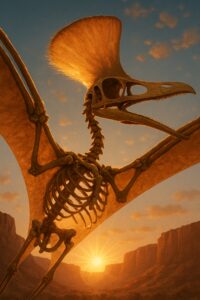
Tupuxuara leonardii pterosaur skeleton soaring over a dramatic desert canyon at golden hour

Tupuxuara leonardii: The Crested Sky Giant of the Cretaceous

One hundred and ten million years ago, a winged giant ruled Cretaceous skies. Tupuxuara leonardii — a pterosaur with a nearly 15-foot wingspan and a dramatic fan-shaped crest — challenges paleontologists to decode the intersection of aerodynamics, social signaling, and survival written into its extraordinary anatomy.

Read More
Facial recognition green bounding boxes overlaid on crowded Chinese subway commuters

China’s Skynet: The AI Surveillance Web Watching Millions

Since 2005, China's Skynet has evolved from a modest camera network into one of the most expansive surveillance infrastructures on Earth. Today, integrating advanced AI, facial recognition, and big data, it can identify individuals in real time across hundreds of millions of cameras — raising urgent questions about privacy, civil liberties, and the future of public space.

Read More
Researcher applying golden onion juice serum to man's balding scalp in laboratory

Onion Juice and Hair Regrowth: What Science Really Says

In 2002, a small but striking clinical trial found that applying crude onion juice to the scalp helped nearly 87% of alopecia areata patients regrow terminal hair within eight weeks. The results were remarkable — but the science behind this pungent kitchen remedy is far more nuanced than the headlines suggest.

Read More