Axolotl Facts: Why This Salamander Never Grows Up
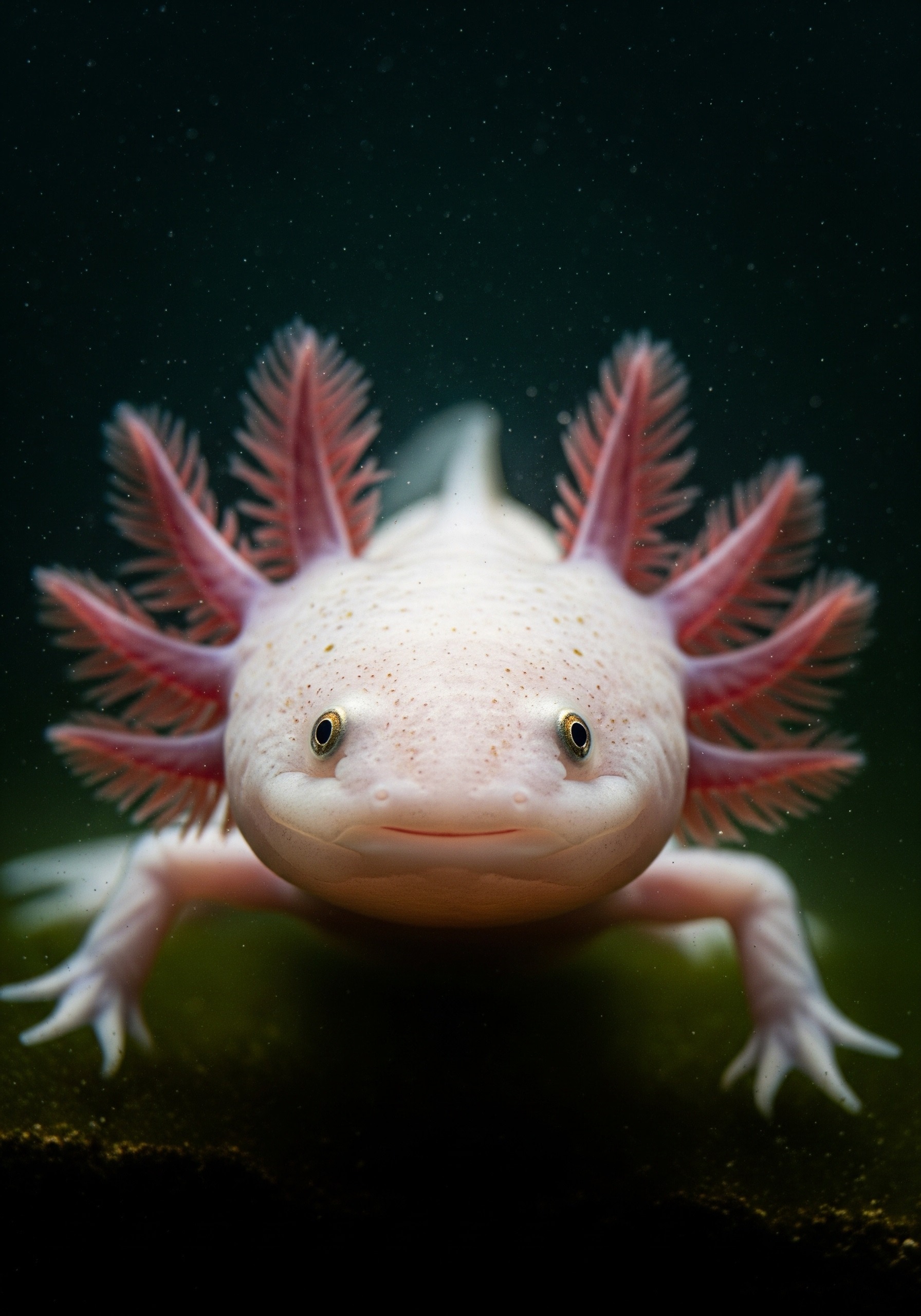
Among the most surreal axolotl facts: this Mexican salamander never grows up — and probably never will. Its pale, feathery, perpetually smiling face is one of the most-recognized animals on the internet, yet in the wild it is almost a ghost. Fewer than a thousand are believed to remain in a single canal system on the edge of Mexico City, and what biology labs are learning from the way it regrows its own limbs may one day rewrite human medicine.
Key Facts
- The axolotl (Ambystoma mexicanum) lives wild in exactly one place on Earth: the Xochimilco canal system south of Mexico City.
- It is a salamander that never metamorphoses — it keeps its larval body for life, a rare trait called neoteny.
- It can regrow legs, tail, spinal cord, parts of the heart, and portions of the brain — without scarring.
- Its genome is roughly 32 billion base pairs, about ten times the size of the human genome.
- IUCN status: Critically Endangered, with an estimated 50–1,000 adult individuals left in the wild (2020 assessment).
In short: The axolotl is a salamander that refuses to grow up, heals wounds that mammals scar over, and is functionally vanishing in the wild while booming as a pet, a meme, and a research animal all at once.
Key Facts
- The axolotl (Ambystoma mexicanum) lives wild in exactly one place on Earth: the Xochimilco canal system south of Mexico City.
- It is a salamander that never metamorphoses, keeping its larval body for life, a rare trait called neoteny.
- It can regrow legs, tail, spinal cord, parts of the heart, and portions of the brain, without scarring.
- Its genome is roughly 32 billion base pairs, about ten times the size of the human genome.
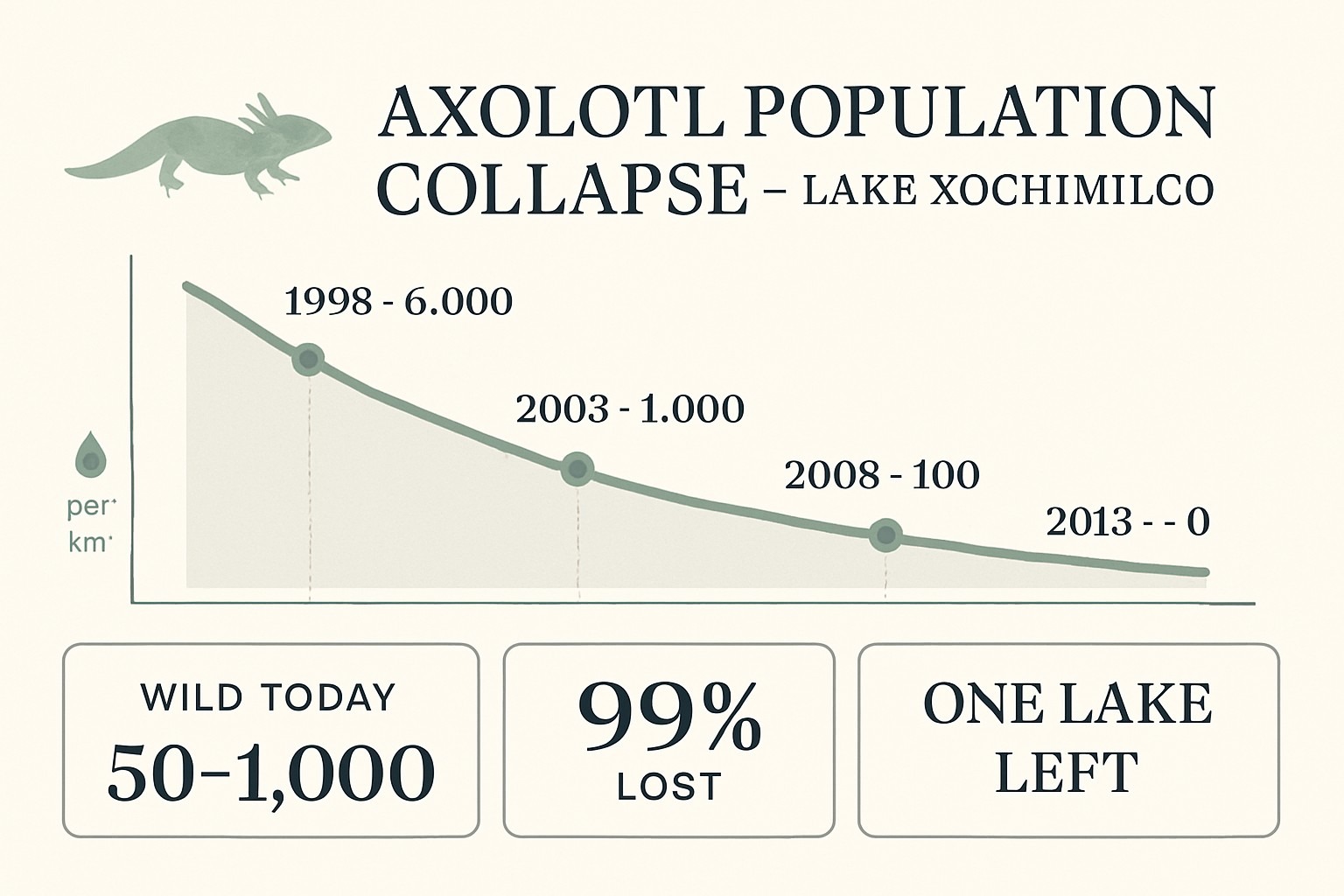
- It is IUCN Critically Endangered, with an estimated 50 to 1,000 adults left in the wild (2020 assessment); density fell from about 6,000 per square kilometre in 1998 to around 100 by 2008.
In short: The axolotl (Ambystoma mexicanum) is a salamander that never grows up, keeping its larval gills and fins for life through a trait called neoteny. It regrows legs, tail, spinal cord and parts of the heart and brain without scarring. It lives wild only in Mexico City’s Xochimilco canals and is critically endangered, with an estimated 50 to 1,000 adults left.
The salamander that refused to grow up
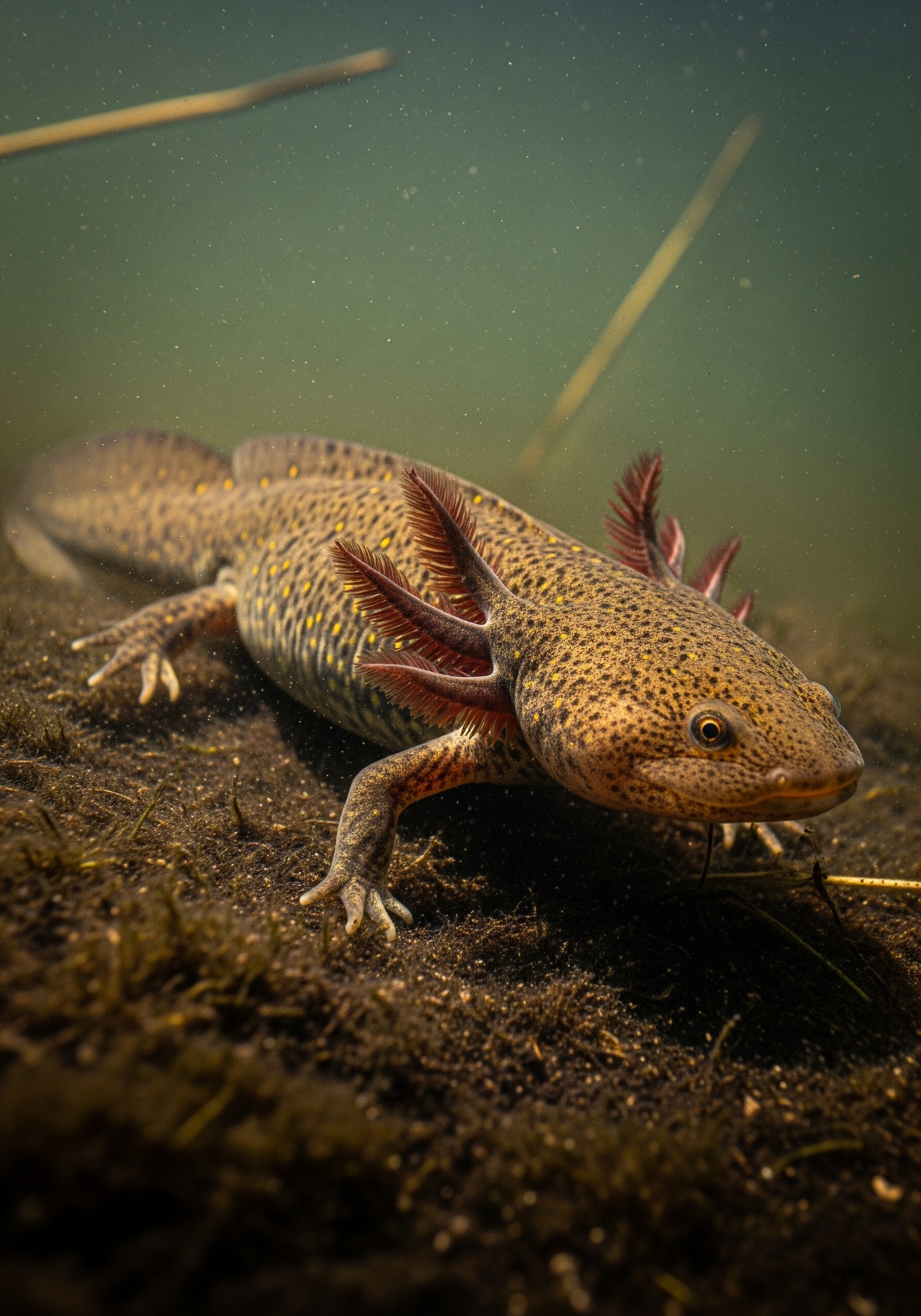
Most salamanders begin life looking like little fish — gilled, finned, swimming larvae — and then crawl out of the water, lose the gills, and finish life as terrestrial adults. The axolotl never bothers. It keeps the gills. It keeps the dorsal fin. It keeps the entire larval body plan for life, even when it is fully sexually mature and capable of breeding. Biologists call this neoteny, or paedomorphosis.
The mechanism is hormonal. A fully grown axolotl simply does not produce enough thyroid-stimulating hormone to trigger metamorphosis. Inject one with iodine or thyroid hormone, and the body — against its will, essentially — can finish growing up: gills shrink away, lungs take over, the animal walks out onto land looking like a stubby tiger salamander (which is essentially what its close cousins are). The Czech biologist Vilem Laufberger and Julian Huxley demonstrated this hormone-induced metamorphosis in the 1920s and 1930s, and the trick still works in any decent vertebrate-biology lab today.
Turns out the body that refuses to grow up is also the body that refuses to stop healing. That is not coincidence.
Axolotl facts at a glance
Quick Reference Card
- Scientific name: Ambystoma mexicanum
- Family: Ambystomatidae (mole salamanders)
- Adult length: 15–45 cm (6–18 in); typically about 23 cm
- Lifespan: 10–15 years in the wild; sometimes longer in well-kept captivity
- Diet: mollusks, worms, insect larvae, crayfish, small fish — anything they can suction up
- Wild population: 50–1,000 individuals (IUCN Critically Endangered, 2020)
- Native habitat: Lake Xochimilco canal system, Mexico City
- Genome size: ~32 billion base pairs (≈10× human)
{IMAGE_2}
How an axolotl regrows its own brain
Cut a limb off most salamanders and you usually get back a stumpy, simplified version of the original. Cut it off an axolotl and the limb comes back properly. Bones, blood vessels, nerves, muscle, skin, the correct number of fingers — all of it, arranged in the right places, scar-free, in a few weeks. The animal can pull the same trick on its tail, its spinal cord, parts of its heart, sections of its eye, and what researchers describe as “non-vital” portions of its brain. It can even accept transplanted organs from other axolotls without rejection.
How? That is a multi-billion-dollar question, and the Vienna-based regenerative biologist Elly Tanaka has spent twenty years closing in on the answer. Her lab at the Research Institute of Molecular Pathology (IMP) in Vienna showed in 2024 that the chromatin structure inside axolotl cells acts as a kind of biological “zip code” — even before any injury, the cells in the upper arm already know they are upper-arm cells, distinct from the cells in the wrist. In 2025, her group reported that the gene Hand2 is a master switch in that positional memory; Tanaka received the FWF Wittgenstein Award the same year for the broader body of work.
Here is the editorial verdict on why any of this matters: every mammal alive — humans included — carries silenced versions of many of the same genes axolotls use to rebuild themselves. The question is no longer whether regeneration is possible in vertebrates. The axolotl already proved it. The real question is why our cells stopped listening.
A god-named animal
The name “axolotl” is Nahuatl, the language of the Aztecs. It is usually translated as “water dog” or “water monster,” and it carries the name of Xolotl — the Aztec god of fire, lightning, and bad luck, twin brother of Quetzalcoatl. In one telling, Xolotl, doomed to be sacrificed by the other gods, fled into the lakes of central Mexico and turned himself into a salamander to hide. The axolotl, in that story, is a god in disguise.
Aztecs ate them. So did the Spanish, after the conquest. The animal still appears on Mexico’s 50-peso banknote (the 2021 series), and in 2017 it became the official emoji of Mexico City. Pokémon’s Wooper and Mudkip are loosely modeled on it. Minecraft added axolotls in 2020 partly to draw attention to their conservation status, which by that point was already grim.
Crashing in plain sight
Here is where the familiar “critically endangered” label needs unpacking. The collapse of wild axolotls is not a slow burn. It is a cliff. Repeated surveys in Lake Xochimilco — the only place wild axolotls still live — tracked roughly 6,000 individuals per square kilometer in 1998. By 2003, it was about 1,000 per square kilometer. By 2008, around 100. In a four-month search in 2013, researchers found none at all in their main survey transects; only two were later spotted in adjacent canals.
That is a population that lost roughly 99% of its density inside fifteen years. The current best estimate for the entire wild population is somewhere between 50 and 1,000 adult animals — total, across all the surviving canals combined.
What did it? Mexico City, mostly. The growing metropolis drained most of the original interconnected lake system across the 20th century. Sewage and agricultural pesticides pushed water chemistry past what the axolotl’s permeable skin can tolerate. And then, beginning in the 1970s and 1980s, fisheries authorities stocked the canals with Nile tilapia and common carp — large, aggressive, generalist fish that eat axolotl eggs and outcompete the adults for food. None of those species belonged there.
Pink, black, gold: the colors you’ll actually see
Internet wisdom has decided that axolotls are pink. They are not — at least not in the wild. Almost every wild axolotl is dark: brown or tan on top, dappled with gold or olive speckles, near-perfect camouflage against muddy canal bottoms. The pale-pink, feathery look that dominates every social-media feed is the leucistic morph — a genetic variation rare in nature but selectively bred in captivity because it photographs beautifully and shows the gills clearly.
Five colour forms are commonly recognized today: wild type (brown with gold flecks), leucistic (pale pink with black eyes), albino (white-pink with red eyes), melanistic (almost black, no speckling), and golden albino (pale yellow with red eyes). Same animal, same genome, different switches.
The carp, the tilapia, and the chinampas fightback
Saving the axolotl is, in practice, an exercise in fixing the lake around it. Conservation International and the Laboratorio de Restauración Ecológica at Mexico’s National Autonomous University (UNAM) are working with local farmers to revive the centuries-old chinampa system — narrow strips of cultivated soil between canals that act as natural water filters. Biofilters, pesticide-free farming, and physical refuges designed to exclude tilapia and carp have shown measurable improvements in small test sections. A 2025 study confirmed that captive-bred axolotls released into well-managed canal stretches can survive long enough to breed, though predation by great egrets remains a real bottleneck.
There is a paradox in all of this that is bleak and weirdly hopeful at the same time. There are almost certainly more axolotls alive right now in fish tanks, university labs, and Mexican pet shops than in the wild population. Captivity will not save the species in any meaningful ecological sense — a population that lives only in glass boxes is not really a wild animal anymore. But for now it is keeping the genome alive while the lake gets a second chance.
Frequently Asked Questions
Q: Are axolotls fish?
A: No. Axolotls are amphibians — specifically salamanders, in the same family as the North American tiger salamander. They keep their external gills and live entirely underwater, which is why they look fishlike, but they have four legs, lungs that they sometimes use to gulp surface air, and the skeletal anatomy of a tetrapod.
Q: Can axolotls really regrow their brain?
A: Partly. Researchers have shown they can regenerate non-vital sections of brain tissue and can rebuild functional spinal cord, but they cannot regrow an entire brain. They also regrow limbs, tail, parts of the heart, and portions of the eye, all without scarring.
Q: How long do axolotls live?
A: The commonly cited range is 10–15 years in the wild and sometimes longer in well-kept captive conditions. Stress, poor water quality, and overfeeding are the most common reasons captive axolotls die younger than that.
Q: Why are axolotls endangered if pet stores sell them everywhere?
A: Because the wild and captive populations are essentially two different gene pools. Almost all pet axolotls descend from a small founding group sent to Paris in 1863, with generations of selective breeding behind them. The wild population — what the IUCN actually tracks — lives only in the polluted, shrinking canals of Lake Xochimilco, and that is the population in collapse.
Sources
- International Union for Conservation of Nature (IUCN) Red List — 2020 axolotl assessment
- Research Institute of Molecular Pathology (IMP), Vienna — Elly Tanaka lab publications, 2024–2025
- Natural History Museum, London — axolotl species overview
- Conservation International — Mexico axolotl program documentation
- Laboratorio de Restauración Ecológica, UNAM (National Autonomous University of Mexico)
The axolotl is, in the end, a small reminder that biology still has tricks the textbook has not caught up to. An animal that refuses to grow up — and in refusing, refuses to die quietly when wounded — clings on in a few hundred polluted canals on the edge of a megacity, holding a key that medicine is only beginning to copy. The least we can do, while the lab figures out the rest, is keep its water clean.
Illustrations are AI-generated. Article fact-checked and human-edited. Our editorial standards.