The Flat-Faced Fox: Most of That Square Head Is Hair
The flat face fox you keep seeing online — the permanently unimpressed, square-headed one that looks like a badly compressed JPEG of a dog — is a real, living animal. It is the Tibetan fox, Vulpes ferrilata, and once you understand what built that face, you cannot quite look at the meme the same way again.
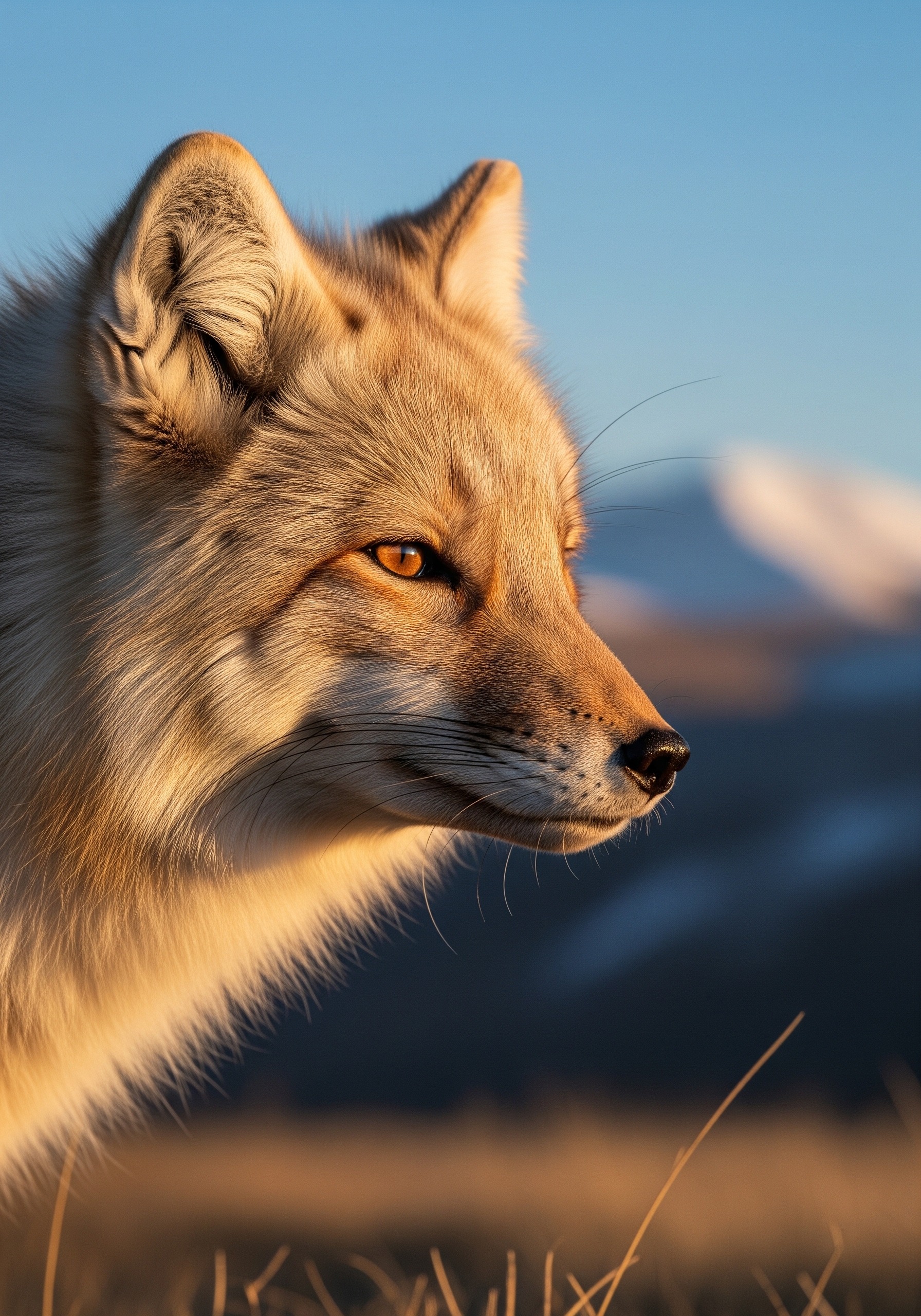
Key Facts
- The flat face fox is the Tibetan fox (Vulpes ferrilata), first formally described in 1842 by the British naturalist Brian Houghton Hodgson.
- It lives only on the Tibetan Plateau and the surrounding high country of China, Bhutan, India and Nepal, between roughly 3,500 and 5,300 metres (11,500–17,400 ft) above sea level.
- An adult weighs only 4–5.5 kg (8.8–12.1 lb) — smaller than a red fox — with a 60–70 cm body and a 29–40 cm tail.
- Around 99% of its diet is a single prey species: the plateau pika, Ochotona curzoniae, making it one of the most prey-specialized true foxes ever measured.
- Its skull is the most carnivory-specialized of any true fox — longer canines, a narrower jaw, and the longest condylobasal length in the genus Vulpes.
In short: The famous flat face is roughly half optical illusion. A thick winter coat puffed out around a working hunter’s skull is what produces the meme. Underneath that fur is the most carnivorous skull in the fox family — and the reason it evolved that way is a small, fluffy mammal called a pika.
Key Facts
- The flat-faced fox is the Tibetan fox (Vulpes ferrilata), first formally described in 1842 by British naturalist Brian Houghton Hodgson.
- It lives only on the Tibetan Plateau and surrounding high country of China, Bhutan, India and Nepal, between roughly 3,500 and 5,300 metres above sea level.
- An adult weighs only 4 to 5.5 kg, with a 60-70 cm body and a 29-40 cm tail smaller than a red fox.
- Around 99% of its diet is a single prey species, the plateau pika (Ochotona curzoniae).
- It has the most carnivory-specialized skull of any true fox, including the longest condylobasal length in the genus Vulpes; a 2014 Harris et al. study found 99% of fox scats contained pika DNA.
In short: The flat-faced fox of internet memes is the real Tibetan fox (Vulpes ferrilata), native to the Tibetan Plateau at 3,500 to 5,300 metres. Its famously square head is largely thick winter fur framing the most carnivory-specialized skull of any true fox. About 99% of its diet is a single prey species, the plateau pika.
So what is this animal, exactly?

The flat-faced fox of internet legend is not a breed, a hybrid or a Photoshop. It is a true fox in the genus Vulpes, an unusual fox species restricted to one of the harshest land surfaces on Earth: the open steppe and semi-desert of the Tibetan Plateau and the alpine country folded around it. Hodgson, an English administrator and naturalist based in the Himalayas, named the species in 1842 from specimens collected at altitude. He sent enough material back to London that the animal has carried his original Latin epithet ever since.
It is roughly the size of a small terrier. Pale rust and cream above, grey along the flanks, with a sandy mask running across the long muzzle. The eyes are narrow, slit-like, almost squinting — a feature that does a lot of the comic work in photographs. And it lives where almost nothing else with this body plan can: above the tree line, on grassland baked by ultraviolet by day and frozen at night, where oxygen levels are roughly two-thirds of those at sea level.
{IMAGE_2}
Most of the flat-faced fox’s square head isn’t bone — it’s hair
Here’s the thing the viral photos never tell you. Look at a Tibetan fox in summer pelage, after the moult, and the famous square head is suddenly less square. The muzzle thins. The cheeks drop. The animal looks, almost, like a normal fox with a slightly heavy brow.
Now look at the same animal in mid-winter. The coat doubles in volume. Long guard hairs stand out around the cheeks and the back of the skull. The face frames itself into a near-perfect rectangle.
That is the meme face.
A significant share of what we read as a “flat” or “square” face is therefore not anatomy — it is winter insulation puffed up to defend a four-kilogram body against –30 °C nights and unrelenting plateau wind. Strip the fur in your mind and you are left with a fox that is still odd-looking, but in a subtler, more interesting way: short-muzzled, broad across the temples, with a flat forehead.
That underlying oddness is the part worth understanding.
The skull underneath, and why it matters
Among the world’s true foxes — there are about a dozen species in Vulpes — the Tibetan fox has the most carnivory-specialized skull of all. That is not an opinion. It is the conclusion of the Mammalian Species account for Vulpes ferrilata, published by the American Society of Mammalogists, summarising decades of comparative osteology across the genus.
What does “most carnivorous” mean here? Three things. First, the canines are noticeably longer than those of related foxes — useful for puncturing a fast, hidden prey animal in a single bite. Second, the jaw is narrower than other foxes’, concentrating force on a smaller contact area. Third, the skull is unusually long front-to-back (the longest condylobasal length in the genus), which extends the lever arm of the jaw muscles and increases bite force at the canine tips.
The temporalis — the big chewing muscle that runs from the top of the skull down into the lower jaw — anchors on a broadened cranial crest. That broader anchoring is part of what reads from the outside as a wide, flat brow. The masseter, the cheek muscle, has correspondingly large attachment surfaces. None of this would matter if the fox were eating berries. It is a skull built to bite small, fast, warm things, repeatedly, all day, for life.
So before any fur is added, before any wind blows, the underlying head is already short, broad and built for serious hunting work. The pelage just turns it into a meme.
The pika that built this face
What is the small fast warm thing? Almost always one species: the plateau pika, Ochotona curzoniae. Pikas are small lagomorphs (relatives of rabbits), roughly the size of a hamster, that live in dense burrow colonies across the Tibetan grasslands. They emerge to graze, freeze at any shadow, and vanish underground at the slightest disturbance. A predator gets, generously, a one-second window per attempt.
How much of the Tibetan fox’s diet is pika? In 2014, Harris and colleagues published a landmark dietary study in the Journal of Mammalogy using DNA barcoding on fox scats from Qinghai Province in China. The results were almost ridiculous: 99% of scats contained pika DNA, 97% were dominated by pika DNA, and 73% contained pika and nothing else. The authors called the Tibetan fox an “obligate predator” of the plateau pika. In plain English, this is a fox that has bet everything on a single prey species.
That is the form-function chain in one sentence. One specialist prey requires one fast, decisive bite — which requires a longer canine and a narrower, harder-clamping jaw — which requires a longer skull and broader muscle anchorages and a flat forehead to carry the chewing apparatus. Add a winter coat thick enough to survive 5,000 metres, and you have built the face that broke the internet.
Tibetan fox vs bat-eared fox: two weird faces, two different problems
The flat face fox is not the only canid with a famously strange head. The bat-eared fox of the African dry savannas (Otocyon megalotis) is the other contender, and the comparison is genuinely useful — because the two species’ faces look weird for opposite reasons.
| Trait | Tibetan fox (flat face fox) | Bat-eared fox |
|---|---|---|
| Visible “weirdness” | Square, almost flat-fronted head | Outsized ears on a small face |
| Habitat | High, cold Tibetan Plateau (3,500–5,300 m) | Hot, dry African short-grass and shrub savanna |
| Main prey | Plateau pika (small mammal, fast, hidden) | Harvester termites and beetles (tiny, sound-producing) |
| Skull built for | High bite force, single decisive kill | Fast jaw, many small bites — more teeth than any other canid |
| The “strange” feature actually does | Anchors chewing muscles, adds insulating fur | Hears insects underground, dumps body heat |
Same family, opposite continents, opposite problems, opposite solutions. The Tibetan fox needed bite force and warmth, and it got a flat-fronted skull packed in fur. The bat-eared fox needed acoustic sensitivity and a way to lose body heat, and it got radio-dish ears. Both look surreal in photographs. Neither is surreal in its own life.
Here is the honest editorial part: the popular “wind adaptation” theory you will see repeated across nature blogs — that the flat face is shaped to cut through plateau wind like a windshield — is plausible but unevidenced. The form-function story driven by pika hunting and winter insulation is the one with measurements behind it.
What the flat face fox meme actually misses
The Tibetan fox is currently listed as Least Concern by the IUCN, mostly because its range is enormous and humans rarely climb that high. That comfortable label is starting to creak.
Two pressures are closing in. One is conservation policy aimed at the wrong target. Plateau pikas — the prey that built the fox’s face — have for decades been targeted by large rodenticide campaigns in parts of western China, on the grounds that they damage grassland productivity. Ecologists have argued for years that pikas are in fact a keystone species for the plateau, supporting nearly every predator above them, and that poisoning them out of an area collapses the food web rather than restoring it. For an obligate pika predator like Vulpes ferrilata, “fewer pikas” reads, biologically, as “fewer foxes.” The rest of this fox’s high-altitude survival kit — kidneys, blood, paired hunting, denning — is another story altogether.
The other pressure is climate. A 2025 distribution-modelling study by Zhang and colleagues on the Tibetan Plateau found the Tibetan fox’s suitable habitat moving steadily uphill as the plateau warms, and overlapping increasingly with the red fox — a larger, more aggressive competitor that is itself moving up. The flat face fox evolved a very narrow envelope. The envelope is shrinking from below and getting crowded from the side.
It is hard to look at the meme face and feel the species is in danger. It looks too sturdy, too unimpressed, too internet-proof. But specialists are always fragile. A fox built around one prey species and one altitude band has fewer cards to play when the rules change.
Frequently Asked Questions
Q: What is the actual name of the flat face fox?
A: The Tibetan fox, Vulpes ferrilata, sometimes also called the Tibetan sand fox. It was first formally described in 1842 by Brian Houghton Hodgson, a British naturalist based in Nepal. The viral meme photos are almost all of this single species.
Q: Is the Tibetan fox’s flat face real, or is it just the camera angle?
A: It is real, but mostly an illusion of fur. A great deal of the apparent flatness comes from a very thick winter coat that frames the head; the underlying skull is broad and short-muzzled but not literally flat-fronted. In summer pelage, the famous “square head” looks noticeably less square.
Q: Why does it eat almost nothing but pikas?
A: Because the plateau pika is abundant, predictable and roughly the right size for a 4–5 kg solitary hunter. A 2014 dietary study (Harris et al., Journal of Mammalogy) found pika DNA in 99% of Tibetan fox scats sampled, with 73% containing pika and nothing else. The fox is, functionally, an obligate pika specialist.
Q: Can you keep a fox with a flat face as a pet?
A: No. It is a wild high-altitude carnivore adapted to oxygen-poor air, freezing nights, and a one-species prey base. It does not survive well outside that envelope, and it is protected as wildlife across most of its range. Its meme appeal does not translate to domestic life.
Sources
- Hodgson, Brian Houghton (1842). Original description of Vulpes ferrilata, type material from the Tibetan Plateau.
- Harris, R. B. and colleagues (2014). “Evidence that the Tibetan fox is an obligate predator of the plateau pika,” Journal of Mammalogy, 95(6): 1207–1213.
- Mammalian Species Account for Vulpes ferrilata, American Society of Mammalogists — comparative osteology and ecology of the species.
- IUCN Red List assessment for Vulpes ferrilata (Least Concern).
- Zhang and colleagues (2025) — distribution-shift modelling of Vulpes ferrilata on the Tibetan Plateau under climate change.
The flat face fox is one of those animals that the internet found before it ever met a biologist. The image traveled. The science stayed quiet. Now you have both — the meme face and the skull underneath it, the prey species that shaped it and the warming plateau that may one day take it away. Look at the next photo of that unimpressed little hunter and you should see a small, working specialist in a thick coat, doing the job evolution gave it, four thousand metres above the rest of us.
Illustrations are AI-generated. Article fact-checked and human-edited. Our editorial standards.