The Black Serval: A Shadow Cat That Shouldn’t Exist
There are fewer than a dozen confirmed black servals on record. Fewer than a dozen in the entire documented history of wildlife photography and field research. And the crazier part? The spots are still there — you just can’t see them until the light hits right.
I spent way too long reading about this at 2am, and I still can’t quite explain why it matters so much. A serval, already one of Africa’s strangest small cats, showing up in midnight fur so rare that each sighting becomes its own little news event. Not a legend. Not a myth. An actual animal, moving through East African grassland, carrying genetics that almost never happen.
Key Facts
- Fewer than 12 black servals were officially documented as of 2023.
- Melanistic leopards make up roughly 11% of populations in parts of Malaysia, compared to well under 0.1% in servals across their entire range.
- Wildlife photographer Will Burrard-Lucas captured the first clear documentation of a black serval’s ghost-pattern coat at Kenya’s Lewa Wildlife Conservancy in 2019.
- Servals have a hunting success rate around 50%, compared to 25-30% for lions.
- A serval can leap 2.7 to 3 meters vertically while its body averages 60-100 cm in length.
In short: Among wild cats, black serval melanism is one of the rarest coat mutations, with fewer than 12 individuals documented as of 2023. Caused by the MC1R gene flooding the coat with eumelanin, the dark fur still reveals ghost spots in direct sunlight, first clearly photographed by Will Burrard-Lucas in Kenya in 2019.
Black Serval Melanism: A Mutation That Barely Exists
Melanism — that’s the overproduction of dark pigment, the thing that makes black leopards and melanistic jaguars possible — should theoretically work in any spotted cat. In black leopards, you’re looking at roughly 11% of the population in certain Southeast Asian regions. Straightforward genetics. Happens often enough that researchers have built datasets around it.
But the serval?
Luke Hunter, who’s spent decades actually studying wild felids in the field (not in papers, but in the field), estimates that documented black serval sightings are so rare they barely constitute statistics. Each one is basically its own census event. A category with almost no members. The mutation that’s supposed to be possible — that genetic pathway, that MC1R gene variant flooding the coat with eumelanin — it almost never fires. And here’s the infuriating part: nobody really knows why.
The Spots Don’t Vanish
This is where it gets legitimately weird.
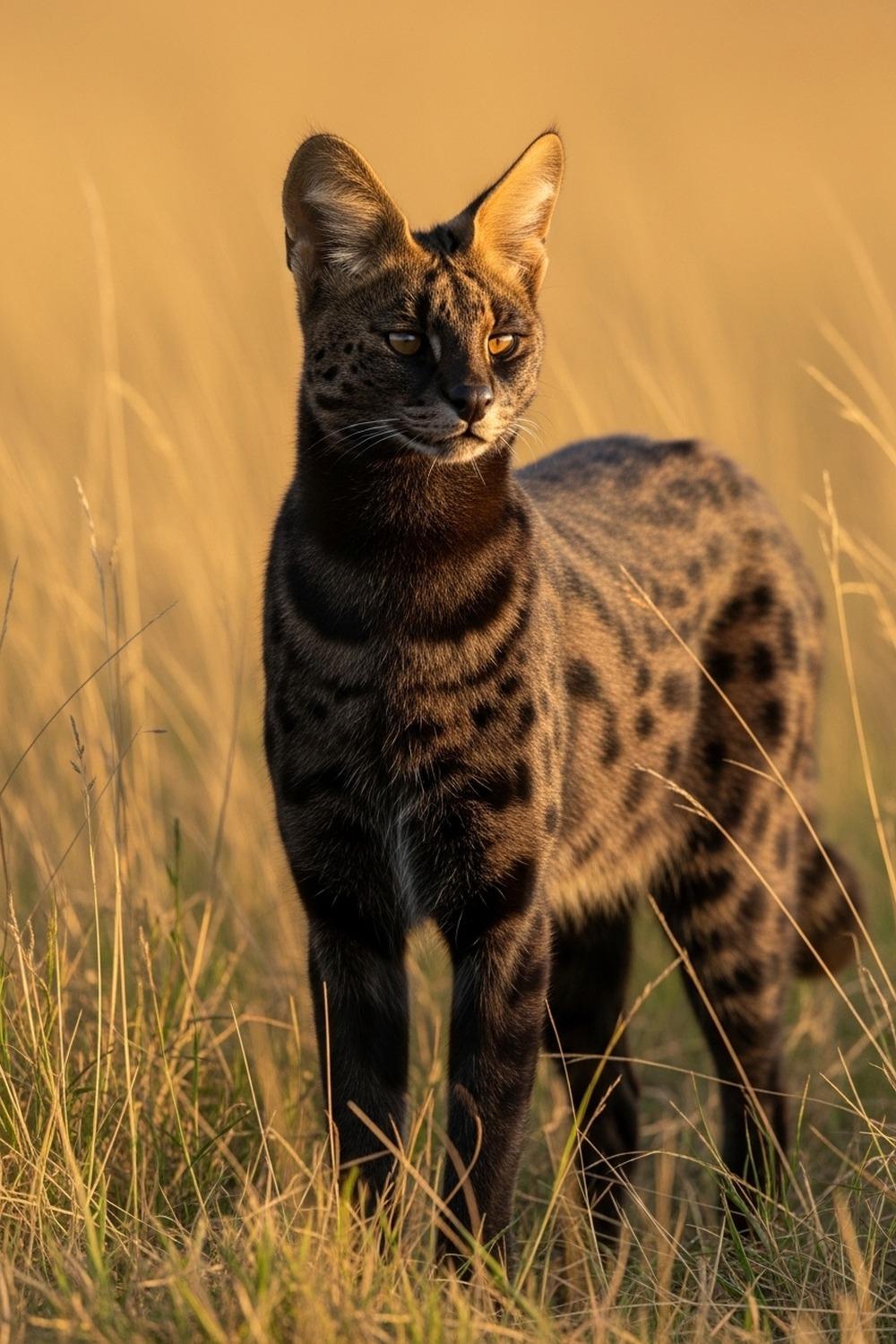
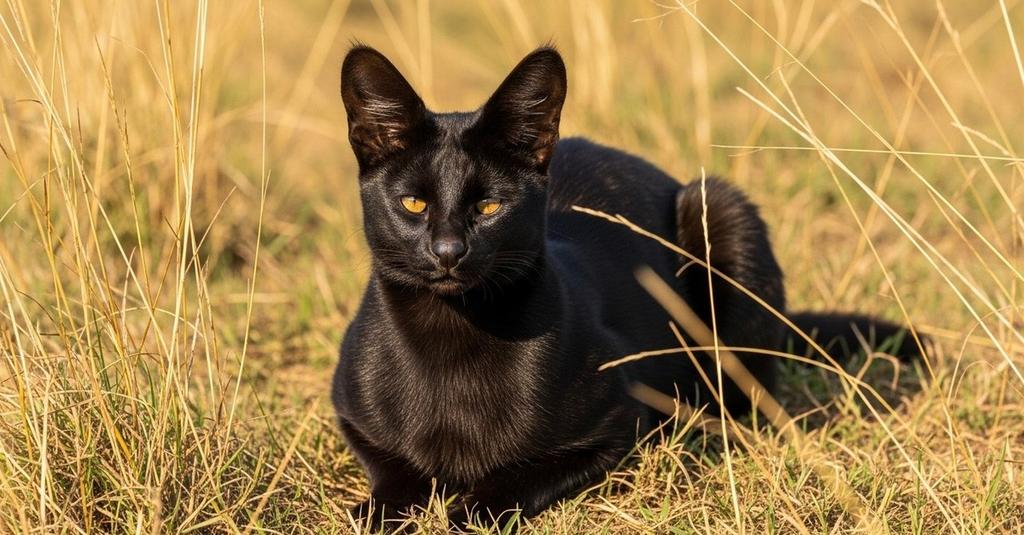
A black serval in flat light looks like pure shadow — featureless, unmarked, a cat-shaped hole in the world. But hit it with direct sunlight and something impossible happens: the original pattern bleeds through. Spots. Stripes. The ghost image of what a normal serval looks like, visible only at certain angles, like someone printed two images on top of each other and forgot to make them line up perfectly.
Wildlife photographer Will Burrard-Lucas caught this in Kenya’s Lewa Wildlife Conservancy in 2019. His images are the first clear documentation of this dual-nature coat, and they’re genuinely unsettling — not scary, just strange. The cat is wearing two identities.
What does this tell us? That genetics doesn’t erase the original blueprint. It just overwrites it. The underlying instructions for spots and stripes are still there, still encoded in the fur structure. Darkness covers it, but light exposes it. You see the same principle in other species breaking their own rules — there’s a whole collection of these biological paradoxes where animals seem to have forgotten what they’re supposed to look like.
And the serval doesn’t care. Doesn’t behave differently. Doesn’t hunt differently. Just walks around wearing something extraordinary and acts completely normal about it.
The Serval Is Already Impossible
Even without the midnight coat, this cat is a biological contradiction. Longest legs relative to body size of any cat on Earth — not built for speed, but for precision. Those proportions let it leap nearly three meters straight up to snatch birds mid-flight. Its ears are disproportionately massive, capable of hearing rodents moving underground. The hunting success rate runs around 50% — double what lions pull off.
The serval doesn’t chase. It listens. Pinpoints. Strikes with almost surgical accuracy.
Add black fur to that equation and you’ve got something that shouldn’t exist on an African savanna, and yet it does, and yet it works.
Does Being Black Actually Work in Open Grassland?
Here’s where the science gets murky and the story gets interesting.
The conventional logic says melanism works in forest cats — black leopards in dense jungle — because the shadows work. Low light. Densely packed trees. Darkness becomes camouflage. But the serval is a savanna animal. Golden grass. Bright midday sun. Open terrain that seems engineered to make a black cat more visible, not less.
Yet they survive. They breed. The mutation persists across generations, however rarely.
Which means either the darkness doesn’t disadvantage them the way we assume, it provides an advantage nobody’s identified yet, or the survival factor depends on something we’re measuring wrong entirely.
What the Data Actually Shows
A 2021 analysis pulling from museum specimens and camera trap records across multiple wild cat species found something unexpected: melanistic individuals appear more frequently in higher-altitude and wetter environments, even in species typically associated with open grassland. If black servals show up more often near forested highland edges in East Africa, that might not be coincidence.
It might be landscape selection happening in real time.
The implication is significant. Melanism might not be just a random genetic accident that persists despite itself. It could be a slow, long-term adaptation — an evolutionary experiment still running, still testing whether darkness works, still waiting for enough data to answer the question.
By the Numbers
- Fewer than 12 black servals officially documented as of 2023.
- Melanistic leopards make up roughly 11% of populations in parts of Malaysia — compared to well under 0.1% in servals across their entire range.
- Serval hunting success rate: around 50%. Lions: 25-30%. One of Africa’s most efficient predators by strike-to-kill ratio.
- A serval can leap 2.7 to 3 meters vertically. Its body averages 60-100 cm. Proportionally, one of the highest jumps of any cat species, and we still don’t fully understand why they need to jump that high.
Field Notes
- Will Burrard-Lucas, 2019. Kenya’s Lewa Wildlife Conservancy. First clear photographs of the ghost pattern — original spots visible through dark fur in direct sunlight.
- Servals hunt insects, frogs, even fish. Their diet is dramatically more varied than most people realize. This dietary flexibility might explain their adaptability across different terrain types — they’re not locked into one food source the way many carnivores are.
- Black servals don’t get socially rejected. They integrate normally into territorial ranges, mate successfully, raise young. No documented social disadvantage from their color, which raises an obvious question — what exactly is the cost we keep assuming should exist?
Why This Matters More Than Just Looking Weird
Black serval melanism isn’t a visual novelty. It’s evolution happening in real time — not in clean textbook diagrams, but in isolated individuals, rare mutations, and environments quietly testing hypotheses nobody asked out loud. Each confirmed black serval is a data point in an experiment that’s been running for thousands of years without a lab, without funding, without anyone watching closely enough.
If we lose serval populations before we understand what sustains this mutation, we lose the question entirely.
The black serval exists at the edge of what genetics considers likely. It moves through grassland built for golden cats, wearing a coat that should make it visible and somehow doesn’t. It carries its original pattern like a secret written in UV ink — literally invisible until the light changes. Sometimes the strangest things are hidden in plain sight, just waiting for the angle to shift. If this kind of thing keeps you reading past midnight, there’s more at this-amazing-world.com — and the next story is even stranger.
Frequently Asked Questions
Q: How rare is black serval melanism compared to other cats?
Extremely rare. Fewer than 12 black servals were officially documented as of 2023, putting melanism in servals at well under 0.1% of the population across their entire range. By contrast, melanistic leopards make up roughly 11% of populations in parts of Malaysia. The mutation that produces dark coats theoretically works in any spotted cat, but in servals the genetic pathway almost never fires, making each confirmed sighting its own census event.
Q: Why are the spots still visible on a black serval?
A black serval looks like featureless shadow in flat light, but direct sunlight reveals the original spots and stripes bleeding through, like two images printed slightly out of alignment. This happens because melanism overwrites rather than erases the coat’s original blueprint; the instructions for the pattern remain encoded in the fur structure. Will Burrard-Lucas first clearly photographed this dual-nature coat at Kenya’s Lewa Wildlife Conservancy in 2019.
Q: How does melanism survive in open grassland habitats?
It is a genuine scientific puzzle. Melanism is expected to help forest cats like black leopards, where dense shadow becomes camouflage, but servals live on bright, open savanna where a dark coat should be more visible. Yet black servals survive and breed. A 2021 analysis of museum specimens and camera-trap records found melanistic individuals appear more often in higher-altitude and wetter environments, hinting at landscape selection still playing out.
Q: What makes the serval such an effective hunter?
The serval has the longest legs relative to body size of any cat, built for precision rather than speed, letting it leap nearly 3 meters straight up to catch birds in flight. Its oversized ears can hear rodents moving underground. Rather than chasing, it listens, pinpoints, and strikes, achieving a hunting success rate around 50%, roughly double the 25-30% rate of lions, making it one of Africa’s most efficient predators.
Illustrations are AI-generated. Article fact-checked and human-edited. Our editorial standards.