Shanay-Timpishka: The Amazon’s Boiling River, Explained
Strip away the folklore and the boiling river Amazon locals call Shanay-Timpishka is a tidy piece of field geology: a 9-kilometre tributary in Peru’s Huánuco region, 6.3 kilometres of which runs hot enough to kill on contact, with one spring along its bank measured at 99.1 °C. Here is the part that should not work. The nearest active volcanic centre is more than 700 kilometres away, and the river sits in the middle of a sedimentary basin with no known magma body under it. Big thermal rivers are supposed to need volcanoes. This one never got the memo.
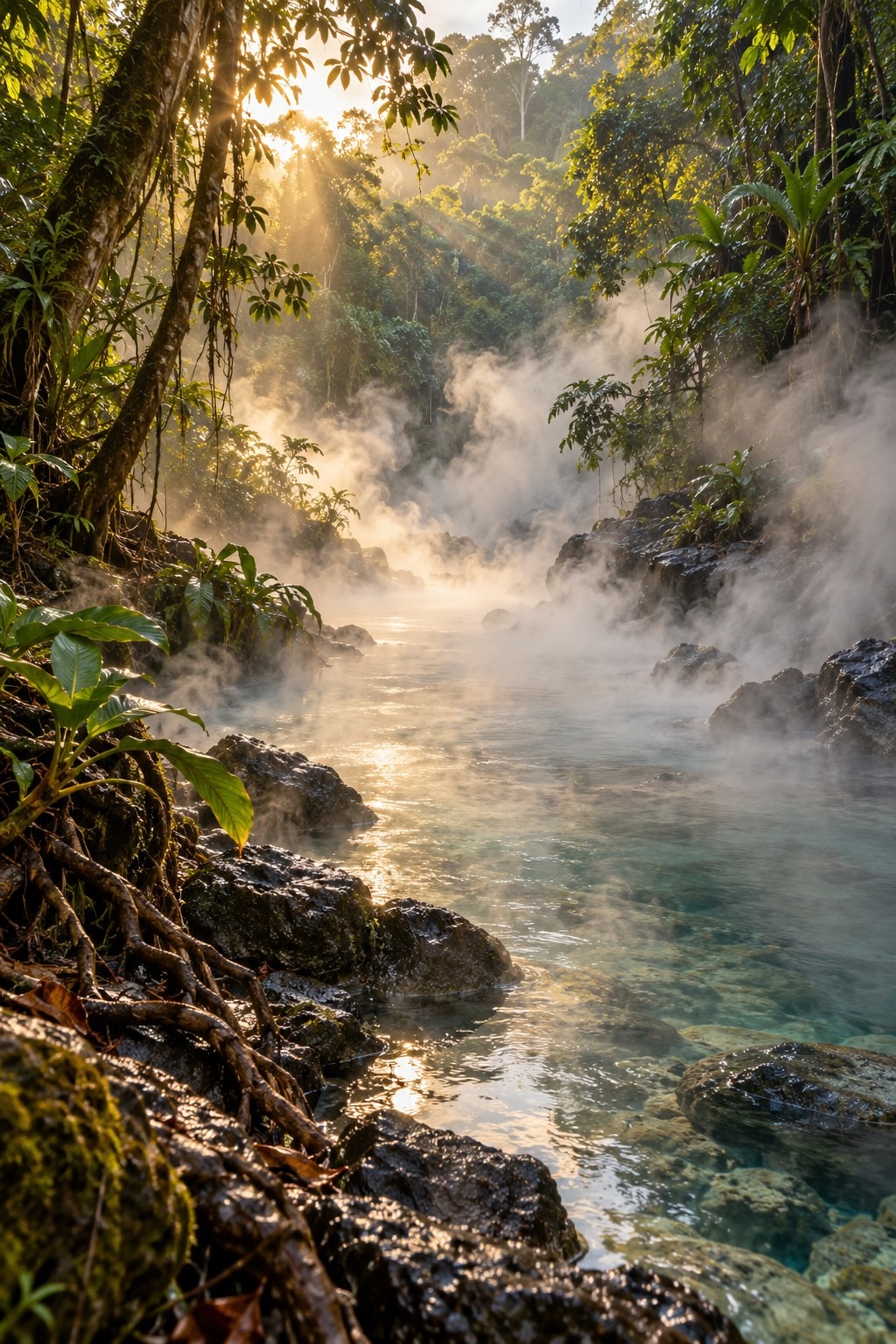
- Where: Puerto Inca province, Huánuco region, Peru (about 8°49′S, 74°44′W) — a tributary of the Pachitea, which feeds the Ucayali and then the Amazon.
- Hot stretch: 6.3 km of a 9 km river; up to 25–30 m wide and 4.5–6 m deep in places.
- Temperature: roughly 27 °C at the headwaters; averages in the mid-80s °C along the hot reach; hottest spring on record 99.1 °C.
- Heat source: no magma — rainwater circulating kilometres deep along faults and returning through fault-fed hot springs.
- Name: Quechua, roughly “boiled with the heat of the sun.”
Key Facts
- The river’s hot stretch spans 6.3 km of its total 9 km length, up to 30 m wide and 6 m deep, in Puerto Inca province, Huánuco region, Peru.
- The hottest recorded spring, La Bomba, reached 99.1 °C, while the thermal reach averages in the mid-80s °C.
- The nearest active volcanic centre is more than 700 km away, and no magma body exists beneath the sedimentary basin.
- Geoscientist Andrés Ruzo of Southern Methodist University became the first researcher granted permission to study the river, in 2011.
- In 2021, University of Miami biologists led by Kenneth Feeley measured a 4 °C shift in mean annual air temperature, up to 11 °C in maximum temperature, within less than a kilometre of riverbank.
In short: Peru’s Shanay-Timpishka, a 9-kilometre Amazon tributary in Huánuco, runs lethally hot for 6.3 kilometres, averaging in the mid-80s °C with a peak of 99.1 °C, despite no volcano within 700 kilometres. Geoscientist Andrés Ruzo traced the heat to rainwater circulating through deep fault zones rather than magma, making it the largest documented non-volcanic geothermal river system on Earth.
How hot the boiling river Amazon Shanay-Timpishka really gets
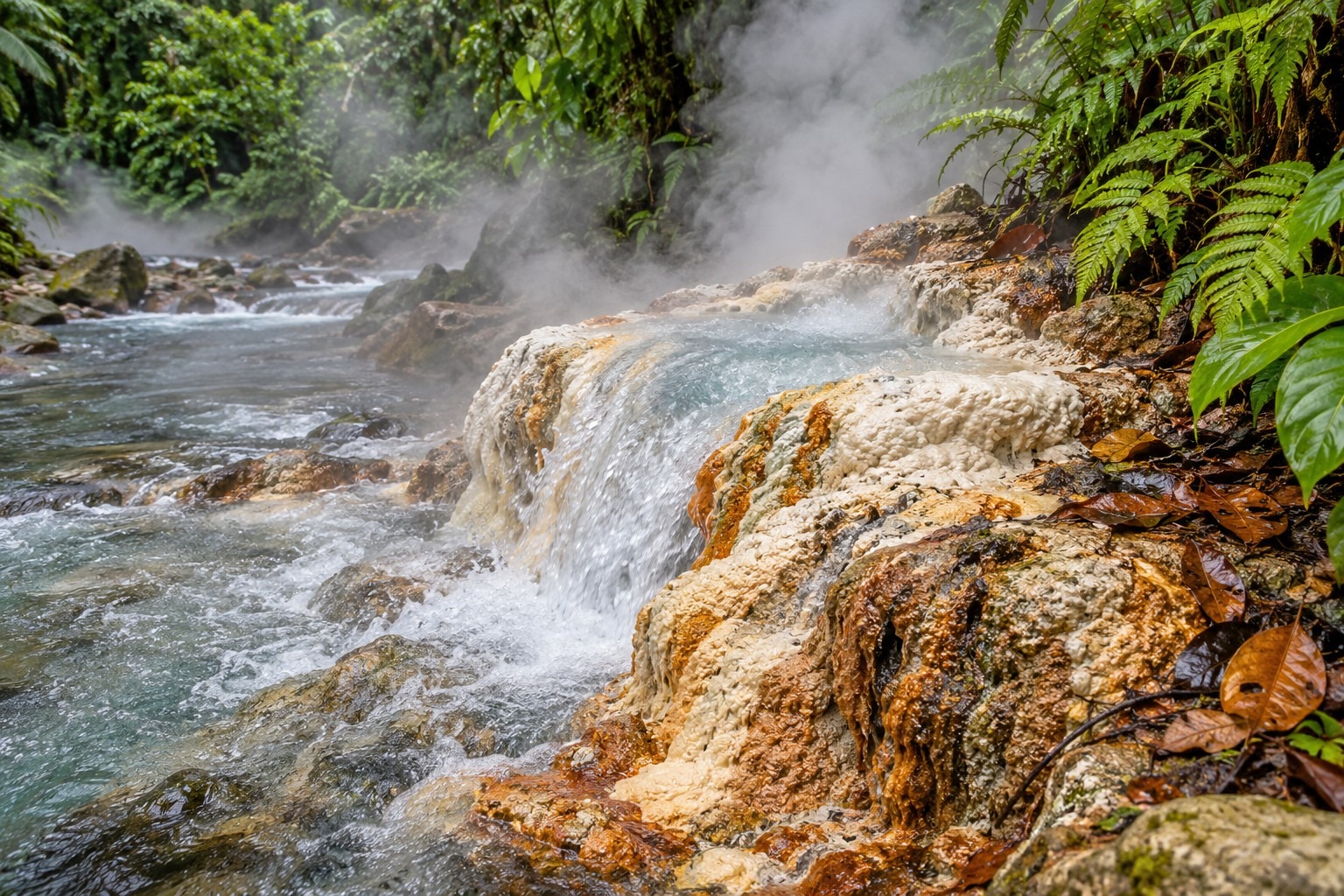
“Boiling” is a promise the river doesn’t quite keep, and the distinction matters. Water at the surface here boils at about 100 °C. Measurements along the thermal reach cluster in the mid-80s, with the hottest sustained river averages reported close to 95 °C and that single record of 99.1 °C coming from a hot spring on the bank rather than from the channel itself. So: scalding, lethal, steaming at dawn — but not a rolling cauldron end to end.
Andrés Ruzo, a Peruvian-American geoscientist trained at Southern Methodist University, became the first researcher granted permission to study it in 2011, led in by his aunt after a childhood story from his grandfather. His account of that first thermometer reading is blunt: “The average temperature in the river was 86 degrees Celsius, not quite boiling but definitely close enough… It’s not a legend.”
What the temperature does to animals is the detail everyone remembers. Frogs and rodents that slip in are cooked from the outside in, eyes first, which is as grim as it sounds and also a decent reminder that this is not a hot spring you wade into casually. Downstream, past the thermal reach, the water cools to something ordinary again; near the lodges at Mayantuyacu there are pools people genuinely do bathe in.
The plumbing: rain goes down, heat comes up
Every working explanation of this river is a story about circulation, not combustion. Rain falls on the Andean foothills to the west, soaks into fractured sedimentary rock, and keeps going — down through fault zones that behave less like cracks and more like vertical pipework. As it descends it warms, because rock gets hotter with depth everywhere on Earth, volcano or not.
Then the water comes back up, and speed is everything. Rising fast along a permeable fault, it reaches the surface before it has time to shed its heat into the surrounding rock. Isotopic and geochemical sampling by Ruzo’s team pointed squarely at meteoric water — rain and surface water that fell at altitude — rather than fluids cooked off a magma chamber. One local spring, large enough to earn its own name, is known as La Bomba: the pump.
{IMAGE_2}
So the river is not heated along its length by some hidden fire. It is fed, repeatedly, by hot springs entering a cool jungle stream, and the sum of those inputs is a watercourse that runs at bath-to-lethal temperatures for nearly four miles.
Why no volcano is needed
Here’s the thing about the geothermal gradient: it is unremarkable. Continental crust typically warms by something like 25–30 °C for every kilometre of depth, which means ordinary rock a couple of kilometres down is already hot enough to produce near-boiling water if you can get fluid to it and back again quickly. No magma required — just depth, faults, and a lot of rain.
- Surface jungle stream: about 27 °C
- Typical continental geothermal gradient: about 25–30 °C per kilometre
- Depth needed to approach boiling: on the order of 2–3 km
- Distance to the nearest active volcanic centre: more than 700 km
The circulation depth has not been drilled or directly logged; it is inferred from water temperature and the regional gradient.
Systems like this are called amagmatic — hot without magma — and they are not unique to Peru. Fault-fed thermal springs of the same basic design appear in the Pyrenees, in parts of Turkey, in the Great Basin of the United States. What makes Shanay-Timpishka extraordinary is scale: the volume of near-boiling water surfacing in one place, far from any volcanic arc, in the middle of a rainforest. Ruzo has argued it is the largest documented non-volcanic geothermal river system on Earth, and no geothermal scientist has publicly disputed him.
A 4 °C climate ramp in under a kilometre
In 2021 a group of biologists from the University of Miami came to look at the river and realised they were standing in something rarer than a curiosity. Because the hot water warms the air above it, the forest on the banks experiences a temperature gradient — cool and ordinary upstream, brutally hot beside the thermal reach — compressed into less than a kilometre of walking.
Their sensors put numbers on it: a difference of about 4 °C in mean annual air temperature, and up to 11 °C in maximum air temperature, between the cooler and hotter ends. Those hottest conditions are roughly what climate models project for much of the lowland Amazon later this century. Kenneth Feeley, the Miami professor whose lab ran the work, described the fieldwork conditions plainly — on the heat index, he noted, “everything says immediate danger of heat stroke.”
Why does that compression matter so much? Because to find a 4 °C temperature change in normal Amazonian forest you would have to travel dozens of miles, crossing different soils, rainfall regimes and species pools along the way — and then you could never tell whether temperature or any of the rest of it was doing the work. Beside the boiling river, the soil and the rainfall stay broadly the same. Only the heat changes.
What happened to the trees
Returning in 2022, the team inventoried 70 circular plots, each six metres across, counting every woody stem at least two centimetres thick and sampling soils at fifteen points to rule out confounding effects. Their results were published in Global Change Biology in 2024 by Riley Fortier, Alyssa Kullberg, Kenneth Feeley and co-authors including Ruzo himself.
Tree diversity fell by roughly 11% for every 1 °C of warming. In plot terms, the coolest sites averaged about 8.6 woody species while the hottest averaged about 5.7 — a third of the local diversity, gone, across a distance you could cover in fifteen minutes. Surviving communities were not a random subset either; they shifted towards thermophilic species, trees normally found in the hotter parts of the Amazon basin. Tall closed canopy gave way to smaller trees, more vines, scrubbier and drier vegetation that the researchers likened to a forest–savanna transition.
| Along the thermal gradient | Woody species per plot | Forest character |
|---|---|---|
| Cooler upstream end | ~8.6 | Taller, closed-canopy rainforest |
| Hottest reach (up to ~11 °C hotter at maximum) | ~5.7 | Smaller trees, more vines, scrubby and drier |
| Change | ≈ −11% per 1 °C | Shift towards heat-adapted species |
Of the two stories this river tells, the mystery is by far the smaller one. A hot stream with no volcano is a lovely puzzle; a natural thermometer that shows what 4 °C does to Amazonian forest, with the other variables held still, is something science cannot build on purpose.
Yacumama, the shamans, and who actually guards the water
Long before any thermometer arrived, the heat had an explanation. Local shamans attribute the boiling water to Yacumama — a vast serpent spirit, Mother of the Waters — and the site has been treated as sacred ground rather than a resource. Three small communities sit along the thermal reach: Mayantuyacu, Santuario Huistín, and a centre that carries the river’s own name.
Asháninka families steward the forest around the river, and healing traditions, including ayahuasca ceremony, are part of why the surrounding trees are still standing. That is not a sentimental observation — it is the reason the 2024 study was possible at all. Researchers described their study area as a bubble of intact forest inside a heavily cleared region.
Outside that bubble, the pattern is familiar: high-value timber taken first, the remainder burned off for pasture or smallholdings. Ruzo founded the Boiling River Project, a non-profit combining research, conservation economics and Indigenous knowledge, on exactly that premise — his line about the place is that it is a natural wonder that will not be around unless someone does something about it. Access, incidentally, has got easier as the forest has thinned; what took hours of hiking in 2011 is now closer to a drive, a short boat ride and a walk in from Honoria.
What’s proven here, and what isn’t
Three corrections are worth making, because the popular retellings of this river keep repeating them.
First, it is not “unexplained.” Headlines still frame the heat as baffling scientists; the mechanism — deep meteoric circulation along faults — is well understood and fits the water chemistry. It is the scale, not the physics, that is remarkable. Second, it is not “the only one of its kind in the world.” Non-volcanic thermal springs are widespread; the honest claim is that this is the largest documented river of the type, and that superlative rests on Ruzo’s own undisputed assessment rather than on a global survey anyone has published.
Third — and this is the part nobody tells readers — the river’s geology is less formally documented than its ecology. Its temperature and geochemical dataset is described in Ruzo’s 2016 TED Books volume, his talks and his project’s reporting; as far as we can establish, it has not appeared as a standalone peer-reviewed geoscience paper. The strongest peer-reviewed science to come out of Shanay-Timpishka so far is about trees. Turns out the famous mystery is the softer half of the record.
Common Questions
Does the river actually boil? Not along its length. Parts of the thermal reach average in the mid-80s °C and the hottest sustained averages approach 95 °C, but the 99.1 °C record belongs to a bank-side hot spring. Steam, scalding, lethal — yes. Rolling boil, no.
Can you swim in it? Not in the hot reach, where contact is fatal. Downstream and around the Mayantuyacu lodges the water mixes with cool inflow and reaches bathing temperature, which is where visitors go in. Conditions vary along the river and with the season, so this is a question for the resident guides on the day, not for an article.
How do you reach it? A common route runs from Pucallpa overland to Honoria (roughly two to two and a half hours), then a short boat trip, then about an hour on foot. Tours leave Pucallpa early; the site is managed by the resident communities and charges a modest entry fee.
Could it generate power? In principle the heat is usable, and that is precisely the tension. Near-boiling water at the surface is a geothermal engineer’s dream and a sacred site’s nightmare, and the communities’ position has been protection rather than development.
Sources and Notes
- Fortier, Kullberg, Feeley and colleagues, “Hotter Temperatures Reduce the Diversity and Alter the Composition of Woody Plants in an Amazonian Forest,” Global Change Biology (2024)
- University of Miami, Department of Biology — Feeley lab research announcements
- Mongabay — reporting on the Boiling River thermal-gradient study
- Andrés Ruzo, The Boiling River: Adventure and Discovery in the Amazon (TED Books / Simon & Schuster, 2016), and his TEDGlobal talk
- ScienceAlert — coverage of the river’s temperature measurements and hydrothermal interpretation
One question the thermometers haven’t answered: how old is this plumbing? Nobody has drilled the faults, dated the circulation, or established whether the river has run hot for a few centuries or for far longer — and the answer would tell us how stable the system is, and how much warning we would get if it changed. For now it keeps doing the thing it has always done, steaming quietly through a forest that is slowly showing us its own future.
Frequently Asked Questions
Q: Is the boiling river in the Amazon actually boiling?
Not quite, but it comes close. Surface water boils at about 100 °C, and measurements along Shanay-Timpishka’s thermal reach cluster in the mid-80s °C, with the hottest sustained averages near 95 °C. The single highest reading, 99.1 °C, came from a hot spring called La Bomba on the riverbank rather than the main channel. Geoscientist Andrés Ruzo described his first thermometer reading as 86 °C — ‘not quite boiling but definitely close enough.’
Q: Why doesn’t the boiling river need a volcano to get so hot?
The nearest active volcanic centre is more than 700 km away, and there’s no magma body beneath the basin. Instead, rainwater soaks into fractured rock on the Andean foothills and descends along fault zones that act like pipework. Continental crust warms roughly 25–30 °C per kilometre of depth, so water circulating down 2–3 km gets hot enough to approach boiling when it rises quickly back to the surface through permeable faults, without losing its heat along the way.
Q: What happens to animals that fall into the river?
Animals that slip into the hot stretch of Shanay-Timpishka, such as frogs and rodents, are cooked from the outside in, eyes first, according to researcher Andrés Ruzo’s observations. Temperatures along the thermal reach are high enough to kill on contact, which is why the river is treated as a genuine hazard rather than a bathing spot. Downstream, past the hot section, the water cools enough that visitors at Mayantuyacu lodges do bathe safely in it.
Q: Why does the river matter to climate scientists?
In 2021, University of Miami biologists led by Kenneth Feeley found that heat from Shanay-Timpishka compresses a dramatic climate gradient into less than a kilometre of forest: about 4 °C difference in mean annual air temperature, and up to 11 °C in maximum temperature, between the cooler and hotter banks. Those hottest conditions roughly match what climate models project for much of the lowland Amazon later this century.
Illustrations are AI-generated. Article fact-checked and human-edited. Our editorial standards.