Brinicle Ice Finger of Death: What It Really Does
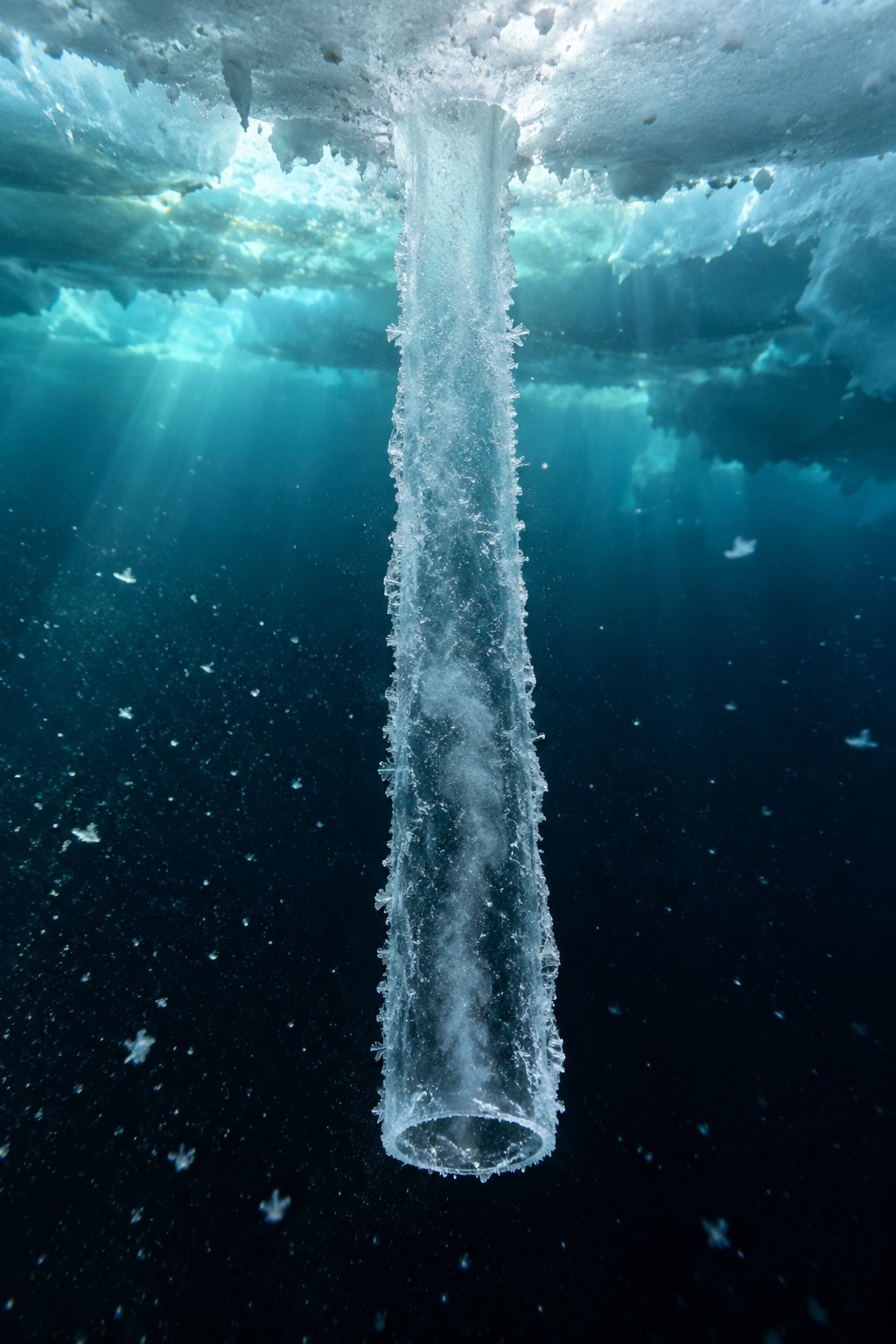
In February 1971, two scientists published five pages in the Journal of Geophysical Research that explained the brinicle ice finger of death four decades before a BBC camera crew made it famous. Paul Dayton and Seelye Martin had been diving beneath the sea ice of McMurdo Sound, Antarctica, and they kept finding the same strange object hanging from the ceiling: hollow tubes of ice, growing downward, the longest of them six metres from top to tip. They were not icicles. Nothing was dripping. Each tube was being built from the inside out by a thread of brine so cold and so salty that it had no business still being liquid.
Key Facts
- Paul Dayton and Seelye Martin first measured brinicles beneath McMurdo Sound sea ice, publishing in the Journal of Geophysical Research in 1971.
- Measured specimens ran 1.5 to 6.0 metres long and 10 to 25 centimetres across, with thin walls that broke when touched.
- Seawater freezes at about -1.9°C, but White Sea measurements in January 2014 recorded brine draining from sea ice at 120-156 practical salinity units versus 28 psu in the surrounding sea.
- Seelye Martin’s 1974 paper in the Journal of Fluid Mechanics modeled brinicle growth as a laminar-flow Graetz problem, showing length grows with the square root of elapsed time.
- The first time-lapse footage of a brinicle forming was shot by a BBC Frozen Planet crew near Little Razorback Island, Antarctica, in 2011, taking about five hours to reach the seafloor.
In short: Brinicles are hollow ice tubes formed when extremely cold, salty brine drains out of sea ice and freezes the surrounding seawater. First measured by Paul Dayton and Seelye Martin in 1971, modeled mathematically by Martin in 1974, and filmed forming for the first time by a BBC Frozen Planet crew in 2011 near Little Razorback Island, Antarctica.
McMurdo Sound, the 1960s: a tube of ice that grows the wrong way
Dayton and Martin measured what they found rather than marvelling at it, which is why the 1971 paper still carries the load half a century later. Their tubes ran 1.5 to 6.0 metres long and 10 to 25 centimetres across (the title calls them “ice stalactites” — the word brinicle arrived much later, from television). Walls were thin. Several specimens broke when touched.
Dayton, a marine ecologist at Scripps Institution of Oceanography, was in McMurdo for the seafloor animals. Martin, an oceanographer, was there for the ice. That pairing matters, because the two of them immediately asked a question the pretty pictures never ask: where does all the salt go when the Antarctic freezes over?
Sea ice is not frozen seawater. As water molecules lock into a crystal lattice, they reject dissolved salt, and the rejected salt collects in a shrinking network of channels inside the young ice. Drop by drop, that concentrated brine drains downward through the floe and out of its underside. The 1971 paper proposed that brinicles are one of the visible plumbing fixtures of that drainage — a mechanism in the natural desalination of sea ice, not a curiosity bolted onto it.
1974: Seelye Martin works out the plumbing
Three years later Martin published the theory, in the Journal of Fluid Mechanics, and it is still the equation everyone tests against. He treated the descending brine as laminar flow down a cold pipe — formally, a Graetz problem, the classic heat-transfer case of fluid cooling as it travels through a tube.
The result explains the shape. Brine leaving the ice is denser than the seawater below, so it sinks as a coherent plume rather than mixing away. It is also far below the freezing point of ordinary seawater, so the ocean it touches freezes around it. Freeze a skin, and the plume is now insulated; insulated, it stays cold further down; staying cold, it extends the skin. The tube builds its own delivery pipe as it falls.
Martin’s model also predicts the braking. Length grows with the square root of elapsed time — fast at first, then slower and slower, because every added centimetre of wall drains a little more heat from the plume before it reaches the open tip. A brinicle does not accelerate toward the seabed. It decelerates toward it.
{IMAGE_2}
What the ocean has to agree to first
Seawater at full ocean salinity freezes at about −1.9 °C. Brine squeezed out of cold sea ice can stay liquid tens of degrees below that, and the gap between those two numbers is the entire engine. Field measurements on the coast of Russia’s White Sea in January 2014 put the arithmetic on paper: with air at −1 °C, brine draining from the ice measured 30–35 practical salinity units against 28 in the surrounding sea. When the air dropped to −12 °C, brine salinity rose to between 120 and 156 psu.
Four and a half times saltier than the ocean. That is what is running down the inside of the tube.
So why are brinicles so rare on film if sea ice forms across millions of square kilometres every winter? Because the engine is fussy. The brine supply overhead has to be steady; the water below has to be much fresher than the plume; the floe must sit still rather than flex and shear; currents have to be close to nothing, or the plume bends and the fragile wall snaps. Shallow water helps, because a plume has only so much cold to spend. Get all of that at once, in daylight, with a diver present — that is the rare part, not the physics.
2011: five hours on a time-lapse camera
Nobody had filmed one forming until a BBC team working on Frozen Planet set up time-lapse gear under the ice near Little Razorback Island, in Antarctica’s Ross Archipelago. Producer Kathryn Jeffs and cameramen Hugh Miller and Doug Anderson got the sequence that has since been watched tens of millions of times. The shoot was not elegant: the seabed was awkward to work on and curious seals kept nudging the camera out of frame.
It took about five hours.
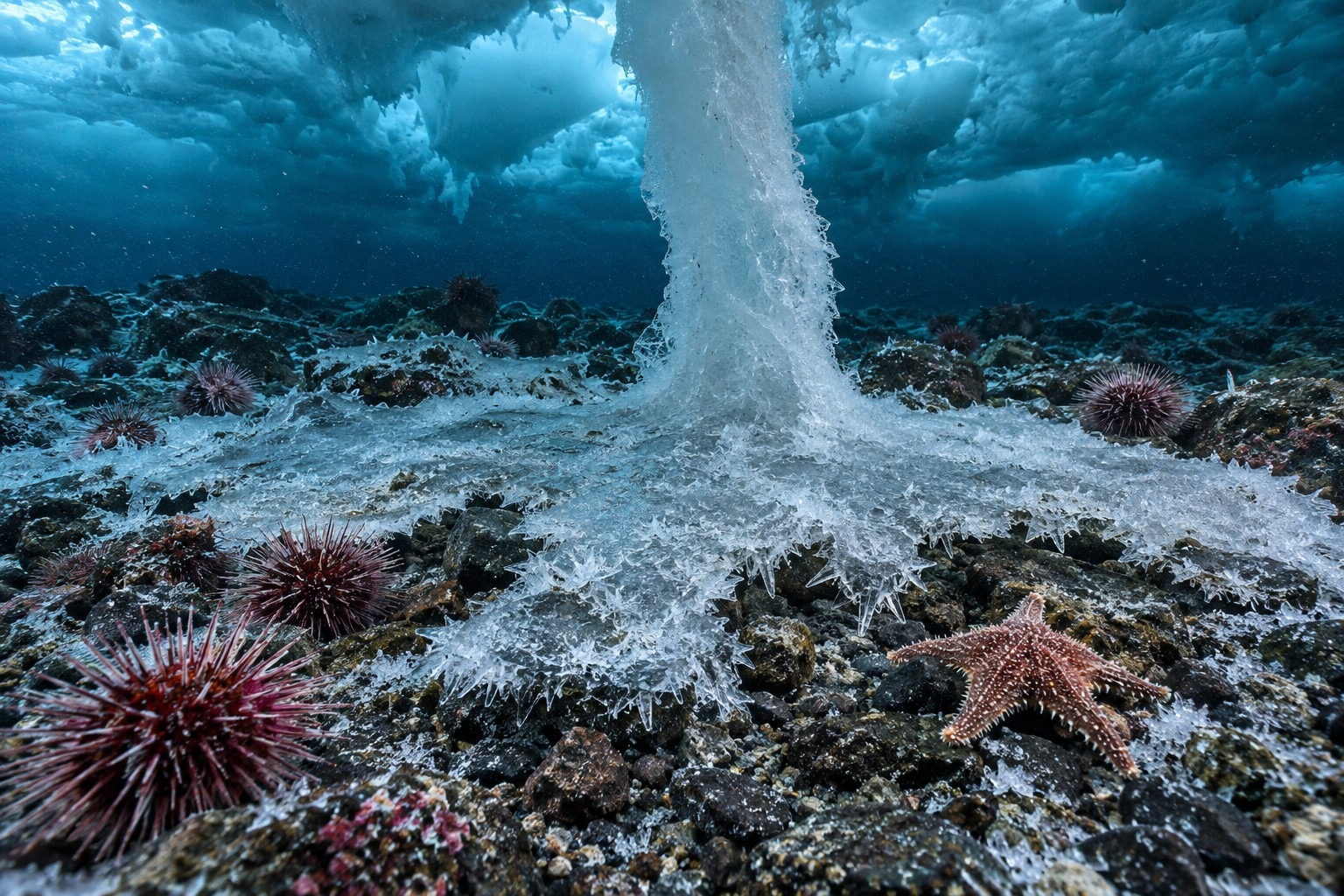
Miller said afterwards that nobody had really known how fast they formed. The footage settled it, and it also delivered the images that made the phenomenon famous — the tube reaching the bottom, then a sheet of ice spreading sideways across the seafloor, overtaking sea urchins and a starfish and locking them in place. The narration called it a finger of death. The name stuck harder than any of the measurements.
- 1960s — Divers under McMurdo Sound sea ice report hanging tubes of ice.
- 1971 — Dayton & Martin publish measurements: 1.5–6.0 m long, 10–25 cm wide.
- 1974 — Martin’s laminar-flow theory: length grows as the square root of time.
- 2011 — First time-lapse film, Little Razorback Island; seabed reached in ~5 hours.
- 2013 — Brinicles reclassified as an “inverse chemical garden”.
- 2019 — Proposed as self-assembling osmotic membranes on icy ocean worlds.
- 2023 — First numerical simulation reproduces the hollow channel.
- 2024 — Lab-grown brinicles confirm the 1974 square-root growth law.
So is the brinicle ice finger of death really a killer?
Partly — and far less than the clip implies. A brinicle is a thin-walled, hollow, fragile structure a few tens of centimetres wide that creeps downward at a decelerating rate over hours. Anything that can swim, crawl or roll has time to leave. The animals caught in the Frozen Planet sequence are slow-moving echinoderms on a patch of seabed directly beneath a working plume, which is a narrow definition of doom.
Here’s the thing the famous footage leaves out: Antarctic shallows already have a far more effective ice killer, and it has been documented for longer. Anchor ice — ice crystals that nucleate directly on the seabed and on the animals living there in supercooled water — buoyantly rips loose and floats upward, carrying whatever it has grown onto. Dayton and colleagues mapped the consequences in McMurdo Sound as a vertical zonation of life. The shallowest band, roughly 0–15 metres, is effectively stripped of attached organisms by this annual disturbance. From about 15 to 33 metres, anchor ice still forms and has been recorded lifting objects weighing as much as 25 kilograms off the bottom. Below roughly 33 metres it does not form at all, and the sponge gardens begin.
The documentary framing earned the phenomenon its audience, but it credited the wrong agent: at the scale of a McMurdo seafloor, anchor ice does the real damage and the brinicle is its photogenic minor cousin.
Which leaves a more honest version of the headline. The brinicle does not hunt, does not flash-freeze an ecosystem, and cannot chase anything. What it does is deliver a few hours of lethal cold to a few square metres of seabed — a local, slow, geometrically precise event that happens to be one of the strangest-looking things on this planet.
2023 and 2024: the brinicle moves into the tank
Two laboratories have recently done what Antarctic fieldwork cannot: run the experiment again and again. In October 2023, a team led by Felipe Gómez-Lozada at the Universidad Nacional de Colombia, with Boyan Lazarov of Lawrence Livermore National Laboratory, published the first numerical simulation that grows a brinicle from the governing equations of coupled heat and salt transport. Their model produced hollow ice channels and dendritic fringes that look like the real thing — and it worked best at the gentler end of the range they tested, with brine at −16 to −18 °C and inflow around 100–200 cubic millimetres per second. The authors are candid that their two-dimensional setup forces artefacts at the boundaries, and that a fully three-dimensional model is the next step.
Then in 2024, in the journal The Cryosphere, Sergio Testón-Martínez and colleagues at CSIC–Universidad de Granada, working with Laura Barge of NASA’s Jet Propulsion Laboratory, grew real brinicles in cold rooms by injecting 25 % salt brine at roughly −18 to −20 °C into a seawater analogue near 0 °C. Thin two-dimensional cells failed — they made solid ice, not tubes. Wider cells and a simple three-litre beaker produced centimetres-to-tens-of-centimetres tubes within minutes.
Two findings stand out. Growth followed the square root of time, which is a direct experimental vindication of Martin’s 1974 theory. And the ice crystals in the lab walls aligned perpendicular to the flow — the same orientation found in natural Antarctic specimens, meaning a tube grown in a beaker in Granada is built the same way as one hanging under the Ross Sea. The team also reported odd oscillations in growth rate that nobody has yet explained.
Why a tube of ice interests people who study the origin of life
In 2013, Julyan Cartwright’s group at CSIC–Universidad de Granada argued that a brinicle is not really a stalactite at all but a chemical garden turned inside out. Chemical gardens are the mineral tubes that sprout when a salt crystal meets a solution it can react with, building a self-organising membrane between two fluids of different composition. A brinicle does the same trick with ice instead of mineral, and with the aggressive fluid inside rather than outside.
That reframing has consequences. A semipermeable ice wall separating two solutions of different salinity is, physically, an osmotic device: water can be pulled across it, which means the structure can be driven by an osmotic pump rather than only by gravity. In 2019, Steven Vance and Laura Barge of NASA’s Jet Propulsion Laboratory, Silvana Cardoso of the University of Cambridge and Cartwright took that idea to Astrobiology, describing brinicles as self-assembling ice membranes and asking whether similar structures could grow in the ice shells of Europa and Enceladus — where a membrane holding a chemical and electrical gradient is exactly the sort of thing prebiotic chemistry is thought to need.
Whether anything of the kind exists on another world is, at present, unknown and untested. No spacecraft has looked. What is established is narrower and still remarkable: freezing seawater on Earth spontaneously assembles hollow, osmotically active ice tubes, and it does so by physics so ordinary that a graduate student can grow one in a beaker.
Quick Answers
How long does a brinicle take to reach the seafloor? The only one ever filmed forming took about five hours to touch down in shallow water near Little Razorback Island in 2011. Growth slows as it lengthens, so a longer brinicle takes disproportionately more time than a short one.
Can you touch a brinicle? Divers in McMurdo Sound found that several broke on contact — the walls are thin ice and the structure has no strength. The danger is not the tube; it is being a sessile animal on the patch of seabed beneath it.
Sources and Notes
- Dayton, P. K. & Martin, S., “Observations of ice stalactites in McMurdo Sound, Antarctica”, Journal of Geophysical Research, 1971
- Martin, S., “Ice stalactites: comparison of a laminar flow theory with experiment”, Journal of Fluid Mechanics, 1974
- Testón-Martínez, S. et al., “Experimental modelling of the growth of tubular ice brinicles from brine flows under sea ice”, The Cryosphere, 2024
- Gómez-Lozada, F. et al., “Modelling and simulation of brinicle formation”, Royal Society Open Science, 2023
- Vance, S. D., Barge, L. M., Cardoso, S. S. S. & Cartwright, J. H. E., “Self-Assembling Ice Membranes on Europa”, Astrobiology, 2019
- BBC Frozen Planet (2011) production accounts, and Dayton and colleagues’ published work on anchor-ice zonation in McMurdo Sound
Six decades of work on brinicles has turned a diver’s anecdote into an equation, a simulation and a beaker experiment — and made the thing stranger, not tamer. A freezing ocean builds its own drainpipes, out of itself, downward, and in doing so may be rehearsing the oldest trick in chemistry: putting a wall between two liquids and letting the difference do the work. The footage is worth watching. The 1971 measurements are worth remembering.
Frequently Asked Questions
Q: What is a brinicle, and why is it called the “ice finger of death”?
A brinicle is a hollow tube of ice that grows downward from sea ice as extremely cold, salty brine drains out and freezes the seawater around it. The name “ice finger of death” came from a 2011 BBC Frozen Planet narration, after time-lapse footage showed the tube reaching the seafloor and spreading ice across it, trapping slow-moving animals like sea urchins and a starfish in place.
Q: Who first discovered and measured brinicles?
Marine ecologist Paul Dayton and oceanographer Seelye Martin documented brinicles beneath the sea ice of McMurdo Sound, Antarctica, publishing measurements in the Journal of Geophysical Research in 1971. Their specimens ranged 1.5 to 6.0 metres long and 10 to 25 centimetres wide, with thin, fragile walls that broke when touched. Dayton studied seafloor animals while Martin studied ice, and together they linked the tubes to how sea ice expels salt.
Q: Why does the brine stay liquid at such low temperatures, and how does that build the ice tube?
As seawater freezes into sea ice, it rejects dissolved salt, concentrating it into brine channels far colder than seawater’s normal freezing point of about -1.9°C. White Sea measurements recorded brine salinity reaching 120-156 practical salinity units, far saltier than the surrounding ocean. When this dense brine sinks as a plume, it freezes a skin of ice around itself, which insulates it and lets the tube keep extending downward.
Q: How fast do brinicles grow, and how was the process finally filmed?
Seelye Martin’s 1974 theory showed brinicle length grows with the square root of elapsed time, meaning growth is fast at first and slows as the tube’s walls thicken and insulate the descending brine. Nobody filmed the process until a BBC Frozen Planet team set up time-lapse cameras near Little Razorback Island, Antarctica, in 2011, capturing a brinicle reaching the seafloor in about five hours.
Illustrations are AI-generated. Article fact-checked and human-edited. Our editorial standards.