Can Goldfish See Ultraviolet and Infrared Light?
Can goldfish see ultraviolet and infrared light? The short version, before anything else: yes to ultraviolet — real, measured, and genuinely alien — and no to the heat-sensing “infrared” of aquarium legend. That single split is where almost every article on the internet trips. Goldfish carry a fourth color cone, tuned to ultraviolet, that opens a band of the spectrum your eyes will never register. The “infrared” part is a tangle of half-truth and copy-paste, and it’s worth untangling carefully, because the real story is stranger than the myth.
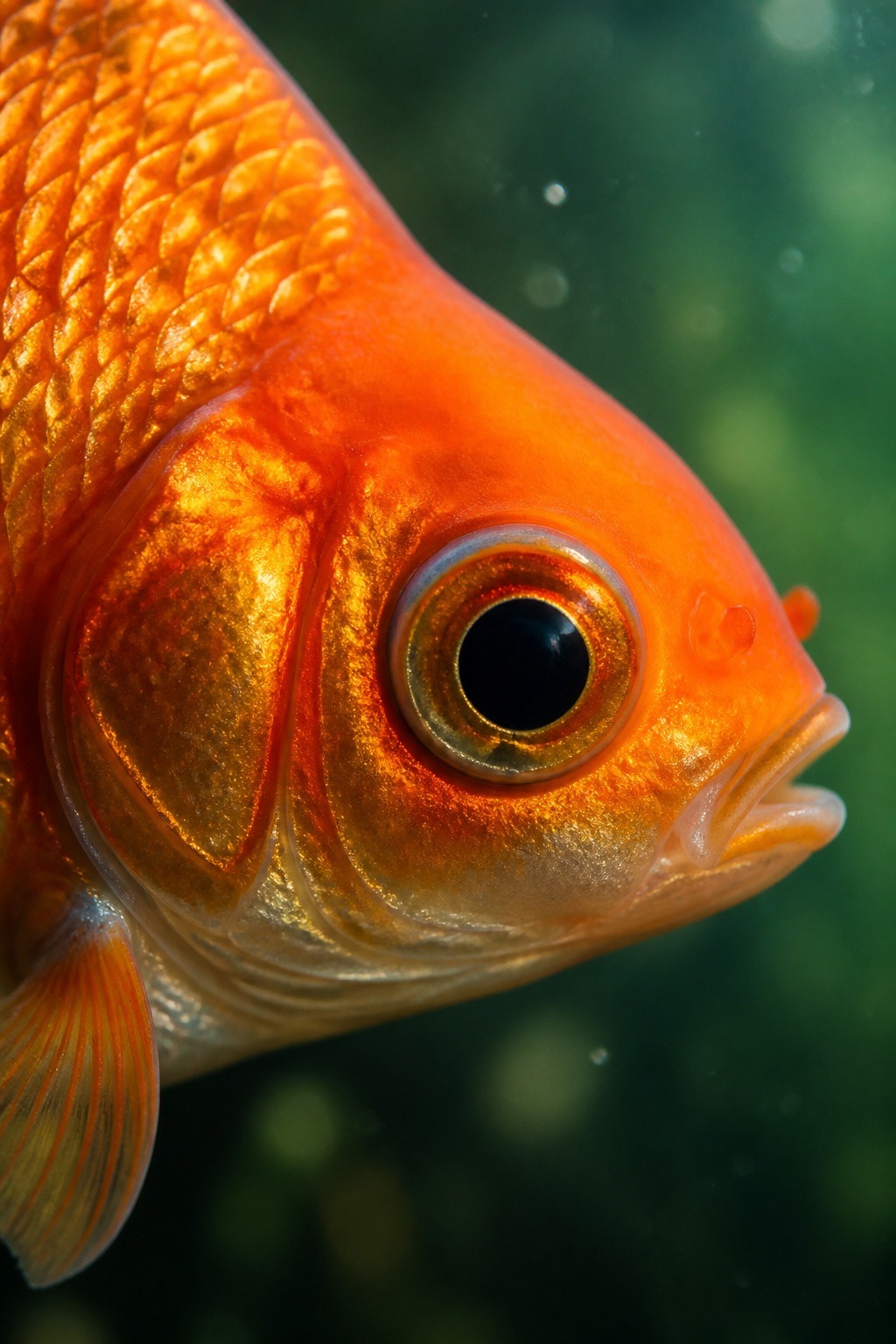
- Four cone types (a tetrachromat) with peak sensitivities near 356 nm (UV), 447 nm (blue), 537 nm (green), and 623 nm (red) — measured directly from goldfish retinas.
- Ultraviolet: yes. Behaviorally proven, not just anatomically guessed.
- Thermal (“heat camera”) infrared: no. No fish eye does this. It’s a physical impossibility for a lens-and-cone eye.
- Near-infrared (~860 nm, just past red): faint and fringe. Strong in carp and Nile tilapia (865 nm); goldfish show only a weak response.
- Polarized light: likely yes — a separate channel tied to the UV cones, layered on top of color.
Key Facts
- Goldfish (Carassius auratus) are tetrachromats with four cone types peaking near 356 nm (UV), 447 nm (blue), 537 nm (green) and 623 nm (red).
- Goldfish can see ultraviolet light, confirmed by direct cone recordings and behaviour.
- Goldfish cannot see thermal (heat-camera) infrared at 8,000-14,000 nm — no vertebrate eye can.
- A 2005 Fisheries Science study found common carp and Nile tilapia are sensitive to near-infrared around 865 nm; goldfish show only a weak response near 860 nm.
- UV sensitivity in goldfish is strongest in juveniles and can fade as the fish matures.
In short: Goldfish can see ultraviolet light — they carry a fourth, UV-tuned cone near 356 nm, making them tetrachromats with a colour dimension humans lack. They cannot see thermal infrared, which no vertebrate eye detects; the infrared-goldfish myth comes from carp’s faint near-infrared sensitivity around 865 nm. UV helps young goldfish spot tiny prey.
Can goldfish really see ultraviolet and infrared light?
Let’s answer it flat out, because you came here for a verdict. Ultraviolet: confirmed. Goldfish (Carassius auratus) have a cone class that peaks around 356 nanometres — deep in the ultraviolet, well past the violet edge where human color vision quits at roughly 400 nm. That cone isn’t a rumor. Physiologists have recorded its electrical response directly from isolated goldfish cones.
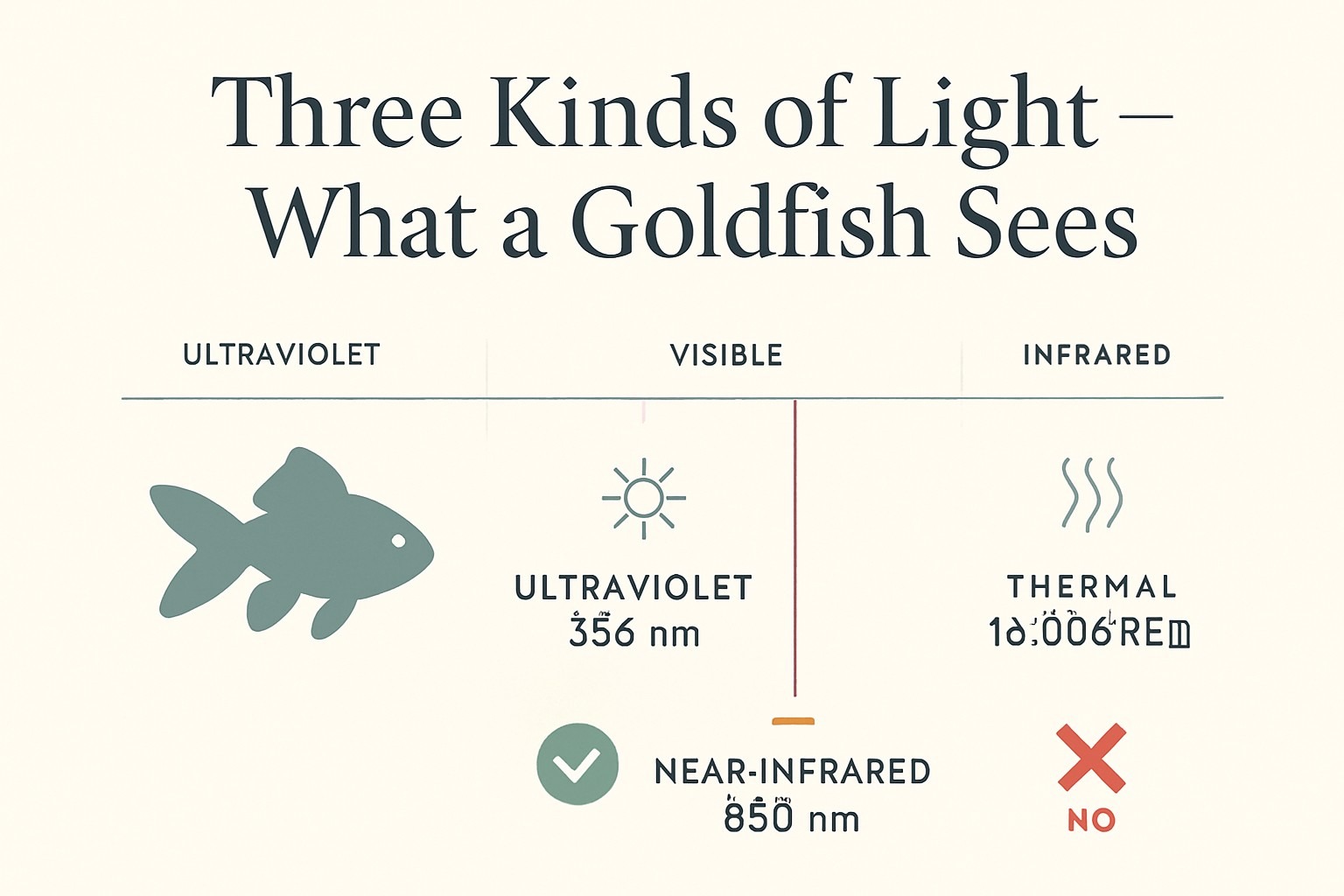
Infrared is where the trouble starts. There are two completely different things people mean by “infrared,” and mashing them together is how the myth spreads. True thermal infrared — the long-wave heat glow a snake’s pit organ or a night-vision camera picks up, out around 8,000 to 14,000 nm — is invisible to every known vertebrate eye. Goldfish included. Full stop.
Then there’s near-infrared, the sliver just beyond visible red (roughly 750–950 nm). That’s a real, if faint, story in some cyprinids. And it’s the reason a kernel of truth got inflated into a heat-vision fairy tale. Here’s the whole claim in one table.
| Light band | Wavelength | Goldfish verdict | Evidence |
|---|---|---|---|
| Ultraviolet | ~356 nm | Yes — true color vision | Cone recordings + behavior (Neumeyer, Mainz) |
| Near-infrared | ~860 nm | Faint response only | Weak optomotor response; strong in carp/tilapia |
| Thermal infrared | 8,000–14,000 nm | No — heat vision is a myth | No vertebrate eye detects this |
Four cones, one color you will never picture
You are a trichromat. Three cone types — red, green, blue — and every shade you have ever seen is a mix of those three. Painters, screens, printers: all of it lives inside that three-way system. Think of your color world as a triangle, with red, green, and blue at the corners. Everything you can see falls somewhere inside it.
A goldfish adds a fourth corner. The UV cone doesn’t just extend the range a little further into the blue-violet — it adds a whole new axis. Geometrically, the flat triangle of human color becomes a solid, a tetrahedron. And that extra dimension holds combinations that have no name and no human equivalent, because there is nothing in your head to compare them to.
{IMAGE_2}
This is the part that breaks people’s brains, and rightly so. We can describe “ultraviolet” as a wavelength on a chart. What we cannot do is imagine the color, any more than a person born without a green cone can conjure green from a definition. A goldfish sees mixtures — UV blended with green, UV blended with red — that are, to us, genuinely unpicturable. Not brighter. Not more saturated. Categorically new.
The ultraviolet world a goldfish sees (and why it helps them eat)
Why grow an expensive fourth cone at all? Food, mostly. Freshwater is full of scattered ultraviolet light near the surface, and many of the things a goldfish wants to eat — tiny crustaceans, zooplankton, algae — either absorb UV or reflect it in ways that make them pop against the background. A translucent water flea that’s nearly invisible in ordinary light can throw a sharp silhouette under UV.
Turn on the UV channel and the water stops being a soft green blur. Prey gains contrast. Edges sharpen. For a small omnivore hunting specks in murky water, that’s the difference between a full gut and an empty one.
There’s a twist that almost nobody writes about. UV sensitivity in goldfish isn’t fixed for life. Studies comparing juvenile and adult goldfish retinas found that UV sensitivity is strongest in young fish and can fade as they mature — a life-stage adaptation. Larvae and juveniles live or die by spotting minuscule plankton, so they lean hard on the UV cone; adults shift diet and, in some cases, the UV channel quietly dials down. The eye rebuilds itself around what the fish needs to find.
So where did the “infrared goldfish” myth come from?
Here’s the honest bit. The infrared claim isn’t pure invention — it’s a real finding about the wrong fish, stretched into a phrase it can’t support.
Goldfish descend from Asian carp, and carp live in a different optical world: turbid, muddy, eutrophic water where suspended particles soak up the short wavelengths and leave the long, reddish and near-infrared end of the spectrum relatively abundant. A 2005 study in Fisheries Science by Japanese researchers showed that the common carp and Nile tilapia are genuinely sensitive to near-infrared light around 865 nm — with hints that carp may register even longer wavelengths near 936 nm. In murky water where red light survives best, a nudge of near-infrared sensitivity is a real survival edge.
Goldfish inherited a whisper of it. At least one optomotor study found goldfish responding weakly around 860 nm — a faint tug at the very edge of red, not a functioning color sense, and nowhere near the thermal band. So when a blog says “goldfish see infrared,” the least-wrong version is: a distant cousin sees near-infrared well, and goldfish carry a faded trace of it. What no goldfish does is see heat — the pop-science image of a fish reading the warm glow of your hand through the tank is simply wrong. If you ask me, the real scandal isn’t that people believe goldfish see infrared; it’s that the truth — a fourth ultraviolet dimension of color — is stranger and more beautiful, and almost nobody bothered to tell them.
Polarized light: the third hidden channel
Ultraviolet color is layer one. Polarization may be layer two.
Light waves vibrate, and when they scatter off water molecules or bounce off a silvery fish scale, those vibrations can line up in a preferred direction — they become polarized. Your eyes are blind to it (which is why sunglasses have to do the filtering for you). Many fish are not. Polarization sensitivity in fish is tied closely to the ultraviolet cone system, and researchers including Craig Hawryshyn, who spent a career studying polarization vision in fish, linked this sense in cyprinids like goldfish to their UV photoreceptors.
What’s it good for? Contrast, again. A transparent prey animal that’s nearly invisible by brightness alone can still disturb the polarization pattern of the water around it. Work by vision scientist Iñigo Novales Flamarique on polarization-sensitive fish has shown that reading polarized light can roughly double the distance at which a predator like an anchovy detects transparent prey. Whether a bowl goldfish uses its polarization channel as dramatically is less certain — and it’s fair to say the goldfish-specific evidence is thinner than for UV. But the machinery is there, riding on the same UV cones.
How we actually know: Neumeyer’s color-mixture experiments at Mainz
Plenty of animals have “extra” cones on paper that they don’t actually use for color. Anatomy alone proves nothing. So how do we know goldfish truly see in four dimensions rather than just carrying a spare receptor?
Behavior. In a series of experiments at the University of Mainz, sensory biologist Christa Neumeyer trained goldfish to discriminate colors, then tested them with additive color mixtures — the visual equivalent of asking, “how many primary lights do you need to match any color you can see?” For a trichromat like us, the answer is three. Neumeyer’s goldfish needed four. Her 1992 paper in the Journal of Comparative Physiology A reported results that could only be explained by four functioning cone types — the behavioral proof of tetrachromacy, not just the anatomical hint.
There’s an elegant footnote. Earlier work found that under bright white light, goldfish color vision collapses from four dimensions back to three — the UV channel effectively drops out when the eye is flooded. Tetrachromacy, it turns out, is a low-and-moderate-light superpower, strongest in exactly the dim, scattered-light conditions where a goldfish actually forages.
Why a goldfish in a bowl sees more colors than you ever will
Sit with the arithmetic for a second. Four cones against your three. A color space that’s a solid where yours is a plane. A UV band you can’t picture, plus a polarization channel you can’t access, plus that ghost-trace of near-infrared at the edge of red. The much-mocked “three-second memory” fish is, in the one department that counts here, running richer visual hardware than the person watching it.
Goldfish are not alone in this. Ultraviolet vision is common across the animal world — many birds, from tiny songbirds to raptors, carry a UV cone and use it to read plumage and track prey. If you want to see how far a UV-tuned eye can be pushed in a hunter, the golden eagle’s ultraviolet vision is a spectacular companion case. We are, in fact, the odd ones out — mammals lost most of their color range during a long nocturnal chapter of our evolution and never fully rebuilt it.
The practical takeaway? Two things. First, kill the heat-vision myth wherever you meet it — your goldfish cannot feel your warmth through glass, and telling the truth here costs nothing and respects the animal. Second, a goldfish in a bright, bare, all-white bowl is living in a washed-out version of its own senses; a planted tank with softer, natural light lets that ultraviolet-tuned, low-light eye do what it evolved to do. The next time you look into a fishbowl, remember: it’s looking back with an eye that sees a color you will never, ever get to name.
Frequently Asked Questions
Do goldfish see more colors than humans? Yes. Goldfish are tetrachromats with four cone types (UV, blue, green, red) versus our three, so their color space includes ultraviolet-based combinations we can’t perceive or even imagine.
Can a goldfish see infrared like a heat camera? No. Thermal (“heat”) infrared is invisible to all vertebrate eyes. Goldfish show only a faint response to near-infrared (~860 nm), a wavelength right next to visible red — not heat, and not color vision.
Why can goldfish see UV when we can’t? They kept a fourth, ultraviolet-tuned cone that most mammals lost. It helps them spot UV-reflecting or UV-absorbing plankton and prey in scattered underwater light.
Do goldfish keep UV vision their whole lives? Not always. UV sensitivity is strongest in juveniles and can fade in some adults — a life-stage adaptation as diet and habitat change.
Sources and Notes
- Christa Neumeyer, University of Mainz — “Tetrachromatic colour vision in goldfish: evidence from colour mixture experiments,” Journal of Comparative Physiology A (1992); and related work showing tetrachromacy reverting to trichromacy under bright white adaptation (Vision Research).
- Spectral sensitivity recordings of goldfish (Carassius auratus) cones (~356, 447, 537, 623 nm), and electroretinographic studies of UV sensitivity in juvenile vs adult goldfish retinas.
- Matsumoto & Kawamura, “The eyes of the common carp and Nile tilapia are sensitive to near-infrared,” Fisheries Science (2005) — near-infrared sensitivity at ~865 nm.
- BrainFacts.org (Society for Neuroscience), “Beyond the Rainbow: The Incredible Visual World of Fishes” (2022).
- Research on polarization vision in fish by Craig Hawryshyn and Iñigo Novales Flamarique, linking polarization sensitivity to the ultraviolet cone system.
Goldfish don’t read your body heat and they never did — but they do carry a fourth color cone, a low-light ultraviolet channel, and a polarization sense that together paint a world you’ll spend your whole life unable to picture. The myth was small. The truth is enormous.
Illustrations are AI-generated. Article fact-checked and human-edited. Our editorial standards.