Cuckoo Finch vs Tawny-Flanked Prinia: A 3-Second Con
Everything about the cuckoo finch–tawny-flanked prinia relationship is a forgery, and it begins with a crime that lasts about three seconds. A small drab bird drops out of the Zambian sky, folds herself into a woven grass nest the size of a fist, lays a single egg among a stranger’s clutch, and is gone before the owner returns. No struggle, no theft of an existing egg — just a swap so fast the human eye would miss it. What she leaves behind is a counterfeit, painted to match eggs she has never seen, in a con that has been refined over an almost unimaginable stretch of evolutionary time.
Key Facts
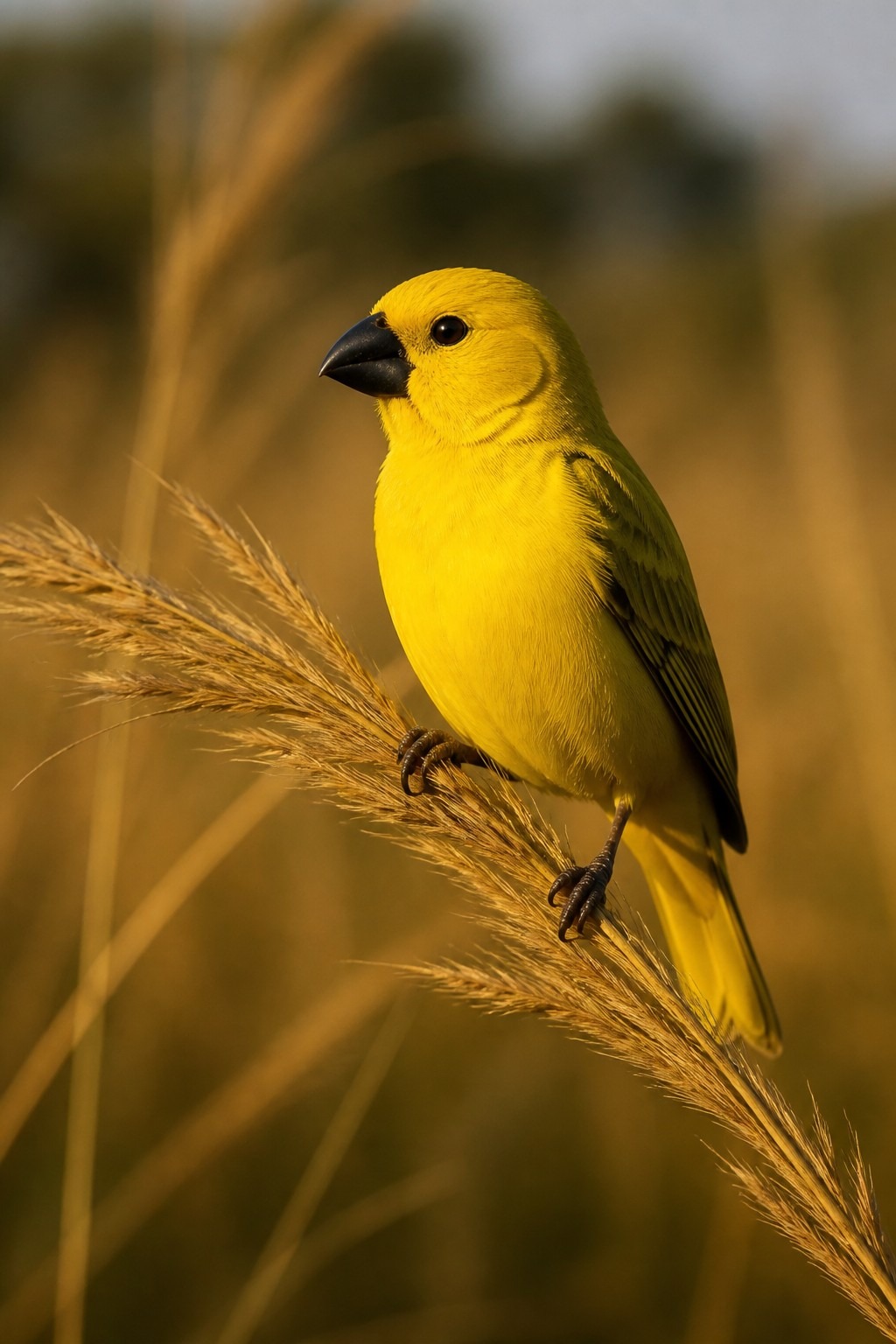
- The cuckoo finch (Anomalospiza imberbis) is not a true cuckoo but a member of the weaver family, and a brood parasite.
- A cuckoo finch can lay an egg in a host nest in about three seconds, versus around 20 minutes for a typical songbird.
- Its main host is the tawny-flanked prinia (Prinia subflava), an African warbler.
- A 2013 Nature Communications study found prinias rejected a good-mimic egg about 64% of the time when their own eggs outnumbered fakes 3-to-1, dropping to about 9% when fakes outnumbered them 2-to-1.
- Tawny-flanked prinias lay highly varied, individually signatured eggs as an anti-counterfeiting defence.
In short: The cuckoo finch is a weaver-family brood parasite, not a true cuckoo, that lays a mimic egg in a tawny-flanked prinia’s nest in about three seconds. A 2013 study showed the finch beats the prinia’s careful egg-rejection not by better forgery but by laying two eggs, flooding the clutch so the mother’s rejection rate collapses from 64% to 9%.
The finch that borrowed the cuckoo’s name — and its crime
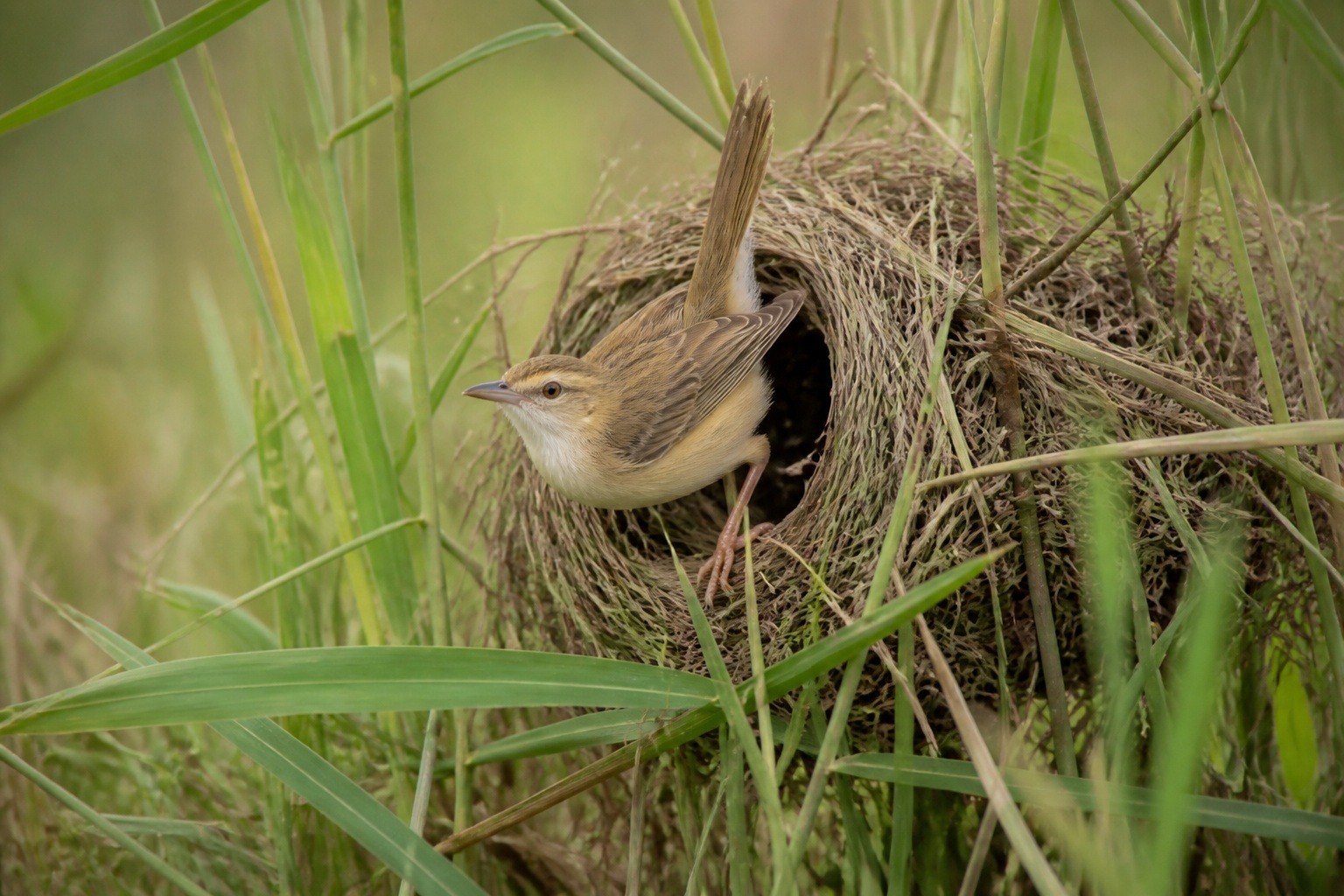
Here’s the first surprise: the cuckoo finch is not a cuckoo. Its scientific name is Anomalospiza imberbis, and it sits in the weaver family, closer kin to the little seed-eaters flocking through African grass than to the grey, hawk-like cuckoos of Europe. It simply arrived, independently, at the same dark idea — let another bird raise your young — and got very, very good at it. Biologists call the strategy brood parasitism, and only a handful of bird lineages have ever committed to it fully.
Its preferred victim across the grasslands of Africa is the tawny-flanked prinia, Prinia subflava — a slender, warbler-like bird with a long tail it flicks upward like a metronome. The finch lays in other warblers too, several cisticolas among them, but the prinia is the one researchers return to, because this particular pairing has become one of the most revealing evolutionary duels on the planet.
The comparison with the true cuckoo everyone knows is worth drawing out, because the two parasites solve the same problem in strikingly different ways.
| Trait | Cuckoo finch (Anomalospiza imberbis) | Common cuckoo (Cuculus canorus) |
|---|---|---|
| Family | A weaver relative (Ploceidae) | A true cuckoo (Cuculidae) |
| Eggs per host nest | Often more than one — the “overload” trick | Usually one |
| What the chick does | Hatches early, out-begs the host chicks until they starve | Hatches early, then heaves host eggs and chicks out of the nest |
| Main host here | Tawny-flanked prinia and other African warblers | Reed warblers, dunnocks, pipits and more |
Three seconds flat: the fastest swap in the nest
A typical songbird spends around twenty minutes laying an egg, settled and vulnerable. A cuckoo finch cannot afford twenty seconds. “They swoop into the nest and they squeeze out an egg in three seconds flat,” is how Rosalyn Gloag, an evolutionary biologist at the University of Sydney, describes the parasite’s smash-and-grab in a 2024 survey of brood parasites for Knowable Magazine. It is among the fastest egg-laying known in any bird.
Three seconds. Then gone.
Speed is not showing off — it is survival. Every extra moment at the nest is a moment the prinia parents might return, spot the intruder, and either attack her or, worse for the finch, grow suspicious enough to inspect their clutch afterwards. By treating the nest like a bank robbery rather than a nesting attempt, the finch keeps the hosts calm and their guard down. The egg she deposits is the real weapon, and it needs the owners to stay relaxed.
{IMAGE_2}
The two-egg swindle that blinds a careful mother
The prinia is not a passive victim. She studies her own eggs, holds an internal “template” of what they should look like, and throws out anything that clashes. So the finch faces a hard problem: she paints only one pattern her entire life — inherited, unchangeable — and she has to gamble that she lands in a nest whose owner happens to lay something similar. Get it wrong and the egg goes over the side.
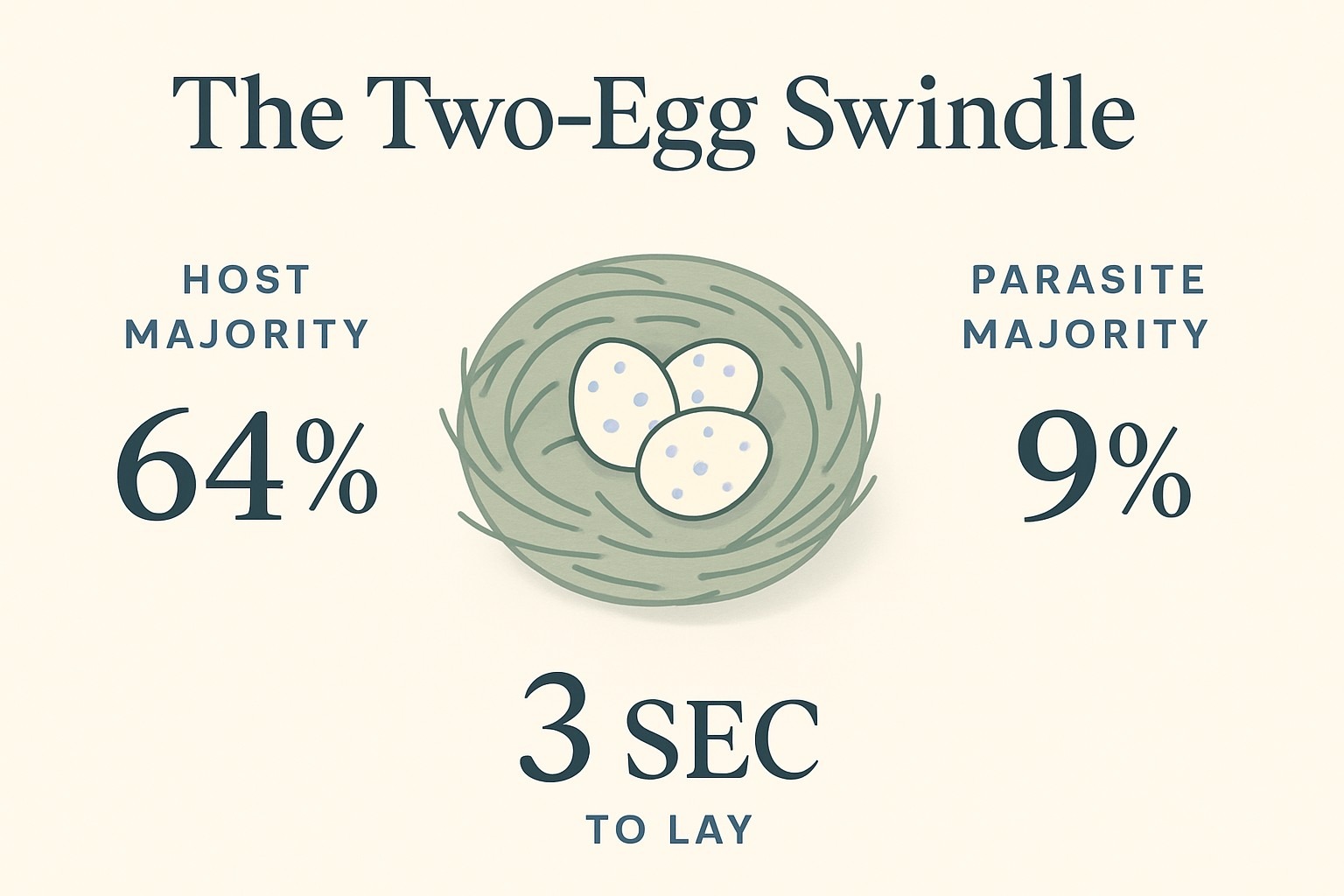
So why doesn’t the prinia simply bin anything that looks slightly off? Because the finch has learned to turn the mother’s own caution against her. In a 2013 study in Nature Communications, Martin Stevens, Jolyon Troscianko and Claire Spottiswoode showed what happens when a female finch lays not one but two eggs in the same prinia nest. The extra fake tips the numbers. When a prinia’s own eggs still outnumbered the impostors three to one, she rejected a good-mimic egg roughly 64% of the time. But when the finch’s eggs outnumbered hers two to one, that rejection rate collapsed to about 9%.
- ~64% — chance a prinia rejects a near-perfect fake when her own eggs outnumber it 3 to 1
- ~9% — that same rejection chance once the finch’s eggs outnumber hers 2 to 1
- 31 of 48 — experimental clutches in which prinias rejected a foreign egg overall
- ~3 sec vs ~20 min — a cuckoo finch’s laying time against a typical songbird’s
The logic is quietly brutal. Faced with a majority of matching eggs, the mother second-guesses herself — reject too readily and she risks tossing her own young. The finch exploits exactly that doubt. This is the single most under-told fact about the species, and it flips the usual story: the parasite wins not by better forgery but by flooding the market with just-good-enough fakes.
Banknote eggs: how the prinia forges her own signature
The host’s counter-move is beautiful. Tawny-flanked prinias lay one of the most varied ranges of egg colours and patterns of any bird on Earth — clutches in reds, blues, olives and whites, streaked and scrawled with dark squiggles that differ from female to female. Each mother’s eggs carry a consistent, individual “signature,” and researchers describe them almost exactly the way a treasury describes currency: a colour, a watermark, a set of marks that are hard to counterfeit and easy to authenticate.
That is the point. If every prinia laid the same plain egg, the finch would only need one perfect fake. By making each female’s clutch a private, near-unique design — an anti-counterfeiting stamp — the prinia forces the parasite to match a moving target it can never see in advance. An egg, it turns out, is one of evolution’s most fought-over canvases; the same pressures that shape a prinia’s signatures also sculpt the strange, specific eggs of birds as different as the hummingbird and its coffee-bean-sized clutch. Colour and pattern are never just decoration.
The gene passed only from mother to daughter
For decades one puzzle nagged at biologists. A female finch inherits half her genes from a father — and that father was raised in some other host’s nest, carrying “recipes” for the wrong pattern. Mix the two and every daughter should end up with a muddled, mismatched forgery. Yet the mimicry stays crisp. How?
The answer arrived in 2022, and it is a genuine breakthrough. An international team led by Claire Spottiswoode, of the University of Cambridge and the FitzPatrick Institute at the University of Cape Town, working with Michael Sorenson of Boston University, showed that the egg-mimicry pattern is inherited down the female line only — carried on the W chromosome, the female-specific chromosome that mothers pass to daughters and fathers can never contribute. A daughter gets her forgery recipe from her mother, full stop. The father’s mismatched genes are locked out of the design.
She never learns a new pattern; she never needs to. And that is the elegant catch buried in the discovery: the same maternal inheritance that lets one finch lineage exploit many different hosts also chains each female to her mother’s single template, likely slowing the parasite’s ability to invent new disguises as hosts evolve fresh defences. The trick that made the cuckoo finch flexible across species makes each individual rigid.
A killer dressed as a harmless seed-eater
The deception does not stop at the egg. Look at an adult female cuckoo finch and she is oddly unremarkable — streaky, brownish, forgettable. That plainness is itself a disguise. In 2015, William Feeney, Jolyon Troscianko, Naomi Langmore and Claire Spottiswoode reported in Proceedings of the Royal Society B that the female finch closely resembles the southern red bishop, a common and completely harmless grassland seed-eater.
Scientists call this aggressive mimicry — a predator or parasite wearing the costume of something benign. When a prinia sees what looks like a bishop drifting past, it does not mob or panic; a seed-eater poses no threat to eggs. The finch buys herself calm, unguarded seconds near the nest by impersonating a bird nobody bothers to chase. It is a con inside a con: a forger who also forges her own identity.
Inside the cuckoo finch–tawny-flanked prinia arms race
Pull back, and the whole thing becomes an arms race with no finish line. Every improvement on one side is answered on the other. The finch refines her egg; the prinia diversifies her signatures. The prinia grows choosier; the finch floods the nest with extra fakes. The finch adopts a bishop’s disguise; the host stays wary of anything unfamiliar. Neither wins for long, and that is precisely why the standoff has persisted so long.
Much of what we know comes from a single, extraordinary field site around Choma, in southern Zambia, where Spottiswoode and colleagues have tracked this system across many seasons of painstaking work — measuring egg colours as birds themselves see them, and swapping eggs between nests to test who rejects what. If there is a villain in this story, it is not the finch; it is natural selection itself, which quietly rewards the better forger on either side and never once asks whether the game is fair.
Beyond birds, the pairing has become a living model for how deception, recognition and counter-deception evolve together — the same tug-of-war that plays out between immune systems and pathogens, or between mimics and the models they copy across the natural world. A prinia sorting her clutch is, in miniature, running one of biology’s oldest problems: how do you tell the real thing from a very good fake?
Frequently asked questions
How long does a cuckoo finch take to lay an egg?
About three seconds — one of the fastest egg-layings recorded in any bird, against roughly twenty minutes for a typical songbird. The speed keeps the host parents from catching her at the nest.
Who is the host of the cuckoo finch?
Chiefly the tawny-flanked prinia (Prinia subflava), a small warbler-like bird of African grasslands, along with several cisticola warblers. The prinia is the most studied host.
Why do prinias have so many egg colours?
It is a defence. By making each female’s clutch a near-unique “signature” of colour and squiggle-like markings, prinias force the parasite to match a target it cannot predict — much like anti-counterfeiting marks on a banknote.
Is the cuckoo finch actually a cuckoo?
No. It belongs to the weaver family (Anomalospiza imberbis) and only evolved the cuckoo-style habit independently. It shares the lifestyle, not the lineage.
Sources and notes
- Stevens M, Troscianko J & Spottiswoode CN, 2013. “Repeated targeting of the same hosts by a brood parasite compromises host egg rejection.” Nature Communications 4:2475 — Universities of Cambridge and Exeter; field site Choma, Zambia.
- Spottiswoode CN, Sorenson MD and colleagues, 2022. Maternal (W-chromosome) inheritance of egg mimicry in the cuckoo finch — University of Cambridge, the FitzPatrick Institute (University of Cape Town) and Boston University; reported via the University of Cambridge and ScienceDaily.
- Feeney WE, Troscianko J, Langmore NE & Spottiswoode CN, 2015. “Evidence for aggressive mimicry in an adult brood parasitic bird, and generalized defences in its host.” Proceedings of the Royal Society B.
- Rosalyn Gloag, University of Sydney, quoted in Knowable Magazine’s 2024 survey of brood parasites.
Strip away the drama and the cuckoo finch and the tawny-flanked prinia are really doing the same thing from opposite ends — one perfecting a forgery, the other perfecting the means to detect it — and neither will ever be finished. That unresolved tension, replayed in a fist-sized nest in a Zambian grassland, is as clear a window into how evolution actually works as you will find anywhere in nature.
Illustrations are AI-generated. Article fact-checked and human-edited. Our editorial standards.