Capuchin Monkeys Washing Fruit: A Glimpse of Culture
Capuchin monkeys washing fruit looks like a small thing. A monkey picks up a mango, carries it to the water’s edge, scrubs off the grit, then eats. Nobody taught it. It worked that out alone. And here’s the part that matters: not every monkey in the group bothers.
In the coastal forests of Brazil, researchers watching wild white-faced capuchins (Cebus capucinus) have logged this deliberate cleaning — not splashing, not play, but methodical removal of sand and dirt before a meal. The habit isn’t universal. Some monkeys do it; others eat the dirty fruit without a second thought. That gap is where the real story hides.
Key Facts
- Wild white-faced capuchins (Cebus capucinus) have been observed deliberately washing fruit to remove grit before eating.
- The behavior is selective — it appears in some individuals within a group but not others, a hallmark of learned rather than instinctive behavior.
- Capuchins are documented tool users, cracking nuts with stones, a skill that can take years to master.
- In controlled studies, capuchins have shown a sense of fairness, rejecting unequal rewards.
- The family Cebidae includes capuchins among the most studied New World monkeys for cognition and culture.
In short: Capuchin monkeys washing fruit is a learned, not instinctive, behavior. Because it spreads selectively through a wild group — passing from one individual to another while skipping others — biologists treat it as evidence of culture. The same way a habit moves through a human community, it moves through the canopy.
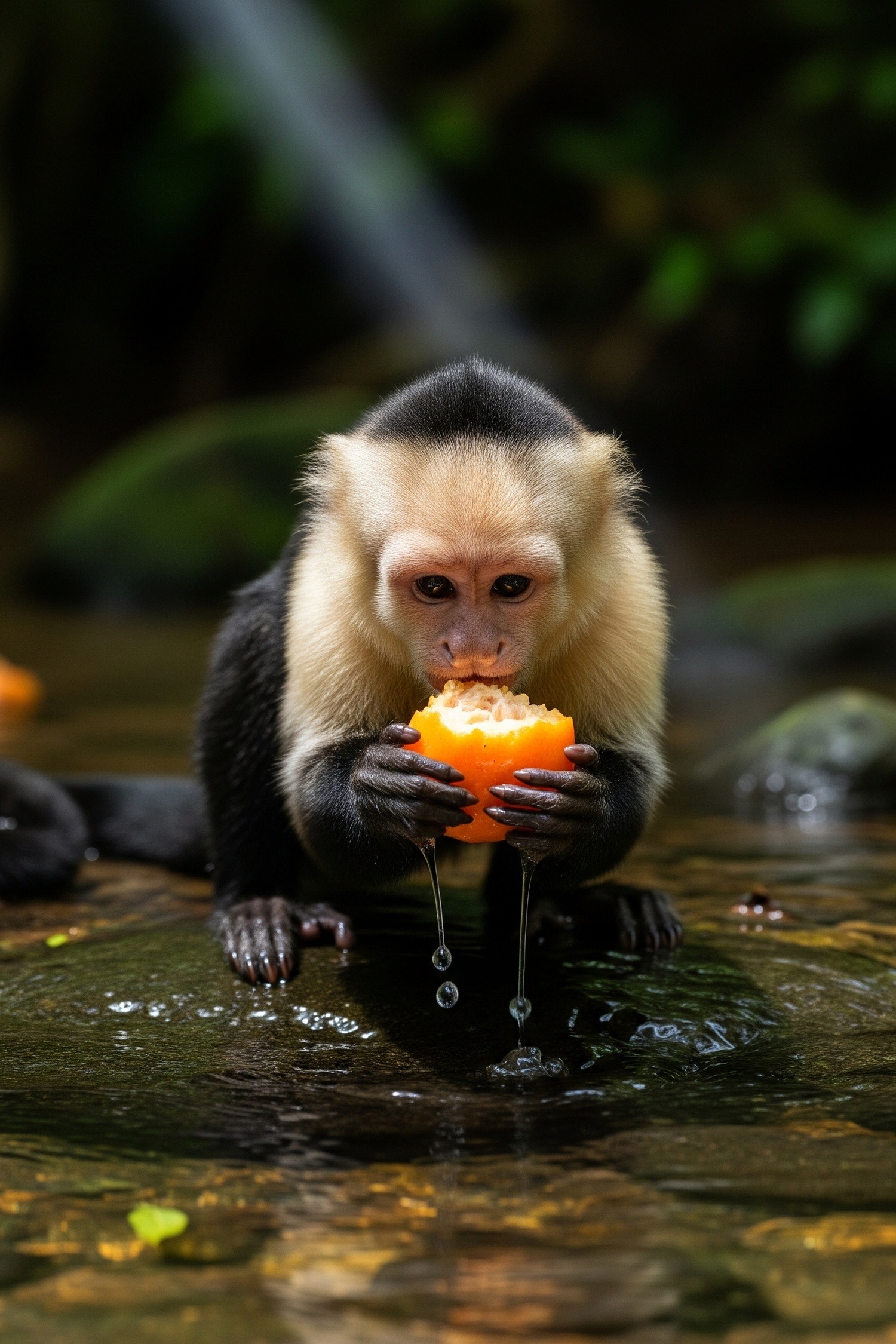
Why are capuchin monkeys washing fruit at all?
The practical answer is dental. Sand and grit wear down teeth fast, and for a wild animal a worn molar is a slow-motion crisis — less efficient chewing, less nutrition, a shorter life. Washing fruit removes the abrasive coating that clings to anything dropped on a forest floor or beach. Researchers studying white-faced capuchins at sites like Santa Rosa in Costa Rica and along Brazil’s Atlantic coast have catalogued food-processing behaviors in these monkeys since the 1980s, and washing sits among the more pointed examples. The monkey isn’t being fastidious for its own sake. It’s protecting the only set of teeth it will ever get.
But function alone doesn’t explain the pattern. If clean teeth were the whole story, every monkey would wash. Instead, the behavior clusters — present in some individuals, absent in their neighbors who eat the same gritty fruit from the same trees. Two monkeys can grow up in the same troop, eat from the same branches, and walk past the same stream, and one will scrub its food while the other never does.
That selectivity is the tell. Genes don’t switch on for one sibling and off for another sharing the same diet and habitat. Learning does. Whether a young capuchin picks up the habit seems to depend on who it watches, how closely, and how tolerant the demonstrator is of a curious onlooker leaning in.
When does a habit become culture?
Instinct is uniform. Every member of a species blinks, breathes, flinches the same way. So when a behavior spreads through a population unevenly — from one animal to another, skipping others entirely — it stops looking like hardwiring and starts looking like learning. Observed, borrowed, copied. The same way a kid watches an older sibling and thinks, oh, that’s how you do it. Primatologists call the wider phenomenon animal culture, and capuchins keep turning up in the literature; the broader conservation and behavior stories tracked at This Amazing World show how often “just an animal habit” turns out to be socially transmitted knowledge.
Culture, in the biological sense, doesn’t require language or ritual. It requires only that behavior pass between individuals by social learning rather than genes. By that definition, a fruit-washing habit moving through a capuchin troop qualifies — and that’s a far bigger claim than it first appears. The classic precedent came from Japanese macaques on Koshima Island in the 1950s, where a young female named Imo began washing sweet potatoes in the sea and the habit slowly spread to her troop, generation by generation. That single observation reshaped how scientists thought about animal minds. Capuchin fruit washing belongs to the same lineage of evidence.
Small habit. Enormous implication.
What capuchin intelligence really looks like
Capuchins earned their reputation as the problem-solvers of the New World monkeys honestly. In a now-famous experiment published by primatologists Frans de Waal and Sarah Brosnan in 2003, captive capuchins offered unequal pay for the same task — a cucumber slice for one, a grape for another — reacted with what looked unmistakably like outrage, refusing to cooperate. The study, reported widely including by Nature, suggested a sense of fairness once assumed unique to humans. In the wild, capuchins crack open hard nuts using carefully selected stone hammers and anvils, a skill juveniles take years to refine through watching adults.
Each of these — fairness, tool use, fruit washing — points the same direction. These are not reflex machines. They are minds that observe, weigh, and learn from one another across a lifetime, accumulating skills no single monkey could invent alone. A capuchin selecting the right stone hammer is drawing on knowledge it watched an adult demonstrate, sometimes for years, before its own hands grew strong and precise enough to copy the motion.
The canopy, it turns out, runs on apprenticeship.
How capuchin monkeys washing fruit reshapes our view of culture
For most of the 20th century, “culture” was a wall humans built around themselves. Then the evidence started leaking through. Chimpanzees in different regions use different tools for the same job. Some whale pods sing dialects unique to their group. Now capuchins add fruit washing to the ledger — a behavior the Smithsonian and other research institutions have folded into the growing case that cultural transmission is widespread across intelligent social animals, not a human monopoly. Each documented case since roughly the 1990s chips away at the old wall.
The consequence isn’t just academic. If culture is widespread, then conservation has to protect more than bodies and habitats — it has to protect knowledge. A troop that loses its elders can lose the accumulated skills of generations: which nuts to crack, which fruit to wash, which trees fruit when. Wipe out the teachers and the curriculum vanishes with them.
This matters acutely in fragmented forests, where capuchin groups can be cut off from one another by farmland, roads, and clearing. An isolated troop that loses a key skill has no neighbors to relearn it from. The knowledge doesn’t just shrink — it can disappear from an entire region, the way a language dies when its last fluent speakers do. A monkey reintroduced from a captive population, however genetically healthy, arrives illiterate in the local know-how its wild cousins spent generations building.
What field researchers do now is document these behaviors before they disappear, troop by troop. Long-term study sites matter enormously here, because culture only reveals itself over time. A single season tells you what a monkey eats; decades of continuous observation tell you how a habit was born, who adopted it, and how it spread or died out. Some of the most important capuchin findings have come from research stations that have tracked the same family lines across generations, building a record of behavior the way a historian builds an archive. Cut the funding or lose the forest, and that archive closes mid-sentence — with no way to know what the next chapter would have shown us about how minds learn from one another.
Where to See This
- Brazil’s Atlantic coastal forests and reserves such as the cerrado sites of Piauí — strongholds for wild capuchin troops engaged in tool use and food processing.
- Santa Rosa and the Área de Conservación Guanacaste in Costa Rica, where white-faced capuchins have been studied continuously for decades.
- For ethical viewing: watch with accredited research-linked eco-tours and never feed wild monkeys — provisioning rapidly distorts the very behaviors that make them worth observing.
By the Numbers
- 2003 — year the de Waal and Brosnan fairness study made capuchin cognition front-page science.
- Years — the time a juvenile capuchin needs to master stone-tool nut cracking.
- 1980s — decade long-term white-faced capuchin field studies began in earnest.
- Selective — the spread pattern of fruit washing, present in some individuals and absent in others.
- New World — capuchins are among the most-studied monkeys of the Americas for culture and tool use.
Field Notes
- Some capuchin troops rub crushed millipedes and other pungent plants into their fur — a behavior thought to repel insects, and one that also spreads socially rather than by instinct.
- Nut-cracking capuchins choose their stone tools by weight and hardness, sometimes carrying a favored hammer between feeding sites.
- Fruit washing isn’t only about cleanliness; for some primates, dunking food in water can also help process or soften it, blurring the line between hygiene and cooking-like behavior.
- Researchers still can’t fully explain why one capuchin adopts a habit while a neighbor ignores it. Personality, rank, and who a young monkey watches most all seem to matter, but the exact recipe remains uncertain.
Frequently Asked Questions
Q: Why are capuchin monkeys washing fruit if it isn’t instinct?
Because the behavior is learned and socially transmitted, not hardwired. Washing removes grit that would wear down a monkey’s teeth, which is a real benefit, but the giveaway is that only some individuals in a group do it. Pure instinct would appear in every member uniformly. Instead the habit spreads selectively from one monkey to another, which is exactly the pattern biologists use to identify culture rather than reflex.
Q: Does fruit washing really count as animal culture?
In the scientific sense, yes. Culture doesn’t require language or ritual — it requires that a behavior pass between individuals through social learning instead of genes. A fruit-washing habit moving unevenly through a capuchin troop fits that definition. It joins documented cases like region-specific chimpanzee tool use and whale-pod dialects, all evidence that cultural transmission is far more widespread across intelligent animals than once believed.
Q: How intelligent are capuchin monkeys compared with other primates?
Capuchins are among the most cognitively sophisticated New World monkeys. A 2003 study by Frans de Waal and Sarah Brosnan showed they reject unequal rewards, suggesting a sense of fairness. In the wild they use stone tools to crack nuts, a skill that takes juveniles years to learn by watching adults. Their brain-to-body ratio is high, and their problem-solving in lab tests rivals that of much larger apes.
Q: Why does it matter that animals have culture?
Because it changes what conservation must protect. If skills and knowledge pass between generations socially, then losing a troop’s elders can erase accumulated wisdom — which nuts to crack, which fruit to wash, which trees fruit when. Protecting a species means protecting its living libraries of behavior, not just its bodies and forest. Culture makes each social group partly irreplaceable, even if the species survives elsewhere.
Editor’s Take — Alex Morgan
The detail that gets me isn’t the washing. It’s that some monkeys skip it. That single fact drags the behavior out of the realm of reflex and into something far stranger — choice, observation, the slow seep of an idea from one mind to another. We spent a century insisting culture was ours alone. A capuchin scrubbing a mango at the water’s edge doesn’t care about our definitions. It just quietly proves us wrong.
The canopy is louder than it looks — not with sound, but with information passing hand to hand, generation to generation, in habits we’ve only just begun to notice. A clean mango at a stream’s edge is a sentence in a language we’re barely learning to read. How many other quiet rituals are unfolding up there right now, just beyond what we’ve ever thought to look for?
Illustrations are AI-generated. Article fact-checked and human-edited.