The Hippo Makes Its Own Sunscreen — And That’s the Least Weird Thing About It
A hippo’s skin leaks a red-orange fluid that’s part sunscreen, part antibiotic, part chemical mystery that scientists didn’t fully decode until 2004. Which is wild, because hippos have been parked in African rivers for millions of years doing exactly this, and we just — didn’t notice.
For decades, maybe centuries, people assumed the red ooze was sweat, or blood, or some kind of wound weeping. Nobody looked closely enough. Then a team led by Kimiko Hashimoto in Japan actually isolated the compounds and published findings that amounted to: yes, hippos manufacture their own UV-blocking pigments on their own skin, while they’re just standing there in the shallows. It’s bespoke sunscreen that also kills bacteria. The more you learn about hippo biology, the more you realize we’ve been walking past one of the strangest animals on Earth and filing it under “fat, slow, vaguely funny.”
Key Facts
- Hippos secrete a red-orange fluid that acts as both sunscreen and antibiotic; its chemistry was decoded in 2004 by a team led by Kimiko Hashimoto in Japan.
- The two pigment acids are hipposudoric acid (red-orange) and norhipposudoric acid (orange); the fluid starts colorless and oxidizes within minutes.
- Adult male hippos weigh over 3,000 kilograms and walk along riverbeds rather than swimming, holding their breath for around five minutes.
- A hippo’s bite force is around 8,100 newtons — roughly double a lion’s 4,000 — and its mouth opens about 150 degrees.
- Hippos can run 30 km/h on land and kill more people in Africa each year than lions and leopards combined.
In short: Hippos manufacture their own sunscreen: a red-orange skin secretion of hipposudoric and norhipposudoric acids that blocks UV and kills bacteria, decoded in 2004 by Kimiko Hashimoto’s team. Weighing over 3,000 kilograms, hippos walk underwater, sleep submerged, and have a bite force near 8,100 newtons, killing more Africans yearly than lions and leopards combined.
The sunscreen thing is genuinely incredible
In 2004, Hashimoto’s group isolated two pigment acids that had never been described before: hipposudoric acid, the red-orange one, and norhipposudoric acid, which tilts more toward orange. These aren’t byproducts. They aren’t waste leaking out of a stressed animal. The hippo’s body deliberately synthesizes them in specialized subdermal glands, secretes them through the skin, and they pull double duty — blocking UV rays and acting as an antimicrobial at the same time.
No other land mammal on Earth has anything quite like this.
The fluid starts out colorless and oxidizes to that distinctive red-orange within minutes of meeting air. So it’s not just a sunscreen — it’s a self-applying, auto-reacting skin treatment that activates on contact with the atmosphere. The chemistry behind the color shift is part of why it took so long to crack: the active pigments are unstable, polymerizing into a darker brown over the course of an hour or two, which made them maddening to capture and study in a lab. Hashimoto’s team had to work fast with fresh secretion samples to pin down the molecular structures at all.
There’s a reason this matters beyond trivia. A hippo spends much of its day half-submerged precisely because its skin is so vulnerable. It has almost no hair and very few of the sweat glands most mammals rely on to cool down, so out of water under the equatorial sun it would crack, burn, and dehydrate quickly. The pigment secretion is what lets a thin-skinned, near-hairless animal tolerate the daylight at all — a chemical compromise for a body that can’t sweat its way to safety and can’t grow a protective coat. The hippo walks around in broad daylight wearing a chemical delivery system we only just learned to read.
Then you watch them move underwater
Adult male hippos weigh well over 3,000 kilograms. Their bones are dense enough that they sink rather than float. They don’t swim — not in any way you’d recognize as swimming. They walk along the river bottom in long, arching lunges, pushing off the sediment like astronauts bounding across the Moon in slow-motion footage. It’s disorienting to watch, because nothing that heavy should move that gracefully in any medium. Underwater video from rivers like the Mara in Kenya shows them porpoising along the bottom in near-weightless strides, surprisingly delicate for a two-ton animal.
Here’s the part that really gets me: a submerged hippo can hold its breath for around five minutes. But more than that, they sleep underwater. Their bodies are wired to surface, exhale, inhale, and sink back down automatically — even when the hippo is fully unconscious. It’s a reflex buried so deep in their neurology that they don’t need to think about it. They surface, breathe, and drop back to the bottom without ever waking. It’s closer to the involuntary breathing rhythm of a sleeping human than to anything a fish or a crocodile does.
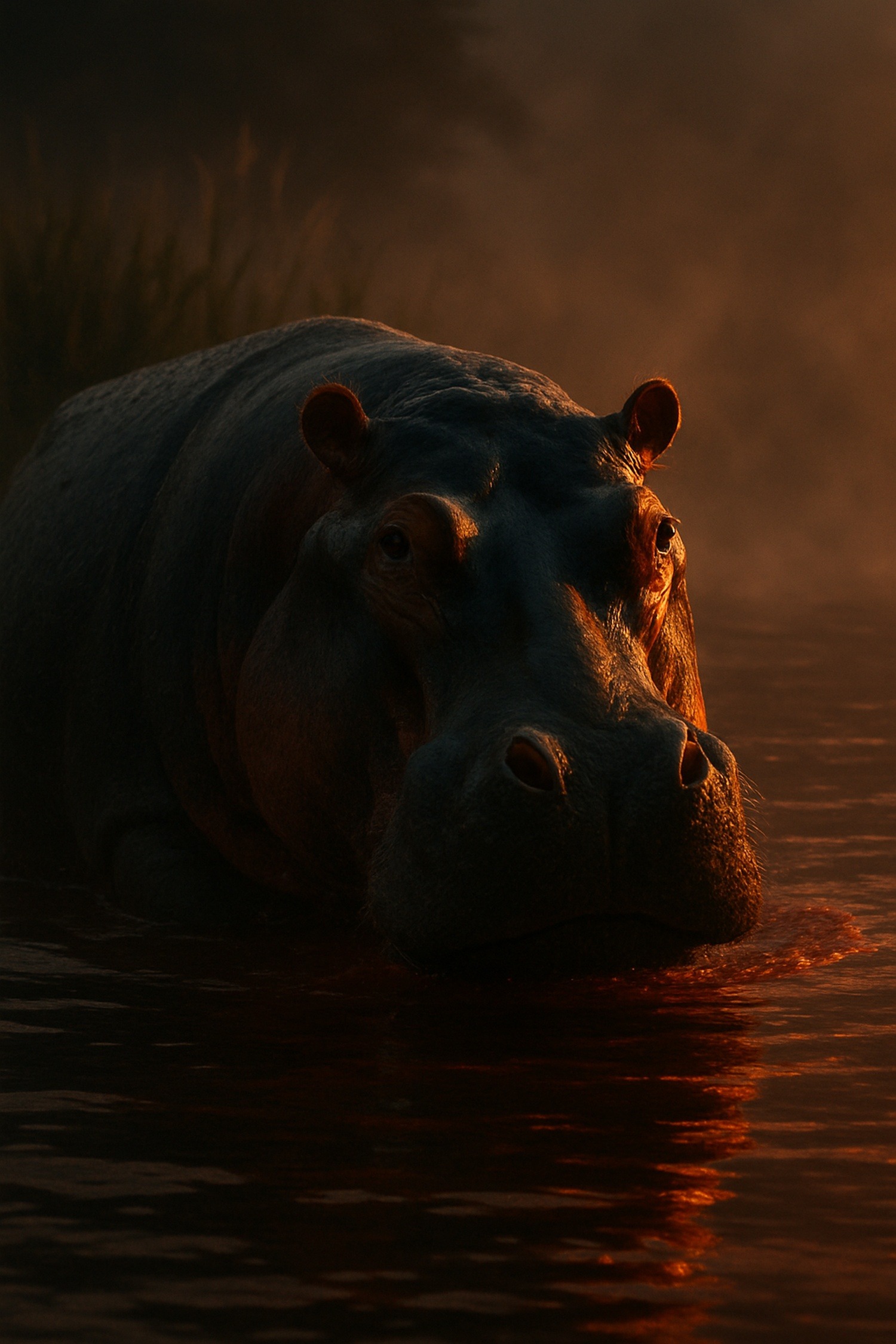
Their eyes, ears, and nostrils sit in a near-perfect line along the top of the skull, so a hippo can keep watch, listen, and breathe while the rest of its enormous body stays hidden below the surface. The nostrils even seal shut when it dives. The animal can essentially run on autopilot, alert and submerged, for as long as the river holds water.
The jaw deserves its own section
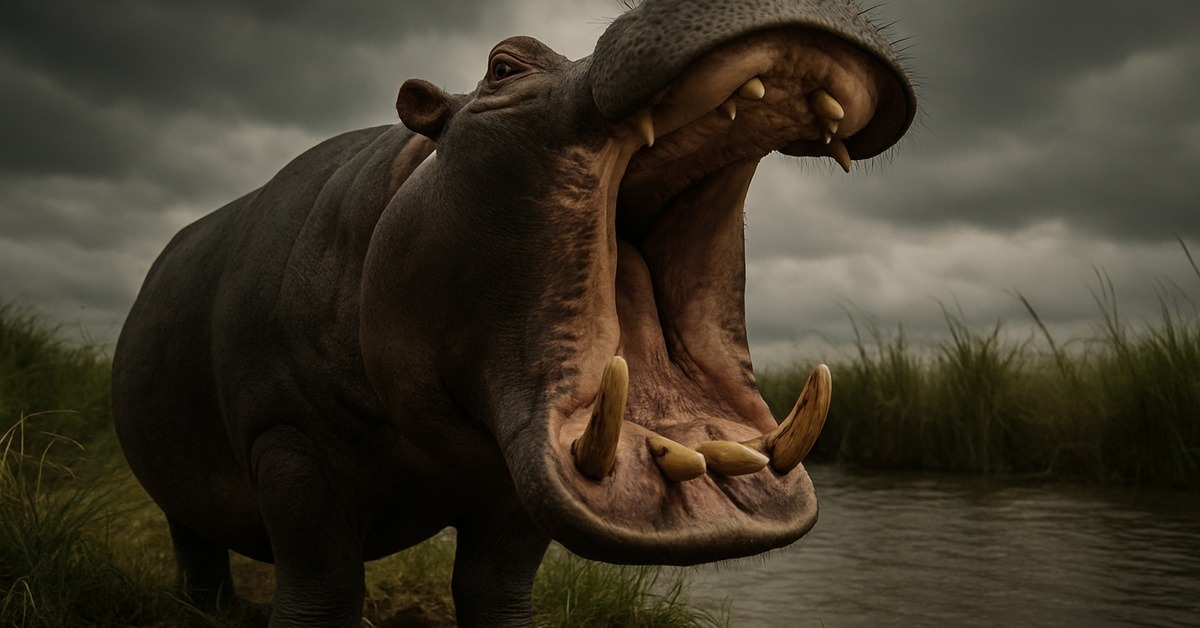
Most hippo facts fixate on the size or the skin. The jaw is the part that should genuinely unsettle you. A hippo can open its mouth to roughly 150 degrees — wide enough to fit an adult human inside with room to spare. The bite force lands somewhere around 8,100 newtons. A lion clocks in near 4,000. A saltwater crocodile reaches around 16,000, but that’s a clamping, drowning bite, evolved to hold prey under and twist.
The hippo’s jaw is built for something messier: pure, blunt destruction.
Those tusk-like canine teeth — which are actually modified canines and incisors, constantly growing and self-sharpening as they grind against each other — reach 50 centimeters in older males. They aren’t for eating. Hippos are herbivores; they crop grass with their broad lips and barely use the front teeth to feed. The tusks exist for fighting other hippos, mostly males contesting stretches of river. And when things go sideways, for fighting boats, fishermen, and anyone who drifts between a hippo and deep water.
They kill more people in Africa each year than lions and leopards combined.
The dangerous part is how harmless they look
The hippo’s reputation as a slow, docile, vaguely cartoonish creature is one of the most lethal misconceptions in all of wildlife. Here’s what’s actually true: they’re territorial. They’re unpredictable. They can run 30 kilometers per hour on land over short distances — faster than most people can sprint. They’re especially aggressive around calves, and especially dangerous when something blocks their path back to water.
Fishermen on African rivers understand this in their bones.
Tourists in small boats learn it the hard way. A hippo at rest — half-submerged, only its eyes and ears breaking the waterline — looks peaceful. Pastoral, even. Safe. It is not safe. Much of the danger comes from geometry: a hippo grazing on a riverbank at dusk will charge anything standing between it and the deep channel, and it does not bluff. The cognitive shortcut of “round animal equals friendly animal” has gotten people killed. That’s worth sitting with for a second. How many genuinely dangerous things slide past our guard simply because they don’t match our mental template for what danger is supposed to look like?
Key Facts
- 2004 — the year Kimiko Hashimoto’s research team isolated hipposudoric acid for the first time, more than a century after people first noticed the red fluid seeping from hippo skin and decided it probably didn’t matter.
- 8,100 newtons — a hippo’s bite force. Enough to crush small wooden boats, and more than double a lion’s.
- 3,000+ kilograms — roughly a compact car’s worth of hippo, making it the third-largest land animal on the planet after elephants and white rhinos.
- 500 meters — how far hippos typically travel from water each night to graze, eating around 40 kilograms of grass before heading back before sunrise. Every single night.
- Under 130,000 — the estimated number of common hippos left in the wild, a sharp contraction from their former range across Africa.
In short
- Hippos secrete a colorless fluid that oxidizes red-orange and works as both sunscreen and antibiotic — chemistry decoded only in 2004.
- They’re too dense to float, so they walk the river bottom and even sleep underwater, surfacing to breathe on pure reflex.
- An 8,100-newton bite and 50-centimeter tusks make them, despite the herbivore diet, one of Africa’s deadliest animals to humans.
- Their closest living relatives are whales and dolphins, not pigs or rhinos — a discovery that redrew the mammal family tree.
The stuff that doesn’t fit neatly
- Hippos communicate underwater using clicks and whines that travel through water and air simultaneously — a single call can reach submerged hippos and anything listening above the surface at the same moment. Researchers studying the species call this dual-medium signaling unusual even among amphibious animals, and recent playback work suggests hippos can even recognize the calls of neighbors versus strangers.
- They can’t float. Despite spending most of their lives in water, their lung capacity relative to their body density means they sink by default. You will never see a hippo drifting lazily on the surface, because it is physically impossible for them to do so.
- The closest living relatives of hippos aren’t pigs or rhinos. They’re cetaceans — whales and dolphins. Fossil and genetic evidence shows that whales and dolphins share a more recent common ancestor with hippos than hippos do with any other land mammal, which reshuffled an entire branch of the mammal family tree. The split is thought to date back tens of millions of years, to a semi-aquatic ancestor whose descendants went two very different directions: one fully into the ocean, the other into the rivers.
Why we keep getting hippo biology wrong
Every few years, new research on hippos forces a revision of something we thought we already understood. The sunscreen discovery rewrote a chapter of mammalian skin chemistry. The acoustic work changed how scientists think about amphibious communication. The cetacean-ancestry connection reshuffled the order Artiodactyla, the group that also contains cattle, deer, camels, and pigs. This is an animal that’s been woven through human culture for thousands of years — painted in ancient Egyptian tomb walls, associated with the goddess Taweret, described by the Greek historian Herodotus, hunted across Africa to the edge of local extinction — and we are still discovering what it fundamentally is.
Part of the problem is that the hippo hides in plain sight. The most interesting things about it happen where we can’t easily look: under the waterline, inside the chemistry of its skin, in sound frequencies that carry through a medium we don’t share. We built our impression of the hippo from the few hours a day it spends visible and motionless, which is exactly when it’s doing the least. The science kept getting ahead of the public image, and the public image — placid, comic, harmless — barely budged.
Fewer than 130,000 common hippos remain in the wild today, and the related pygmy hippo of West Africa is rarer still, listed as endangered. Their range has collapsed under habitat loss, drought, and poaching for meat and ivory-grade tusks. In many places they’re still treated as a nuisance — an agricultural threat that tramples crops, a hazard to be tolerated rather than understood. Background wildlife.
That feels like a significant miscalculation.
The hippo isn’t a footnote in wildlife biology. It’s one of the strangest, most chemically sophisticated, physically formidable animals on the entire planet — and it’s been in the river the whole time, half-submerged, watching us walk past without really looking.
Frequently Asked Questions
Q: Is the red fluid on a hippo’s skin actually blood? No. It’s a common myth, sometimes called “blood sweat,” but it’s neither blood nor sweat. The secretion starts out colorless and only turns red-orange as it oxidizes in air. It’s made of two unique pigment acids — hipposudoric and norhipposudoric acid — that the hippo’s glands manufacture specifically to block ultraviolet light and fight bacteria on the skin.
Q: Can hippos really sleep underwater without drowning? Yes. A hippo can hold its breath for roughly five minutes, and while resting underwater its body surfaces to breathe and sinks back down automatically, even when the animal is completely asleep. The breathing is a reflex that doesn’t require conscious effort, much like a sleeping human’s, so a submerged hippo can rest for hours without waking to take a breath.
Q: Why are hippos considered so dangerous if they only eat plants? Diet has nothing to do with it. Hippos are intensely territorial and unpredictable, they’re surprisingly fast on land at around 30 kilometers per hour, and an adult bull’s bite can reach about 8,100 newtons with tusks up to 50 centimeters long. They become especially aggressive when protecting calves or when something blocks their route back to deep water, which is why they’re blamed for more human deaths in Africa each year than lions and leopards combined.
The red fluid that oxidizes in the air. The bone-heavy river walks. The jaw. The self-manufactured sunscreen no other land mammal can make. The hippo carries all of it without effort, in broad daylight, waiting for someone to actually pay attention. It doesn’t need to hide to be a mystery. It just needs us to stop assuming we already understand what we’re looking at.
Illustrations are AI-generated. Article fact-checked and human-edited.