You Can Dig for Real Diamonds in Arkansas and Keep Them
The field doesn’t look like much. Thirty-seven acres of plowed Arkansas dirt, kind of reddish-brown, slightly damp after rain — and underneath it, a 95-million-year-old volcanic pipe that has been slowly pushing diamonds toward the surface for longer than our entire species has existed.
Since 1972, more than 37,000 diamonds have come out of this ground. Not pulled by mining crews or extracted by geologists with sophisticated equipment. Found by tourists. Retirees. Families who paid a $12 entry fee, rented a screen box, and started sifting. Whatever they pulled from the dirt was theirs to keep — no asterisks, no royalties, no corporate claim on it. That’s the actual policy at Crater of Diamonds State Park, and it’s been that way for over fifty years.
Key Facts
- More than 37,377 diamonds have been registered by visitors since Crater of Diamonds State Park opened in 1972, roughly 730 per year on average.
- The field sits on an eroded lamproite volcanic pipe that formed roughly 95 million years ago, one of only 37 known diamond-bearing lamproite deposits on Earth.
- The Strawn-Wagner Diamond, found by amateur Shirley Strawn in 1990, was cut to a 3.03-carat D color, Internally Flawless gem, a grade fewer than 1% of diamonds achieve.
- The Uncle Sam Diamond, found in 1924, weighed 40.23 carats and remains the largest diamond ever officially found in the United States.
- The adult entry fee is under $12, and visitors keep whatever they find with no royalties or corporate claim.
In short: Crater of Diamonds State Park in Murfreesboro, Arkansas, lets visitors dig a 95-million-year-old volcanic pipe and keep whatever they find for a sub-$12 entry fee. Since 1972 over 37,000 diamonds have been registered, including the flawless Strawn-Wagner Diamond and the 40.23-carat Uncle Sam, the largest ever found in the United States.
Why Crater of Diamonds State Park Sits on a Volcano
The geology here is specific in a way that matters. The field at Murfreesboro, Arkansas sits on the eroded surface of a lamproite volcanic pipe — a deep-earth structure that, roughly 95 million years ago, punched up through the crust like a slow-motion explosion. Lamproite eruptions are among the only geological events powerful enough to carry diamonds from the upper mantle, where they form under crushing heat and pressure, all the way to the surface. According to the Crater of Diamonds State Park Wikipedia entry, this site is one of only 37 known diamond-bearing lamproite deposits on Earth. Geologist Dr. John McFarland has documented the site extensively for the Arkansas Geological Survey.
Here’s the thing about those 37 deposits worldwide: most are either exhausted, inaccessible, or locked up by corporations and governments. This one became a public park.
The reason is almost accidentally poetic. The land changed hands multiple times in the early 20th century as private companies tried and repeatedly failed to make commercial diamond mining profitable here. The deposits were real — but scattered, too spread out for industrial-scale extraction. That failure, compounded over decades, eventually made the whole thing available to the public. What looked like a frustrating geological dead end for mining executives in 1950 turned out to be genuinely lucky for the rest of us.
The Diamond That Became a National Legend
It is 1990. Shirley Strawn is at the park again — not for the first time, not even close to the first time. She isn’t a geologist by training. She’s a determined amateur who kept returning year after year, learning to read the soil, understanding where the volcanic material surfaced most cleanly after rain.
On one of those visits, she found a rough stone. 3.03 carats. It didn’t look remarkable — most raw diamonds don’t, which is the first thing the park staff will tell you. But after it was cut and certified, the Gemological Institute of America gave it a D color grade and an Internally Flawless clarity designation. That combination — D-IF — is so rare that fewer than 1% of all graded diamonds in the world achieve it. The stone was named the Strawn-Wagner Diamond and is now considered one of the most perfect diamonds ever recovered in North America.
That last fact kept me reading for another hour.
She didn’t stumble onto it. She came back, repeatedly, until the field eventually gave it up. That’s the part that’s easy to dismiss when people write this place off as a tourist novelty. You can learn more about extraordinary natural discoveries like this one at this-amazing-world.com. The diamonds are real. The quality can be extraordinary. And patience is, apparently, the most valuable tool you can bring to a dig site.
What You’re Actually Digging Through Out There
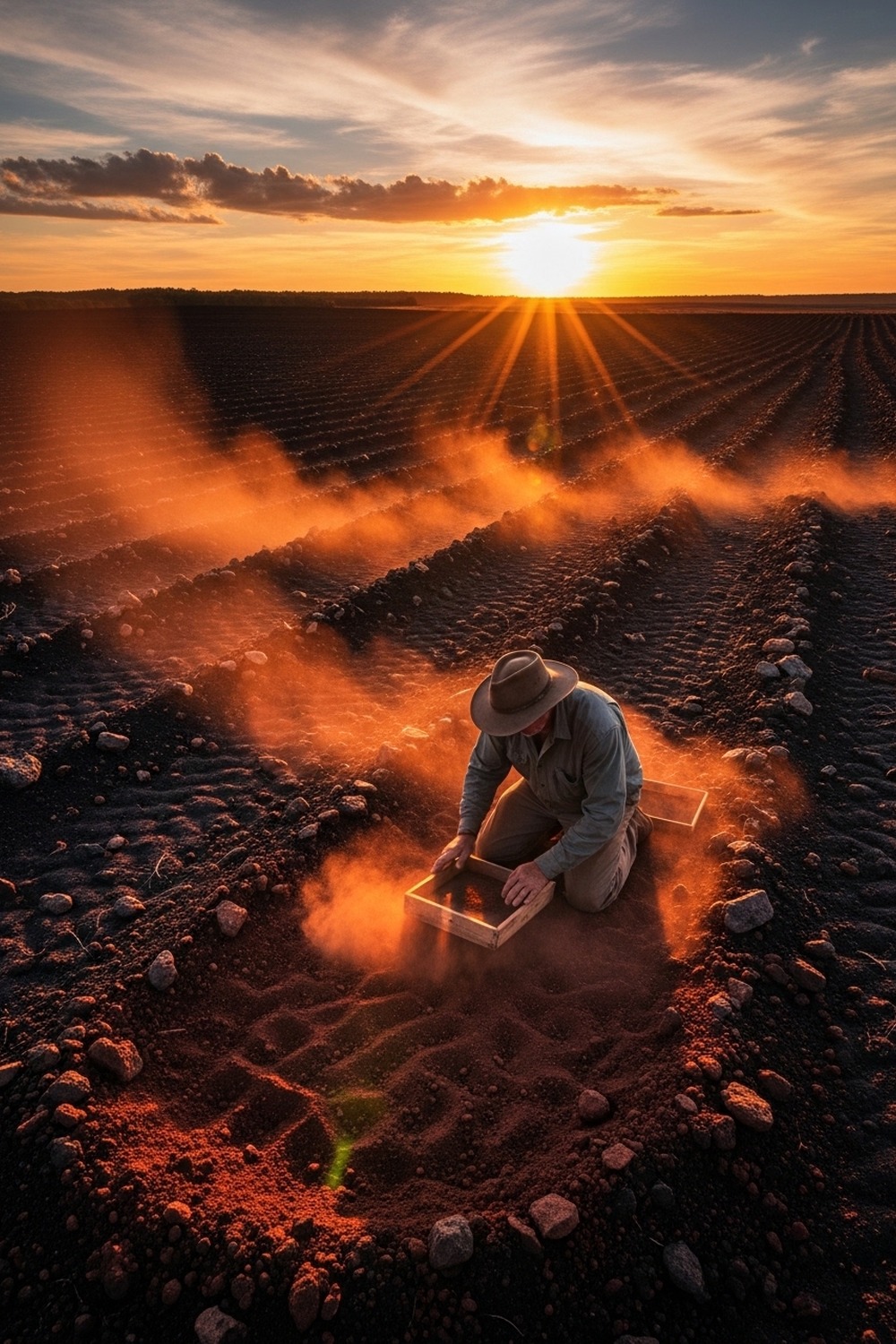
The park plows the surface soil regularly — mimicking what rain and erosion do naturally, coaxing heavier materials (think: diamonds) closer to the surface. Visitors use screen boxes to sift through the dirt, washing it in water troughs to separate out the denser stones. Because diamonds are significantly heavier than most surrounding minerals, they tend to concentrate in specific zones after a good rain event. Park staff will identify any stones you pull out, for free, before you leave.
The search area also yields amethyst, garnet, jasper, calcite, and more than 40 other minerals from the same ground. Some of those finds are genuinely beautiful. But everyone’s really there for the diamonds.
And occasionally the earth delivers something that stops everyone cold.
In 1924, a single diamond found here weighed 40.23 carats. It remains the largest diamond ever officially found in the United States. It came from a public field that anyone could walk into.
The Volcanic Pipe That Time Preserved Perfectly
Most lamproite pipes have been either mined to exhaustion or buried too deep to access without serious industrial infrastructure. The Arkansas pipe is different because 95 million years of erosion has done the excavation work, gradually exposing the diamond-bearing material right at the surface. The same geological processes that destroyed the original volcanic crater also made the diamonds reachable by hand.
Think of it like this: a mining company in the 1920s looked at this scattered, low-concentration deposit and saw an unprofitable mess. What they were actually looking at was a perfectly preserved public treasure that nobody had figured out how to value yet.
There are diamond-bearing kimberlite and lamproite pipes on multiple continents. Almost none of them allow public access. Arkansas made a different call in 1972 — and the diamonds found here have belonged to whoever found them ever since. That’s a genuinely unusual arrangement anywhere on earth, and it’s worth sitting with for a moment.
By the Numbers
- 37,377 diamonds registered by park visitors since Crater of Diamonds State Park opened in 1972, according to Arkansas State Parks records — roughly 730 per year on average.
- Entry fee under $12 for adults. To legally prospect for gemstones on public land, that’s about as low as it gets anywhere in the world.
- The Strawn-Wagner Diamond: D color, Internally Flawless — a combination fewer than 1% of all graded diamonds ever achieve. Found here, by an amateur, after years of patient work.
- The Uncle Sam Diamond weighed 40.23 carats when it was pulled from this same public field in 1924. Still the largest diamond ever officially recorded as found in the United States. Not from a mine. From a field where anyone could dig.
Field Notes
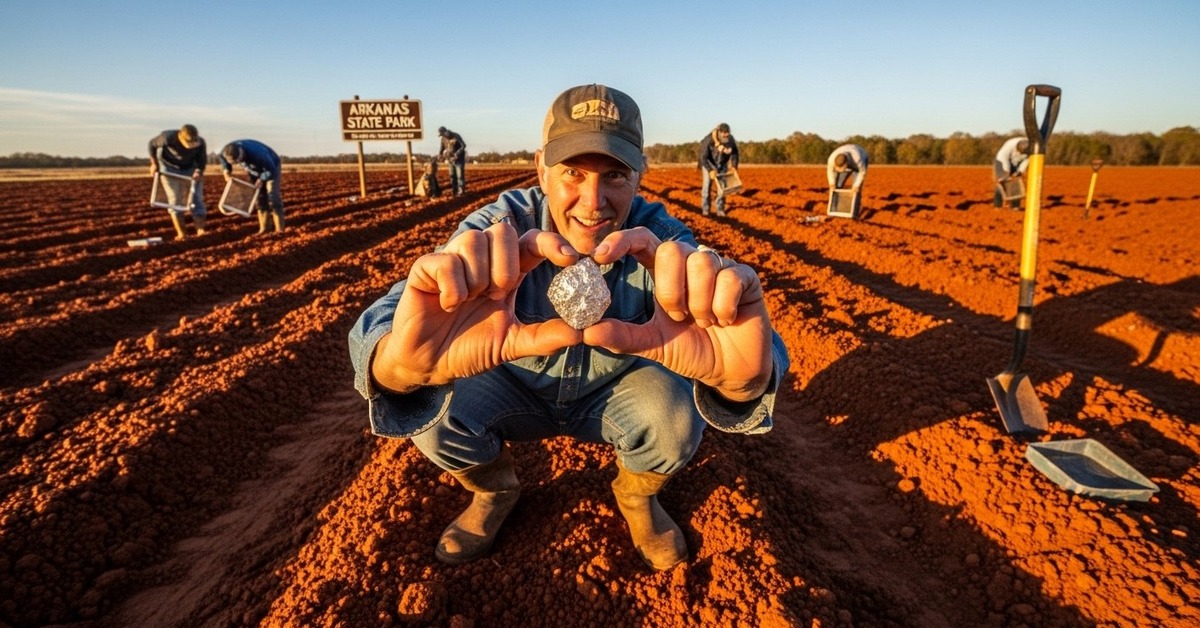
- Three natural colors found here: white, brown, yellow. But rare red diamonds have also been recovered — and red diamonds command some of the highest per-carat prices anywhere in the world, which makes finding one here particularly disorienting to think about.
- Raw diamonds look like pale glass or dull quartz. Not the sparkly thing in a jeweler’s case. Beginners walk past them constantly.
- Free identification service on-site — but you have to register any find before leaving the search area. This isn’t just bureaucracy: the registration data helps scientists track where diamonds are clustering after rain events, building a long-term geological map of the deposit that gets more detailed every year.
What This Place Tells Us About Ordinary Luck
Crater of Diamonds State Park isn’t really about luck, when you look at it closely. The people who find the significant stones here — Shirley Strawn, specifically — weren’t in the right place at the right time. They were in the right place at the right time because they kept showing up and learning the ground. Strawn studied where stones clustered after rain. She paid attention to the geology. The field rewarded that the way almost nothing else does.
What’s quietly remarkable is the scale of time operating underneath all of this. The lamproite pipe beneath Murfreesboro has been delivering diamonds to the surface for 95 million years. It was doing this long before any human arrived on this continent. It’s still doing it now, slowly, one rain event at a time, without any fanfare at all.
A 95-million-year-old volcano. Thirty-seven acres of public land. A $12 entry fee. And the Strawn-Wagner Diamond — D color, Internally Flawless, found by a woman with a screen box and enough stubbornness to keep coming back. The Uncle Sam Diamond, 40.23 carats, still the largest ever found in the United States, came from the same dirt. The next significant find could come from anyone. That’s not a marketing pitch — that’s just the geology. There’s more at this-amazing-world.com, and the next one is even stranger.
Frequently Asked Questions
Q: Can you really keep diamonds you find at Crater of Diamonds State Park?
Yes. At Crater of Diamonds State Park in Murfreesboro, Arkansas, visitors pay an entry fee of under $12, rent a screen box, and keep whatever they find with no asterisks, royalties, or corporate claim. This finders-keepers policy has been in place for over fifty years since the park opened in 1972. More than 37,377 diamonds have been registered by visitors in that time, roughly 730 per year. Park staff identify any stones for free, though you must register finds before leaving the search area.
Q: Why does Crater of Diamonds State Park have diamonds?
The park sits on the eroded surface of a lamproite volcanic pipe that formed roughly 95 million years ago. Lamproite eruptions are among the only geological events powerful enough to carry diamonds from the upper mantle to the surface. The site is one of only 37 known diamond-bearing lamproite deposits on Earth. About 95 million years of erosion has exposed the diamond-bearing material right at the surface, making it reachable by hand, whereas most such pipes worldwide are exhausted, buried too deep, or controlled by corporations.
Q: What is the most famous diamond found at the park?
Two stand out. The Strawn-Wagner Diamond, found by amateur prospector Shirley Strawn in 1990, was a 3.03-carat rough stone later cut and certified by the Gemological Institute of America as D color with Internally Flawless clarity, a combination fewer than 1% of all graded diamonds achieve. The largest is the Uncle Sam Diamond, found in 1924 at 40.23 carats, still the largest diamond ever officially recorded as found in the United States, recovered from a public field where anyone could dig.
Illustrations are AI-generated. Article fact-checked and human-edited. Our editorial standards.