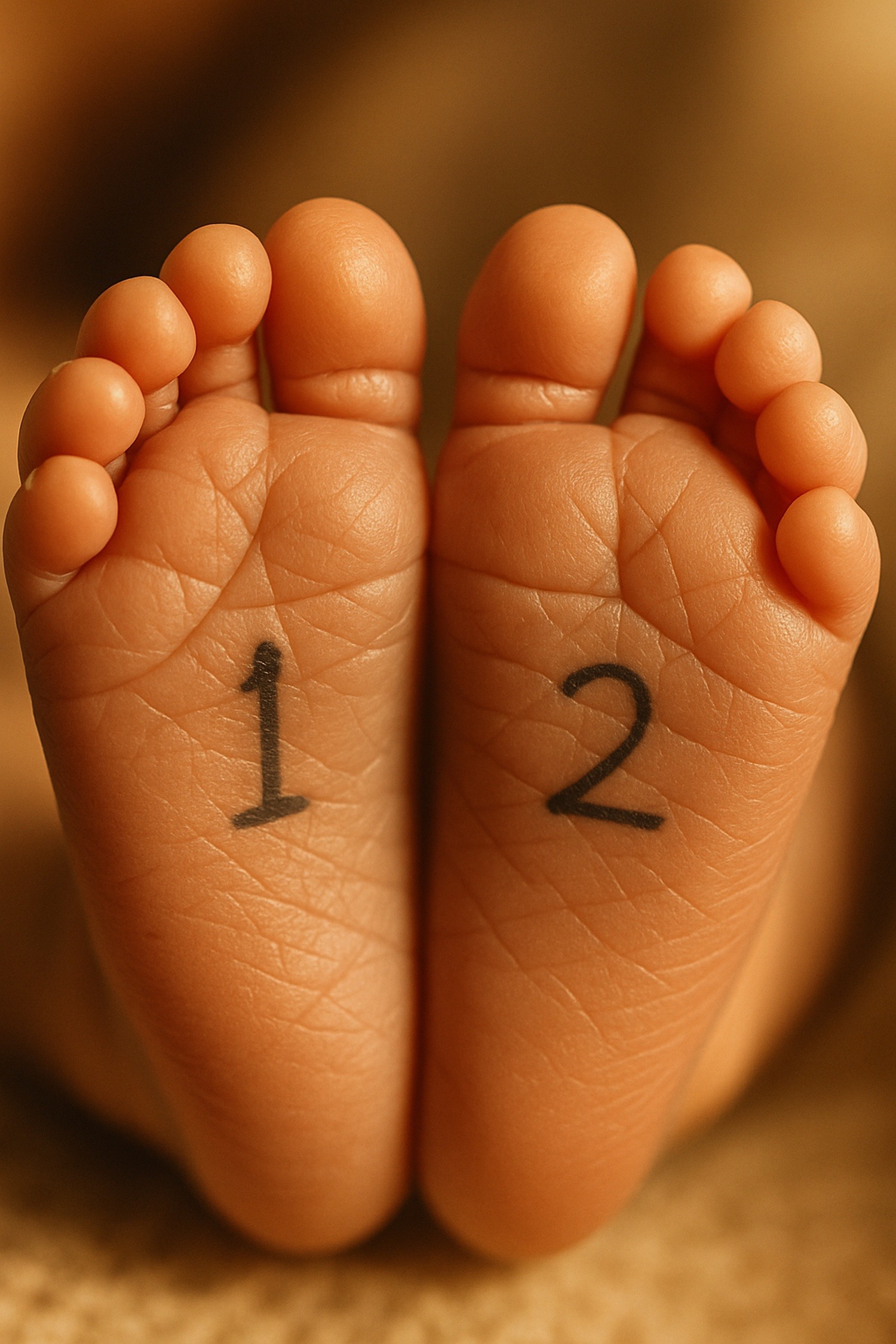
Why a Dad Wrote Numbers on His Twins’ Feet
A sleep-deprived father in the United States stared at his six-week-old identical twins, made a decision in four seconds, and grabbed a washable marker. Two babies. Two feet. Two numbers. Nobody teaches you this particular identical twins mix-up parenting hack, yet parents have been reinventing it independently for thousands of years — from ancient Rome to rural Japan to a suburban bedroom at 3am.
The story spread online because it was funny. Then people thought about it more carefully, and it became something else: a window into the actual biology of why two human beings can share a face so completely that distinguishing them requires improvisation. Why does this happen? Because the science behind it is real, documented, and far stranger than the marker suggests.
Key Facts
- A father in the United States wrote washable marker numbers on the feet of his six-week-old identical twins to tell them apart
- Monozygotic (identical) twins share virtually 100% of their DNA, per 2021 research from the National Human Genome Research Institute
- A 2012 study from the Spanish National Cancer Research Centre found measurable epigenetic divergence between identical twins in early childhood
- The U.S. twin birth rate reached 32.6 per 1,000 births in 2021 (CDC), roughly double the 1980s rate, largely due to assisted reproductive technology
- A 2017 University of Pennsylvania study found sustained sleep restriction matching new-parent patterns caused impairments comparable to total sleep deprivation
In short: A sleep-deprived U.S. father wrote washable marker numbers on his six-week-old identical twins’ feet to tell them apart. Monozygotic twins share virtually 100% of their DNA (NHGRI, 2021), so distinguishing them is genuinely hard. The American Academy of Pediatrics recommends parents use such distinguishing markers from the first day home.
The Biology of Absolute Similarity
One fertilized egg splits in the first two weeks after conception. That’s how identical twins — technically called monozygotic twins — begin their existence. The National Human Genome Research Institute published research in 2021 confirming what seems almost too simple to be true: monozygotic twins share virtually 100% of their genetic zygosity, meaning the same DNA blueprint runs in two separate bodies simultaneously. Not a rounding error. A precise biological fact that explains why even trained medical staff require identification protocols to keep them straight at birth.
The features that distinguish one person from another — the width of the nose, the curve of the ear, the set of the eyes — are all downstream products of that shared genetic code. Built from the same original instructions. And yet here’s where the straightforward part ends.

Despite identical DNA, monozygotic twins are not truly carbon copies of each other. Epigenetic differences — changes in how genes are expressed rather than the genes themselves — begin accumulating almost immediately after the split. A 2012 study from the Spanish National Cancer Research Centre found measurable epigenetic divergence between identical twins even in early childhood. But at six weeks old? Those differences are barely visible.
The slight weight differential, the faint birthmark, the marginally different cry. These are the only handholds a new parent has.
In hospitals, this is managed with identification bracelets from birth. At home, it’s managed with whatever’s in the drawer. The father with the marker wasn’t improvising irresponsibly — he was solving a real problem with real urgency. That’s not chaos. That’s engineering.
When Telling Twins Apart Actually Matters
Hospital mix-ups involving identical newborns existed before identification bracelets and footprints became standard practice. The consequences ranged from briefly confused feeding schedules to, in rare historical cases, babies being sent home with the wrong families entirely. Attachment science compounds the concern: early and consistent caregiver-infant bonding is foundational to neurological development. This connects to something broader in developmental psychology — the same mechanisms that make a baby monkey cling to a stuffed toy as a substitute for reliable attachment figures also underlie why human infants need consistent, correctly-identified caregiving in those first weeks. Accurate identification genuinely matters.
The American Academy of Pediatrics recommends that parents of identical twins use distinguishing markers from the first day home: nail polish on one baby’s toe, a small ankle band, a distinctive piece of clothing. The reason is specifically tied to those early weeks when the twins haven’t yet developed their subtle individual markers.
Pediatricians have a standard toolkit for this, and it’s worth knowing: they don’t ask parents to memorize the differences. They ask parents to create them. A nurse at a Chicago teaching hospital described it simply. “We don’t ask parents to memorize the differences. We ask them to create them.” The marker, it turns out, is entirely consistent with clinical advice. It just looks funnier on a phone screen than in a pamphlet.
Why This Story Went Viral
What spread wasn’t really about the marker. Parents of multiples — a community that numbers in the millions globally — saw a decision they understood viscerally. According to data from the Centers for Disease Control and Prevention, the twin birth rate in the United States reached 32.6 per 1,000 births in 2021. This figure has roughly doubled since the 1980s, largely due to increased use of assisted reproductive technology. That means millions of American families have lived through some version of this moment — the exhausted 3am reckoning with two identical faces and no clear way forward.
The identical twins mix-up parenting hack resonates widely because it captures something about problem-solving under pressure that goes beyond twins entirely. Sleep deprivation measurably impairs cognitive function. A 2017 study from the University of Pennsylvania found that sustained sleep restriction equivalent to new-parent sleep patterns produced impairments comparable to total sleep deprivation.
This means the father with the marker wasn’t just solving a biology problem — he was solving a neuroscience problem while cognitively impaired.
The solution needed to be simple enough to work at maximum cognitive impairment. A single digit on a foot clears that bar. The genius of it isn’t the marker. It’s the ruthless simplicity.
The Identical Twins Mix-Up Parenting Hack Across Centuries
The impulse to mark identical twins for identification isn’t new — it’s ancient. A 2019 study by researchers at the University of Helsinki examined twin-related folklore and naming conventions across seventeen cultures and found consistent patterns of deliberate differentiation. A piece of red thread tied to one infant’s wrist in parts of rural Japan. Different haircut patterns used for twins in certain West African communities. Specific birth-order naming conventions in ancient Rome designed explicitly to prevent mix-ups in legal and inheritance records. The Romans sometimes simply tattooed a small mark on the heel of the second-born twin. The legal need to establish individual identity was that pressing.
Historical contexts presented different pressures. Twins were relatively rare before assisted reproduction became widespread, occurring naturally at a rate of roughly 1 in 250 births. Twin-specific identification practices were niche cultural knowledge, passed from midwife to mother.
Today, with twin birth rates at historic highs and parents frequently raising twins without nearby multigenerational support networks, something peculiar happens: new parents arrive at the identical twins mix-up parenting hack moment completely unprepared. Nobody told them. The marker is their own invention, rediscovered independently, generation after generation. Every set of parents who figures out the marker trick thinks they’ve done something unprecedented. They haven’t joined anything new — they’ve joined a very long line of people who looked at two identical faces and reached for the simplest possible tool.
How It Unfolded
- 1875 — Francis Galton publishes the first systematic scientific study of twins, establishing the framework for understanding identical versus fraternal twinning that researchers still build on today.
- 1980s — Assisted reproductive technology begins driving a measurable increase in twin birth rates across the United States and Western Europe, gradually shifting twins from statistical rarity to common nursery reality.
- 2003 — The completion of the Human Genome Project makes it definitively clear that monozygotic twins share identical DNA sequences, formally explaining why physical differentiation at birth can be essentially impossible without external markers.
- 2021 — The CDC records a twin birth rate of 32.6 per 1,000 births in the US, more than double the pre-IVF baseline, meaning the marker moment is now playing out in hundreds of thousands of households annually.
By the Numbers
- 32.6 per 1,000 births — US twin birth rate in 2021, up from approximately 18.9 per 1,000 in 1980 (CDC, 2023)
- 3–4% — estimated proportion of all twin births in the US that are monozygotic (identical), translating to tens of thousands of families annually navigating the identification challenge
- 100% — shared DNA between monozygotic twins at the sequence level, though epigenetic profiles begin diverging within weeks of birth (National Human Genome Research Institute, 2021)
- 72 hours — the approximate window in which the twin birth-order identification bracelets used by most US hospitals are considered highest-risk for accidental removal or mix-up, according to the Joint Commission on Accreditation of Healthcare Organizations
- 17 — the number of distinct cultures examined in the 2019 University of Helsinki twin differentiation study, all of which independently developed some form of physical marking system for identical newborns
Field Notes
- Nail polish is actually the most clinically recommended DIY differentiation method for identical newborns — specifically on one toe, one color, consistently applied (researchers actually call this the “non-removable marker advantage”). The reason it beats ankle bands: it can’t slip off in the night and end up on the wrong baby.
- Epigenetic differences between identical twins can be detected as early as four weeks after birth, but they’re invisible to the naked eye — they show up in gene expression data, not in the mirror. A 2012 study from the Spanish National Cancer Research Centre found that the divergence accelerates significantly after age three, which is roughly when parents of identicals report finally being able to tell their children apart without any external aids.
- There are at least two documented legal cases in US history where identical twin mix-ups in infancy weren’t discovered until DNA testing in adulthood — meaning the individuals had lived their entire lives under each other’s names without knowing it.
- Researchers still cannot fully explain why some monozygotic twin pairs show significant physical differences at birth — different birth weights, different head circumferences, different skin tone — while others are visually indistinguishable even to their parents for years. The role of intrauterine positioning, placental blood flow, and early epigenetic variation is understood in broad strokes but not yet at the level of individual prediction.
Frequently Asked Questions
Q: Is the identical twins mix-up parenting hack with a marker actually safe for newborns?
Yes — with one important condition. The marker must be washable and non-toxic, which most standard washable markers sold for children’s use are. Pediatricians who advise using distinguishing marks on newborns generally recommend the same principle: something temporary, skin-safe, and clearly visible. The foot is specifically recommended because it’s covered by a onesie, reducing the chance of the mark being rubbed off accidentally during the first few hours.
Q: How do parents of identical twins eventually learn to tell them apart without any markers?
It happens gradually, and it’s different for every family. Most parents report that by three to four months, they’ve developed an intuitive recognition that’s hard to articulate — a combination of subtle behavioral differences, micro-expressions, and the kind of deep familiarity that comes from thousands of hours of close contact. Researchers at the Max Planck Institute for Human Cognitive and Brain Sciences have studied this process and found that parents of identicals develop a form of ultra-fine facial recognition that operates below the threshold of what they can consciously describe. They simply know. They just can’t always explain how.
Q: Do identical twins ever mix themselves up — or confuse each other’s identities?
This is one of the most common misconceptions about identical twins: that they live in a permanent state of identity confusion. They don’t. By toddlerhood, identical twins have a robust and completely separate sense of individual identity — they know who they are, even when strangers don’t. What does occasionally happen is that they strategically exploit other people’s confusion, switching classes, fooling teachers, or covering for each other in ways that have been documented in twin psychology research going back to the 1970s. The confusion belongs to observers, not to the twins themselves.
Editor’s Take — Sarah Blake
Watching parents arrive at this solution independently, century after century across different continents and cultures, you begin to understand that the real gap isn’t in parenting — it’s in knowledge transmission. The information exists everywhere: in folklore, in clinical guidelines, in ancient Roman legal records where individual identity mattered enough to mark with permanent ink. Yet somehow it never makes it into the hospital discharge paperwork. A single sentence in a take-home pamphlet would have saved countless parents the 3am improvisation. Instead, they find the answer anyway, rediscovering what seventeen cultures already knew. Most parents do.
The washable marker washes off within a day or two. What doesn’t wash off is the particular competence that comes from solving an impossible-feeling problem with whatever’s in reach — not because you’re brilliant, but because you’re present and you’re paying attention. That quality of attention is what twin parenting demands from the very first night, and it’s what most parents, given no choice, actually deliver. Somewhere right now, another exhausted parent is staring at two identical sleeping faces and reaching for a drawer. They’ll find their own version of the marker. They always do.
Illustrations are AI-generated. Article fact-checked and human-edited.