Denisovan Finger Bone Discovery: How a Pinky Rewrote Us
The Denisovan finger bone discovery is one of the strangest origin stories in science: an entire branch of humanity, introduced to the world not by a skull or a skeleton but by the tip of a child’s little finger. The fragment is smaller than a coffee bean — the distal phalanx of a pinky, belonging to a girl who died in the Altai Mountains of Siberia tens of thousands of years ago. It sat unremarked in a Russian lab drawer. And when geneticists finally read the DNA inside it, they found something that fit no known human — not us, not Neanderthals, but a third people nobody had ever met.
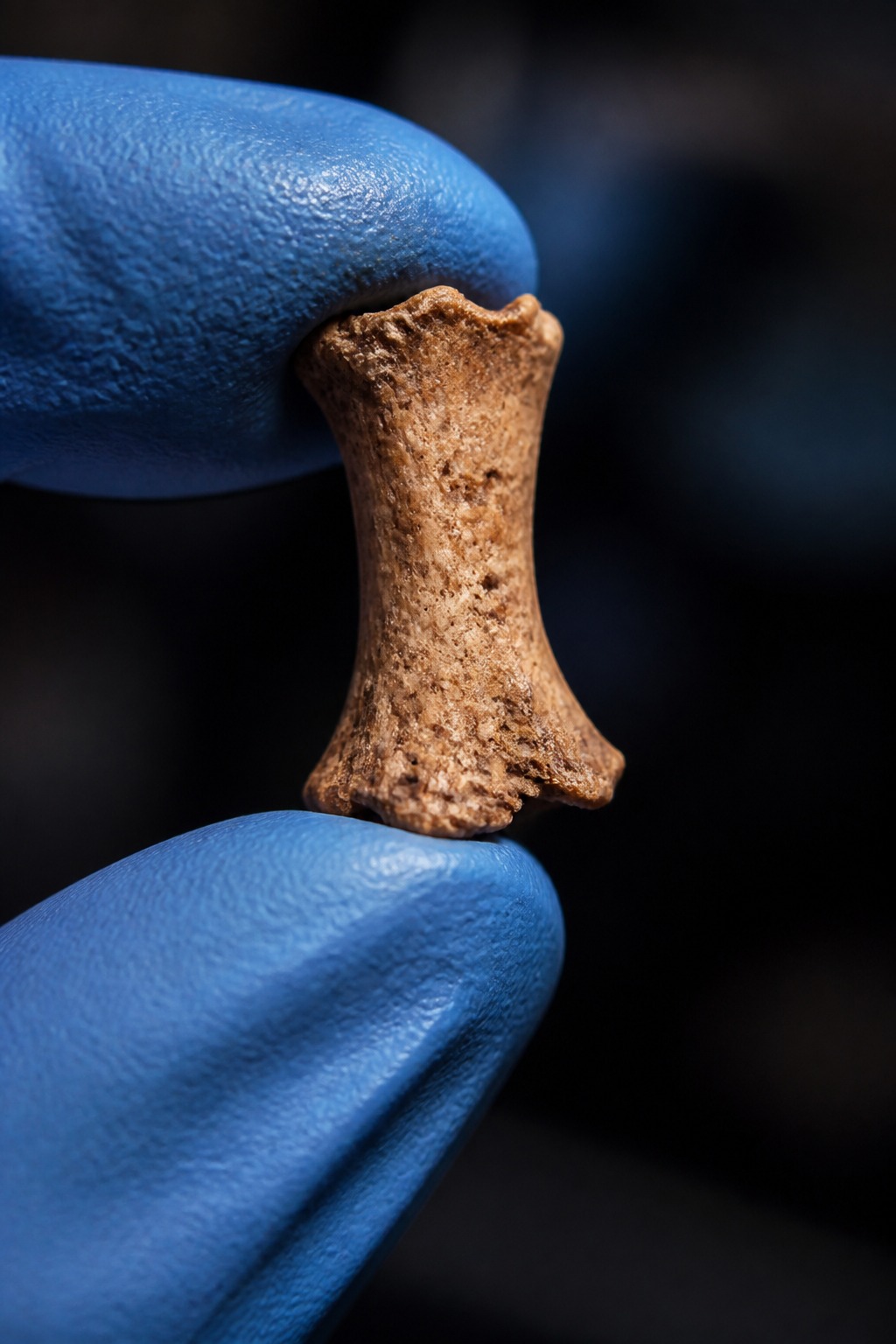
- Found: 2008, Denisova Cave, Altai Mountains, southern Siberia
- The bone: a young girl’s pinky (distal phalanx), a chip under 2 cm
- Age: roughly 30,000–50,000 years old
- Named: “Denisovan,” after the cave — the first human group ever defined by genetics alone (2010)
- Living legacy: 4–6% of the DNA of present-day Melanesians and Papuans
Key Facts
- The Denisovan finger bone was found in 2008 in Denisova Cave, Altai Mountains, southern Siberia
- The fragment is a young girl’s pinky (distal phalanx), a chip under 2 cm, roughly 30,000-50,000 years old
- About 40 milligrams of the bone was ground up to extract and sequence its DNA
- Denisovans were defined by genetics alone in 2010, the first human group so identified, splitting from Neanderthals roughly 400,000-500,000 years ago
- Present-day Melanesians and Papuans carry roughly 4-6% Denisovan DNA
In short: The Denisovan finger bone, a girl’s pinky under 2 cm found in 2008 in Siberia’s Denisova Cave, defined an entire new branch of humanity through DNA alone in 2010. Sequenced from about 40 milligrams of bone, it revealed a population distinct from both modern humans and Neanderthals whose genes survive in living people.
The pinky that belonged to no one we knew
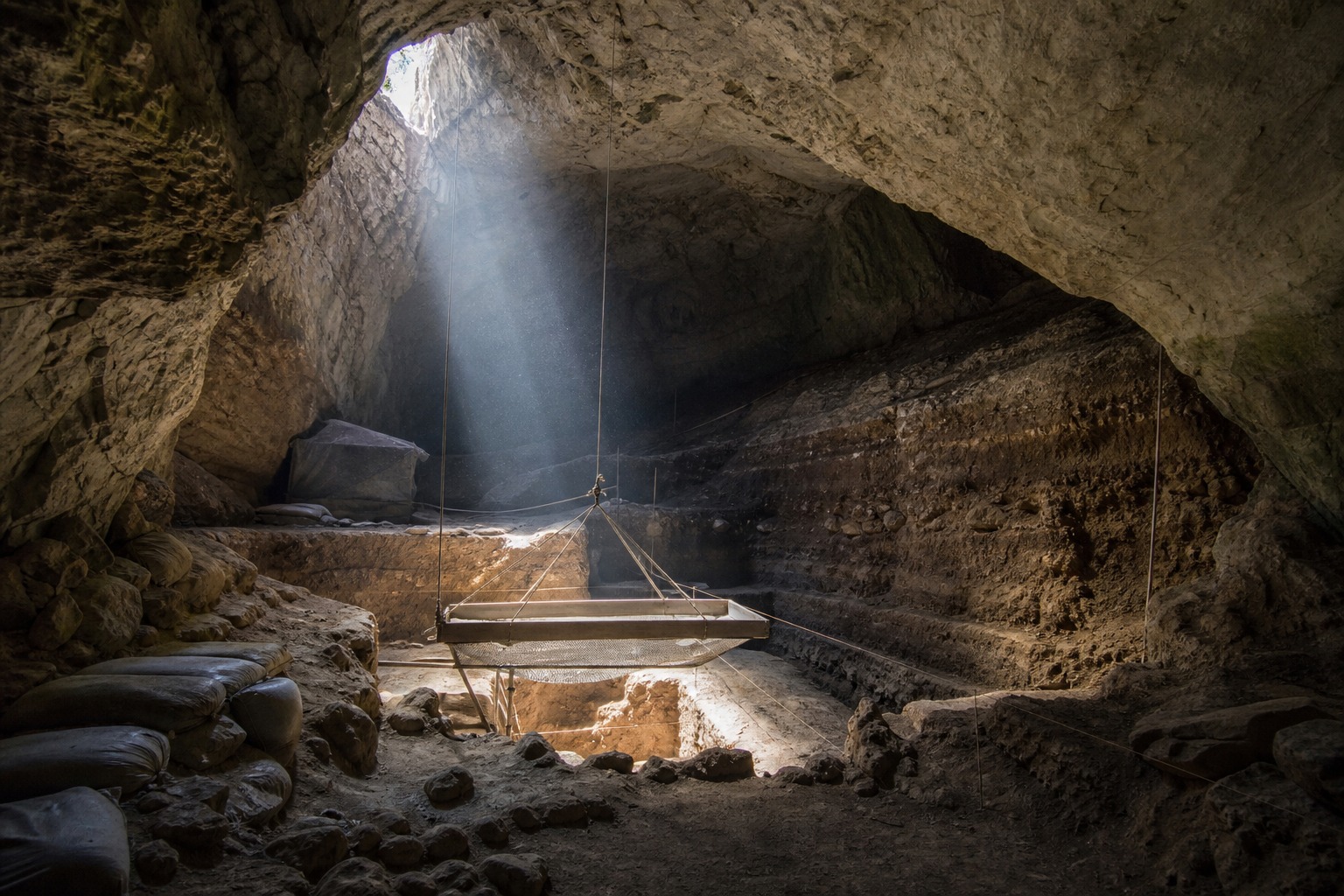
In the summer of 2008, Russian archaeologists sifting the deep floor of Denisova Cave lifted out a bone fragment so ordinary-looking that it was catalogued and set aside. Denisova is a generous site — Neanderthals lived here, modern humans passed through, and the sediment is packed with tools, teeth, and animal remains. A single tip of a finger did not announce itself.
Here’s the thing that makes this cave so frustrating and so rich at once: almost nothing found here is whole. The floor was, at stretches, a carnivore den, and many surviving human remains are chewed, digested scraps — most of the dozen-odd Denisovan fossils are under two centimetres. You do not reconstruct a face from that. For years, that is exactly the wall this population sat behind.
So the team did the only thing the material allowed. Instead of measuring the bone, they ground a sliver of it — about 40 milligrams — and went looking for the instructions written inside.
What the Denisovan finger bone discovery revealed — from 40 milligrams to a new human
So how do you identify an entire branch of humanity from a chip of bone? You read its DNA, in two steps, and the order matters.
First came the easy target: mitochondrial DNA, the small genome inside our cellular power plants, present in thousands of copies per cell. When Johannes Krause and Svante Pääbo’s team at the Max Planck Institute for Evolutionary Anthropology in Leipzig sequenced it in 2010, the result stopped them cold. This mtDNA’s last shared maternal ancestor with living people and Neanderthals sat about a million years back — roughly twice as deep as the split between Neanderthal and modern-human mtDNA. Nothing human was supposed to be that different.
Then came the hard prize. Later that year, a group led by David Reich and Pääbo published the full nuclear genome — the real blueprint — in Nature. It confirmed the shock: the girl was neither Neanderthal nor Homo sapiens, but a distinct population, a sister group to Neanderthals. There was no fossil to name it after, no jaw, no braincase. So it took the name of the place. The Denisovans became the first kind of human ever discovered from genetics alone, before anyone knew what they looked like.
{IMAGE_2}
Cousins, not strangers: splitting from Neanderthals 400,000 years ago
Read the genome as a family tree and the picture sharpens. The ancestors of Denisovans and Neanderthals split from our own lineage first; then, somewhere between roughly 400,000 and 500,000 years ago, that branch itself divided in two. Neanderthals spread west across Europe and the Middle East. Denisovans went east into Asia. Same grandparents, different continents.
And they did not stay apart. In 2018, a team led by Viviane Slon and Pääbo sequenced another tiny Denisova fragment — a bone chip nicknamed “Denny” — and found a first-generation hybrid: a girl with a Neanderthal mother and a Denisovan father, who lived around 90,000 years ago. To catch two vanished human groups in the act of one family, in a single bone, in a single cave, is astonishing luck. It also settled the argument. These were not isolated species passing like ships. They met, and they had children.
They’re still inside us: Denisovan DNA in living people
The Denisovans are gone, but they are not entirely absent. When modern humans moved into Asia, they interbred with Denisovans too — and that inheritance survives, unevenly, across the region. It peaks far to the southeast: people in Papua New Guinea and across Melanesia carry roughly 4–6% Denisovan DNA, with fainter traces spread through island Southeast Asia and the Philippines.
Some of it did real work. The clearest case is EPAS1, a gene variant that helps Tibetans thrive above 4,000 metres without thickening their blood dangerously — a form that a 2014 study led by Emilia Huerta-Sánchez traced back to Denisovans. In other words, a vanished people handed a living population one of its most vital survival tools. Denisovan-derived immune variants, including in the HLA system that helps the body recognise pathogens, persist in Asian and Oceanian populations too.
That is the quietly stunning part of this story. A branch of humanity we only met through a fingertip is not just a museum curiosity — for millions of people alive today, it is a working part of their own biology.
2025: the year the finger bone got a face
For fifteen years the Denisovans had a genome and no face. The pinky told us who they were and stayed silent on what they looked like. That changed in June 2025.
The answer came from a skull with its own cinematic backstory — the “Harbin cranium,” a massive, nearly complete braincase reportedly hidden down a well in northeast China in the 1930s and only handed to scientists decades later. Described in 2021 and nicknamed “Dragon Man” (Homo longi), it was clearly archaic but hard to place. Then two 2025 papers cracked it. In Science, a team including Qiaomei Fu of the Chinese Academy of Sciences recovered 95 ancient proteins from the skull, several carrying Denisovan-specific signatures. In Cell, the same effort pulled mitochondrial DNA from hardened dental plaque — calculus scraped from the ancient gumline — and it, too, was Denisovan.
The pinky had a head, fifteen years late.
The Harbin skull, dated to at least 146,000 years, is now the only Denisovan cranium known to science — a heavy-browed, broad face with room for a brain as large as ours. That reversal, genome first and face last, is the most quietly radical thing about the whole affair: for once biology led and anatomy followed.
An empire mapped backwards: from one Siberian cave across Asia
Once scientists knew the molecular signature to look for, the Denisovans stopped being a Siberian footnote and started turning up everywhere. A jawbone from Baishiya Karst Cave on the Tibetan Plateau — the Xiahe mandible, about 160,000 years old — was tied to Denisovans through ancient proteins in 2019, proving they had conquered high altitude long before Tibetans inherited the gene for it. A jaw dredged from the seabed off Penghu, Taiwan, was linked to them by protein analysis in 2025. Teeth from a cave in Laos push the range into the tropics.
Put the finds on a map and you see it: not a single cave but a continent-spanning people who endured freezing Siberian winters, thin Himalayan air, and humid Southeast Asian forests. We are, in effect, discovering an empire backwards — from its faintest trace to its full extent.
Why this rewrote the human family tree — and what’s still missing
Before 2010, the story of recent human evolution had two main characters: us and the Neanderthals. The Denisovan finger bone discovery added a third, and it did so by proving a new method could work — that a whole population could be resurrected from degraded DNA when no diagnostic fossil existed. In 2022, Svante Pääbo was awarded the Nobel Prize in Physiology or Medicine for the genome sequencing that made all of this possible. As paleoanthropologist Chris Stringer of London’s Natural History Museum has often noted, the Denisovans were, in a real sense, created from DNA work — a people known first as a sequence.
Yet enormous gaps remain. We still have no full Denisovan skeleton, and only one confirmed skull. We do not know their full geographic range, how many distinct Denisovan populations there were, or exactly when — and why — they vanished. The finger bone opened a door. Most of the room behind it is still dark.
Questions readers ask
Who were the Denisovans? An extinct group of archaic humans, close cousins of Neanderthals, who lived across Asia from Siberia to Southeast Asia. They were first identified in 2010 from DNA in a finger bone — the first human group ever defined by genetics rather than by anatomy.
What did the Denisovan finger bone reveal? That the girl it belonged to was neither Neanderthal nor modern human, but a separate population whose lineage had split from ours hundreds of thousands of years earlier. It rewrote the recent human family tree and showed that ancient DNA alone could reveal an unknown people.
Do humans today have Denisovan DNA? Many do. People in Papua New Guinea and Melanesia carry about 4–6%, with lower traces across Asia and island Southeast Asia. Some of it is functional — most famously the EPAS1 variant that helps Tibetans live at high altitude.
What did Denisovans look like? Until 2025, essentially unknown. The Harbin “Dragon Man” skull, confirmed as Denisovan that year, offers the first real glimpse: a large, robust face with a heavy brow and a brain roughly the size of our own.
Sources and notes
- Reich, Krause, Pääbo et al., “Genetic history of an archaic hominin group from Denisova Cave in Siberia,” Nature, 2010 — Max Planck Institute for Evolutionary Anthropology, Leipzig
- Fu Qiaomei et al., “The proteome of the late Middle Pleistocene Harbin individual,” Science, June 2025 — Chinese Academy of Sciences
- Fu Qiaomei et al., Denisovan mitochondrial DNA from dental calculus of the Harbin cranium, Cell, June 2025 — Chinese Academy of Sciences
- Huerta-Sánchez et al., on the EPAS1 high-altitude variant, Nature, 2014
- Slon, Pääbo et al., the “Denny” Neanderthal–Denisovan hybrid, Nature, 2018
- Nobel Assembly at Karolinska Institutet — 2022 Nobel Prize in Physiology or Medicine, Svante Pääbo; and Natural History Museum, London (Chris Stringer)
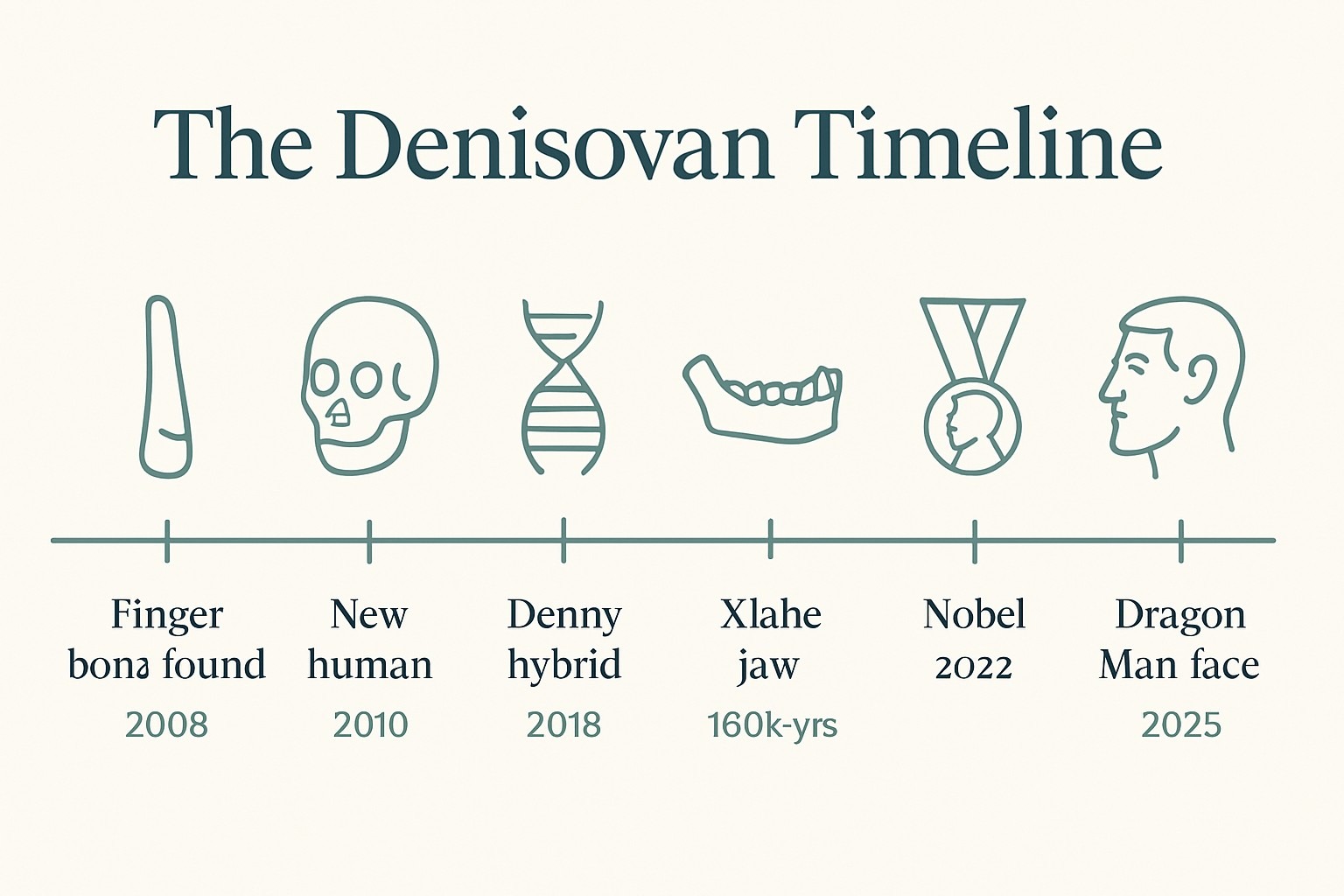
A single fingertip turned two human relatives into three and handed millions of living people a piece of their own ancestry they never knew they carried. The face finally arrived in 2025. But the biggest question the pinky raised is still open: how far did this vanished empire really stretch — and what else is waiting, unread, in a drawer of tiny bones?
Frequently Asked Questions
Q: How was a whole new human group identified from one finger bone?
The bone was too small to reconstruct a face, so the team ground about 40 milligrams and read its DNA in two steps. First they sequenced mitochondrial DNA in 2010, whose last shared maternal ancestor with living people and Neanderthals sat about a million years back. Then a group led by David Reich and Paabo published the full nuclear genome in Nature, confirming the girl was neither Neanderthal nor Homo sapiens but a distinct population, named Denisovan after the cave.
Q: How are Denisovans related to Neanderthals?
Reading the genome as a family tree, the ancestors of Denisovans and Neanderthals split from our own lineage first. Then, somewhere between roughly 400,000 and 500,000 years ago, that branch itself divided in two. Neanderthals spread west across Europe and the Middle East, while Denisovans went east into Asia. They are sister groups, sharing the same grandparents but living on different continents, and they later interbred, producing hybrid offspring.
Q: Do Denisovans still exist in people alive today?
Yes, in their DNA. When modern humans moved into Asia they interbred with Denisovans, and that inheritance survives unevenly. It peaks in Papua New Guinea and across Melanesia, where people carry roughly 4-6% Denisovan DNA, with fainter traces through island Southeast Asia and the Philippines. Some of it does real work: the EPAS1 gene variant that helps Tibetans thrive above 4,000 metres traces back to Denisovans, as do certain immune variants in the HLA system.
Q: Did we ever find out what Denisovans looked like?
For fifteen years the Denisovans had a genome but no face. That changed in June 2025. The answer came from the ‘Harbin cranium,’ a massive, nearly complete braincase reportedly hidden down a well in northeast China in the 1930s and handed to scientists decades later. Described in 2021 and nicknamed ‘Dragon Man’ (Homo longi), it was hard to place until 2025 papers, including work by Qiaomei Fu of the Chinese Academy of Sciences, recovered 95 ancient proteins from the skull.
Illustrations are AI-generated. Article fact-checked and human-edited. Our editorial standards.