What Was the Roman Dodecahedron Used For? The Honest Answer
Ask what was the Roman dodecahedron used for and you get a strange, honest answer: nobody knows. Picture a hollow bronze shell the size of a tangerine, twelve flat pentagonal faces, a round hole punched through each one — every hole a different size — and a little knob at each of the twenty corners. Roman craftsmen cast around 130 of these across northwest Europe roughly 1,700 years ago. Then they left not a single word, drawing, or carving anywhere in the ancient world explaining why. It is one of archaeology’s cleanest, most stubborn blanks.
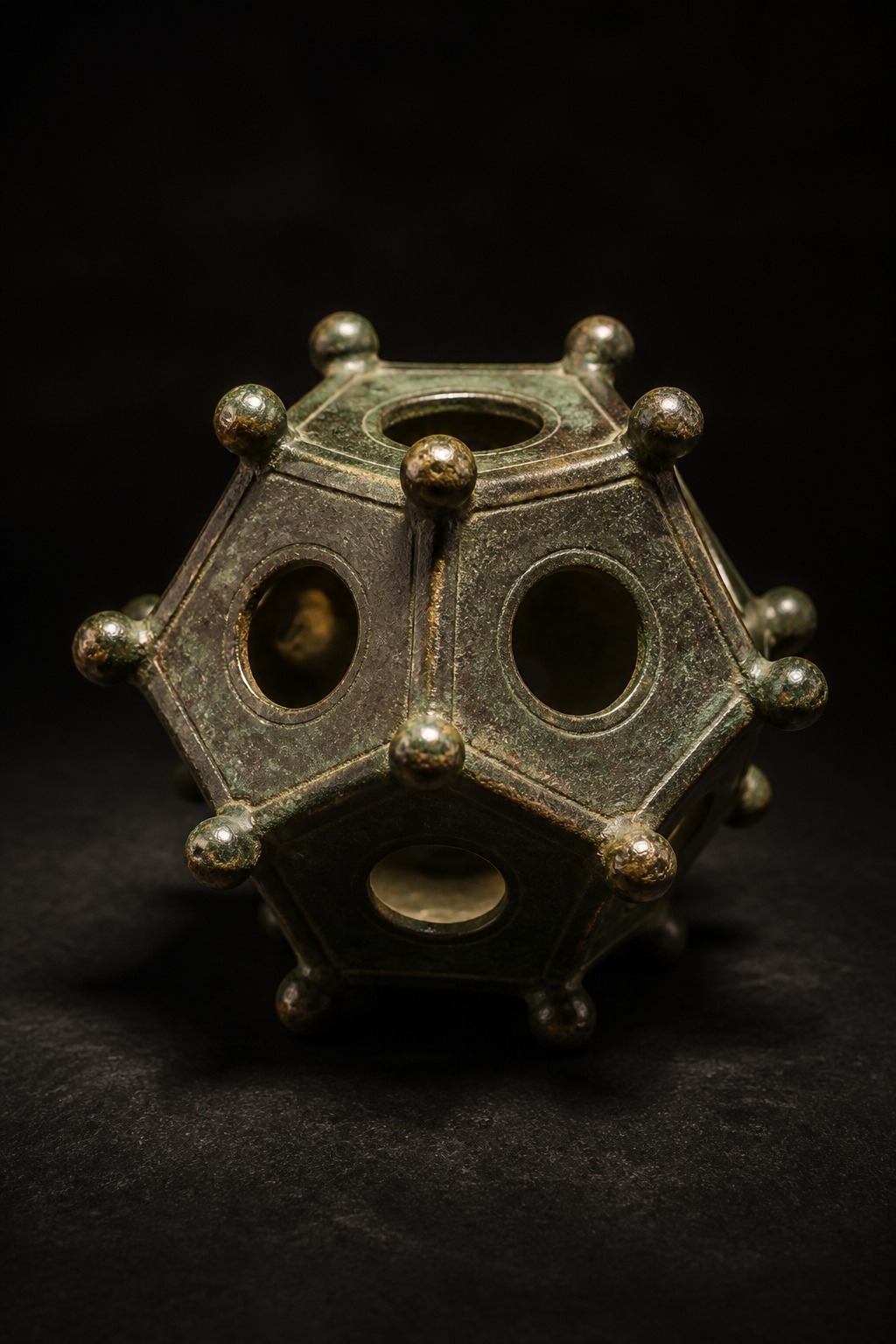
- What it is: a hollow, 12-sided copper-alloy object with round holes of varying sizes and a knob at each corner.
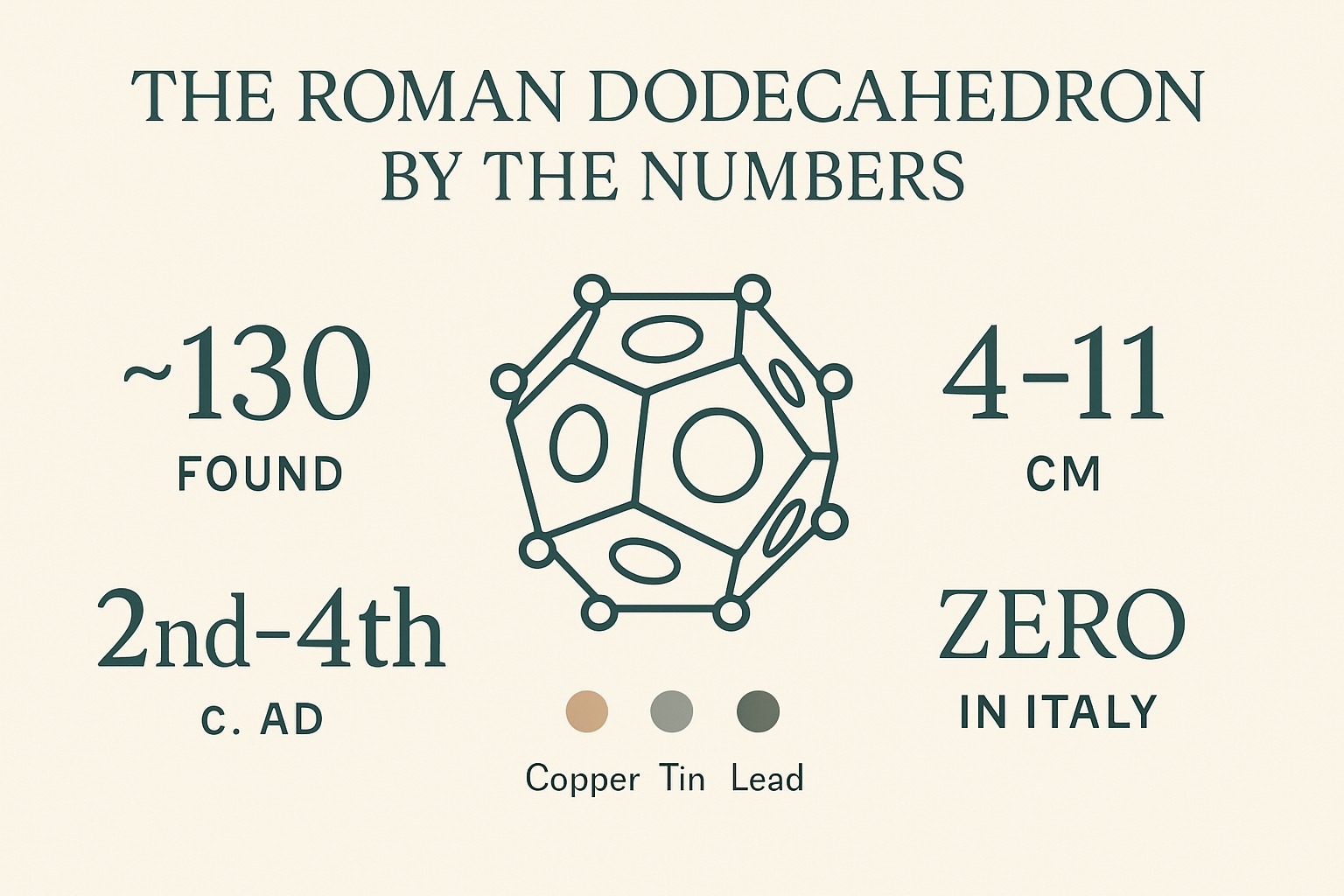
- Size & weight: 4–11 cm across; holes range from about 6 to 40 mm; weight from 35 g to over 1 kg.
- How many: roughly 130 known, spread across about nine northwest-European countries.
- Age: dated to the 2nd–4th centuries AD.
- The catch: not one Roman text, inscription, or image ever mentions or depicts them.
Key Facts
- Roman craftsmen cast around 130 known dodecahedra across about nine northwest-European countries, dated to the 2nd-4th centuries AD
- Each is a hollow copper-alloy object with twelve pentagonal faces, round holes of varying sizes, and a knob at each of the twenty corners
- The objects measure 4-11 cm across, with holes ranging from about 6 to 40 mm, and weigh from 35 g to over 1 kg
- Not one Roman text, inscription, or image ever mentions or depicts them, and scholars have floated more than fifty explanations
- In June 2023 the Norton Disney History & Archaeology Group in Lincolnshire found the 33rd recorded in Britain, deliberately placed in a large pit alongside 4th-century Roman pottery
In short: The Roman dodecahedron is a hollow twelve-faced bronze object, roughly 130 of which survive from 2nd-4th century AD northwest Europe. No Roman text ever mentions them, and over fifty theories all fail. A June 2023 Norton Disney find, deliberately deposited with 4th-century pottery, suggests a symbolic rather than practical purpose.
What is a Roman dodecahedron, exactly?
Start with the geometry, because the geometry is the whole problem. A dodecahedron is a solid with twelve identical five-sided faces — the shape gamers know as a twenty-… no, wait, that’s the icosahedron. This is the twelve-face one. The Roman version is hollow, cast from bronze (a copper alloy), and every face carries a circular opening bored straight through to the empty middle. The openings are deliberately mismatched in diameter. At each of the twenty points where faces meet sits a small rounded stud.
They are beautiful, fiddly, and completely impractical to make by accident. Casting one requires a skilled metalworker and a lost-wax mould. Whatever these things were, someone valued them enough to pay for real craftsmanship — and then never bothered to write down what they did.
That silence is the second half of the mystery. The Romans documented tools obsessively: surveying instruments, medical kits, measuring rods, dice. A groma, a cataract needle, a folding foot-rule — all show up in texts or reliefs. The dodecahedron shows up in none. For an object made in the hundreds, that absence is loud.
Every theory for what the Roman dodecahedron was used for — and where each one cracks
Scholars have floated more than fifty explanations. Here is the honest menu, with the flaw that sinks each one.
A surveying or range-finding instrument. Sight through two holes, the theory goes, and use the ratio to gauge distance. Appealing — until you notice the holes are non-standard from one object to the next. A measuring tool with no fixed calibration measures nothing repeatable. Historian Tibor Grüll, who surveyed the research literature, has stressed exactly this: the wild variation in size argues against any precision-instrument use.
A coin gauge. Drop coins through the graded holes to check their diameter. Same fatal flaw — the hole sizes don’t match a known coin series, and they differ object to object.
An astronomical or calendar device. Twelve faces, twelve months; align the holes to sunbeams. There’s no consistent geometry to support it, and no Roman astronomical text so much as hints at the shape.
A children’s toy, a candlestick, a scepter head, a dice. Each explains one feature and ignores the rest. Wax traces inside a few examples fuel the candlestick idea; the knobs and holes make it a very odd candlestick.
Turns out the one thing all the “tool” theories share is a blind spot: they were built to explain the object’s shape, not the archaeology around it. And the archaeology, when we finally got some, points somewhere else entirely.
{IMAGE_2}
The knitting myth and its 1,000-year hole
You’ve probably seen the video: someone wraps yarn around the corner knobs and produces a knitted glove finger, “proving” the dodecahedron was a Roman knitting jig. It’s charming. It’s also impossible.
Here’s the thing. True knitting — interlocking loops pulled through loops with needles — does not appear anywhere in Europe until roughly the 11th to 13th centuries AD. The earliest confirmed European knitted textiles are medieval silk fragments from Spain, made by craftspeople connected to the Islamic world, centuries later spreading north through cities like London and Oslo. The dodecahedra were cast in the 2nd to 4th centuries. That leaves a gap of the better part of a millennium between the object and the craft it supposedly served.
You cannot knit with a tool a thousand years before knitting exists. (Romans did have a looping technique called nålbinding, worked with a single needle and no frame — but it needs no knobbed bronze jig at all.) A modern person can absolutely make a modern craft work on an ancient object; that demonstrates our ingenuity, not the Romans’ intent. This is the cleanest debunk in the whole saga, and it’s the one most popular articles still soft-pedal.
Norton Disney, 2023: the one found where it was buried
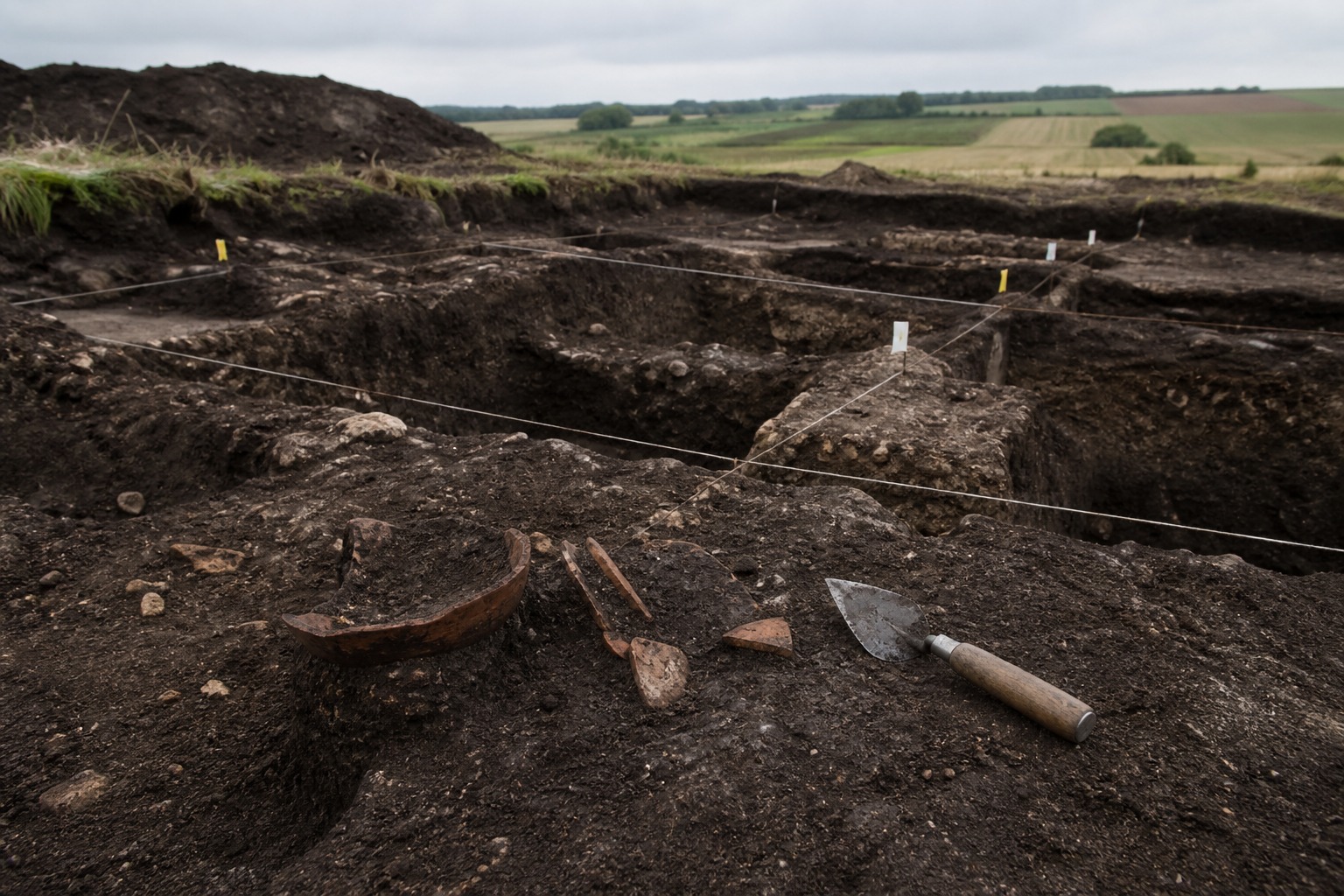
For centuries almost every dodecahedron came to light the same useless way — a farmer’s plough, a metal detector, a stray dig — stripped of any context that could explain it. Then, in June 2023, a community excavation by the Norton Disney History & Archaeology Group in Lincolnshire changed the game.
Their find — the 33rd recorded in Britain and the first ever from the Midlands — wasn’t a random stray. It had been placed, deliberately, in a large pit alongside 4th-century Roman pottery. In archaeology, a careful, intentional deposit is a different kind of evidence from a lost object. It suggests the dodecahedron was meant to go into the ground, the way ritual offerings were.
The group, whose members have handled and studied the object directly, argue it was never a practical tool at all. Strip away the viral videos and the honest picture is close to the opposite of what the internet tells you: the best-documented example we have looks less like a clever gadget and more like something whose whole purpose may have been symbolic. The same Norton Disney landscape has yielded other Romano-British ritual material, deepening the sense of a site where such objects belonged to belief, not the toolbox.
The clue hiding in the map
Now zoom out to a map of every find, and a fingerprint jumps out. Roman dodecahedra cluster in the cool, formerly Celtic provinces of the northwest — Gaul, the Rhineland, Britain, the Low Countries. Museums in Tongeren, Belgium and Bonn, Germany hold fine examples.
And Italy? Rome itself, the empire’s heart, the place with the most Romans and the most Roman writing? Not one. Zero dodecahedra have ever been found in Italy.
That single fact reframes everything. An object that appears in the provinces but never at the center is unlikely to be a standard piece of imperial kit — the army and the bureaucracy would have carried it everywhere. It reads instead like something local, provincial, possibly rooted in Gallo-Roman or Celtic religious practice that Rome’s writers never covered because it wasn’t theirs. The scholar Michael Guggenberger, who catalogued the theories in detail, is among those who lean toward a religious or cult explanation over any utilitarian one.
What the metal and the missing wear tell us
The Norton Disney object also let scientists read its recipe. Analysis put it at roughly 75% copper, 7% tin, and 18% lead — an unusually lead-heavy bronze. That matters in two ways.
- Alloy: ~75% copper · 7% tin · 18% lead — a costly, high-lead bronze.
- Wear: no scratches, no polish, no functional wear on the well-preserved examples.
- Standardization: none — sizes and hole diameters vary from object to object.
First, the high lead content and the expense of the metal point to a prestige object, not a disposable field instrument. Second — and this is the quiet killer — the best-preserved dodecahedra show no functional wear. A surveying tool used in the field for years develops scuffs, polish, stress at the contact points. These don’t. An object that was handled, valued, and deposited intact but never actually worked is exactly what you’d expect from a votive or status piece.
Stack that with a further clue: several dodecahedra have turned up in coin hoards and in the graves of well-off women. Objects buried with wealth, or with the dead, tend to carry meaning rather than utility.
So what was the Roman dodecahedron used for? The honest 2026 answer
Put the strands together and the direction is clear, even if the destination isn’t. What was the Roman dodecahedron used for? On the current evidence — the deliberate ritual deposit at Norton Disney, the total absence from Italy, the missing wear, the pricey lead-rich bronze, the non-standard holes, the finds in hoards and rich graves — the most defensible answer in 2026 is that these were ritual or symbolic objects, most likely tied to local Gallo-Roman religious practice, rather than any measuring, surveying, or knitting tool.
But “ritual” is honestly a label archaeologists reach for when an object clearly mattered and clearly wasn’t practical. It names the category, not the ceremony. Were they used in a cult of a particular deity? Turned during a rite? Kept as protective charms? Passed down as heirlooms of status? We genuinely don’t know, and anyone who tells you the case is closed is selling you a headline. The 2026 flood of “scientists finally solved it” videos adds no real evidence — they’re AI-generated filler.
What’s new here is the reframing: the mystery was never really “what does the shape do.” It was “who made these, where, and why only there” — and the ground at Norton Disney, not the geometry, is finally starting to answer that.
Common questions
How old is the Roman dodecahedron? They date to the 2nd–4th centuries AD, making the objects roughly 1,700–1,900 years old.
How many Roman dodecahedrons have been found? About 130 across northwest Europe. The June 2023 Norton Disney find was the 33rd from Britain and the first from the English Midlands.
Why is it still a mystery? No ancient text or image mentions them, they vary too much to be a standardized instrument, they show no functional wear, and until recently almost all were found without archaeological context.
Were they used for knitting? No. Knitting doesn’t appear in Europe until around the 11th–13th centuries AD, roughly a thousand years after the last dodecahedron was cast. A modern person can knit on one, but the Romans could not have.
Sources and notes
- Norton Disney History & Archaeology Group — excavation report and analysis of the 2023 dodecahedron
- Wikipedia — “Roman dodecahedron” (find totals, distribution, dimensions, scholarship)
- Live Science — reporting on the Norton Disney find as Britain’s 33rd
- Smithsonian Magazine — coverage of dodecahedra from coin hoards and wealthy graves
- Gallo-Roman Museum, Tongeren, and Rheinisches Landesmuseum, Bonn — collections holding notable examples
Seventeen centuries on, the twelve-sided riddle keeps its shape. We now know, with real confidence, several things it almost certainly was not — not a knitting jig, not a survey tool, not everyday Roman kit. What it truly meant to the hands that cast it, buried it, and never wrote it down remains open. And maybe that quiet, deliberate silence was always part of the point.
Frequently Asked Questions
Q: What was the Roman dodecahedron used for?
The honest answer is that nobody knows. Around 130 of these hollow, twelve-faced copper-alloy objects survive from 2nd-4th century AD northwest Europe, yet not one Roman text, inscription, or image ever explains them. Scholars have floated more than fifty theories, from surveying instruments to coin gauges to calendar devices, but each explains only one feature and ignores the rest. The 2023 Norton Disney find, deliberately deposited, suggests the purpose may have been symbolic rather than practical.
Q: Could the dodecahedron have been a knitting tool?
No. True knitting, interlocking loops pulled through loops with needles, does not appear anywhere in Europe until roughly the 11th to 13th centuries AD. The earliest confirmed European knitted textiles are medieval silk fragments from Spain. The dodecahedra were cast in the 2nd to 4th centuries, leaving a gap of nearly a millennium between the object and the craft. You cannot knit with a tool a thousand years before knitting exists. Modern people can make it work, but that shows our ingenuity, not Roman intent.
Q: What made the Norton Disney discovery important?
In June 2023 a community excavation by the Norton Disney History & Archaeology Group in Lincolnshire found the 33rd dodecahedron recorded in Britain and the first ever from the Midlands. Unlike most examples, which came from ploughs or metal detectors stripped of context, this one had been placed deliberately in a large pit alongside 4th-century Roman pottery. A careful, intentional deposit is different evidence from a lost object, suggesting the dodecahedron was meant to go into the ground like a ritual offering.
Q: What does a Roman dodecahedron look like?
It is a hollow copper-alloy object with twelve identical five-sided pentagonal faces, each carrying a circular opening bored straight through to the empty middle. The openings are deliberately mismatched in diameter. At each of the twenty points where faces meet sits a small rounded stud or knob. They measure 4-11 cm across, with holes ranging from about 6 to 40 mm, and weigh from 35 grams to over 1 kg. Casting one required a skilled metalworker and a lost-wax mould.
Illustrations are AI-generated. Article fact-checked and human-edited. Our editorial standards.