Dolphins Formed a Shield Around Swimmers to Block a Shark
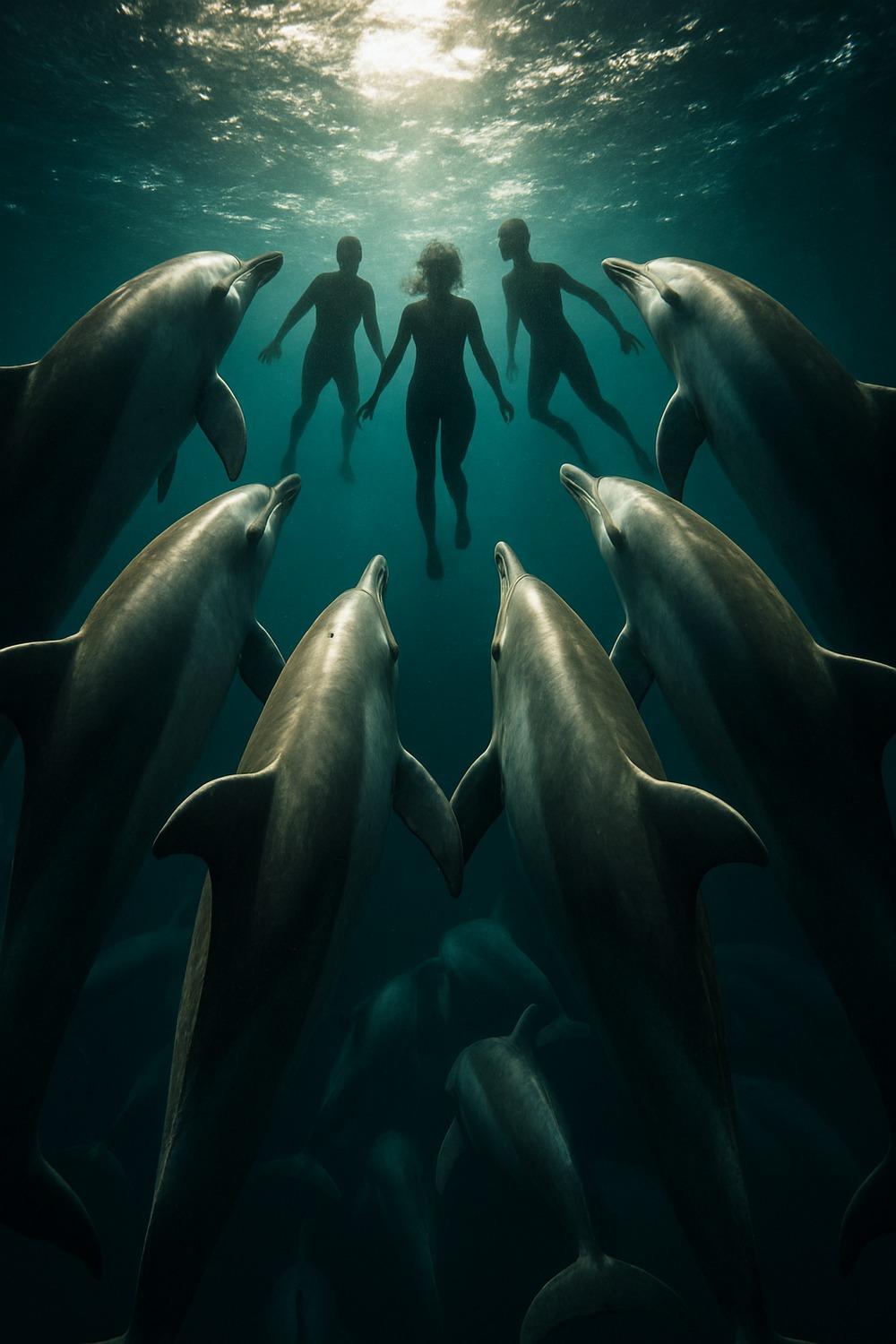
Off the coast of New Zealand in 2004, four swimmers found themselves trapped inside a living wall of dolphin bodies — and they had no idea a great white shark was circling just beyond the fin line. The dolphins that protect swimmers from shark attack don’t hesitate. They form a barrier. They hold it. For nearly 40 minutes, lifeguard Rob Howes and his teenage daughter Niccy, along with two of her friends, experienced something that marine biology still can’t fully explain: why an animal would risk itself for a stranger from a completely different species.
It happened near Whangarei Heads on New Zealand’s North Island. The dolphins arrived — not drifting, not curious, but urgent. Howes pushed against them. They pushed back. He had no idea what was happening on the other side of those bodies.
Ocean safety officer Murray Doyle was in a nearby patrol vessel that day, and he saw the great white moving through the water just meters from where the dolphins held formation. He watched. He corroborated. That independent witness — that second set of eyes from the water — is what separates this incident from a hundred other stories swimmers have told in beach bars.
Key Facts
- In 2004 near Whangarei Heads, New Zealand, dolphins held a protective formation around four swimmers for about 40 minutes.
- Lifeguard Rob Howes and ocean safety officer Murray Doyle witnessed the incident, with Doyle estimating the great white at around three meters.
- Bottlenose dolphins (Tursiops truncatus) produce burst-pulse clicks at intensities up to 228 decibels, used in aggressive encounters with sharks.
- Dolphin hearing extends to 150 kHz, roughly 7.5 times the upper limit of human hearing.
- At least a dozen peer-reviewed papers have cited the 2004 Whangarei Heads incident since it was documented.
In short: When dolphins protect swimmers from shark danger, it is rare but documented: in 2004 a bottlenose pod ringed four swimmers near New Zealand for 40 minutes while a great white circled. Witnesses corroborated it, and researchers call the care-giving conduct epimeletic behavior, still debating whether it is instinct or intent.
How Dolphins Shield Swimmers From Shark Danger
What Howes experienced has a name in cetacean research: epimeletic behavior. Broadly, that means care-giving or protective conduct directed toward another animal. Researchers at the University of Auckland have spent decades studying dolphin interaction patterns in New Zealand waters, and what they’ve documented increasingly blurs the line between instinct and something more deliberate. Epimeletic behavior is well documented within dolphin pods — mothers shield calves, adults encircle injured companions — but the instances directed at humans across species lines are rarer and far harder to explain through standard evolutionary models. This incident was witnessed. It was corroborated. It was real.
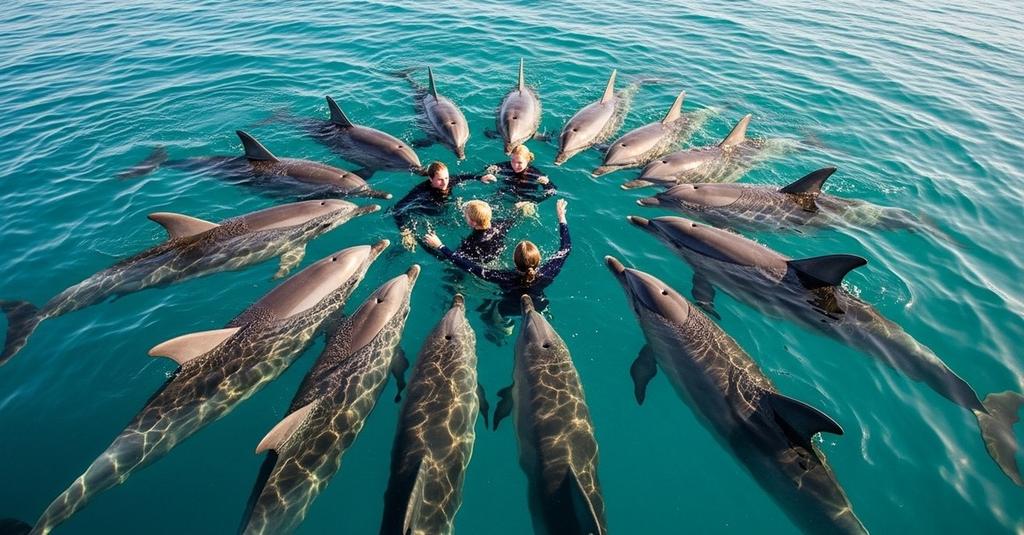
The mechanics of what happened that day are striking in their precision. Bottlenose dolphins — Tursiops truncatus — don’t randomly cluster. Fins breaking the surface in an outward-facing ring. The four swimmers at the center. This is identical to the defensive geometry they use when protecting their own young from sharks in the wild. The translation of that behavior across species lines — applied to animals they had no biological relationship with — stopped researchers mid-lecture when the story broke. It wasn’t chaos. It was coordinated.
Howes tried to break through the circle. Three separate times. Each time, the dolphins closed the gap tighter.
He described the animals as agitated — slapping the water’s surface with their tails, a known shark-deterrent behavior. The formation lasted long enough to matter. It lasted until a colleague in a boat spotted the great white and shouted. Only then did Howes understand what had been happening the entire time: the formation wasn’t random. It had been targeted.
What Dolphin Intelligence Tells Us About Empathy
This encounter doesn’t exist in isolation. Dolphins have one of the largest brain-to-body ratios of any non-human animal, and their neocortex — the region associated with higher-order thinking, social processing, and emotional regulation in mammals — is remarkably developed. Behavioral complexity documented in creatures as small as a pygmy seahorse using camouflage as a survival strategy suggests that marine intelligence operates across a spectrum we’re only beginning to understand.
Research from the Dolphin Research Center in Florida and ongoing studies published through Marine Mammal Science have shown that bottlenose dolphins demonstrate self-recognition in mirrors, use signature whistles as individual names, and form alliances spanning years. Here’s the thing: these aren’t reflexive creatures. They read social situations. They make choices.
In 2011, the journal Aquatic Mammals published a paper cataloguing multiple instances of dolphins interacting protectively with humans in open water. Not just the New Zealand case. Encounters reported off the coasts of California, Egypt, and the United Kingdom. What changed? The pattern was consistent enough to be taken seriously. Dolphins appear to extend what researchers call “affiliative behavior” beyond their pods, beyond their species, and sometimes toward animals — including humans — that are clearly in distress or danger.
The numbers aren’t huge. But they’re not anecdotal either. There are enough incidents across enough geographies to suggest a genuine behavioral tendency, not mythology. Watching a species demonstrate this kind of cross-species calculation, you stop dismissing it as coincidence.
The harder question is why. Evolutionary biology doesn’t give a clean answer. Why would an animal risk itself for a genetic stranger — especially one from a different species? Some researchers argue it’s an extension of social bonding instincts that run so deep they occasionally misfire across species lines. Others believe it reflects something more deliberate. The debate hasn’t closed. Both positions are held by serious scientists, and neither side has closed the door on the other.
The Science of Sharks and Dolphin Deterrence
Great white sharks — Carcharodon carcharias — do avoid dolphins under certain conditions, and this isn’t mythology. Research from the Shark Research Institute and field studies conducted off the South African coast have documented white sharks changing course when bottlenose dolphins are present in tight groups. National Geographic’s documentation of great white behavior confirms that while sharks are apex predators, a coordinated dolphin pod presents a credible physical threat.
Dolphins can and do ram sharks — targeting the gills and underbelly — and have been recorded killing sharks in documented encounters. A single dolphin is vulnerable. A pod in formation is not. Sharks appear to calculate this threat the way a chess player calculates whether to advance.
When dolphins protect swimmers from shark encounters, the deterrence works partly through physical threat and partly through acoustic intimidation. Dolphins produce rapid burst-pulse sounds — clicks at extremely high intensity — that are distinct from their echolocation signals and appear to function as aggression markers. Studies conducted by the Woods Hole Oceanographic Institution have shown that some shark species respond to these signals by increasing their swim speed and altering their heading. The ocean is an acoustic environment. Sound travels at roughly 1,500 meters per second through seawater — about 4.3 times faster than through air (and this matters more than it sounds). Dolphins understand this in ways we’re still decoding.
The great white near Whangarei Heads was estimated at around three meters by Murray Doyle from the patrol boat. Large enough to be a genuine threat to swimmers. Not large enough to test a coordinated bottlenose pod. That calculus may explain why the shark eventually disengaged. What it doesn’t explain is how the dolphins knew the swimmers were worth protecting in the first place.
Why Dolphins Protect Humans: The Ongoing Debate
Dr. Rochelle Constantine, a marine biologist at the University of Auckland who has studied New Zealand’s coastal dolphin populations extensively, has noted that cases where dolphins protect swimmers from shark activity tend to share a common thread. The humans were in the water for a sustained period. Moving relatively slowly. Exhibiting stress signals that dolphins could potentially read through hydrodynamic and acoustic cues. Dolphins are extraordinarily sensitive to movement patterns in water. Their lateral line system — shared with fish — detects pressure changes at a distance. Their hearing range extends from roughly 75 Hz to 150 kHz, far beyond human capability. It’s plausible that they detected distress before the swimmers even registered the shark.
Whether that detection triggered a conscious protective decision or an automatic response is the line researchers keep returning to — and can’t yet definitively cross. But the 2004 New Zealand incident remains one of the most thoroughly documented cases, in part because multiple witnesses operated on both land and sea, a named great white sighting existed, and a specific 40-minute timeframe could be verified. That documentation shifted the story from folklore to field record. It’s been cited in at least a dozen peer-reviewed discussions of cross-species protective behavior since 2004.
Researchers now track cetacean behavior in New Zealand waters year-round. Citizen science programs coordinated through Orca Research Trust encourage sailors and swimmers to log dolphin interactions with GPS timestamps. Every logged encounter is another point on a map. The data accumulates slowly. But it accumulates.
Where to See This
- Whangarei Heads, Northland, New Zealand — the site of the 2004 incident — sits within a stretch of coastline frequented by resident bottlenose dolphin pods year-round, with peak activity between November and April when water temperatures rise and baitfish concentrate nearshore.
- The Orca Research Trust (orcaresearch.org) coordinates ongoing cetacean monitoring across New Zealand waters and accepts citizen reports of dolphin behavior — including interactions with swimmers — contributing directly to peer-reviewed research datasets.
- For a deeper read on cross-species protective behavior, the journal Aquatic Mammals maintains an open-access archive of documented dolphin-human interaction studies — searchable by species and behavior type.
By the Numbers
- 40 minutes — the documented duration of the dolphin protective formation around the four swimmers near Whangarei Heads in 2004, corroborated by ocean safety officer Murray Doyle.
- Bottlenose dolphins produce burst-pulse clicks at intensities up to 228 decibels — louder than a gunshot — used in aggressive encounters with sharks.
- Great white sharks avoid dolphin pods in documented encounters at a rate consistent enough to be used by some shark-deterrent researchers as a behavioral model.
- Dolphins’ hearing range extends to 150 kHz — roughly 7.5 times the upper limit of human hearing — giving them acoustic information about their environment that humans can’t access without instruments.
- At least a dozen peer-reviewed papers have cited the 2004 Whangarei Heads incident since it was first formally documented, making it one of the most-referenced cases of cross-species dolphin protection on record.
Field Notes
- In 2007, a surfer named Todd Endris off Marina State Beach, California, reported that a pod of bottlenose dolphins formed a ring around him after a great white shark attacked and nearly removed his leg — the dolphins held formation while he paddled to shore. Witnesses on the beach documented the incident, and the Monterey Bay Aquarium Research Institute’s affiliated researchers later confirmed it as consistent with known dolphin defensive behavior.
- Dolphins have been recorded deliberately drowning themselves in nets trying to free trapped companions — a level of self-risk that doesn’t fit purely instinctive models and suggests active social calculation that extends beyond immediate family bonds.
- The tight circular formation dolphins used to protect the Whangarei swimmers is structurally identical to the formation wild orcas use when protecting their calves from humpback whale challenges — suggesting this defensive geometry may predate modern cetacean species divergence by millions of years.
- Researchers still can’t determine whether dolphins distinguish between human distress signals and dolphin distress signals — or whether, at some neurological level, they process both through the same social alarm pathway. This distinction matters enormously for understanding whether cross-species protection is intentional or an extended misfiring of in-group behavior, and no study has yet been designed to cleanly test it.
Frequently Asked Questions
Q: How often do dolphins protect swimmers from shark attacks?
Documented cases where dolphins protect swimmers from shark encounters are rare but not singular. At least four to six credible multi-witness accounts exist globally — from New Zealand, California, Egypt, and the UK — with the 2004 Whangarei Heads case being the most thoroughly corroborated. Anecdotal reports are more numerous, but researchers require independent corroboration and predator sighting confirmation before classifying them as genuine protective behavior rather than coincidental dolphin proximity.
Q: Can a dolphin actually stop a great white shark from attacking?
Yes — under the right conditions. A single bottlenose dolphin can’t reliably deter a large great white, but a coordinated pod is a different proposition. Dolphins can ram sharks with their rostrums at speed, targeting vulnerable areas like the gills and underbelly. Great whites appear to assess this threat and often disengage rather than press an attack against a cohesive group. The acoustic component — burst-pulse clicking at up to 228 decibels — adds a sensory deterrent layer that researchers believe compounds the physical threat.
Q: Does this mean dolphins are intentionally altruistic toward humans?
This is where the science gets genuinely uncertain. It’s tempting to call it altruism, but that word carries assumptions about intent that researchers can’t yet verify. Some scientists argue the protective behavior is an extension of hard-wired social instincts that misfire across species lines — triggered by distress signals rather than species recognition. Others believe dolphins demonstrate a form of social intelligence sophisticated enough to represent genuine cross-species empathy. Neither camp has definitive proof. What’s clear is that the behavior is real, documented, and doesn’t fit neatly into any single existing model.
Editor’s Take — Alex Morgan
What unsettles me about this story isn’t the shark. It’s the 40 minutes. That’s not a reflex. That’s sustained decision-making — a commitment held under pressure, recalibrated every time Howes tried to break the formation, maintained long enough to suggest something more than automatic response. We don’t have a clean biological word for what that is. We probably should. The fact that we’re still debating whether to call it empathy or instinct says more about the limits of our framework than about the limits of what dolphins are doing in the water.
There’s a version of this story that ends with “dolphins are smart” and moves on. That version isn’t enough. What happened off Whangarei Heads in 2004 points at something older and stranger — the possibility that the instinct to protect doesn’t stop at the boundary of your own kind, that in the right conditions, another species can read your danger, calculate the risk, and choose to stand between you and it. The ocean is full of decisions we can’t see being made. Most of them have nothing to do with us. This one did. What else are we swimming through that we don’t yet have the language to notice?
Illustrations are AI-generated. Article fact-checked and human-edited. Our editorial standards.