Why Drift Racing Rewards the Thing You’re Never Supposed to Do
Nobody sets out to win a championship by going slower. But in drift racing sport, the sideways car at 100 miles per hour is the one collecting points while the faster driver watches from the sidelines.
It exists somewhere between physics and pure theater, which is probably why most people can’t quite wrap their heads around it. The rules don’t match anything else in motorsport. Lap times don’t matter. Finishing first doesn’t matter. What matters is whether you can hold a slide with enough precision and nerve that trained judges will score you on the angle of your car, the thickness of your tire smoke, and the sheer drama of not crashing into a wall. And that one decision — to reward the slide instead of punish it — changed everything about how we think about speed.
Key Facts
- Formula Drift was established in North America in 2004 and scores runs on four categories: Line, Angle, Style, and Speed, with speed carrying the least weight
- Japan’s D1 Grand Prix launched in 2001, the world’s first fully sanctioned professional drift series, three years before Formula Drift
- Drifting originated on Japan’s mountain touge roads in the 1970s, with driver Kunimitsu Takahashi discovering that a controlled slide through a hairpin could carry more speed than traditional cornering
- Top-tier professional drift cars run 800 to 1,500 horsepower, and the record competition drift angle was approximately 75 degrees from the direction of travel
- Formula Drift draws over 50,000 spectators to its annual championship finale in Irwindale, California, and a single set of competition tires can be destroyed in as little as 3 runs
In short: Drift racing sport scores drivers on holding a controlled sideways slide, not on speed or finishing first. Born on Japan’s mountain touge roads in the 1970s and codified by the D1 Grand Prix in 2001 and Formula Drift in 2004, it judges Line, Angle, Style, and Speed, rewarding deep angles and thick tire smoke over raw pace.
Drift Racing Sport Inverted Every Rule in the Playbook
In every other form of racing, a sliding car means failure. Engineers spend millions of dollars and thousands of hours trying to eliminate oversteer. Safety protocols have entire chapters dedicated to recovery. But then someone looked at that slide and asked: what if it’s not a mistake?
According to motorsport historians, drifting codified the oversteer as a discipline — scored simultaneously on angle, line adherence, speed, and visual impact. Andrew Marriott, a researcher and motorsport analyst, described it like this: “the only competition where the aesthetic of control is the competition itself.” Speed became almost irrelevant. A driver holding a deeper angle with thicker tire smoke beats a faster driver running a cleaner line.
Judges want commitment.
They want the kind of commitment that looks, from the outside, exactly like losing control.
Japan’s Mountain Passes Created Something Nobody Expected
It is 1970s Japan. The mountain roads carved through the passes called touge wind so tight that conventional cornering feels too slow. A driver named Kunimitsu Takahashi discovers something: a controlled slide through a hairpin can actually carry more speed than traditional cornering. This spreads through underground racing culture like a rumor no one can stop repeating.
What Takahashi and others were doing wasn’t reckless — and this is the part people miss. It was deeply technical. Reading the road camber. Managing throttle input with millimeter precision. Using the car’s weight transfer like a surgical tool. Recklessness would have sent them off the mountain in the first five minutes.
That last fact kept me reading for another hour.
The underground drifting culture that emerged on those mountain roads spread across Japan, then Asia, then the world. You can explore how underground movements reshape entire disciplines over at this-amazing-world.com — because this isn’t the only time a subculture rewrote the rules from the ground up.
Your Brain Is Literally Fighting Against This
Here’s what makes drift racing sport genuinely strange at the neuroscience level. Every human being carries a corrective reflex that fires the moment a car starts to slide sideways. Lift off the throttle. Counter-steer. Stop the car from falling. It’s ancient, protective, and it’s saved countless lives in normal driving situations. Your body treats oversteer as a threat because in almost every real-world scenario, it is one.
Drift drivers spend years training themselves to override that reflex entirely.
They push harder into the slide instead of backing away. They sustain what every neural pathway is screaming to stop. Neuroscientists call this “counter-intuitive skill acquisition,” and they study it because it’s extraordinarily difficult to build. The muscle memory has to actively suppress something protective. And drivers have to do it at speed, in competition, with a wall three feet away and judges watching whether they’ve made it look beautiful while doing it.
What the Judges Are Actually Scoring (And Why It Gets Weird)
Professional drift competitions use a rubric that confuses most traditional motorsport fans immediately. Formula Drift, established in North America in 2004, breaks scoring into four categories:
- Line — how closely the driver follows the designated path
- Angle — measured in degrees of deviation from the direction of travel, with judges actively preferring deeper slides
- Style — the visual quality and drama of the performance
- Speed — though this carries the least weight relative to the others
Here’s the thing: these categories create genuine tension. A driver can sacrifice line for a more dramatic angle and still win. A technically flawless run can lose to a more visually captivating one. Drift racing sport is, at some level, judged like gymnastics or figure skating — which means it’s judged like art.
Traditionalists absolutely hate this.
The crowd doesn’t cheer for precision. They cheer for smoke. And that subjectivity is exactly why drifting built the fan base it did. Drama isn’t a side effect. It’s the product.
The Tire Smoke Is Actually Data
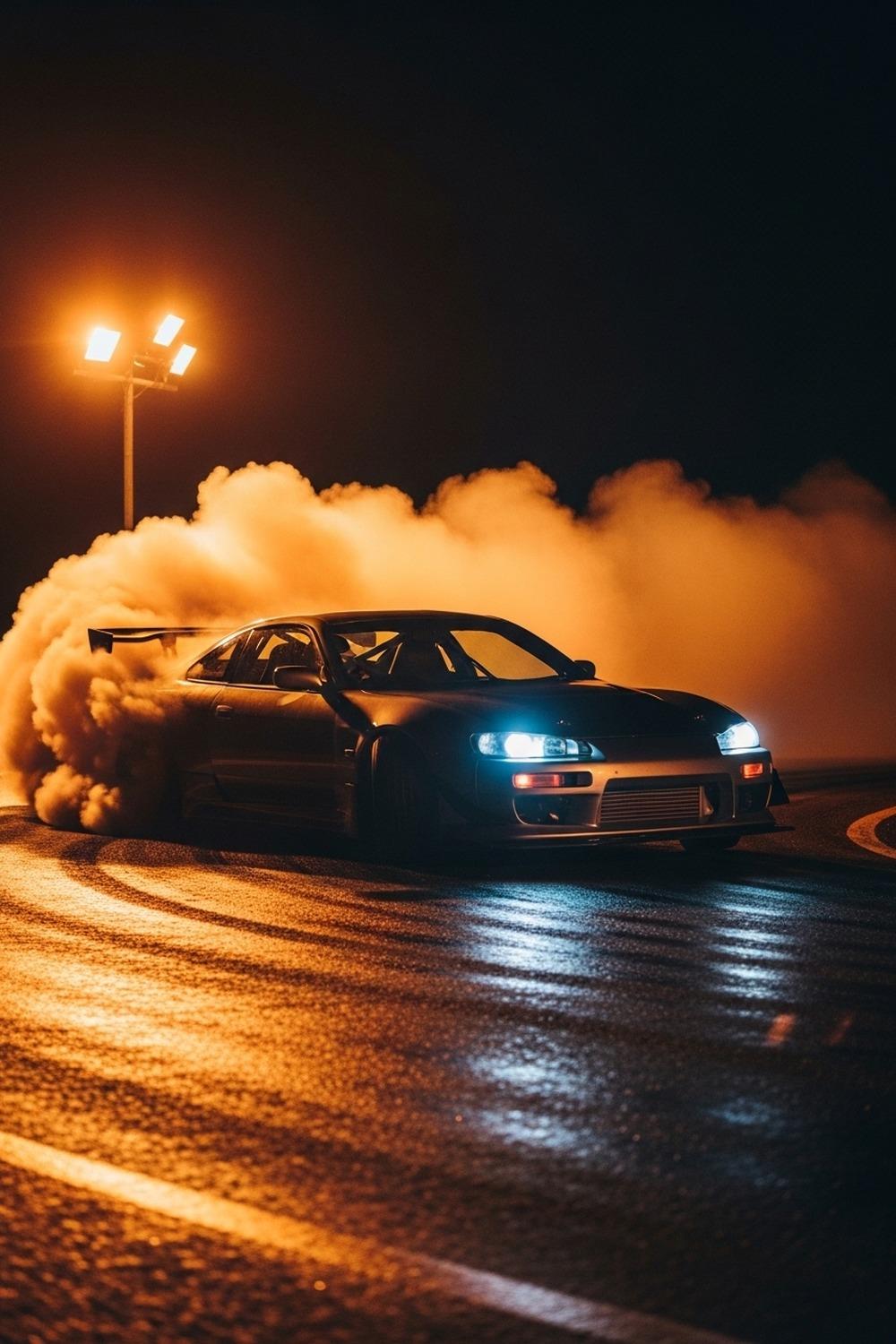
That billowing white cloud pouring off the rear tires during a drift run is one of the most honest signals in motorsport. It means the rear wheels are spinning significantly faster than the car is traveling — a state called wheelspin — which is what sustains the drift in the first place. No smoke means the driver lost the slide or never committed fully. Thick, continuous smoke means they’re holding throttle through the corner, maintaining angle, keeping the rear loose while somehow steering the front tires to stay on line.
It’s physics made visible. Judges read it instantly.
Competition tires wear through completely in a single event weekend. Teams budget for this as a normal operational cost. Some pro drivers go through 20 or more sets across a competition day, each tire sacrificed to the science of controlled sliding. The expense is significant. The commitment is total.
By the Numbers
- Formula Drift now draws over 50,000 spectators to its annual championship finale in Irwindale, California — making it one of the fastest-growing motorsport series in North America since its 2004 founding.
- 800 to 1,500 horsepower in top-tier professional drift cars. That’s far more than most race cars in comparable series because sustained wheelspin demands enormous engine output.
- The record drift angle ever recorded in competition was approximately 75 degrees from the direction of travel — meaning the car was essentially pointing nearly sideways while still moving forward.
- A single set of competition drift tires can be destroyed in as little as 3 runs, compared to endurance racing tires designed to last 50+ laps.

Field Notes
- Tandem drifting — where two cars drift simultaneously just feet apart, mirroring lines — originated in Japanese street culture and is now a professional competition staple. The lead driver’s job is to be unpredictable; the chase driver’s job is to stay close no matter what the lead car does.
- Professional drift drivers rarely come from traditional circuit racing. They come from go-karts and rally racing, both of which build the oversteer management skills that drifting demands. Speed backgrounds actually translate poorly to this discipline.
- Japan’s D1 Grand Prix launched in 2001 — the world’s first fully sanctioned professional drift series, established three years before Formula Drift and creating the judging framework that nearly every major series still uses today.
Why This Sport Reveals Something About Who We Are
There’s a question underneath all of this worth sitting with for a minute. What does it say about us that we looked at one of the most dangerous and counterintuitive things a car can do — lose traction, slide sideways, teeter at the edge of total loss of control — and decided to build a sport around doing it as beautifully as possible?
Drift racing sport didn’t come from engineering labs or corporate sponsorship meetings. It came from mountain roads and midnight runs. It came from people who refused to believe that the “wrong” way to take a corner was actually wrong.
The sport keeps winning new fans because watching someone master the thing they’re not supposed to do — watching the slide held perfectly, the smoke thick, the angle absurd and sustained — triggers something that feels a lot like awe. We root for the driver riding the edge because most of us know what it feels like to resist the instinct to overcorrect. To hold the line even when every signal says let go.
Drift racing is what happens when humans take a mistake and transform it into mastery. Sideways cars. Burned rubber. Judges awarding points for drama. Somehow, it’s also one of the most technically demanding disciplines in motorsport. The sport keeps growing because what it rewards is genuinely rare: the ability to do the hard, counterintuitive thing and make it look effortless. There’s more of this at this-amazing-world.com — and the next one gets even stranger.
Frequently Asked Questions
Q: What is drift racing sport and how is it scored?
Drift racing is a motorsport where drivers are scored on holding a controlled sideways slide rather than on lap times or finishing position. Formula Drift, established in 2004, breaks scoring into four categories: Line (how closely the driver follows the designated path), Angle (degrees of deviation from the direction of travel, with judges preferring deeper slides), Style (the visual drama), and Speed, which carries the least weight. A driver with a deeper angle and thicker tire smoke can beat a faster driver on a cleaner line.
Q: Where did drift racing originate?
Drift racing originated in 1970s Japan on mountain roads carved through passes called touge. A driver named Kunimitsu Takahashi discovered that a controlled slide through a hairpin could actually carry more speed than traditional cornering. The technique spread through underground racing culture, then across Japan, Asia, and eventually the world. Japan’s D1 Grand Prix launched in 2001 as the world’s first fully sanctioned professional drift series, three years before Formula Drift was founded in North America.
Q: Why is drifting so difficult for drivers?
Drifting is hard because it requires overriding a deep human reflex. Every person has a corrective instinct that fires when a car begins to slide sideways: lift off the throttle and counter-steer to stop the car. Drift drivers spend years training to suppress that reflex, pushing harder into the slide instead. Neuroscientists call this counter-intuitive skill acquisition and study it because the muscle memory must actively suppress a protective response, performed at speed with a wall feet away and judges watching.
Q: Why does tire smoke matter in drift racing?
Tire smoke is one of the most honest signals in drift racing because it is physics made visible. The billowing white cloud means the rear wheels are spinning significantly faster than the car is traveling, a state called wheelspin that sustains the drift. No smoke means the driver lost the slide or never committed. Thick, continuous smoke means they are holding throttle through the corner and maintaining angle. Competition tires wear out fast, with a single set destroyed in as little as 3 runs.
Illustrations are AI-generated. Article fact-checked and human-edited. Our editorial standards.