Owl Facts for Kids: How Silent Night Hunters Really Work
Looking for owl facts for kids that go deeper than the usual list? Good — because owls are stranger than almost any cartoon makes them look. They fly without making a sound. They hear in 3D. They swivel their heads almost all the way around. And one of them is the size of a teacup.
Key Facts
- There are more than 200 owl species in the world — from the sparrow-sized Elf Owl to the Great Gray Owl, which can stand about 32 inches tall.
- An owl can rotate its head about 270 degrees in either direction — three quarters of the way around, not all the way (that’s the myth).
- Most owls hunt at night and fly almost silently, thanks to comb-like serrations on the front edge of their wing feathers.
- Owl feet are zygodactyl: two toes face forward, two face backward — and they can pivot a back toe forward to grip a branch.
- A group of owls is called a parliament, a name popularized by C.S. Lewis in The Chronicles of Narnia.
In short: Owls are some of the most specialized hunters on Earth — built for silent flight, pinpoint hearing, and seeing in light so dim a human would be blind. This guide pulls together the real science behind their best tricks, busts a few stubborn myths, and helps you tell five common owls apart.
Key Facts
- There are more than 200 owl species worldwide, from the sparrow-sized Elf Owl (about 5-6 inches) to the Great Gray Owl, which can stand about 32 inches tall.
- An owl can rotate its head about 270 degrees in either direction, three quarters of the way around, not the full circle of the myth.
- Most owls fly almost silently thanks to three wing structures described by engineer Robert Rule Graham in 1934: the comb, the velvet, and the fringe.
- Owl feet are zygodactyl with two toes forward and two backward, and a back toe can pivot forward to grip a branch.
- In many species the left and right ears sit at different heights, letting the owl pinpoint sound up or down, with Barn Owl hearing among the most precise measured in any land animal by the Cornell Lab of Ornithology.
In short: Owls are highly specialized hunters built for silent flight, pinpoint hearing, and vision in extremely dim light. There are more than 200 species living on every continent except Antarctica, and much of their reputation, such as the full head-spin, is myth.
What actually makes an owl an owl?
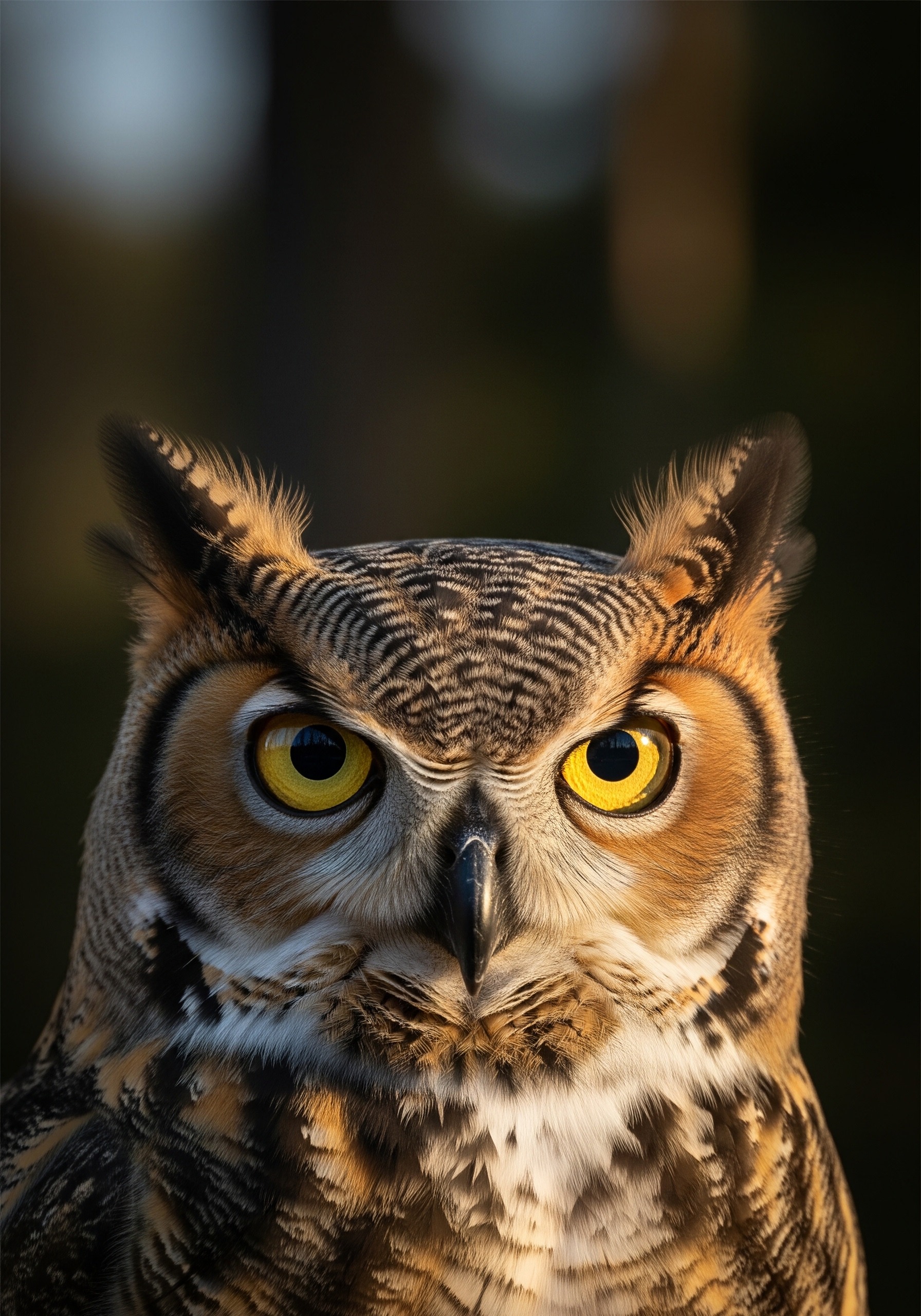
Big round head. Forward-facing eyes. A flat “facial disk” that works like a satellite dish for sound. A hooked beak hidden in feathers. Soft, fluffy plumage. That’s the owl recipe.
Scientists put owls in their own order — Strigiformes — split into two families: the barn owls, with their heart-shaped faces, and the “true” owls, with rounder faces like the Great Horned Owl. Around the world, there are more than 200 living species, and they live on every continent except Antarctica.
Most are nocturnal. A few aren’t. Snowy Owls and Northern Hawk Owls hunt in broad daylight. Burrowing Owls live in old prairie-dog tunnels in the Americas and pop up out of the ground like small feathered prairie dogs themselves.
Owl facts for kids: how silent flight really works
Here’s the trick that fascinates engineers as much as it does kids. A pigeon-sized owl can swoop within inches of a mouse, and the mouse never hears it coming. How?
Three tiny structures on each wing do most of the work. In 1934, British aeronautical engineer Robert Rule Graham first described them: the “comb” — fine serrations on the leading edge of the wing that break loud, swirling air into smaller, quieter streams; the “velvet” — a soft surface on the upper feather that absorbs sound; and the “fringe” — a soft trailing edge that smooths the air before it leaves the wing. Together, they turn flapping into a near-whisper.
It’s so effective that researchers at the American Chemical Society and aerospace labs around the world have copied owl wings to design quieter wind turbines, drones, and aircraft. A bird that hunts mice is teaching humans how to make planes.
That spinning head: 270 degrees, not 360
{IMAGE_2}
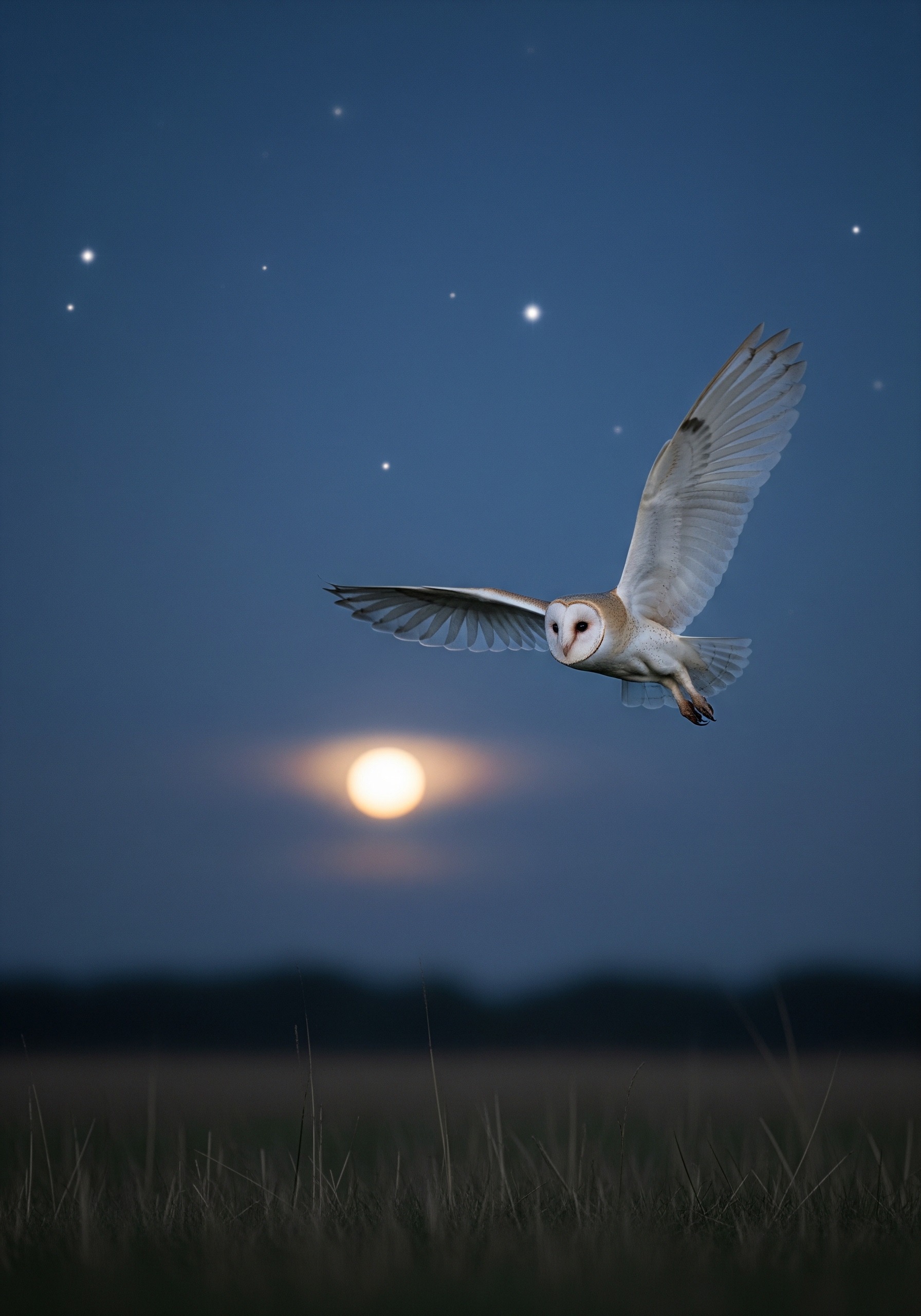
Pop quiz: can an owl turn its head all the way around? No. Not even close. The real answer is about 270 degrees — three quarters of a full circle — and it can do that to either side. That’s still extraordinary. You can probably manage about 90.
Why so flexible? Because an owl’s eyeballs barely move. They aren’t really balls at all — they’re long tubes, locked into the skull to gather every last photon of light. To look sideways, an owl has to move its whole head. So evolution gave it a remarkable neck: 14 vertebrae (humans have 7), extra-stretchy blood vessels, and tiny reservoirs that pool blood to keep the brain supplied even when the neck is fully cranked.
If a human tried that swivel, we’d cut off the blood supply to our own brain. The owl, basically, has a built-in plumbing workaround.
Hearing in 3D — the asymmetric ear trick
Look at an owl’s head and you won’t see ears. The “ear tufts” on a Great Horned Owl are just decorative feathers; the real ears are hidden slits under the facial feathers. And here’s the surprise: in many species, the left ear and right ear sit at different heights on the head.
That tiny asymmetry is a superpower. A sound from below reaches one ear a fraction of a millisecond before the other. The owl’s brain reads the difference and pinpoints the source not just left or right, but up or down. That’s why a Barn Owl can drop on a mouse it cannot see — under leaves, under snow, in pitch dark — and still hit it.
The Cornell Lab of Ornithology describes Barn Owl hearing as some of the most precise ever measured in any land animal. They aren’t exaggerating.
Owl sizes: from teacup to toddler
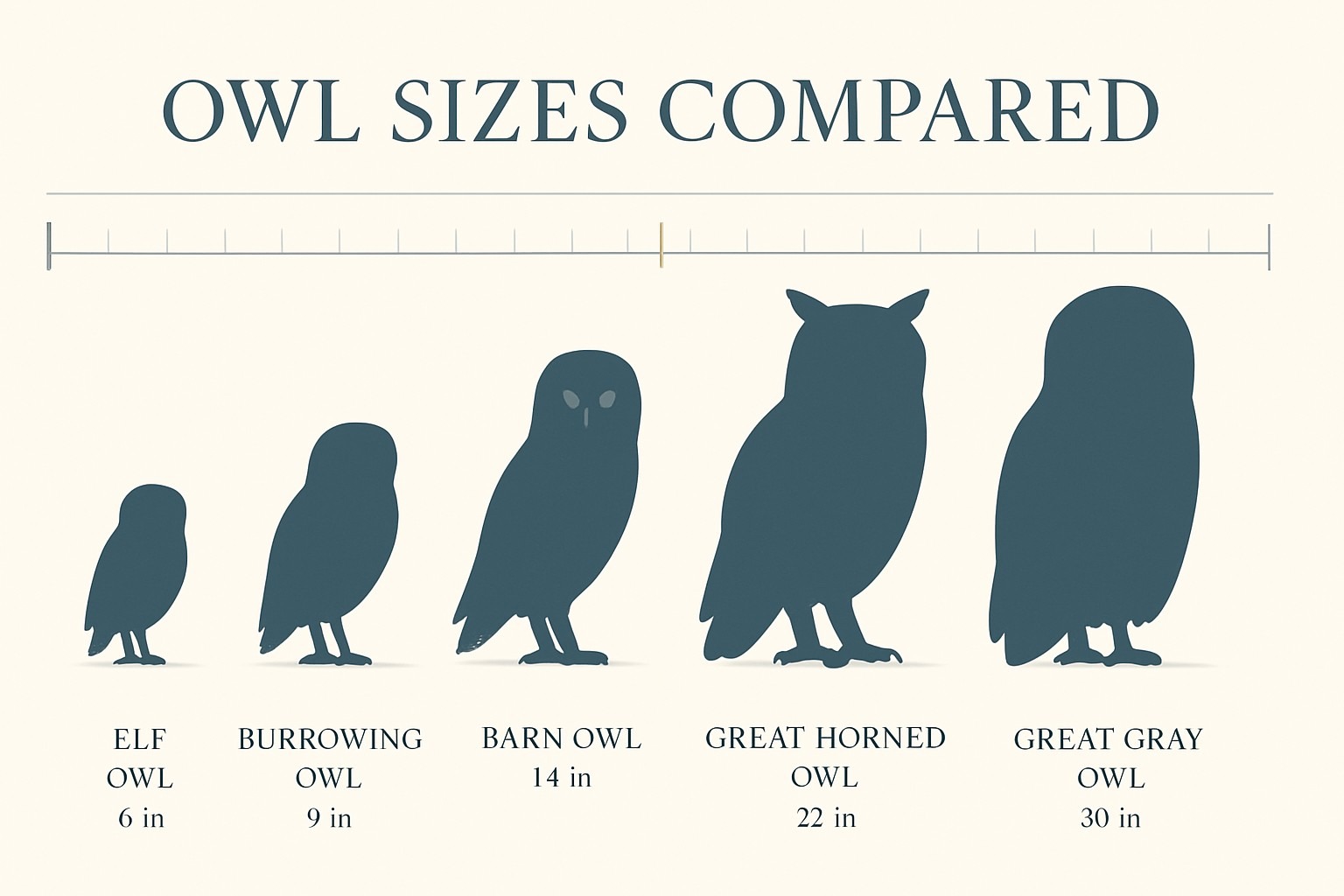
Owl species range from tiny to “wait, that’s a bird?” Here’s a clean comparison of five owls a curious kid might actually run into — in a backyard, a national park, or the pages of a field guide.
Quick owl size facts
- Smallest: Elf Owl — about 5-6 inches tall (smaller than a soda can), around 1.4 ounces.
- Heaviest: Eurasian Eagle-Owl — can weigh up to about 9 pounds (heavier than a house cat).
- Tallest in North America: Great Gray Owl — up to about 32 inches.
- Total species worldwide: more than 200.
- Continents found on: every continent except Antarctica.
| Owl | Height | Where it lives | Easy spot-it clue |
|---|---|---|---|
| Elf Owl | 5-6 in | SW U.S., Mexico | Tiny — nests in cactus holes |
| Barn Owl | 13-15 in | Almost worldwide | White heart-shaped face |
| Burrowing Owl | 7-10 in | Open Americas grasslands | Long legs, stands on the ground |
| Great Horned Owl | 18-25 in | Americas, very wide range | Two feather “horns,” deep hoot |
| Snowy Owl | 20-28 in | Arctic tundra (visits south in winter) | White feathers, yellow eyes, hunts by day |
What’s for dinner (and why owls cough up pellets)
Most owls are carnivores. The menu depends on the size of the owl. Tiny Elf Owls catch moths and beetles. Barn Owls and screech owls focus on small mammals — voles, mice, shrews. A Great Horned Owl is a heavyweight that will tackle rabbits, skunks, and even other owls. Fish owls in Asia do exactly what their name says.
Here’s the part most kids love: owls cannot chew. So they swallow small prey whole — fur, feathers, bones, teeth, everything. A few hours later, the bits they cannot digest get packed into a neat little package called a pellet and coughed back up. Scientists and schoolchildren dissect them to figure out exactly what an owl has been eating. It’s one of the easiest ways to read a wild predator’s diary.
The Barn Owl Trust estimates that a single wild Barn Owl can eat around 1,000 small rodents in a year. That’s a free, fluffy pest-control system most farmers are very happy to host.
Are owls actually wise? (A small myth-bust)
Sorry, Hedwig. Owls are not the brainy geniuses of cartoons. Compared with crows, ravens, and parrots — the real Einsteins of the bird world — owls are roughly average problem-solvers. They look thoughtful because their huge forward-facing eyes give them a serious, almost human stare. Add a flat face and a slow head-turn and you get a creature that looks like it’s about to deliver a lecture.
What owls actually are is arguably more impressive: extreme specialists. A crow can solve a puzzle box. A Barn Owl can locate, intercept, and kill an unseen mouse in total darkness on the first try. Different brains, different jobs.
The wisdom association is ancient, anyway. The Greek goddess Athena, patron of wisdom, was so closely tied to her little owl companion that the species still carries her name — Athene noctua, the Little Owl. The reputation is mythological, not biological.
Why owls matter (and a few owl manners)
Owls are quiet, hard-working pieces of every ecosystem they live in. By eating rodents, they keep mouse populations from exploding through farm fields. By coughing up pellets, they recycle small bones back into the forest floor. Lose the owls and the food web wobbles.
If you ever meet a wild owl, the kind thing is the boring thing: watch from a distance, stay quiet, don’t shine a bright light into its eyes, and don’t try to feed it. Don’t pick up a baby owl on the ground, either. Most “lost” owlets are doing exactly what they’re supposed to be doing, and a parent is almost always watching from a nearby tree.
Frequently Asked Questions
Q: Can owls really see in total darkness?
A: Not in total darkness — nothing can see with zero light. But owls can see in light far too dim for a human. Their eyes are enormous for the size of their head, packed with light-catching rod cells, and shaped like tubes to maximize the light reaching the retina.
Q: Can owls see during the day?
A: Yes. The “owls are blind in daylight” idea is a myth. Most owls just prefer to hunt at night because their prey is active then. Snowy Owls, Burrowing Owls, and Northern Hawk Owls hunt happily in full sun.
Q: Why do owls hoot?
A: Mostly to talk to each other — to claim a territory, attract a mate, or warn off rivals. Different species have very different “voices.” Great Horned Owls give the classic deep hoo-hoo. Barn Owls let out a chilling raspy scream. Screech owls trill. Hooting is owl language, not just background noise.
Q: Do owls make good pets?
A: No — and in most countries it is illegal to keep one without a special license. Owls are wild predators with razor-sharp talons, very specific diets, and a strong dislike of being handled. Wild is where owls belong.
Sources
- Cornell Lab of Ornithology — All About Birds, owl species accounts.
- National Audubon Society — owl biology and silent-flight features.
- Smithsonian’s National Zoo & Conservation Biology Institute — owl fact sheets.
- The Barn Owl Trust — Barn Owl behavior, diet, and rodent intake.
- Graham, R. R. (1934), “The silent flight of owls” — Journal of the Royal Aeronautical Society.
Owls are proof that “quiet” and “powerful” can be the same thing. Next time you hear a hoot at dusk, you’ll know exactly what’s listening back.
Illustrations are AI-generated. Article fact-checked and human-edited. Our editorial standards.