Frog Legs: The Ultimate Multi-Tool Built by Evolution
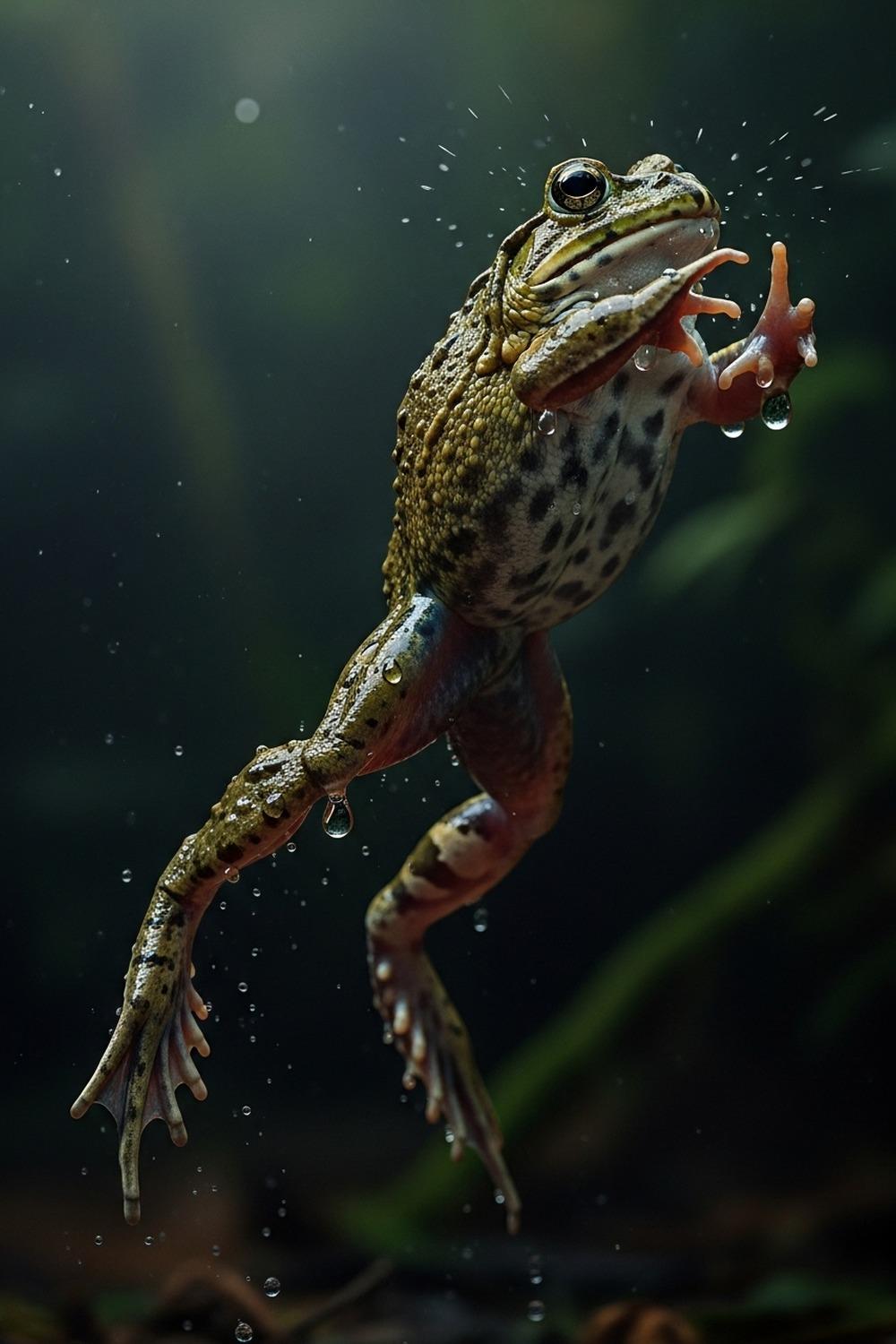
Launch a frog into the air and something impossible happens: a body twenty times smaller than the distance it travels propels itself there anyway, in a fraction of a second, with no runway and no warm-up. Just coiled muscle, instant geometry, and frog jumping legs evolution solved that long ago. The same anatomy folds into a paddle the moment the animal hits water — two extraordinary, over-engineered rear limbs that can outrun a snake, cross a river, and glide between tree canopies sometimes all in the same afternoon.
Roughly 250 million years. That’s how long frogs have been on Earth. Evolution didn’t hand them armor, venom glands, or size during that span. It handed them legs. Two limbs that keep surprising the biologists chasing them, and keep solving problems in ways that shouldn’t work on paper.
Key Facts
- The earliest known frog ancestor, Triadobatrachus massinoti, appeared roughly 250 million years ago in the Early Triassic with elongated hind limbs.
- Brown University researchers Henry Astley and Thomas Roberts demonstrated the frog tendon catapult mechanism in a landmark 2011 study.
- Peak power output of the gray tree frog hind limb reaches about 1,600 watts per kilogram of muscle, roughly 10 times human sprint muscle output (Journal of Experimental Biology, 2019).
- Australian rocket frogs were documented clearing 55 body lengths in a single leap in a 2020 Queensland field study.
- 41% of all frog species are currently threatened with extinction, making the anuran order the most endangered vertebrate group on Earth (IUCN Red List, 2022).
In short: Frog jumping legs evolution produced a catapult mechanism rather than raw muscle power: hind-limb tendons store elastic energy as the frog crouches, then release it all at once. Confirmed at Brown University in 2011, this design has stayed nearly unchanged across 250 million years and 7,000-plus species, and now inspires spring-loaded robotics.
The Explosive Mechanics Behind Frog Jumping Legs
For most of the twentieth century, biologists assumed frog jumping worked the same way human sprinting does — muscles contracting fast, energy released immediately. That picture collapsed in 2011. Henry Astley and Thomas Roberts at Brown University published a landmark study demonstrating that frogs actually pre-load energy into their tendons like a catapult, not a motor. When the leg extends, that stored energy releases all at once — far faster than any direct muscle contraction could achieve. The result is a power output that can exceed what the muscle alone is physically capable of generating. This “catapult mechanism” is why frog jumping legs evolution produced something that looks almost impossible on paper.
The crouching phase is where the magic accumulates. Muscles contract slowly, and elastic energy pools in the tendinous aponeurosis of the hind limb — that network of connective tissue that runs through the leg like a spring waiting to unwind.
The African goliath frog — Conraua goliath — makes this even stranger. Despite weighing as much as a newborn human baby (roughly 3.3 kilograms) and stretching 32 centimeters, it can clear approximately 3 meters in a single bound. For comparison: a professional long jumper covers about 8.9 meters but weighs roughly 20 times more and uses a full running approach. Scaled to body length, the goliath frog’s jump ratio destroys every human record ever set.
Smaller tree frogs push the ratio further. The Cuban tree frog, barely 3 centimeters long, regularly clears 150 times the energy output per gram of muscle that a human athlete generates in a sprint. Evolution, it turns out, was working on this problem for a very long time before human engineers started thinking about spring-loaded robotics.
One Limb, Four Jobs: How Frogs Evolved a Multi-Tool
What stops frog legs from being merely impressive is the moment they enter water. The same limb that just propelled a red-eyed tree frog off a bromeliad becomes a rowing paddle in under a second. No ratchet, no reconfiguration — just the same bones folding along the same joints in a different sequence. Webbed species like the Agalychnis callidryas of Central America deploy that interdigital membrane as both a swimming fin and, during aerial descents, a crude gliding surface.
It’s the kind of elegant ruthlessness you find when evolution has had millennia to iterate. Why does this matter? Because for another example of anatomy pushed to its absolute limit by environmental pressure, consider the Southeast Asian flying lemur, which glides over 90 meters using a membrane that doubles as a nursery for its young — a different animal, a different solution, but the same uncompromising evolutionary logic at work.
Researchers at the University of California, Berkeley spent years cataloguing locomotor modes in anurans — the scientific order containing all frogs and toads — and by 2017 had documented at least six functionally distinct uses for the hind limb across different species: jumping, swimming, burrowing, climbing, parachuting, and gliding. The burrowing adaptation alone is extraordinary: species like the spadefoot toad (Scaphiopus) have evolved a hardened tubercle on the inner heel of the hind foot that acts as a shovel. The frog essentially corkscrews itself backward into desert soil during dry seasons, sealing itself in a moisture-preserving mucus cocoon for months at a time.
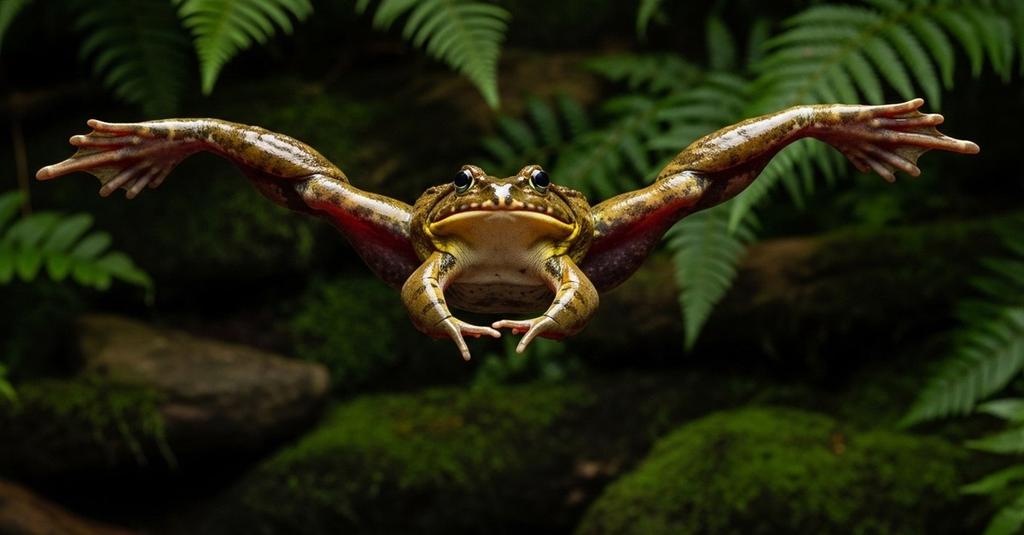
Field biologists working in Borneo’s lowland rainforests in 2019 documented Wallace’s flying frog (Rhacophorus nigropalmatus) using its fully webbed hind feet to steer mid-air between trees separated by more than 12 meters. The animal wasn’t falling. It was navigating, actively adjusting angle and trajectory. One limb. One evolutionary lineage. Genuinely astonishing range of application.
Ancient Legs: 250 Million Years of Refinement
The earliest known frog ancestor, Triadobatrachus massinoti, appeared in the fossil record approximately 250 million years ago during the Early Triassic, already equipped with elongated hind limbs. What it lacked was the full ankle-and-shin extension chain that makes modern frog leaping possible. That mechanism crystallized later, in species like Prosalirus bitis, dated to around 190 million years ago in what is now Arizona. A 2008 study published in the Proceedings of the Royal Society B confirmed that the triphasic jumping motion — crouch, pre-load, explosive extension — is preserved almost unchanged across 190 million years of evolution.
Evolution found the answer early and didn’t mess with it.
You can read more about how that same patience shapes animal anatomy at National Geographic’s amphibian coverage, which tracks how amphibians became the first vertebrates to colonize land and why their body plans still define the blueprint for everything that followed.
Here’s the thing about frog jumping legs evolution: what didn’t change is what fascinates most. Most organisms under sustained evolutionary pressure diversify wildly — different species branch into radically different morphologies. Despite 7,000-plus known species living in habitats ranging from Saharan desert edges to Andean cloud forests above 4,500 meters, the basic architecture of the frog hind limb remains astonishingly conserved. Elongated tibia. Elongated fibula. Fused ankle bones. Large muscular thigh. The variation lives in the details: webbing, tubercles, adhesive toe pads, webbing angle. The core machine stayed the same.
When evolution keeps something unchanged across 250 million years and seven thousand species, it’s not because the organism stopped encountering new challenges. It’s because the solution was so good that no challenger beat it.
How Frog Jumping Legs Evolution Inspires Modern Robotics
In 2013, engineers at EPFL (École Polytechnique Fédérale de Lausanne) in Switzerland unveiled a jumping robot called Jumper that used a spring-loaded mechanism directly modeled on the frog tendon pre-load system documented by Astley and Roberts two years earlier. The robot could leap 1.4 meters — roughly 7 times its own height — using stored elastic energy rather than direct motor thrust. By 2022, a team at Harvard’s Wyss Institute for Biologically Inspired Engineering had taken that concept further, developing a soft-bodied jumping robot with a compliant hind limb that could both leap and swim. The frog, unchanged for 190 million years, had become a design specification for 21st-century engineering.
Peak power output of the gray tree frog (Hyla versicolor) hind limb measures approximately 1,600 watts per kilogram of muscle — roughly 10 times the power output of human leg muscle during a maximal sprint. This research, published in the Journal of Experimental Biology in 2019, revealed that the catapult mechanism isn’t just faster than direct muscle contraction. It’s fundamentally a different category of force delivery. Engineers building search-and-rescue robots, planetary exploration devices, and military reconnaissance platforms have all cited frog jumping biomechanics as a direct design source in peer-reviewed literature published between 2015 and 2023.
And here’s what researchers at EPFL and Harvard keep returning to: not the power output alone, but the simplicity. The frog leg achieves extraordinary performance with a minimal number of moving parts. No complex gearing. No redundant systems. Just precisely shaped bones, tendons with the right stiffness, and muscles positioned to load them efficiently. Simple, optimized geometry beats complicated brute force every time — a lesson evolution learned 190 million years ago that human engineers are still catching up to.
The Frogs That Push the Design to Its Limits
Most frog species jump. A handful have taken the same limb architecture and done something genuinely strange with it. The Malagasy tomato frog (Dyscophus antongilii) uses its hind legs almost exclusively for digging and almost never jumps. Behavioral studies in 2016 by herpetologists at the California Academy of Sciences confirmed the finding across captive and wild populations — a reversal that confounded researchers. The purple frog of India (Nasikabatrachus sahyadrensis), described by science only in 2003, spends 11 months underground and surfaces for roughly two weeks each year to breed. Its hind legs are powerful shovels with almost no jumping function. The basic architecture is identical to a leaping tree frog. The use is unrecognizable.
At the opposite extreme, Australian rocket frogs (Litoria nasuta) have refined the catapult mechanism to produce some of the highest jump-to-body-length ratios ever recorded in a vertebrate. In 2020, field measurements in Queensland’s wet tropics documented individual rocket frogs clearing distances of 55 body lengths in a single leap. That’s equivalent to a 1.8-meter human jumping roughly 100 meters without a run-up. The limb morphology shows extreme elongation of the tibiofibula relative to body mass — essentially the same solution that long-jump specialists show in their femur-to-tibia ratios, arrived at independently, in a lineage that separated from the mammalian line 350 million years ago.
Stand at the edge of a Queensland wetland at dusk and watch rocket frogs hunt. They don’t stalk. They don’t wait. They launch, land, launch again — each jump a calibrated energy equation that the frog’s nervous system runs in milliseconds. The grass blurs.
Where to See This
- The Daintree Rainforest in Queensland, Australia (best season: October–April, wet season) offers reliable sightings of rocket frogs and white-lipped tree frogs; guided night walks run from Cape Tribulation most evenings.
- The Centre de Recherche Herpétologique in Madagascar conducts ongoing field studies on tomato frogs and welcomes international researchers; contact through the Université d’Antananarivo’s biology faculty for access.
- Thomas Roberts and Henry Astley’s 2011 Brown University catapult study is freely available via PubMed and remains the clearest non-technical explanation of how frog tendon pre-loading works — start there if you want the biomechanics without a physics degree.
By the Numbers
- 7,000+ known frog and toad species globally, with approximately 100–200 new species described each year (IUCN Amphibian Specialist Group, 2023)
- 1,600 watts per kilogram — peak power output of gray tree frog hind limb muscle, roughly 10× human sprint muscle output (Journal of Experimental Biology, 2019)
- 190 million years — age of Prosalirus bitis, the earliest frog fossil showing the complete three-phase jump mechanism (Shubin & Jenkins, 1995)
- 55 body lengths — maximum single-leap distance recorded in Australian rocket frogs (Litoria nasuta), Queensland field study, 2020
- 41% of all frog species are currently threatened with extinction, making the anuran order the most endangered vertebrate group on Earth (IUCN Red List, 2022)
Field Notes
- In 2003, Indian herpetologist S.D. Biju discovered the purple frog (Nasikabatrachus sahyadrensis) in the Western Ghats — a species so evolutionarily isolated it represents an entirely separate family, Nasikabatrachidae, diverged from all other frogs roughly 130 million years ago. Its hind legs are almost purely for digging. It had been hiding in the soil, unknown to science, for longer than dinosaurs dominated land.
- The toe pads of climbing tree frogs aren’t suction cups — they work via capillary adhesion and nanoscale hexagonal surface structures that increase contact area. Remove the moisture film and the adhesion collapses instantly.
- Frog hind legs make up roughly 30% of total body mass in jumping species — a proportion nearly identical to the hindquarter muscle mass ratio in kangaroos, which evolved their spring-loaded limbs entirely independently.
- Researchers still cannot fully explain why some individual frogs jump farther than others of identical body size and species. Motivation, neural firing rate, and pre-load duration all vary between individuals in ways that current biomechanical models don’t predict — suggesting the full performance envelope of frog legs is still not understood.
Frequently Asked Questions
Q: How does frog jumping legs evolution explain the power behind a frog’s leap?
A catapult mechanism, not raw muscle speed. Frog hind limb tendons store elastic energy as the frog crouches, then release it all simultaneously — producing power outputs that exceed what the muscle alone could generate through direct contraction. Brown University researchers confirmed this pre-load mechanism in 2011 (and this matters more than it sounds: it’s the same physics principle used in a crossbow). It’s why small frogs can outperform large mammals on a body-length-to-distance ratio.
Q: Do all frogs use their hind legs for jumping?
No — and this surprises most people. While jumping is the default association, hind leg function varies dramatically by species. The purple frog of India uses its legs almost entirely for burrowing. The tomato frog of Madagascar favors digging over leaping. Aquatic species like the African clawed frog (Xenopus laevis) use their hind legs primarily for swimming. The architecture is nearly identical across all these species — what changes is which movement pattern the nervous system prioritizes. Evolution kept the hardware and changed the software.
Q: Is it true frogs can glide with their hind legs?
Yes, several species genuinely glide rather than simply fall. Wallace’s flying frog in Borneo uses fully webbed hind feet as paired parachutes, controlling descent angle and lateral movement between trees. This is not passive falling — high-speed video analysis by researchers at Universiti Malaysia Sarawak in 2018 confirmed active mid-air repositioning of the hind limbs during descent. The webbing adds drag and lift simultaneously. The same feet that propel the frog through water are also doing aerodynamic work in the air. No separate adaptation required.
Editor’s Take — Alex Morgan
What genuinely stops me about this story isn’t the jump distances or the power-output numbers, impressive as they are. It’s the 190-million-year conservatism. Evolution is usually restless — it keeps pushing, keeps diversifying, keeps experimenting. The frog leg made it try that experiment once, get it right, and leave it alone across 250 million years and seven thousand species. Watching a species survive with virtually unchanged mechanics while everything else on Earth reshapes itself, you stop calling it adaptation — you recognize it as a final answer. And we’re only now building robots capable of approximating it.
Frogs are vanishing faster than almost any other vertebrate group — 41% of species currently threatened, whole lineages blinking out before we’ve fully understood what they carry. What we lose isn’t just biodiversity. It’s 250 million years of accumulated mechanical solutions that no human engineer has yet improved upon. The next time a frog launches off a lily pad and disappears into water without breaking rhythm, watch the legs. Something that took evolution the entire age of the dinosaurs to perfect just happened in your peripheral vision, and it was over before you could blink.
“
Illustrations are AI-generated. Article fact-checked and human-edited. Our editorial standards.