Giant Dinosaur Tracks Found in Texas: A T. Rex-Sized Discovery
Dinosaur tracks found in Texas shouldn’t still be surprising — not in a state that’s been pulling Cretaceous footprints from limestone for nearly a century. And yet here we are: fifteen prints, each one close to a meter long, exposed by flood-control workers who were looking for debris and found something considerably older. The animal that made them was moving slowly. That detail, more than the size, is what has paleontologists paying attention.
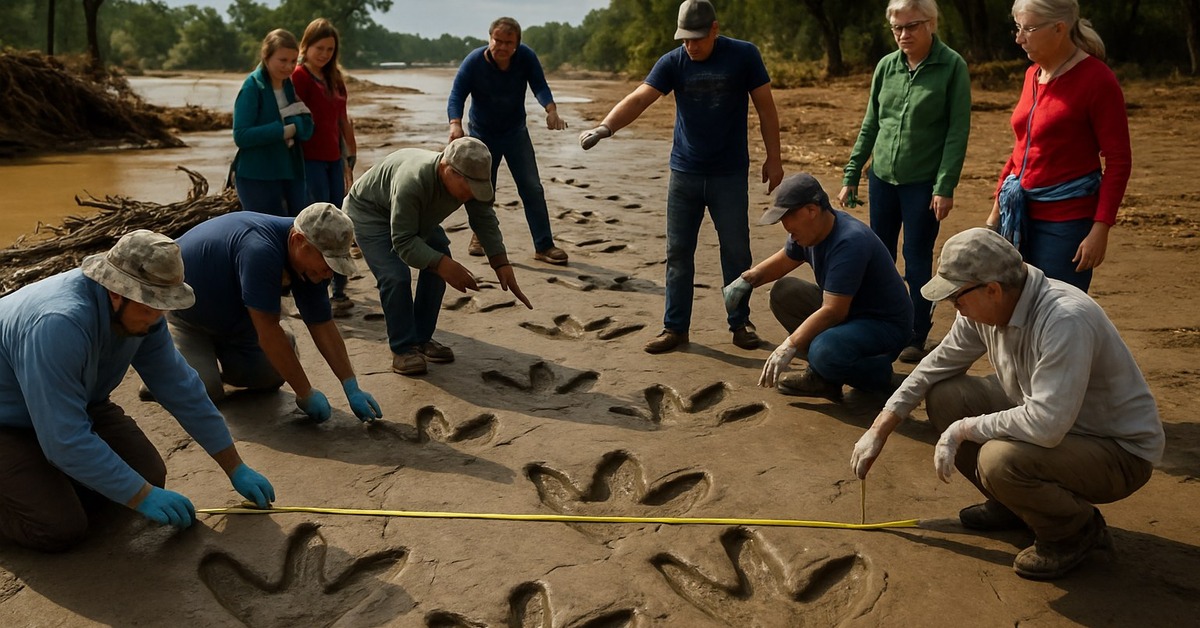
Flood-control workers clearing debris along a Central Texas waterway weren’t looking for fossils. Nobody ever is. But when the mud peeled back from the bedrock, what emerged stopped the whole operation cold. Pressed into ancient limestone were the tracks of an enormous carnivore — a predator that moved with the kind of unhurried confidence that only comes from being the largest thing in the room. The prints measure close to a meter in length. The animal that made them weighed, by conservative estimate, several tonnes. Now paleontologists are asking the question that every great trackway forces: what, exactly, was this creature doing?
What the Texas Limestone Actually Preserved
Near Glen Rose, Texas — a town synonymous with dinosaur footprints since the early twentieth century — the tracks surfaced within the same geological unit that has been yielding prehistoric evidence for decades. The Paluxy River basin, where Dinosaur Valley State Park now sits, first gave up its prehistoric secrets in the 1930s when paleontologist Roland T. Bird of the American Museum of Natural History documented sauropod and theropod trackways in extraordinary detail. What Bird found in 1938 rewrote the understanding of how large dinosaurs moved — and nearly a century later, that same limestone formation keeps delivering. The current site sits within the Glen Rose Formation, a sequence of Early Cretaceous limestones and marls laid down roughly 113 million years ago in a shallow coastal environment. The fifteen newly exposed prints belong to a large theropod — a bipedal carnivore — and the dimensions align closely with the largest known predators of the Cretaceous period.
Here’s the thing about the Glen Rose Formation: it isn’t just hard rock that happened to catch an impression. The original sediment was a carbonate mud — fine-grained, wet, and responsive — the consistency of stiff modeling clay after rain. When a multi-tonne animal stepped into it, the substrate deformed not just at the point of contact but outward, creating pressure ridges at the edges of each print. Those ridges survived diagenesis — the slow process by which sediment becomes stone — and they’re still visible today. You’re not looking at a print. You’re looking at a moment of biomechanical force, permanently recorded. The University of Texas at Austin’s Jackson School of Geosciences has studied Glen Rose trackways extensively and notes that preservation quality at many sites rivals anything found globally.
The new prints are deeper at the heel than at the toe. That single detail carries real weight. It suggests the animal was decelerating — slowing down, possibly changing direction. Not fleeing. Not chasing. Moving deliberately through a landscape it knew.
Tracks Tell You What Bones Never Can
Why does this matter? Because bones are static and tracks are not — and that distinction changes everything a researcher can claim about an animal’s life.
Ichnologists — scientists who study trace fossils — get genuinely animated when a trackway surfaces. Bones tell you morphology: what an animal looked like, how its skeleton was arranged, roughly how large it grew. Tracks capture behavior. Speed can be calculated from stride length and estimated hip height using formulas developed by British paleontologist R. McNeill Alexander in 1976 — formulas that have held up across decades of testing. Gait patterns reveal whether an animal was running, walking, or transitioning between the two. At sites like this Texas location, where ancient life left behind behavioral evidence half a billion years old, trace fossils carry a kind of intimacy that body fossils simply can’t replicate. The Texas prints show a stride length of approximately 3.7 meters — consistent with a large, unhurried walk. Whatever that animal was doing in that coastal wetland 113 million years ago, it wasn’t panicking.
Each rear footprint is driven roughly 8 centimeters deeper into the substrate than the front portion of the same print — a rear-loading pattern that biomechanical models associate with a slow, powerful stride in large theropods. The spacing and depth of impressions allow researchers to model estimated body mass with surprising precision. Texas State University’s Vertebrate Paleontology Laboratory, involved in documenting Glen Rose trackways since the 1990s, uses photogrammetry to build three-dimensional models of each print. The new site has already been scanned. Resulting models show individual claw impressions on three toes, with the medial claw — the inner one — leaving the deepest mark. That’s not coincidence. It’s posture.
Field crews working the site in recent weeks have noted something the initial reports didn’t mention: faint impressions between the main prints. Possible partial tracks, half-destroyed by the same flood event that exposed the rest. Researchers haven’t confirmed what made them. That ambiguity is, in its own way, thrilling.
The Cretaceous Coast Beneath Modern Texas
To understand why dinosaur tracks found in Texas are so consistently spectacular, picture what Texas looked like during the Early to Late Cretaceous — and the picture is nothing like today. The interior of North America was bisected by the Western Interior Seaway, a shallow epicontinental sea stretching from the Gulf of Mexico to the Arctic Ocean. Texas sat at its southern margin — river deltas, tidal flats, and coastal mudflats where terrestrial animals came to drink, hunt, and cross. That geography is the reason the Glen Rose Formation is so richly fossiliferous. Animals were funneled by the landscape into predictable corridors, crossing the same soft mud repeatedly until sediment buried the evidence and time did the rest.
Counterintuitive as it sounds, many Glen Rose sites record interaction rather than isolation. Theropod tracks run parallel to sauropod trackways — raising the question, debated since Bird’s original work, of whether these were predator-prey pursuit events or simple co-occurrence in a shared landscape. The new fifteen-print site doesn’t show obvious interaction with other species, but it also hasn’t been fully excavated. The tracks visible now represent what flood erosion chose to expose. There may be more beneath the surface layer, waiting for the next high water. The data left no room for comfortable assumptions about what remains hidden — and every researcher on this site knows it.
Chemically, the Cretaceous mud those animals crossed was different from modern river sediment — higher in calcium carbonate, more prone to rapid lithification. That’s why the texture survived. Change the water chemistry, the sediment grain size, or the burial rate by even a small margin, and there’s nothing to find.
Reading the Dinosaur Tracks Found in Texas: What Comes Next
Southern Methodist University’s Roy M. Huffington Department of Earth Sciences, which has collaborated on Cretaceous trackway studies in Texas since the 2000s, typically begins with full photogrammetric documentation before any physical extraction is attempted. Every centimeter of the site is mapped in three dimensions. The surrounding matrix is assessed for additional trace fossils — invertebrate burrows, plant impressions, anything that helps reconstruct the paleoenvironment. Only after that baseline is established do researchers begin the careful process of determining whether any prints can or should be physically removed for laboratory study. At this site, the prints are large enough that removal would require machinery, and the risk of damage is real. The working assumption is that the rock stays where it is.
Dating the prints precisely requires cross-referencing the stratigraphy with established chronologies for the Glen Rose Formation, which spans roughly 113 to 108 million years ago — placing these tracks in the Aptian to Albian stages of the Early Cretaceous, well before the T. rex lineage even existed. The popular framing of “T. rex-sized” reflects the physical scale of the animal, not its identity. The actual trackmaker was almost certainly a large allosauroid or possibly an early member of the carcharodontosaurid lineage (researchers actually call this group the “shark-toothed lizards,” and the name earns its drama) — massive, bipedal, apex predators, but evolutionary predecessors to the tyrannosaurs rather than relatives. The distinction matters scientifically, extending the record of giant carnivore activity in this precise geographic corridor much further back than T. rex ever roamed.
Researchers at the site have now flagged it for protected status. Texas Parks and Wildlife has been notified. The logistics of preservation at an outdoor site exposed by a flood — subject to future flooding, weathering, and the simple problem of public access — are formidable. But the academic community is paying close attention. Casts will be made. Models will be published. This trackway isn’t going to disappear into a drawer.
How It Unfolded
- 1938 — Roland T. Bird of the American Museum of Natural History documented the first scientifically significant theropod and sauropod trackways along the Paluxy River near Glen Rose, Texas, establishing the site as a global benchmark for Cretaceous ichnology.
- 1972 — Dinosaur Valley State Park was established in Somervell County, Texas, formally protecting the most extensive exposed trackway surfaces in the Glen Rose Formation and opening the site to public and scientific access.
- 2000s–2010s — Photogrammetry and 3D scanning technology transformed trackway documentation across Texas sites, allowing researchers to capture sub-millimeter surface detail without touching or removing the original rock.
- 2024–2025 — Flood-control workers clearing debris in Central Texas exposed fifteen new large theropod prints in the Glen Rose Formation, triggering emergency documentation by regional paleontologists and a formal notification to Texas Parks and Wildlife.
By the Numbers
- 15 — number of individual footprints in the newly exposed Texas trackway, each measuring approximately 90–100 centimeters in length.
- 3.7 meters — estimated stride length between consecutive same-side prints, indicating a slow, purposeful walk rather than a running gait.
- 113–108 million years ago — the age range of the Glen Rose Formation, placing the trackmaker in the Early Cretaceous, roughly 45 million years before T. rex evolved.
- 8 centimeters — the additional depth of the rear portion of each footprint compared to the toe region, indicating rear-loaded body mass during each stride.
- Over 1,500 — the approximate number of individual dinosaur tracks documented across Dinosaur Valley State Park alone, making it one of the highest-density Cretaceous trackway sites on Earth.
Field Notes
- In 2000, a previously unknown sauropod trackway at Dinosaur Valley State Park was exposed by drought conditions that dropped the Paluxy River to record-low levels — the same logic in reverse: water both buries and reveals, depending on its mood. That single drought season added nearly sixty new prints to the park’s documented inventory.
- Claw impressions in large theropod tracks are almost never symmetrical. The medial claw — inner toe — consistently registers deeper than the lateral claw, a postural consequence of how bipedal theropods distributed weight during the push-off phase of each stride. Decades of comparative biomechanical work were required to fully interpret that detail.
- Dinosaur tracks in Texas have occasionally preserved what researchers call “undertracks” — ghost impressions in rock layers below the actual surface the animal walked on, created by compressive stress waves traveling downward through wet sediment. A single step can leave evidence in three or four separate rock layers simultaneously.
- Researchers still can’t definitively determine from tracks alone whether large theropods were solitary or moved in loose groups. The new Texas site shows one animal’s path clearly — but whether other animals traveled the same route in the same period, or whether this individual was alone in a vast coastal wetland, remains genuinely unknown.
Frequently Asked Questions
Q: How significant are the dinosaur tracks found in Texas compared to other global sites?
Among Cretaceous trackway sites worldwide, the dinosaur tracks found in Texas — particularly those in the Glen Rose Formation — rank near the top for scientific value. Preservation quality, species diversity, and print density together make the regional record unusual. Sites in Bolivia, China, and Morocco preserve dinosaur tracks, but few match the behavioral detail readable in Texas limestone. The newly exposed fifteen-print site adds a significant new data point to an already exceptional regional record.
Q: How do scientists calculate a dinosaur’s speed from its footprints?
British paleontologist R. McNeill Alexander formalized the method in 1976, using a relationship between stride length, estimated hip height, and gravitational acceleration. Hip height is estimated from footprint length — typically around four times the print length for large theropods. The resulting formula produces a velocity estimate in meters per second. It’s not perfectly precise, but it’s consistent enough to distinguish walking from trotting from running, and it’s been validated against living animals with measurable gaits. The Texas prints indicate a walking speed of roughly 4–6 kilometers per hour.
Q: Were the Texas tracks really made by something the size of a T. rex?
The popular framing needs a correction here. Scale-wise, yes — the tracks reflect an animal of comparable physical dimensions to T. rex, similar foot length, similar estimated mass. But the Glen Rose Formation is 45 to 50 million years older than the rock layers where T. rex fossils occur. T. rex didn’t exist yet. The likely trackmaker belonged to an earlier lineage of giant carnivores, possibly a large allosauroid or carcharodontosaurid. The size comparison is accurate. The species attribution is not.
Editor’s Take — Dr. James Carter
What strikes me about this discovery isn’t the size of the prints — it’s the gait. Fifteen footprints from an apex predator moving at a casual walk across a coastal wetland 113 million years ago. No panic. No pursuit. Just presence. We spend a lot of time imagining these animals as perpetual killing machines, all speed and aggression. This trackway suggests something closer to a large carnivore on patrol — occupying its landscape, not fighting it. That’s a subtler picture, and a more unsettling one.
And somewhere beneath the mud of the Paluxy watershed, there are almost certainly more prints — more trackways, more behavioral snapshots, more moments from a world that vanished before the first human ancestor stood upright. Every flood that tears through a Texas river basin destroys something and reveals something else; the same water that erodes one layer of stone exposes the next. The dinosaur tracks found in Texas keep surfacing because the geology keeps moving. The question isn’t whether there are more discoveries waiting. The question is what the next flood decides to show us.