191 Grams of Gold Hidden Inside Your Old SIM Cards
Nobody was looking for gold in a pile of old SIM cards. That’s what makes the number so strange — 191 grams, pulled from discarded chips most people had already forgotten they owned.
In a workshop in southern China, a team of recyclers spent weeks sorting, soaking, and coaxing metal from chips smaller than your thumbnail. No mine shafts. No dynamite. Just broken technology, chemical baths, and an enormous amount of patience — producing real, sellable gold from the things we throw away.
Key Facts
- Recyclers in southern China recovered 191 grams of gold from discarded SIM cards.
- Electronic waste contains gold concentrations up to 50 times richer than gold ore, according to researcher Markus Reuter at Helmholtz Institute Freiberg.
- Global e-waste reached 53.6 million metric tons in 2019, of which only 17.4 percent was formally recycled (UN Global E-waste Monitor 2020).
- One ton of smartphones yields roughly 300 grams of gold, about 60 times the concentration of typical gold ore.
- The estimated value of raw materials in global e-waste in 2019 alone was $57 billion.
In short: Recovering gold from e-waste became real when recyclers in southern China pulled 191 grams of gold from discarded SIM cards. Electronic waste holds gold concentrations up to 50 times richer than ore, yet of the 53.6 million metric tons generated globally in 2019, only 17.4 percent was formally recycled, leaving billions in materials unrecovered.
How Gold From E-Waste Actually Works
Every SIM card contains a tiny amount of gold — we’re talking micrograms, not ounces. But scale that up across billions of discarded cards, old phones, and circuit boards, and the numbers get serious fast. According to researcher Markus Reuter at Helmholtz Institute Freiberg, electronic waste contains concentrations of gold up to 50 times richer than gold ore pulled from the ground.
Fifty times richer. And we’re still digging holes in the earth.
The answer to why isn’t simple. Urban mining — recovering precious metals from e-waste — requires specialized knowledge, careful handling, and infrastructure that most of the world doesn’t have yet. But where it exists, it’s genuinely transforming local economies in ways that traditional mining never did, because the ore body is sitting right there in someone’s junk drawer.
China’s E-Waste Mountain Changes Everything
China generates more than 10 million tons of electronic waste every year — old phones, laptops, printers, and yes, mountains of SIM cards, accumulating in warehouses and informal workshops across cities like Guiyu and Shantou. The potential locked inside that mountain of junk is staggering, and the race to unlock it is already underway. You can read more about unexpected treasure hidden in everyday objects at this-amazing-world.com.
What started as informal scavenging — families picking apart old electronics by hand in the late 1990s — has slowly evolved into something else entirely. Small workshops, chemical processing units, and increasingly, licensed recycling facilities are all competing for the same buried wealth. It’s a gold rush in slow motion, playing out under fluorescent lights instead of open sky.
The Danger Hidden Inside Every Circuit Board
Here’s where the story gets complicated.
Extracting gold from e-waste isn’t just a matter of melting things down. The process typically involves acid baths — hydrochloric acid, nitric acid, or a mixture called aqua regia — that dissolve the surrounding metals and leave gold behind. Done correctly, gold from e-waste recovery can be clean and surprisingly efficient. Done wrong, it poisons rivers, soil, and the people doing the work.
In informal operations across Delhi, Lagos, and São Paulo, workers — sometimes children — handle these chemicals without protection. The gold comes out. But so do the toxins.
This is the part nobody puts on a recycling poster.
Urban Mining Is Rewriting What Gold Even Means
Think of it like this: traditional mining destroys ecosystems, consumes enormous amounts of water, and often displaces entire communities before a single ounce of gold reaches the surface. Urban mining, when done responsibly, does none of those things. One ton of circuit boards contains roughly 250 grams of gold — compared to just 5 grams per ton of ore from a conventional mine. That last fact kept me reading for another hour, because it completely reframes what a “gold mine” actually is in 2024.
Major manufacturers like Apple and Samsung have started building take-back programs specifically to recover these metals. Not out of altruism — the economics are becoming impossible to ignore.
Every phone you hand back to a manufacturer instead of tossing in a drawer is a small vote for a different kind of supply chain. That sounds abstract until you do the math on billions of devices.
By the Numbers
- Global e-waste reached 53.6 million metric tons in 2019. Only 17.4% was formally recycled, according to the UN’s Global E-waste Monitor 2020 — meaning the vast majority of that recoverable gold simply… vanished into landfill.
- One ton of smartphones yields roughly 300 grams of gold — 60 times the concentration of a typical gold ore deposit.
- The Guiyu region of China, once called the “e-waste capital of the world,” processed an estimated 1.5 million tons of e-waste per year at its peak, employing over 150,000 workers.
- $57 billion. That’s the estimated value of raw materials sitting in global e-waste in 2019 alone — more than the GDP of many small countries.
- A single smartphone contains up to 0.034 grams of gold. Tiny on its own. Multiply it by a few hundred million discarded handsets and the arithmetic becomes genuinely unsettling.
Field Notes
- Gold isn’t the only treasure — a single laptop contains trace amounts of palladium, silver, copper, and indium, a rare metal critical to touchscreen production that’s genuinely scarce in the Earth’s crust.
- The SIM card was invented in 1991 by a German company called Giesecke & Devrient. The original was the size of a credit card, which means early-generation cards have significantly more gold-plated contacts than the nano-SIMs in your pocket right now. Early adopters were, unknowingly, carrying more gold.
- Auction prices for old military and aerospace circuit boards — bought purely for their metal content, not their function.
- Some high-end boards from that era contain so much gold that individual components have sold for hundreds of dollars. Not as electronics. As ore.
Why The Real Riches Might Be What We Discard
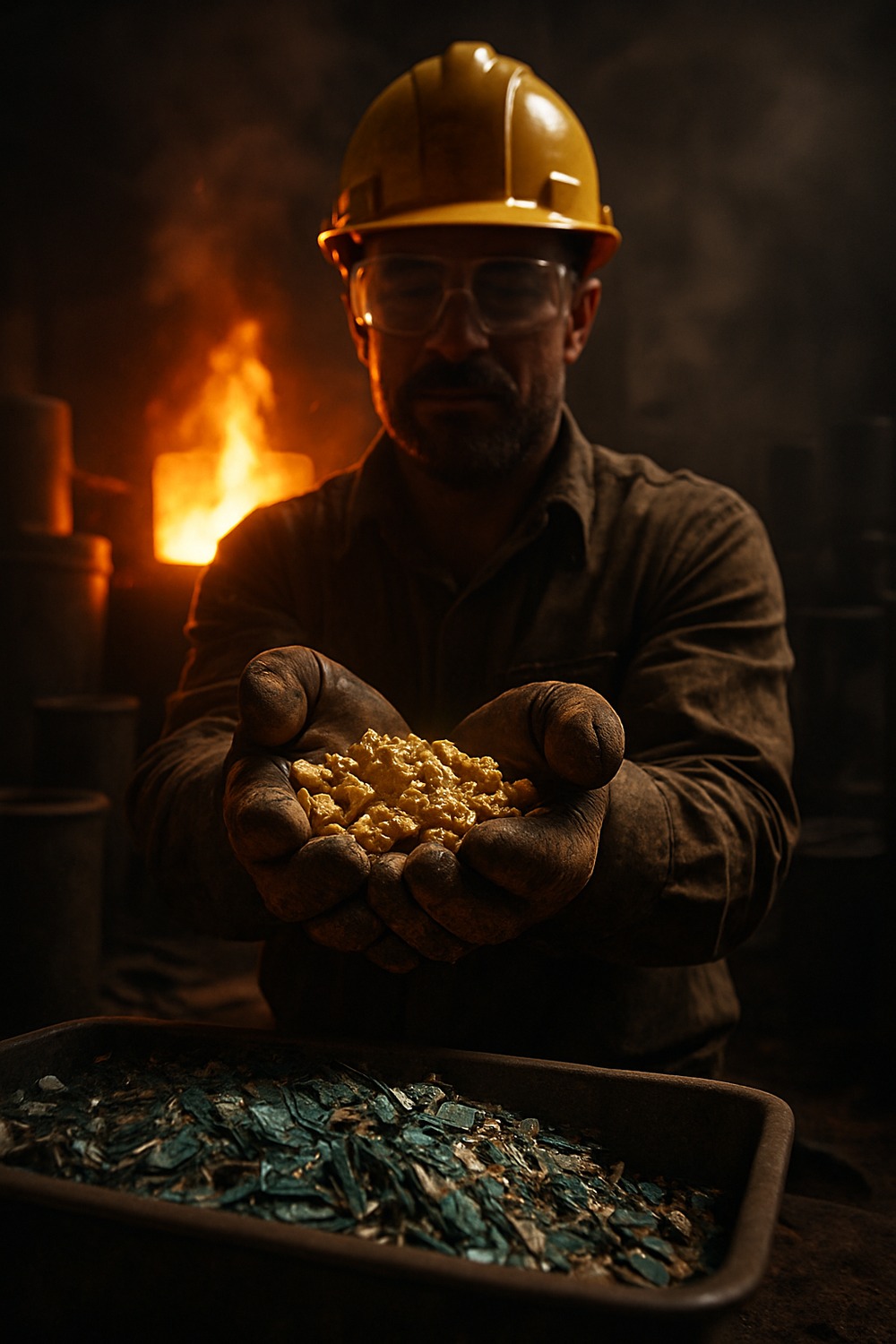
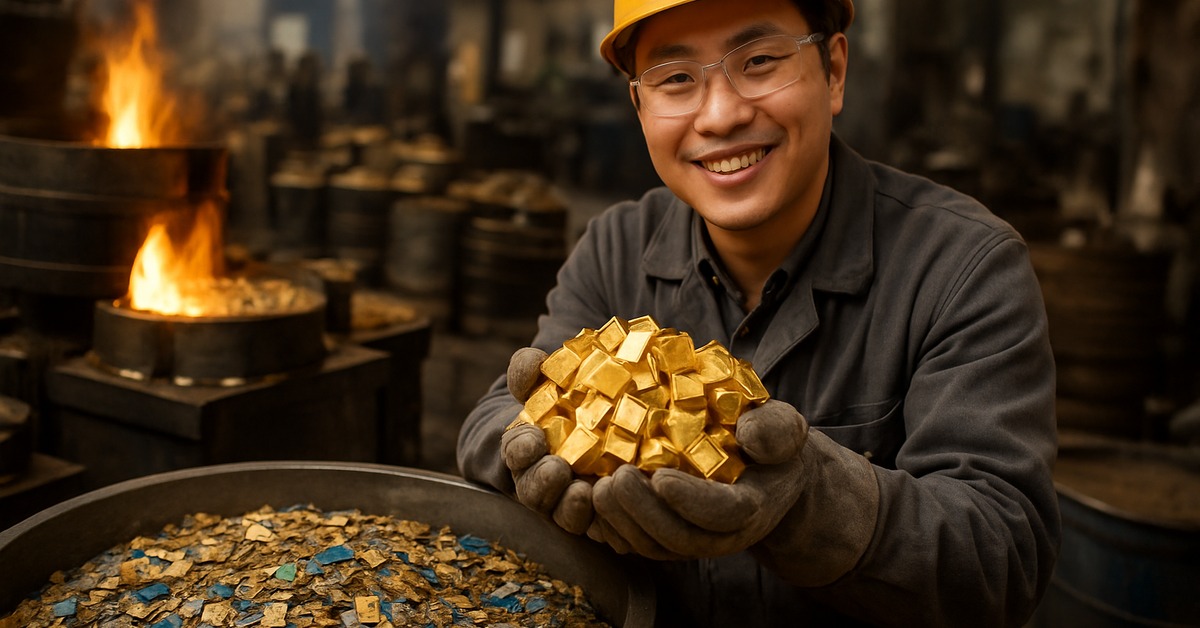
It is a workshop in southern China. A worker reaches into a container of soaking SIM cards and pulls out something that, by any reasonable definition, shouldn’t be there. Not in a pile of phone chips. Not in something this small. But the gold from e-waste recovery doesn’t care about reasonable definitions — it only cares about chemistry and patience and whether anyone bothered to show up.
The 191 grams isn’t a fluke. It’s a proof of concept. The 21st century’s gold rush isn’t happening in the mountains of Nevada or the rivers of the Amazon — it’s happening in recycling centers, workshops, and increasingly sophisticated urban mining facilities that treat e-waste like the ore body it actually is. Gold from e-waste isn’t a novelty anymore. It’s a serious, growing industry with serious environmental stakes attached to every gram recovered.
But the story isn’t really about gold. It’s about what we value and what we throw away. Every device we upgrade carries metal that took enormous energy to pull from the ground. Recovering it — safely, at scale — means we don’t have to extract it again.
That matters more than most people realize.
A workbench in southern China. A pile of forgotten SIM cards. 191 grams of gold that almost ended up in a landfill. It’s a small number — until you multiply it by the billions of discarded devices sitting in drawers and dumps around the world right now. The treasure is real. The question is whether we’re ready to take it seriously. For more stories about the strange value hiding in ordinary things, there’s always more at this-amazing-world.com.
Frequently Asked Questions
Q: How much gold can really be recovered from e-waste?
Recyclers in southern China recovered 191 grams of gold from discarded SIM cards, each of which contains only micrograms. At scale the numbers grow fast: one ton of smartphones yields roughly 300 grams of gold, about 60 times the concentration of typical gold ore, and a single smartphone contains up to 0.034 grams. Electronic waste holds gold concentrations up to 50 times richer than ore mined from the ground.
Q: How is gold extracted from electronic waste?
Extraction is not simply melting things down. The process typically uses acid baths, including hydrochloric acid, nitric acid, or a mixture called aqua regia, which dissolve surrounding metals and leave gold behind. Done correctly the recovery is clean and efficient. Done wrong, in informal operations across Delhi, Lagos, and Sao Paulo where workers handle chemicals without protection, it poisons rivers, soil, and the people doing the work.
Q: How much e-waste does the world generate?
Global e-waste reached 53.6 million metric tons in 2019, but only 17.4 percent was formally recycled, according to the UN’s Global E-waste Monitor 2020. China alone generates more than 10 million tons of electronic waste every year. The estimated value of raw materials sitting in global e-waste in 2019 was $57 billion, more than the GDP of many small countries, with most recoverable gold lost to landfill.
Q: Why is urban mining better than traditional mining?
Traditional mining destroys ecosystems, consumes enormous water, and often displaces communities before a single ounce reaches the surface. Urban mining, done responsibly, does none of those things. One ton of circuit boards contains roughly 250 grams of gold compared with about 5 grams per ton of conventional ore. Manufacturers like Apple and Samsung have begun building take-back programs because the economics of recovering these metals are becoming impossible to ignore.
Illustrations are AI-generated. Article fact-checked and human-edited. Our editorial standards.