The Golden Pheasant: Nature’s Most Extravagant Bird
Scarlet chest. Golden crest. A tail longer than most birds are tall. The golden pheasant moves through shadow like something that refuses to dim, yet this bird — one of Earth’s most extravagant animals — spends most of its life deliberately hidden from light. In the mountain forests of western China’s Sichuan and Shaanxi provinces, it has dazzled observers for centuries, appearing in imperial Chinese art dating back more than a thousand years, prized in European royal aviaries, and yet, for all its visual drama, the golden pheasant remains surprisingly little understood in the wild.
A creature whose beauty, it turns out, comes with a specific and fascinating set of survival rules. These aren’t decorative. They’re evolutionary infrastructure.
Key Facts
- The male golden pheasant (Chrysolophus pictus) measures 90 to 105 centimeters total length, with 60 to 75 centimeters being tail alone.
- Carl Linnaeus formally described the species in 1758 in the 10th edition of Systema Naturae.
- Wild populations live at elevations of 1,000 to 2,000 meters in Sichuan, Shaanxi, Gansu, and adjacent Chinese provinces.
- The feral UK population was estimated at 101 breeding males in the early 2000s (RSPB), now believed to be under 50 pairs.
- The IUCN lists the golden pheasant as Least Concern with a declining population trend, per the 2016 assessment.
In short: The golden pheasant, China’s most colorful bird, is a ground-dwelling species of western Chinese mountain forests with five or six distinct color zones and a tail reaching 75 cm. Despite its brilliance it seeks shade, possibly to protect carotenoid pigments from UV, and the IUCN lists it as Least Concern with a declining trend.
The Colors Aren’t Random — They’re Precisely Calculated
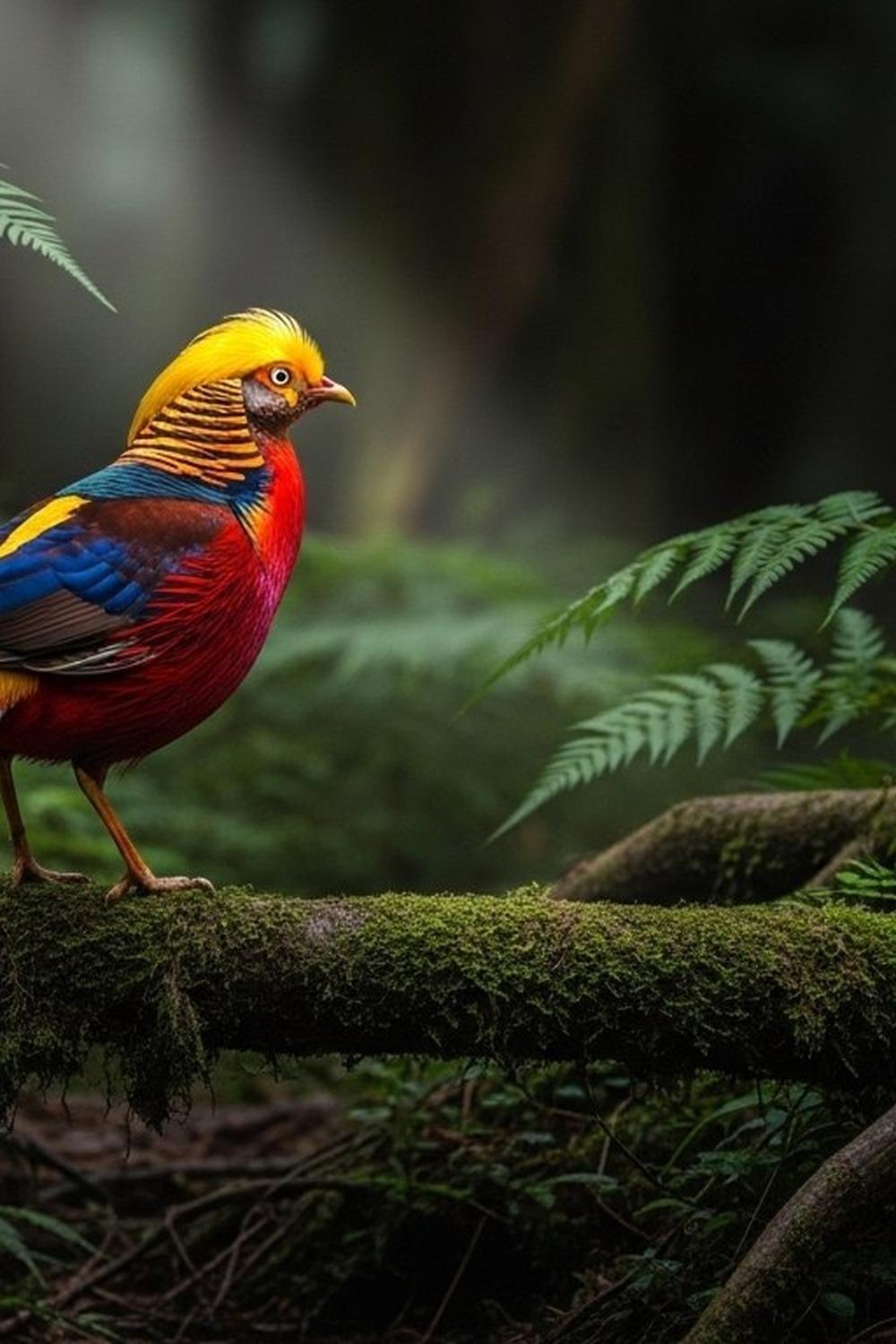
Somewhere between five and six distinct color zones exist on the male golden pheasant — Chrysolophus pictus, which translates roughly from Greek as “painted golden crest” — at any given moment. Golden-yellow crown. Orange-and-black barred cape. Scarlet underparts. Iridescent dark green upper back. Deep blue wings. And a long, mottled gold-and-black tail that accounts for well over half the bird’s total length of 90–105 centimeters.
Ornithologists at the Natural History Museum in London have catalogued specimens going back to the early 18th century. Every single one demonstrates the same remarkable consistency of patterning. The coloration isn’t random variation. It’s precise, repeatable, and — researchers now believe — under intense evolutionary pressure to stay exactly as it is.
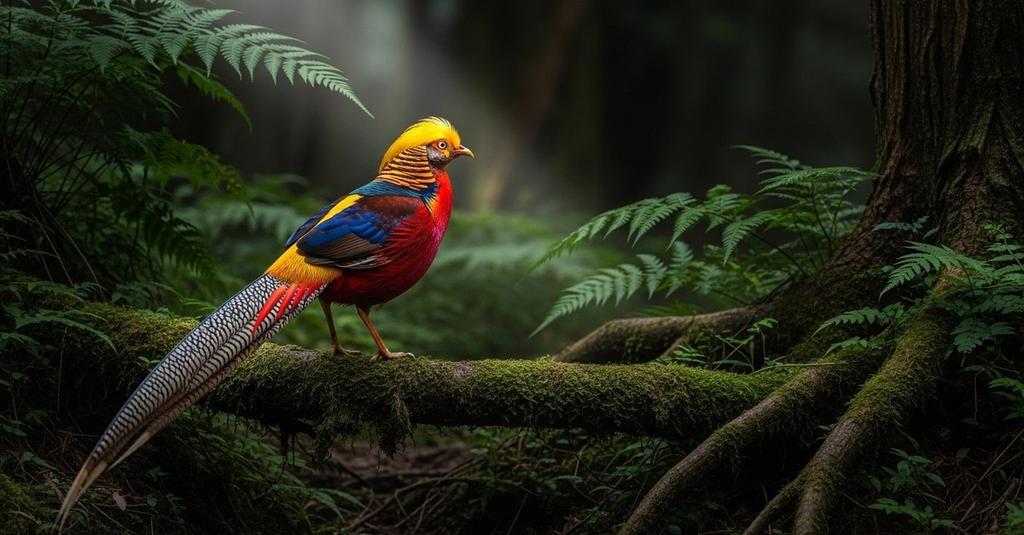
Two different pigment sources drive this precision. Carotenoids, absorbed through diet, create the yellows and reds. Structural coloration — the physical architecture of feather microstructure — generates the iridescent blues and greens. What’s unusual about the golden pheasant is how many distinct pigment types coexist in a single bird without bleeding into one another. Each feather tract operates as a separate color system. The result resembles less a gradual gradient and more a series of hard-edged zones, almost as if the bird were painted in blocks rather than blended. That visual sharpness is part of what makes it so arresting in person.
Field observers in Sichuan consistently report the same first reaction: disbelief.
Why Does a Bird This Brilliant Choose Darkness?
The colors look artificially saturated, like something processed through a filter. They’re not. This is the real thing, unenhanced and operating under its own evolutionary logic. Yet here’s the counterintuitive part — a bird this visually explosive doesn’t spend its time in open clearings, catching the sun. It does the opposite. Dense undergrowth, rhododendron thickets, bamboo slopes, shaded ravines. The golden pheasant is a creature of forest shadows where the canopy filters direct light down to almost nothing.
Predator avoidance has long explained this behavior. But research emerging from Peking University’s School of Life Sciences in 2019 suggested something more nuanced. Prolonged UV exposure degrades carotenoid-based pigments in bird plumage over time, and species that rely heavily on carotenoid coloration for mate selection have, in several documented cases, evolved habitat preferences that limit their UV exposure during non-breeding periods. The golden pheasant’s commitment to shade isn’t just about hiding from hawks — (and this matters more than it sounds) — it’s about protecting the very asset that makes it reproductively successful. The bird is, in the most literal sense, guarding its own appearance.
You can find similar strategies playing out in unexpected ways across the animal kingdom. Like the way crows use formic acid from ants to maintain feather condition, a behavior that took researchers decades to fully explain. And ground-dwelling birds that evolved shade-seeking aren’t aberrations. They’re solving a problem most of us never think about: how to stay beautiful in an environment that destroys beauty.
Flight behavior fits the same pattern. Golden pheasants can fly — short, explosive bursts when threatened — but they’re fundamentally ground birds. They roost in low branches at night, forage on the forest floor during the day, and run rather than fly when given the option. Their legs are strong and their feet are built for leaf litter, not perching. Most wild sightings are glimpses: a flash of scarlet between bamboo stems, a tail disappearing into shadow.
Ornithologist Dr. Zheng Guangmei, who spent years documenting Chinese pheasant species through the 1990s and into the 2000s, described wild golden pheasant encounters as “always brief, always on the bird’s terms.” Even in areas where they’re relatively common, they’re rarely fully seen. That elusiveness has real consequences for research — most behavioral data on golden pheasants comes from captive populations, and what happens in the actual mountain forests of Sichuan remains genuinely underresearched. That gap matters more than it might seem at first glance.
From Chinese Forests to European Aviaries: A Three-Century Obsession
The golden pheasant’s relationship with humans is long, complicated, and almost entirely driven by aesthetics. It appears in Chinese imperial iconography dating to the Song Dynasty (960–1279 CE), associated with virtue, beauty, and good governance — an auspicious symbol for officials and emperors alike. By the early 1700s, live specimens had been transported to Europe, where they became prized additions to aristocratic menageries. King George III kept them at Kew. Carl Linnaeus formally described and named the species in 1758.
In Britain, small feral populations established themselves from escaped captive birds — the Royal Society for the Protection of Birds estimates that a feral UK population, now largely concentrated in Breckland, Norfolk, numbered around 101 breeding males as of the most recent survey, though numbers have declined significantly since the early 2000s. These birds aren’t native to Britain. They’re living evidence of centuries of human fascination with something too beautiful to leave where it was found. Watching a species disappear at this speed from the very places we exported it to, you stop calling it a trend.
Three centuries of captive breeding has created an odd scientific problem. Detailed records exist of courtship displays, incubation periods, chick development, and feeding preferences going back to the Victorian era. But captive conditions don’t replicate mountain forest life. Diet differs. Social structures differ. Predation pressure differs. Stress levels differ. The golden pheasant understood from captivity may behave meaningfully differently from the bird living wild at 1,000 to 2,000 meters elevation in Gansu province. This is the central frustration for researchers working with this species — the most beautiful bird in its range is also, paradoxically, one of the least observed in natural conditions. The data gap is real, and it matters for conservation planning.
The Habitat Crisis Is Happening Quietly
Listed as Least Concern on the IUCN Red List — a classification that sounds reassuring but carries a significant caveat. The IUCN assessment, last updated in 2016, notes that population trends are decreasing and that the quality of remaining habitat is declining due to agricultural expansion, logging, and human settlement encroachment into mountain forest zones across Sichuan and adjacent provinces.
China’s rapid economic development through the 1990s and 2000s reshaped these landscapes dramatically. The Wolong National Nature Reserve in Sichuan, established in 1963 and later expanded as part of China’s broader effort to protect giant panda habitat, has provided some indirect protection to golden pheasant populations. But the reserve system doesn’t cover the full range of the species, and outside protected zones, habitat fragmentation is an ongoing and documented problem.
Deforestation doesn’t just reduce territory. It changes the light environment of the forest. When canopy cover thins, more UV reaches the forest floor. If the hypothesis from Peking University’s 2019 research holds — that golden pheasants actively select shaded microhabitats to protect pigmentation — then even partial deforestation could push birds into suboptimal conditions, affecting both plumage quality and, consequently, breeding success.
The chain of consequence is specific: fewer trees means more light means degraded feather color means reduced mate attractiveness means lower reproductive rates. The bird’s beauty becomes a liability the moment its environment stops protecting it. Conservation teams working through the Sichuan Forestry and Grassland Bureau have begun incorporating pheasant species into habitat assessments alongside panda monitoring. It’s imperfect, and underfunded. But it acknowledges something important: that protecting iconic species sometimes means protecting the less iconic ones sharing their forest.
Where to See This
- Tangjiahe National Nature Reserve, Sichuan Province, China — one of the most accessible protected areas within the golden pheasant’s native range; best visited between March and May during breeding season when males display most actively.
- Breckland, Norfolk, England — home to a small but established feral population descended from escaped captive birds; the RSPB’s Thetford Forest reserve offers the best viewing opportunities in Western Europe, particularly at dawn in conifer plantations.
- For background reading, the Handbook of the Birds of the World (HBW Alive) carries the most detailed species account available, including habitat range maps, behavioral records, and subspecies information updated through 2023.
By the Numbers
- 90–105 cm: total length of an adult male golden pheasant, of which 60–75 cm is tail alone.
- 101 breeding males: estimated feral UK population at last structured survey (RSPB, early 2000s); current numbers are believed to be lower, possibly under 50 pairs.
- 1758: year Carl Linnaeus formally described the species in the 10th edition of Systema Naturae.
- 1,000–2,000 meters: typical elevation range for wild populations in Sichuan and Gansu, China.
- Least Concern (decreasing): current IUCN Red List status, with population trend listed as declining as of the 2016 assessment.
Field Notes
- In 2011, behavioral ecologists observing captive golden pheasants at Beijing Zoo documented males performing courtship cape-spreading displays lasting up to 40 seconds continuously — the barred orange-and-black cape fanning outward to frame the face like a ruff, a display structure with no clear parallel in closely related pheasant species.
- The female golden pheasant is cryptically brown and barred — so thoroughly camouflaged that she’s often invisible at distances where the male would be immediately obvious. They’re such visually different birds that early European naturalists briefly classified them as separate species.
- Golden pheasants hybridize readily in captivity with Lady Amherst’s pheasants (Chrysolophus amherstiae), producing fertile offspring — which has complicated efforts to maintain genetically pure captive populations and raises questions about what wild contact zones between the two species might look like.
- Researchers still can’t reliably explain why wild golden pheasant population density varies so dramatically across apparently similar forest patches in Sichuan. Habitat quality metrics don’t fully account for the distribution patterns observed. Something about microhabitat selection, possibly related to specific food plant availability or soil invertebrate density, remains poorly characterized.
Frequently Asked Questions
Q: Where does the golden pheasant naturally live?
The golden pheasant is native to the mountain forests of central and western China, primarily in Sichuan, Shaanxi, Gansu, Guizhou, and Yunnan provinces. It typically occupies dense forest and bamboo undergrowth at elevations between 1,000 and 2,000 meters. Small feral populations exist in the UK, France, and parts of South America, all descended from escaped captive birds introduced over the past three centuries.
Q: Why is the male golden pheasant so much more colorful than the female?
This is classic sexual selection — the same evolutionary mechanism Charles Darwin identified in the 1870s. Female golden pheasants choose mates partly based on plumage quality, which signals genetic fitness and health. Males with brighter, more intact coloration tend to have greater reproductive success. The female, meanwhile, needs camouflage for the 22–23 day incubation period when she sits alone on the nest, often on the ground, exposed to predators. Her drab coloring isn’t a failure of evolution — it’s a different solution to a different problem.
Q: Are golden pheasants endangered?
Not currently — but “Least Concern” is more complicated than it sounds. The IUCN lists the golden pheasant as Least Concern, but explicitly notes a declining population trend driven by habitat loss across its native Chinese range. It’s not in immediate crisis, but it’s also not stable. The feral UK population, sometimes cited as a conservation backup, is genetically limited and itself declining. The species doesn’t face imminent extinction, but it’s moving in the wrong direction, and its native forest habitat is under sustained pressure from agriculture and development in Sichuan and adjacent provinces.
Editor’s Take — Alex Morgan
What strikes me most about the golden pheasant isn’t the plumage — it’s the hypothesis that the plumage is why the bird hides. We usually think of bright coloration as a trade-off: look good, risk predation. But if the shade-seeking behavior is actually protecting the pigment from UV degradation, then this bird has evolved an entirely different solution. It doesn’t accept the trade-off. It engineers around it. That’s not just beautiful. That’s a genuinely different way of thinking about how appearance and behavior co-evolve — and we’re only beginning to test it rigorously.
There’s something uncomfortable about a creature this extraordinary remaining this poorly understood in the wild. We’ve kept golden pheasants in cages for three hundred years. We’ve painted them, traded them, catalogued their feathers in museum drawers across Europe. And yet the basic question of how they actually live — what they eat across seasons, how they choose territories, whether that UV-protection hypothesis holds at the population level — remains genuinely open. Maybe that’s the real story: not how spectacular the bird is, but how little its spectacle has motivated us to understand it. What else are we looking at without actually seeing?
Illustrations are AI-generated. Article fact-checked and human-edited. Our editorial standards.