How Did Ancient Egyptians Really Look Like?
How did ancient Egyptians look like in real life — not on the gold-bright wall paintings, but in flesh and bone? The short, honest answer is that they looked like what they were: a North African people, sun-dark and varied, living for three thousand years at the hinge where Africa meets Asia, slowly absorbing genes and faces from both sides. The longer answer — the one the tomb art quietly hides — only got sharper in July 2025, when scientists at the Francis Crick Institute and Liverpool John Moores University pulled a whole genome from a 4,500-year-old potter and rebuilt his face.
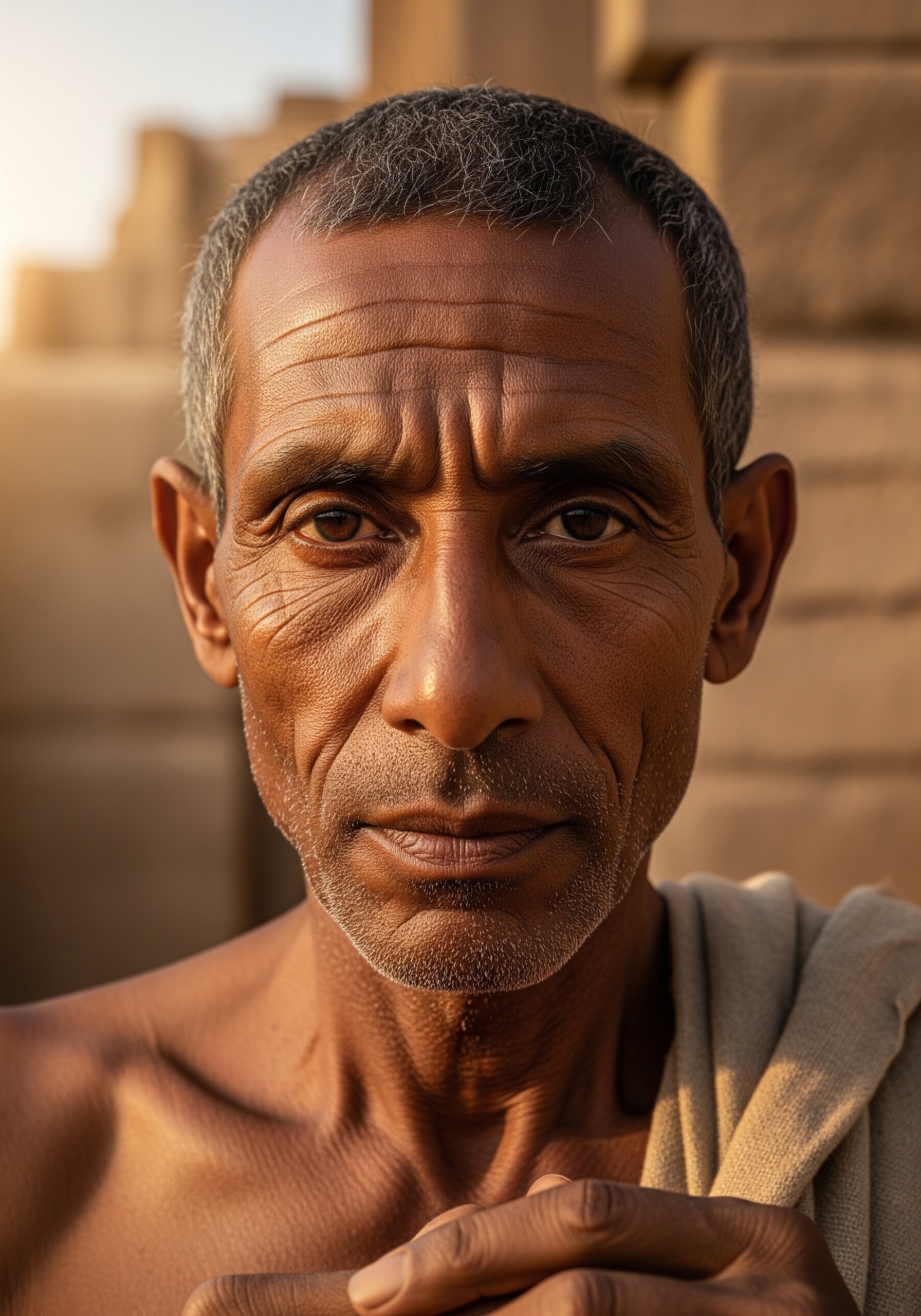
Key Facts
- The reddish-brown skin tone on men in Egyptian art is a visual code, not a photograph — women in the same scenes are painted yellow for the same coded reason.
- In July 2025 the journal Nature published the first whole genome ever recovered from ancient Egypt — a man buried at Nuwayrat around 2700 BCE, roughly when the Step Pyramid was new.
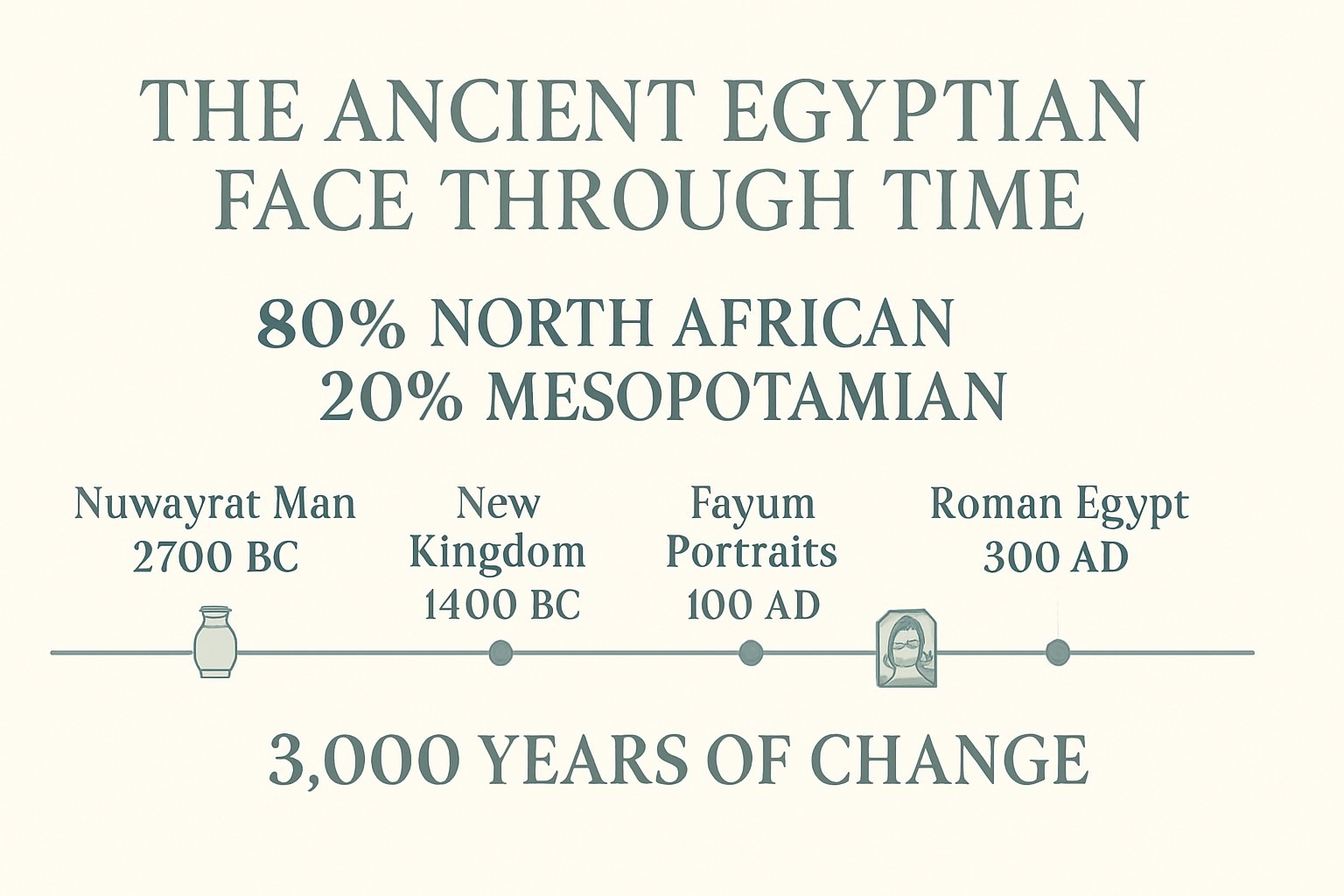
- His ancestry was about 80% indigenous North African and 20% from the eastern Fertile Crescent (Mesopotamia) — the first genetic proof of a long-suspected connection.
- DNA-based predictions and his skull suggest brown eyes, dark hair, and skin somewhere in the dark-brown range — though the team deliberately rendered the reconstruction in grayscale to avoid overclaiming.
- A 2017 study of 90 mummies from Abusir el-Meleq found that sub-Saharan African ancestry in the Egyptian gene pool rose noticeably after Roman rule — meaning “ancient Egyptian” is not one face, but a face that changed across 3,000 years.
In short: Ancient Egyptians were a varied North African people whose looks shifted gradually over three millennia, blending an indigenous Nile Valley population with neighbors from the Fertile Crescent. The painted skin tones in tombs are symbolic gender code, not realism — the real faces come from mummies, bones, and now whole genomes.
Key Facts
- The reddish-brown skin tone on men in Egyptian art is a visual code, not a photograph; women in the same scenes are painted yellow for the same coded reason.
- In July 2025 the journal Nature published the first whole genome ever recovered from ancient Egypt — a man buried at Nuwayrat around 2700 BCE, roughly when the Step Pyramid was new.
- His ancestry was about 80% indigenous North African and 20% from the eastern Fertile Crescent (Mesopotamia) — the first genetic proof of a long-suspected connection.
- DNA-based predictions and his skull suggest brown eyes, dark hair, and skin in the dark-brown range, though the team rendered the reconstruction in grayscale to avoid overclaiming.
- A 2017 study of 90 mummies from Abusir el-Meleq found that sub-Saharan African ancestry in the Egyptian gene pool rose noticeably after Roman rule.
In short: Ancient Egyptians were a varied North African people whose looks shifted gradually over three millennia, blending an indigenous Nile Valley population with Fertile Crescent neighbours. The painted skin tones in tombs are symbolic gender code, not realism; real faces come from mummies, bones and, since 2025, a whole genome.
The painting is not the person
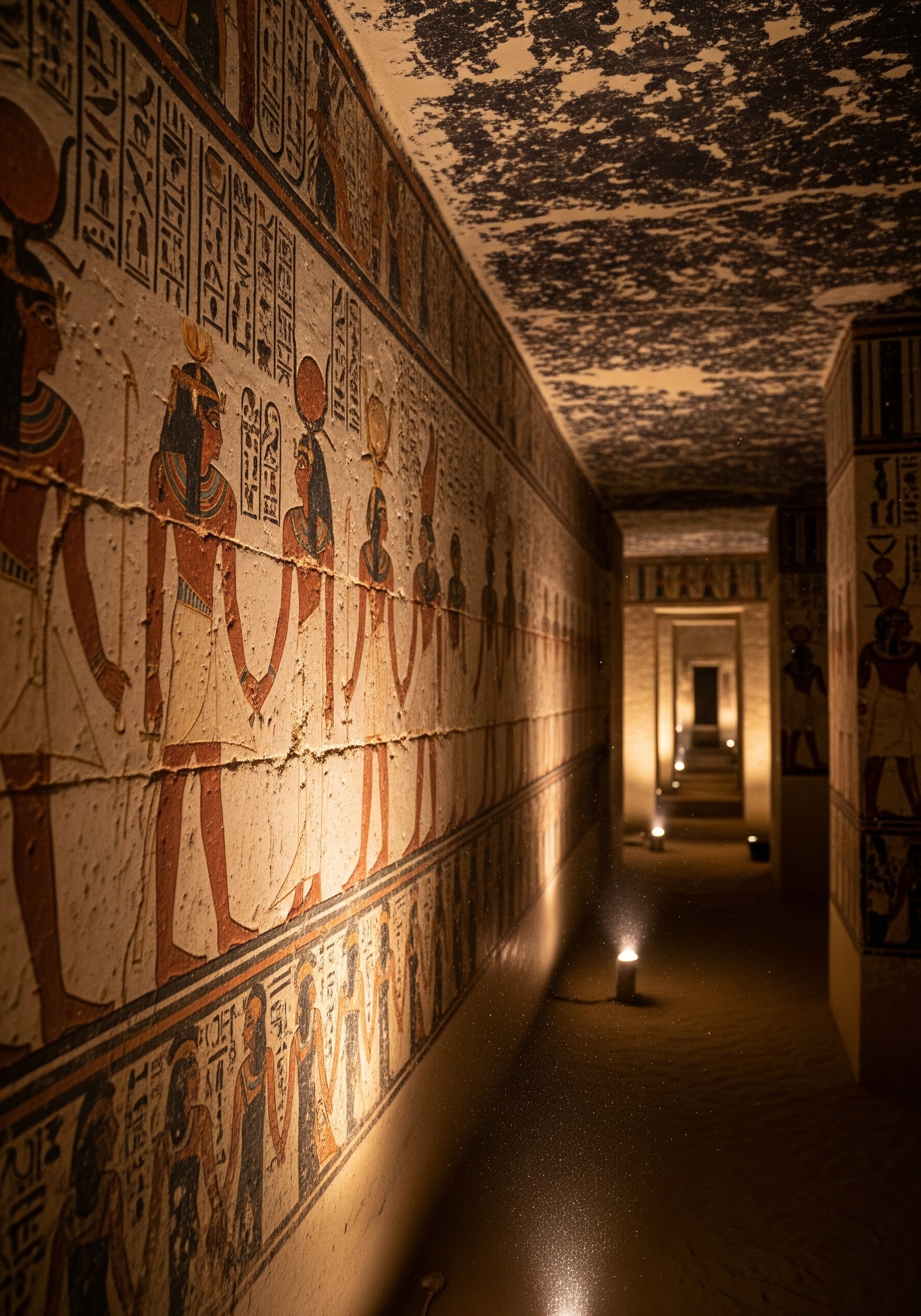
Walk into any reconstructed Egyptian tomb — the Met’s Perneb chapel, the British Museum’s Nebamun fragments — and the first thing you notice is that everyone is the same color. Men are the rich red-brown of fired clay. Women are pale, almost butter-yellow. Foreigners get their own palette: chalky pink for Levantines, jet black for Nubians, ivory for Libyans.
None of it is a record of real skin.
That code is a sign system, as deliberate as the way medieval painters gave Jesus a halo. Egyptologists call it the “tan men, pale women” convention, and it was already in place by the Fourth Dynasty. Red ochre signaled male vigor and the outdoor world. Yellow ochre signaled the indoor, protected sphere of women. When Hatshepsut — a woman ruling as pharaoh — wanted to argue her own legitimacy in paint, she had herself shown with the dark male skin tone. In her tomb, skin color was an argument about power.
This matters because for two centuries, modern racial debates about Egypt have leaned on these symbolic colors as if they were photographs. They aren’t. They tell us how Egyptians thought about gender and ethnicity, not how they actually looked.
{IMAGE_2}
What a 4,500-year-old skeleton finally said out loud
For decades, ancient Egyptian DNA was almost impossible to recover. Egypt is hot. Heat shatters DNA. Mummification — the embalming oils, the bitumen, the long centuries in temple caches — does more damage. Every previous attempt had pulled scraps.
And then there was the man from Nuwayrat. British archaeologists found him in 1902, in a rock-cut tomb cracked into a limestone hillside about 150 miles south of Cairo. He had not been mummified at all. He had been bundled inside a large ceramic vessel and pushed into the rock, and the dry stone had quietly preserved him. He lived between roughly 2855 and 2570 BCE — the very door of the Old Kingdom, before Giza, around the time the Step Pyramid rose at Saqqara.
In July 2025, a team led by researchers at the Francis Crick Institute and Liverpool John Moores University published his entire genome in Nature. It was the first complete one ever read from ancient Egypt.
His ancestry resolved into two parts. About 80% matched Neolithic North African populations — the indigenous Nile Valley stock that had farmed the floodplain for thousands of years already. The remaining 20% traced cleanly to ancient peoples of the eastern Fertile Crescent, the world of Mesopotamia. For the first time, the long-suspected pottery-and-script connection between Egypt and Sumer had a body to point at.
The face the scientists chose not to color in
At the Face Lab at Liverpool John Moores University, Professor Caroline Wilkinson — the forensic anthropologist whose team has rebuilt the faces of Richard III and St Nicholas of Myra — produced the reconstruction. From a 3D scan of his skull came a tight-jawed, hollow-cheeked older man, probably between 44 and 64 years old when he died, with a healed jaw and the worn vertebrae of someone who had spent decades crouched over a potter’s wheel.
Here is the part that made the team careful. The genetic skin-color predictor HirisPlexS read his DNA as brown-eyed, dark-haired, and pigmented somewhere “from dark to black.” But Wilkinson and her colleagues deliberately published the face in grayscale, without hair, without skin tone painted on. Their reason was honest: the prediction tools were trained mostly on modern Europeans, and a single 4,500-year-old man cannot stand for an entire civilization.
That restraint is the article behind the article. They had every incentive — clicks, certainty, simplicity — to color him in. They didn’t. Which is, in itself, what good ancient DNA work now looks like.
The Nuwayrat Man — by the numbers (2025 Nature genome study)
- ~80% indigenous North African / Nile Valley ancestry
- ~20% eastern Fertile Crescent (Mesopotamia)
- Lived: c. 2855–2570 BCE — Early Dynastic / dawn of the Old Kingdom
- Age at death: roughly 44–64 years, probably the older end
- Likely occupation: potter — bones showed long-term squatting and leaning wear
The Fayum window: 900 real ancient faces
If you want to see actual ancient Egyptian faces as they wanted to be remembered, skip the tomb walls and find the Fayum portraits. These are roughly 900 painted wooden panels, made between about 50 and 250 CE, fastened over the faces of mummified individuals in the Fayum oasis. They are realistic — startlingly so. Wide dark eyes, thick lashes, gold jewelry, individual jawlines. You can pick a particular nose out of a crowd.
The catch is honest: this is Roman-period Egypt, after Alexander, after the Ptolemies. The faces are an ethnic patchwork — native Egyptians, Greek settlers, Romans, mixed families. They are not the Old Kingdom face. But they prove something important: by the time portraiture mattered to Egyptians, the people in front of the brush already showed a range of features wider than any single skin tone could carry.
How did ancient Egyptians look like across 3,000 years — one answer is not enough
Here’s the trap in this question: the word “ancient.” Egyptian civilization runs from roughly 3100 BCE to 30 BCE — more time than separates us from the founding of Rome. A face from the Old Kingdom and a face from Cleopatra’s court are 2,500 years apart. Of course the population changed.
The clearest measurement of that change is a 2017 paper led by Verena Schuenemann at the Max Planck Institute and the University of Tübingen, working with mummies from Abusir el-Meleq. Her team sequenced DNA from 90 individuals spanning roughly 1400 BCE to 400 CE. Across that whole stretch, the population stayed remarkably stable, with a profile closest to ancient Near Eastern and Anatolian groups. Then something shifted. After the Roman period, sub-Saharan African ancestry in the Egyptian gene pool rose markedly — almost certainly the demographic shadow of the trans-Saharan trade routes that opened in earnest in the centuries that followed.
Here is the cleaner way to say it: the ancient Egyptian “look” was never a snapshot. It was a slow, three-millennium drift, weighted at first toward an indigenous North African base with a Mesopotamian seasoning, and gradually broadened by every conquest and every caravan that crossed the Nile.
What the bones and braids actually tell us
Mummies are forensically useful in ways paintings will never be. Hair survives. Skin survives in fragments. Skulls can be measured. The picture they paint, taken across many sites, is consistent and unromantic.
Hair on Egyptian mummies ranges from straight to wavy to tightly curled, and in color from reddish brown through dark brown to black. But what about that famous reddish tint on some mummies — were the pharaohs secretly redheads? Turns out it’s mostly chemistry: hair pigment oxidizes over millennia, and even very dark hair can come out auburn after a few thousand years in dry rock. Cranial measurements describe a North African population that overlaps with Levantine and Nubian ranges at the edges. Lips, broadly speaking, run from thin to full. A protrusive jaw is not unusual. None of this should be remarkable — it is what you would expect from a civilization sitting on the African continent, at the entrance to Asia, for thirty centuries.
For one well-documented look at how Egyptians thought about their own animals — and what kind of tenderness their preserved remains can record — see our piece on the wild cat ancient Egyptians mummified but never tamed.
What the ancient writers actually said
The Greeks who came to Egypt told us, in their own words, what they saw. Herodotus, writing in the 5th century BCE, described Egyptians as having melanchroes skin — dark-complexioned — and curly hair, and noted that they and the Ethiopians shared the practice of circumcision. Diodorus Siculus, four centuries later, recorded that the Ethiopians (Nubians) claimed the Egyptians as colonists of their own people. Ammianus Marcellinus, writing in the 4th century CE, called Egyptian men “mostly brown and black, with a skinny and desiccated look.”
Modern Egyptologists treat these descriptions carefully — Herodotus is famously hit-or-miss, and Greek vocabulary for skin tone does not map neatly onto modern racial categories. But taken together, the ancient eyewitness record describes a darker-complexioned, curly-haired North African population. That matches the genome of the man from Nuwayrat far better than it matches either the bright red-brown of tomb art or the pale fictions that crept into later European paintings.
The honest answer
So: what did ancient Egyptians look like? They looked like North Africans. Sun-darkened skin in a range of browns. Hair from straight to tightly curled. Dark eyes, mostly. Faces with the geometry of a people whose deepest roots ran along the Nile and whose secondary roots reached east toward the Fertile Crescent — and, over the long Roman and post-Roman centuries, gradually picked up sub-Saharan ancestry as well. Not white. Not “Black” in the modern American sense, either. African, on their own terms, before either of those categories existed.
The reason this question keeps coming back is that for two hundred years, outsiders have tried to drag Egypt into a black-or-white argument that ancient Egyptians themselves would not have recognized. They divided people by language, by city, by which god they served — not by a single pigment. The cleanest way to honor them is to answer the same way: with specifics, with sources, and without picking a color from a chart.
Frequently Asked Questions
Q: Were ancient Egyptians black or white?
A: Neither category fits. Mainstream Egyptology rejects the black-vs-white framing as anachronistic — the ancient Egyptians were a North African population whose look gradually broadened across 3,000 years. The 2025 whole-genome study of a man from c. 2700 BCE found about 80% North African and 20% Mesopotamian ancestry, with DNA-predicted dark skin and brown eyes. After Roman rule, sub-Saharan ancestry in the population rose markedly.
Q: Why are men painted red and women painted yellow in Egyptian art?
A: It is a symbolic convention, not a record of skin color. Red ochre signaled male vigor and the outdoor world; yellow ochre signaled the indoor, protected sphere of women. Foreigners were given their own colors too — chalk for Levantines, black for Nubians, ivory for Libyans — so Egyptian artists could tell ethnic groups apart at a glance. The colors are gender and ethnic code, not portraits.
Q: Are modern Egyptians related to ancient Egyptians?
A: Yes, but with measurable change over time. The 2017 Schuenemann study found long genetic continuity from the New Kingdom through the Roman period, then a marked increase in sub-Saharan African ancestry afterward — likely reflecting the centuries of trans-Saharan trade. Modern Egyptians sit on the same continuum, with North African and Near Eastern roots plus added sub-Saharan ancestry.
Q: What did the face of an ancient Egyptian actually look like?
A: The single most reliable image we have is the Nuwayrat man’s facial reconstruction, published in 2025 by Caroline Wilkinson’s Face Lab at Liverpool John Moores University. The 3D-scanned skull belongs to a thin-faced man in his 50s or 60s, with the worn joints of a lifelong potter. The team deliberately rendered him in grayscale because they refused to overclaim skin tone from a single individual — a choice that says more about scientific honesty than any colored portrait would.
Sources
- Whole-genome ancestry of an Old Kingdom Egyptian — Nature (2025)
- This ancient Egyptian left behind 4,500-year-old DNA. Researchers recreated his face — National Geographic (2025)
- Researchers sequence first genome from ancient Egypt — The Francis Crick Institute (2025)
- Ancient Egyptian mummy genomes — Schuenemann et al., Nature Communications (2017)
- Ancient Egyptian race controversy — Wikipedia overview of historical and modern debates
The portraits ancient Egyptians painted of themselves are not lies — they are language. They tell us what gender meant, what status meant, what a foreigner looked like to a Theban scribe. The bodies in the tombs tell us the rest. Read both, side by side, and the question of how ancient Egyptians looked stops being a controversy and becomes what it always should have been: a study of a particular people, in a particular river valley, slowly changing across thirty centuries — and still recognizable, in modern Egyptian faces, today.
Illustrations are AI-generated. Article fact-checked and human-edited. Our editorial standards.