The Oldest Civilization in the World: 5 Honest Answers
The oldest civilization in the world is not a single place with a single date — it is a fork in the road, and the answer depends on what exactly you mean by “civilization.” Ask an archaeologist over coffee and you will likely get three answers and a sigh.
Key Facts
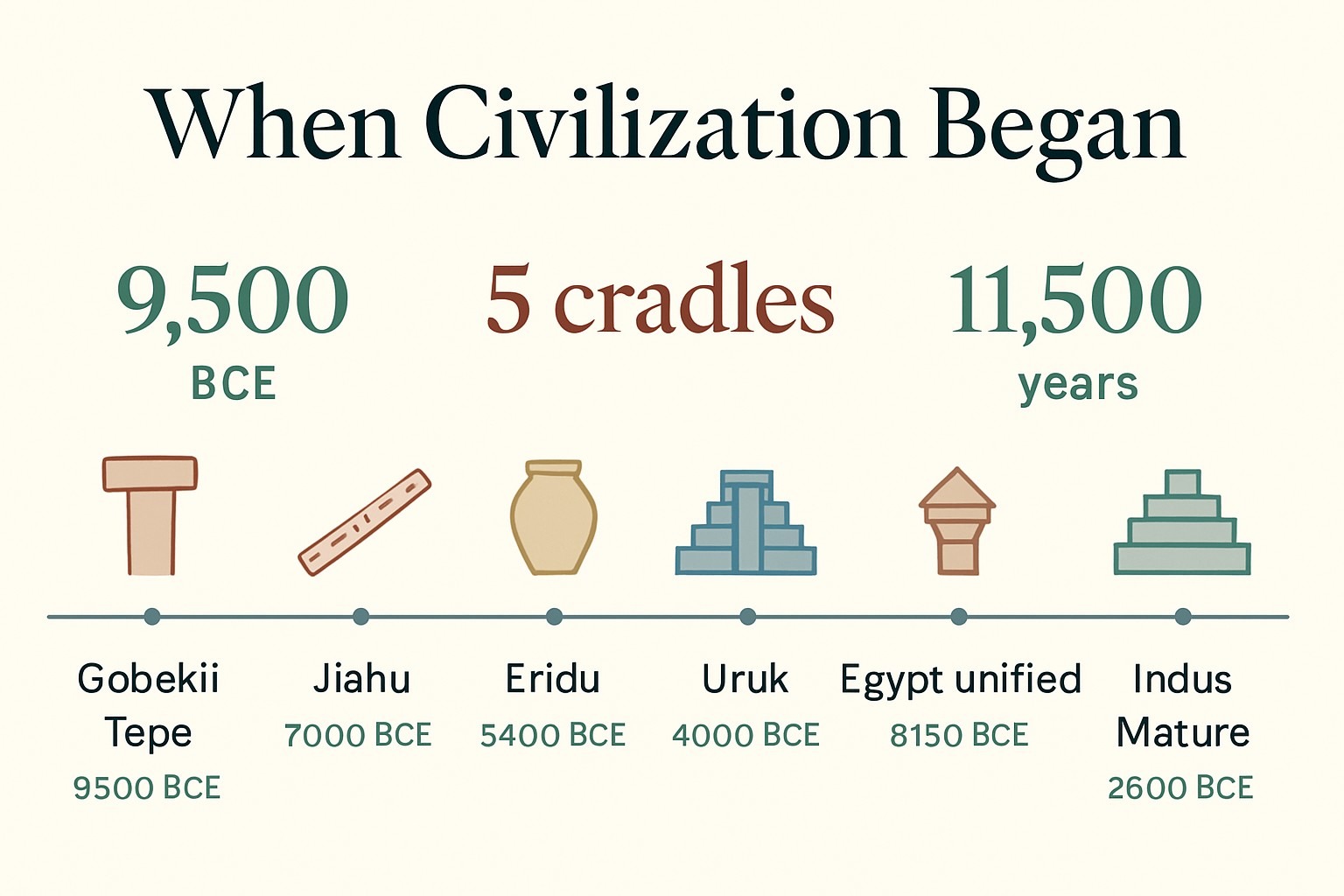
- By the standard archaeological definition — cities, writing, monumental architecture, surplus food, division of labour — Sumer in southern Mesopotamia, with cuneiform writing appearing at Uruk around 3400–3100 BCE, is the oldest known civilization.
- Göbekli Tepe in modern Turkey, built around 9500 BCE, is roughly 6,000 years older than Sumer — but its builders were hunter-gatherers without writing or cities, so most scholars call it pre-civilizational.
- Jiahu in China’s Henan Province (c. 7000–5700 BCE) produced the world’s oldest playable musical instruments and proto-writing symbols on tortoise shells.
- The Norte Chico (Caral-Supe) civilization in coastal Peru built monumental pyramids from around 3000 BCE — the oldest civilization in the Americas.
- “World’s oldest continuous civilization” is a separate claim; the most defensible holder is China, whose written cultural lineage runs from Shang oracle bones (c. 1250 BCE) to today.
In short: If you want one answer, it’s Sumer in Mesopotamia, around 3400 BCE. If you want the honest answer, there are five — depending on whether you mean the first cities, the first monumental architecture, the first writing, the first complex society in the Americas, or the oldest continuous cultural lineage. We will walk through all of them.
Key Facts
- By the standard archaeological definition — cities, writing, monumental architecture, surplus food and division of labour — Sumer in southern Mesopotamia, with cuneiform appearing at Uruk around 3400–3100 BCE, is the oldest known civilization.
- Göbekli Tepe in modern Turkey, built around 9500 BCE, is roughly 6,000 years older than Sumer, but its builders were hunter-gatherers without writing or cities, so most scholars call it pre-civilizational.
- Jiahu in China’s Henan Province (c. 7000–5700 BCE) produced the world’s oldest playable musical instruments and proto-writing symbols on tortoise shells.
- The Norte Chico (Caral-Supe) civilization in coastal Peru built monumental pyramids from around 3000 BCE — the oldest civilization in the Americas.
- The most defensible holder of ‘world’s oldest continuous civilization’ is China, whose written cultural lineage runs from Shang oracle bones (c. 1250 BCE) to today.
In short: There is no single answer to the oldest civilization in the world; it is a definition question disguised as a date question. By the standard definition the answer is Sumer around 3400 BCE, but honest answers also include Göbekli Tepe, Jiahu, Norte Chico and, for continuity, China.
The trick hidden inside a simple question
“Oldest civilization in the world” sounds like a fact you should be able to look up — like the height of Everest, or the speed of light. It isn’t. It’s a definition question wearing the costume of a date question. The word “civilization” was given its modern, technical meaning by the Australian-British archaeologist V. Gordon Childe in the 1950s, who proposed ten markers he called the Urban Revolution: cities, full-time specialists, surplus, monumental public works, a writing system, exact sciences, long-distance trade, and so on. Move the goalposts even slightly, and the winner changes.
So before we name a candidate, we need to agree on what we are measuring. Most lists you find online quietly skip this step and then disagree with each other — which is why the same Google query returns five different answers.
What archaeologists actually mean by “civilization”
The shortest working definition, sometimes called the Masson triad after the Soviet archaeologist Vadim Masson, is three things together: towns, monumental architecture, and writing. Add Childe’s longer checklist — surplus food, division of labour, social hierarchy, organised religion, long-distance trade — and you have the modern threshold.
Two problems immediately appear. First, the Inca empire ran a continent without a writing system; it used khipu, knotted cords. Cahokia, near modern St. Louis, had perhaps 20,000 people and central government around 1100 CE — also without writing. Both are called civilizations anyway. Second, every marker has a fuzzy start date; “writing” depends on what counts as writing, and proto-symbols turn up centuries before clean sentences. Definitions matter, and they bend.
Knowing this, the famous answer comes into sharper focus.
Sumer: the textbook champion
{IMAGE_2}
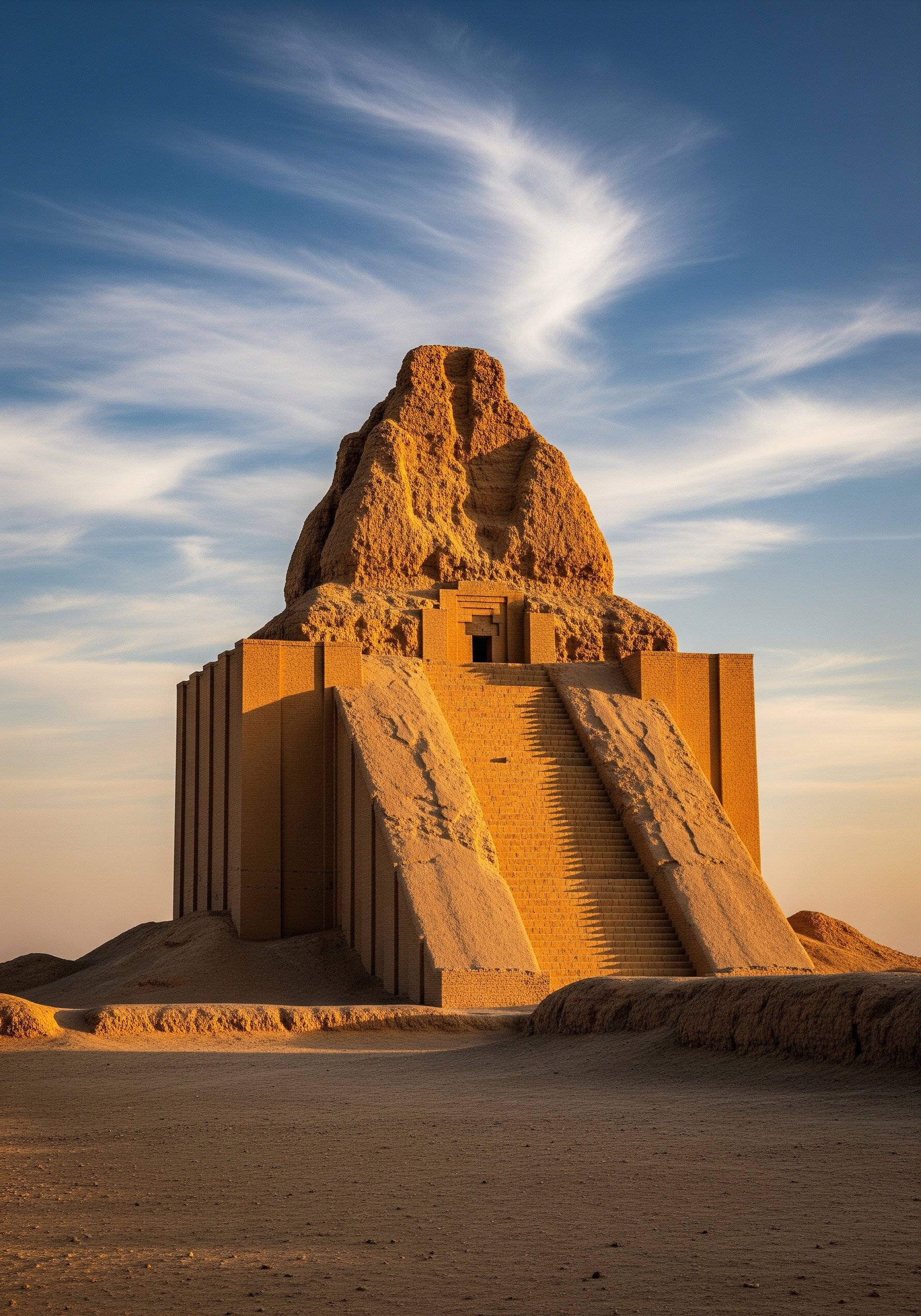
Set the bar at Childe’s full checklist and Sumer wins — clearly and defensibly. In the southern marshlands between the Tigris and Euphrates, in what is now southern Iraq, a chain of city-states crystallised in the fourth millennium BCE. Eridu was founded around 5400 BCE. Uruk, the giant of the early Bronze Age, was thriving by 4000 BCE and ringed by walls associated in legend with the king Gilgamesh. By around 3400–3100 BCE, the Sumerians were pressing cuneiform signs into wet clay — the oldest writing system whose evolution we can read directly.
Cuneiform is the lock. Before it, every civilization candidate has a missing leg in the Masson triad. The University of Pennsylvania’s Samuel Noah Kramer, who spent his life translating Sumerian tablets, famously titled one of his books History Begins at Sumer — a deliberately provocative phrase that nevertheless holds up. The world’s first written law codes, first epic poem (Gilgamesh), first schools, first divided week, and first 60-second minute all trace to the Sumerian cities. That is not marketing; it is what the tablets themselves say.
So if a class asks for one answer, Sumer is the safe, accurate answer. But it is not the whole story.
Göbekli Tepe broke the old timeline
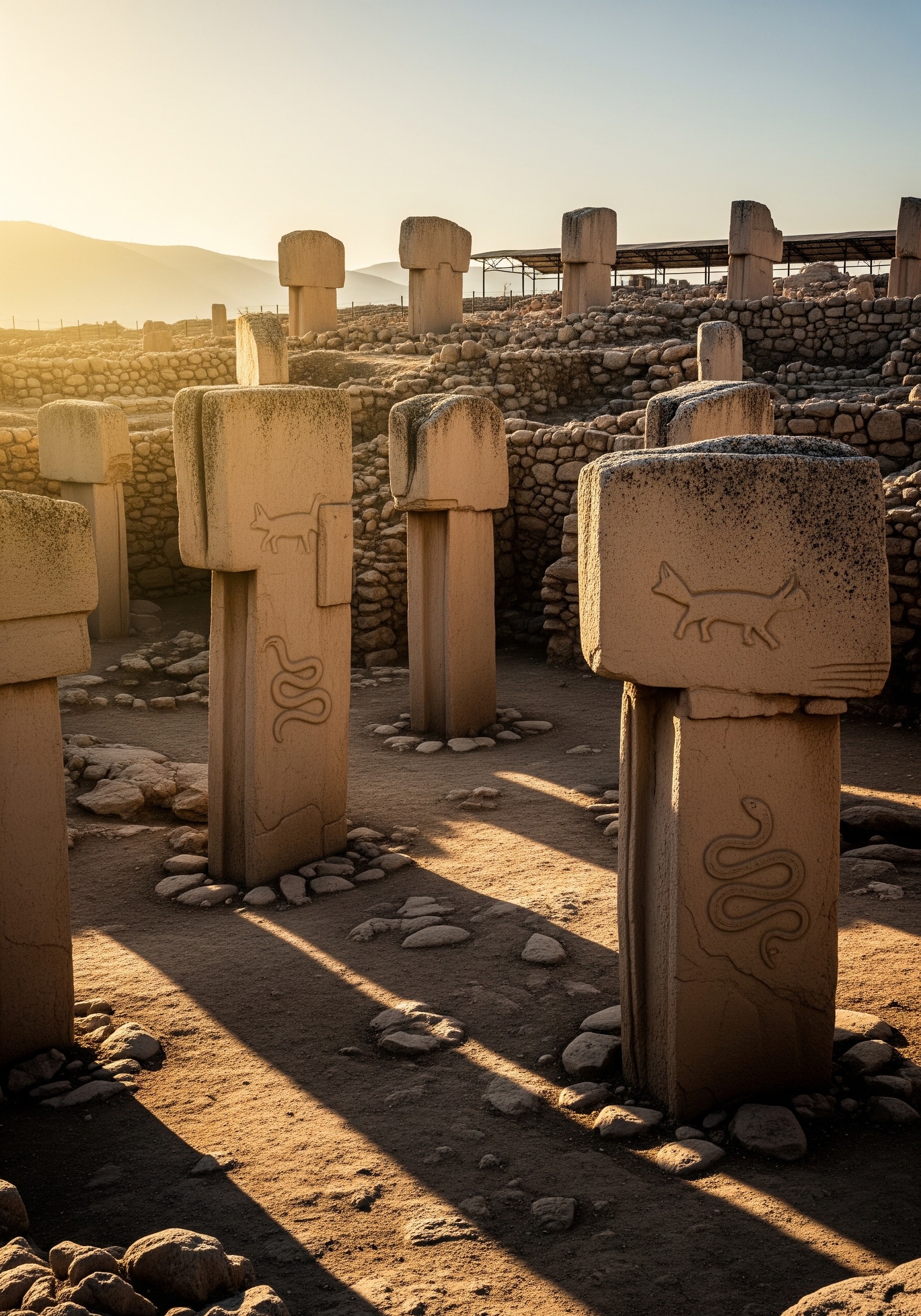
In 1994, the German archaeologist Klaus Schmidt revisited a hilltop in southeastern Turkey that an earlier survey had dismissed as a medieval cemetery. What he uncovered, working with the German Archaeological Institute until his death in 2014, rewrote the textbook chapter on how civilization began. The site, Göbekli Tepe (“Potbelly Hill”), contains rings of T-shaped limestone pillars up to 5.5 metres tall and 10–20 tons each, carved with foxes, snakes, leopards, vultures, and human-like figures.
The dates are the shock. The earliest enclosures were built around 9500 BCE — roughly 6,000 years before Sumer, and a full thousand years before agriculture. The builders were hunter-gatherers. They had no farming, no metal tools, no domesticated animals, no permanent settlements that we have yet found, and certainly no writing. By the Childe checklist this is not a civilization. By any human measure of organisation, ambition and shared belief — coordinating dozens of people to carve and raise multi-ton stones — it is something almost as remarkable.
Schmidt’s interpretation, refined by the project’s current researchers including Jens Notroff, was that monumental religion came first and farming followed, rather than the other way around. Whether or not that holds, Göbekli Tepe forces an honest article to admit one thing: the moment human beings started doing civilizational things — gathering, organising, building monuments — is much older than the moment they invented the technology bundle we use to define civilization.
The other serious contenders, in one table
Once you accept that “oldest” depends on the bar, several other early societies enter the conversation. Each is a legitimate answer to a slightly different question.
| Site / culture | Region | Approximate dates | What makes it a candidate |
|---|---|---|---|
| Göbekli Tepe | SE Turkey | c. 9500–8000 BCE | Oldest known monumental architecture; pre-agricultural |
| Jiahu / Peiligang | Henan, China | c. 7000–5700 BCE | Early rice farming, bone flutes, proto-symbols on shells |
| Mehrgarh | Balochistan, Pakistan | c. 7000–2600 BCE | Neolithic root of the later Indus Valley civilization |
| Sumer (Uruk) | Southern Iraq | cities c. 4000 BCE; writing c. 3400–3100 BCE | First full Childe-checklist civilization |
| Ancient Egypt | Nile valley | Unified c. 3150 BCE | Independent rise; runs almost continuously to the Roman period |
| Indus Valley (Mature Harappan) | Pakistan / NW India | c. 2600–1900 BCE | Largest of the early cradles by area; planned, sewer-equipped cities |
| Norte Chico (Caral-Supe) | Coastal Peru | c. 3000–1800 BCE | Oldest civilization in the Americas; pyramids contemporary with Egypt’s |
| Erlitou (early Chinese state) | Yellow River, China | c. 1900–1500 BCE | Earliest urban state in East Asia; precursor to dynastic China |
Two entries here usually surprise readers. The Norte Chico people in what is now Peru were laying out plaza-and-pyramid cities at the same moment Egypt was raising its first pyramids — entirely independently, on the other side of the planet, without pottery and without (as far as we know) writing. The Peruvian archaeologist Ruth Shady, who runs the Caral excavation, published the radiocarbon dates in Science in 2001 and Nature in 2004, and they have held up. And Jiahu’s bone flutes, carved from crane wing-bones around 7000 BCE, are the oldest playable musical instruments ever found — the sound of culture, four thousand years before Sumer.
The five honest answers at a glance
- Oldest by standard archaeology: Sumer, c. 3400 BCE
- Oldest monumental site: Göbekli Tepe, c. 9500 BCE
- Oldest in the Americas: Norte Chico, c. 3000 BCE
- Oldest continuous lineage: China, from c. 1250 BCE
- Oldest civilization-precursor culture: Jiahu & Mehrgarh, c. 7000 BCE
So, which is the oldest civilization in the world? Five honest answers
Here is where most articles equivocate. Let us not.
If you mean the oldest civilization by the standard archaeological definition — yes, Sumer, around 3400 BCE. That is the safe answer and almost certainly the right one for school, trivia, or general use.
If you mean the oldest known evidence of humans organising at civilizational scale, the answer is Göbekli Tepe, around 9500 BCE — with the caveat that it lacks the writing-and-cities markers.
If you mean the oldest civilization in the Americas, it is Norte Chico / Caral-Supe in Peru, from around 3000 BCE — roughly contemporary with the first Egyptian dynasties.
If you mean the oldest continuous civilization — one cultural lineage running unbroken to today — the most defensible holder is China, whose written record runs from Shang oracle bones (around 1250 BCE) through every successor dynasty to the present. Egypt’s run was longer in years but ended; India’s cultural continuity is real but the script and language broke. None of these is uncontested.
And if you mean the oldest civilization-precursor culture — village-scale societies already doing farming, music, and symbolism — Jiahu and Mehrgarh, both around 7000 BCE, are the strongest cases. They are not civilizations on Childe’s bar, but they are where the road to civilization visibly begins outside the Fertile Crescent.
One sentence of editorial judgement, since you have read this far: the most useful answer is not the textbook one but the disambiguation itself — anyone who insists on a single name without specifying which bar they are using is selling certainty the evidence does not support.
Why the answer keeps moving
Forty years ago, the textbook said civilization started in Mesopotamia around 3500 BCE — full stop. Then radiocarbon dating got better. Satellite survey caught up. Göbekli Tepe came out of the ground. Caral’s pyramids were dated and the Americas turned out to be 1,500 years older than the Olmecs. Each generation of fieldwork pushes the start date earlier and the geography wider.
It will keep doing this. Karahan Tepe, a sister site to Göbekli Tepe excavated since 2019, is producing comparable T-pillars. Underwater surveys around the Persian Gulf — drowned by the post-glacial sea-level rise — may eventually find pre-Sumerian settlements. Honest answer: the “oldest civilization” line on the timeline is being rewritten in real time. Treat any number, including the ones in this article, as the best current estimate, not a final score.
Here’s the thing — that uncertainty is not a weakness of the field. It is the field working.
Frequently Asked Questions
Q: Is Mesopotamia or Egypt the oldest civilization?
A: Mesopotamia. Sumerian city-states and cuneiform writing predate Egypt’s unification by roughly 300–500 years. Egypt’s civilization endured longer as a continuous, recognisable state, but it arose later.
Q: Is China the oldest civilization in the world?
A: Not by start date — Sumer is older. China’s strong claim is to the oldest continuous civilization, with cultural and written traditions running from Shang dynasty oracle bones (c. 1250 BCE) to the present. That is a different superlative.
Q: What about India and the Indus Valley?
A: The Mature Harappan phase (c. 2600–1900 BCE) was one of the largest early civilizations by area. Its Neolithic roots at Mehrgarh go back to about 7000 BCE, but those early villages do not yet meet the standard civilization threshold.
Q: Does not Göbekli Tepe prove civilization is much older than Sumer?
A: It proves something more interesting — that monumental religious architecture is much older than civilization. Göbekli Tepe’s builders had no farming, no cities, and no writing, so most archaeologists do not classify the site itself as a civilization. It is the earliest evidence of organisation on a civilizational scale.
Sources
- Cradle of civilization — Wikipedia (overview of the six accepted cradles and their dates)
- Göbekli Tepe: The World’s First Temple? — Smithsonian Magazine (Klaus Schmidt’s work and the pre-agricultural monument)
- Sumer — World History Encyclopedia (Eridu, Uruk, cuneiform timeline; Samuel Noah Kramer)
- Caral–Supe civilization — Wikipedia (Ruth Shady’s dating; oldest civilization in the Americas)
- Jiahu (ca. 7000–5700 B.C.) — Metropolitan Museum of Art (early Chinese Neolithic society)
The oldest civilization in the world is, in the end, less a fact than a conversation between archaeologists, definitions, and the next dig. Sumer is still the best one-word answer. Göbekli Tepe is still the best reminder that the human urge to gather, build, and believe is older than any of our categories. And the next textbook revision is already underway in someone’s trench.
Illustrations are AI-generated. Article fact-checked and human-edited. Our editorial standards.