How Did Ancient People Get Salt? 4 Methods That Built Empires
How did ancient people get salt — and why did they care so fiercely about a mineral most of us now spill without a second thought? Long before refrigeration, antibiotics or industrial chemistry, salt was the substance that decided whether a village could store its winter meat, whether an army could march, and whether a kingdom could tax. Civilisations did not stumble onto salt by accident; they engineered four distinct, surprisingly sophisticated ways to wring it from the planet.
Key Facts
- The earliest known salt-production site, Poiana Slatinei in north-east Romania, has been radiocarbon-dated to around 6,000 BCE — older than the wheel and the first known cities.
- In medieval Saharan trade, a 90-kilogram slab of rock salt mined at Taghaza could double in value to roughly 450 grams of gold by the time camel caravans reached the markets of Djenné.
- Roman soldiers received a regular salt allowance called the salarium, the linguistic root of the modern English word “salary”.
- In Sichuan, China, brine wells at Zigong have been worked for more than 2,000 years; by the 11th century CE local engineers were drilling percussion bore-holes that eventually exceeded 1,000 metres deep — the deepest wells in the pre-modern world.
- The French gabelle, a tax on salt enacted in 1286, was not abolished until 1945 — meaning the same humble white grain was politically taxed in France for 659 consecutive years.
In short: Ancient humans got their salt in four overlapping ways — boiling or sun-drying sea water, tapping inland brine springs and wells, mining solid rock salt, and (rarely) leaching it from plant ash or relying on the salt already inside fresh meat. Where geography denied them any of these, long-distance trade filled the gap, and salt became one of the very first global commodities.
Key Facts
- The earliest known salt-production site, Poiana Slatinei in north-east Romania, has been radiocarbon-dated to around 6,000 BCE — older than the wheel and the first known cities.
- In medieval Saharan trade, a 90-kilogram slab of rock salt mined at Taghaza could double in value to roughly 450 grams of gold by the time caravans reached the markets of Djenné.
- Roman soldiers received a salt allowance called the salarium, the linguistic root of the modern English word ‘salary’.
- In Sichuan, China, brine wells at Zigong have been worked for over 2,000 years; by the 11th century CE engineers drilled percussion bore-holes exceeding 1,000 metres deep.
- The French gabelle, a salt tax enacted in 1286, was not abolished until 1945 — 659 consecutive years.
In short: Ancient humans obtained salt in four overlapping ways: evaporating sea water by sun or fire, tapping inland brine springs and wells, mining solid rock salt, and rarely leaching it from plant ash. Where geography denied these, long-distance trade filled the gap, making salt one of the first global commodities.
Why Salt Mattered More to Farmers Than to Hunters
A healthy adult needs only a few grams of sodium chloride a day, and humans evolved with no built-in way to store large amounts of it. For hunter-gatherers this was rarely a crisis: meat, blood, fish and shellfish all carry sodium, and a diet centred on game can supply a person’s needs without any separate salt source. Anthropologists who have studied surviving foraging societies, from the Inuit to several Amazonian peoples, note that pure dietary salt was often an afterthought or even unknown.
That changed the moment people sat down and farmed. Grain, root vegetables, dairy and legumes are dramatically lower in sodium than wild meat, and the new sedentary villages also needed to preserve food through long, lean seasons. Suddenly salt was not a seasoning but a survival input — for the diet itself, for curing the autumn pig, for salting cheese and fish, and for the livestock that needed salt licks to thrive. The story of how ancient people got salt is, at its core, the story of the Neolithic Revolution discovering its own dependency.
Method One: Sea Water, Sun and Fire
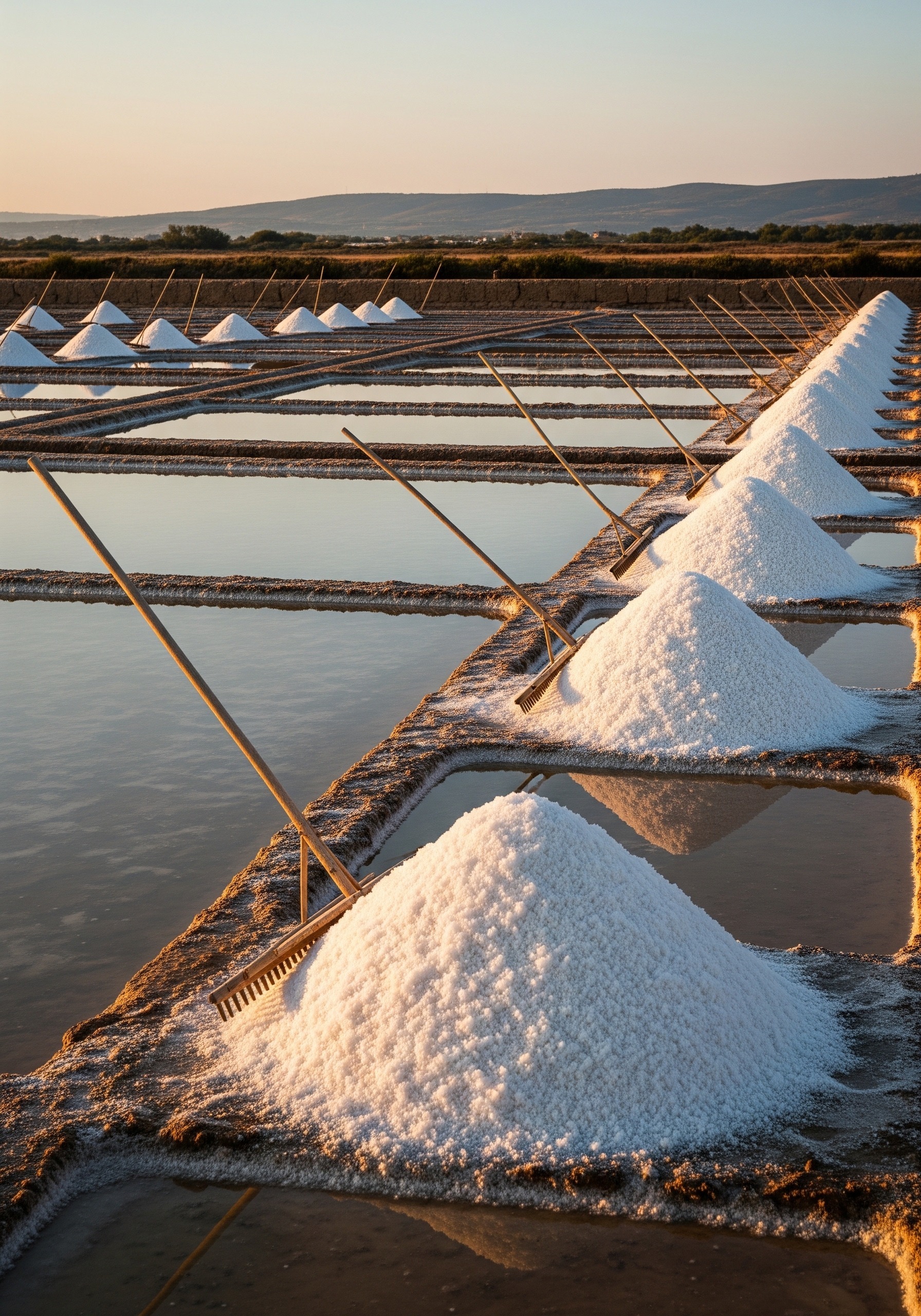
The most obvious source was the sea, but sea water is only about 3.5 per cent salt by weight, so the trick was concentrating it. In hot, dry climates that meant solar evaporation: shallow coastal lagoons or hand-dug rectangular ponds, walled with earth, where wind and sun did the work for weeks at a time. By around 800 BCE the Phoenicians were producing large quantities of salt this way in the lakebeds of North Africa, and Roman tradition credited the early king Ancus Marcius with letting sea water into engineered basins at Ostia roughly 2,500 years ago — the first state-scale industrial salt works in Europe.
Cooler, wetter places had to use fire instead of sun. From Atlantic France to Bronze Age Britain, prehistoric salters built a remarkable system archaeologists call briquetage: clusters of coarse, single-use pottery vessels, propped on clay pillars over open hearths, in which strong brine was boiled down to a hard, transportable cake of salt. Iron Age sites along the Essex and Lincolnshire coasts are littered with the broken red fragments of these vessels — sometimes 60 centimetres wide and 12 millimetres thick — the industrial waste of Britain’s earliest factories.
{IMAGE_2}
Method Two: Brine Springs and the World’s Deepest Wells
Inland communities far from the sea found their salt in geology itself. In many parts of the world — Cheshire in England, Halle in Germany, Salins in eastern France, Hallstatt in Austria — natural springs bubble up groundwater that has dissolved buried Permian salt beds. People learned very early to channel this brine into evaporation pans rather than waste fuel boiling fresh sea water. The English town of Droitwich produced salt almost continuously from the Iron Age until the twentieth century from a single brine source so concentrated it was nearly saturated.
The most astonishing inland operation, however, was in Sichuan. The Chinese had been using brine wells for more than 2,000 years, and by the Song dynasty (10th–13th centuries CE) the salt makers of Zigong had perfected a percussion-drilling rig that pounded a heavy iron bit on a bamboo cable down through the rock. Over generations, single wells deepened past 100, then 500, then more than 1,000 metres — works of engineering that astonished European visitors a thousand years later, and which incidentally also tapped natural gas, which the Chinese piped through bamboo tubes to fire the brine cauldrons. It was an integrated chemical industry running on Tang and Song technology.
Method Three: Mining Rock Salt
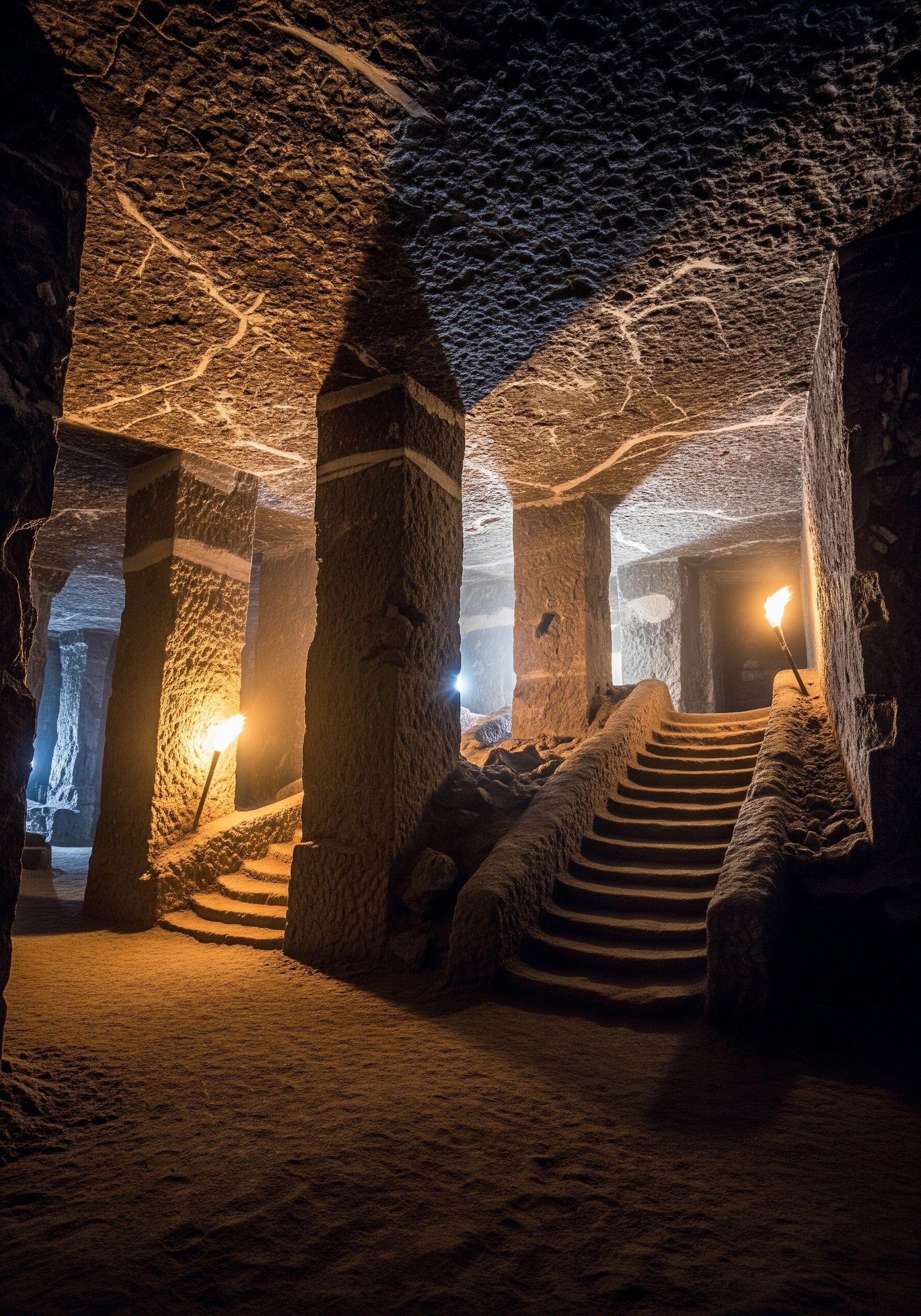
Where geological luck had pushed an ancient seabed close to the surface, people skipped the water entirely and dug straight in. The Austrian alpine town of Hallstatt — the place that gave its name to the early Iron Age culture of central Europe — has been mining salt since at least 1500 BCE. The galleries are so dry and stable that they have preserved Bronze Age leather caps, wooden tools and the body of one prehistoric miner crushed by a roof fall and pickled by the salt itself.
Mining took on an entirely different scale in West Africa. At Taghaza and later Taoudenni in the Saharan flats of modern Mali and Mauritania, workers cut blocks of nearly pure rock salt out of dry lakebeds and stacked them onto camels. Caravans of several hundred to several thousand animals crossed the desert south to the trans-Saharan markets of Timbuktu, Gao and Djenné. According to the 14th-century traveller Ibn Battuta, the buildings at Taghaza itself were made of salt, because there was nothing else to build with. Rome’s Wieliczka in Poland (mined from at least the 13th century) and Romania’s Praid (with roots in Roman times) tell similar stories: where the salt is solid, you simply quarry it.
Method Four: Plant Ash, Animal Blood and the Inland Shift
Communities cut off from sea, spring and mine still found ingenious workarounds. Across pre-Columbian North America, several Indigenous nations boiled brine from inland salt licks — places like the Kanawha valley in West Virginia or the salines of central Illinois — over wood fires. In parts of the Philippines, central Africa and Amazonia, people produced a salty vegetal salt by burning sodium-rich grasses, palms or aquatic plants and percolating water through the ash; the leftover crust, evaporated to dryness, was a low-grade but life-saving substitute. And almost everywhere, a hunting diet of fresh, blood-rich meat quietly supplied the sodium that the cooking pot did not.
A Short Timeline of Salt
- ~6,000 BCE — Earliest known salt production: brine boiled at Poiana Slatinei, Romania.
- ~3,700 BCE — Neolithic salt pans on the Yorkshire coast, England.
- ~1,500 BCE — Underground rock-salt mining begins at Hallstatt, Austria.
- ~640 BCE — Roman tradition: king Ancus Marcius opens state salt works at Ostia.
- ~200 BCE — Han-era brine wells operating at Zigong, Sichuan.
- 800s–1500s CE — Trans-Saharan rock-salt caravans link Taghaza to Timbuktu.
- 1086 CE — Domesday Book records hundreds of English salt-making sites (“wiches”).
- 1286 CE — France imposes the gabelle — the salt tax that lasted until 1945.
Salt as Money, Tax and Empire
Because salt was both biologically essential and geographically lumpy, it was almost impossible not to tax. Whoever controlled the spring, the pan or the mine controlled a captive market, and rulers from China to France to the Aztec Triple Alliance exploited that fact for revenue. China’s imperial salt monopoly, organised in some form from the 7th century BCE onwards, was a foundation of state finance for more than 2,000 years. The Roman Via Salaria — literally the “salt road” — ran inland from the Tyrrhenian salt pans at Ostia, and the salarium paid to soldiers along it left an obvious linguistic fossil in our payslips.
In medieval Europe the same logic produced the French gabelle, a salt tax so unpopular it helped fuel the French Revolution and was finally abolished only after the Second World War. In West Africa, salt slabs travelled south and gold dust travelled north along the same camel routes; medieval Arab geographers describe markets where salt was, gram for gram, traded for gold. Whole cities — Munich (founded in 1158 after Duke Henry the Lion redirected a salt road), Salzburg, Liverpool, Tuzla — owe their names or their fortunes to the trade.
How Ancient Salt Methods Compare
| Method | Where it dominated | Earliest clear evidence | Fuel needed |
|---|---|---|---|
| Solar evaporation of sea water | Mediterranean, North Africa, coastal China | c. 800 BCE (Phoenician North Africa); Roman Ostia | None — sun and wind |
| Boiling sea water (briquetage) | Atlantic Europe, Britain, northern Japan | Bronze Age, c. 1,400 BCE | High — large amounts of firewood |
| Inland brine springs and wells | Cheshire, central Europe, Sichuan | c. 6,000 BCE (Romania); 200 BCE wells in China | High — boiled in pans |
| Rock-salt mining | Hallstatt, Wieliczka, Saharan Taghaza | c. 1,500 BCE (Hallstatt) | Low — quarrying only |
| Vegetal / ash salt | Amazonia, central Africa, Philippines | Ethnographic; ancient origin uncertain | Moderate — burn and boil |
What the Salt Trail Tells Us About Our Ancestors
Trace the journey of a single grain — from a Sichuan brine well, a Saharan salt block, an Essex briquetage hearth — and the deep logic of early civilisation comes into focus. Salt is the reason the first long-distance trade routes were paved, why early states could feed standing armies, why fishing villages could send dried cod across continents. It is also the reason geography mattered so much in the ancient world: a Bronze Age community born near Hallstatt or Cheshire was, almost by accident, sitting on liquid wealth.
For more on how this dependency reshaped daily life, see our companion piece on how Romans preserved food, our deeper look at the ancient spice trade, and our overview of what people actually ate in ancient Egypt. The pattern repeats: small, ordinary substances — salt, grain, oil, fish — quietly run the engine of history.
Frequently Asked Questions
Q: How did ancient humans get salt in their diet before agriculture?
A: They mostly didn’t need a separate source. A hunter-gatherer diet rich in meat, fish, shellfish and blood provides enough sodium for daily needs. Salt deficiency became a real problem only once humans shifted to grain-and-vegetable agriculture and started preserving food, at which point harvesting or trading salt became urgent.
Q: How did Native Americans get salt?
A: Coastal nations evaporated sea water in clay or wooden vessels, while inland peoples boiled brine from natural salt licks — places like the Kanawha River in present-day West Virginia or the salines of Illinois — over wood fires. In some regions they also burned salt-rich plants and percolated the ash to leach out the salt.
Q: Was salt really worth its weight in gold?
A: In specific places, yes. In the trans-Saharan trade, a 90-kg slab of Taghaza rock salt could double its value crossing the desert and arrive in Djenné worth roughly its own weight in gold dust. Elsewhere salt was much cheaper, but it was almost always taxable, which is why so many states grew rich on it.
Q: Did the Romans really pay soldiers in salt?
A: Not directly. Soldiers received money called salarium, originally a stipend connected to salt rations rather than literal bags of salt. The word survives in modern English as “salary” — a small daily reminder that, at the founding of Rome, a man’s pay and his salt were essentially the same thing.
The next time you reach for the shaker, remember that it took six thousand years of human ingenuity — sun-baked Phoenician lagoons, Iron Age firepots in Essex mud, Sichuanese drilling rigs sunk a kilometre into the earth, and camel trains the length of the Sahara — to make that gesture casual. Salt is the oldest, quietest infrastructure of civilisation. And the way ancient people got it tells us, more honestly than almost any other artefact, what they were really willing to work for.
Illustrations are AI-generated. Article fact-checked and human-edited.