How Did Ancient People Drink Water Safely?
The question of how did ancient people drink water is far less obvious than it sounds — long before chlorine, microscopes, or even a clear theory of germs, our ancestors quietly assembled a working toolkit of settling jars, sand columns, charcoal pots, copper vessels, alum coagulation, mountain aqueducts and underground canals that let cities of hundreds of thousands survive on river water that would horrify a modern microbiologist.
Key Facts
- The Sushruta Samhita, a Sanskrit medical text usually dated to roughly the 6th century BCE in northern India, already prescribes boiling, sun-exposure, filtration through sand and gravel, and the use of charcoal to make water “potable and sweet.”
- Tomb paintings from Egypt’s Eighteenth and Nineteenth Dynasties (c. 1450–1200 BCE), including those associated with Amenhotep II and Ramesses II, show water being clarified in tall jars — likely with alum, a mineral the Egyptians mined and traded.
- Around 400 BCE Hippocrates described a cloth bag — later called the “Hippocratic sleeve” — used to strain boiled rainwater for medical use, an early documented filter in the Greek world.
- Between roughly 312 BCE and 226 CE, Rome built eleven major aqueducts stretching well over 250 kilometres in total; most ran underground specifically to keep the water cool, dark and free of contamination.
- Persian qanats — gently sloped, hand-dug underground tunnels that tap mountain groundwater — date back at least 3,000 years; some, like the Gonabad system in eastern Iran, run for tens of kilometres and are still in use today.
In short: Ancient people drank water by carefully choosing the source, then physically removing what they could see (sediment), what they could taste (odours and dissolved organics) and what they suspected but could not name (pathogens) — with a surprisingly sophisticated stack of settling, filtration, chemistry, boiling and large-scale engineering that varied wildly by climate, geology and empire.
Key Facts
- The Sushruta Samhita, a Sanskrit medical text usually dated to roughly the 6th century BCE, prescribes boiling, sun-exposure, filtration through sand and gravel, and the use of charcoal to make water potable.
- Egyptian tomb paintings of the 18th and 19th Dynasties (c. 1450–1200 BCE) show water being clarified in tall jars, likely with alum.
- Around 400 BCE Hippocrates described a cloth bag — later called the ‘Hippocratic sleeve’ — used to strain boiled rainwater.
- Between roughly 312 BCE and 226 CE, Rome built eleven major aqueducts stretching well over 250 kilometres in total, most running underground to keep water cool, dark and clean.
- Persian qanats — gently sloped, hand-dug underground tunnels tapping mountain groundwater — date back at least 3,000 years; some, like the Gonabad system in eastern Iran, are still in use.
In short: Ancient people drank water safely by carefully choosing the source, then removing visible sediment, bad odours and suspected pathogens through settling, sand and charcoal filtration, alum, boiling and large-scale engineering. Methods varied by climate, geology and empire, from Indus wells to Roman aqueducts and Persian qanats.
Where did ancient people actually find drinking water?
The first answer to “how did ancient people drink water” is almost always geographic. The earliest Homo sapiens populations clustered along reliable freshwater: lakeshores in the East African Rift, the seasonal pans of the Kalahari, the lower Danube, the great river deltas of the Nile, the Indus, the Tigris-Euphrates and the Yangtze. Hunter-gatherers strongly preferred fast-flowing streams and springs over stagnant pools — not because they understood bacteria, but because experience taught that still water made people sick.
As settlements grew, rivers alone were not enough. Neolithic farmers across the Levant and Mesopotamia dug shallow wells to reach groundwater. The Indus Valley city of Mohenjo-Daro, occupied roughly 2500–1900 BCE, contained an estimated 700 brick-lined wells — so many that nearly every household had access to its own. Groundwater, then as now, was usually safer than surface water because the soil itself acts as a slow biological and physical filter, trapping pathogens in the pores between grains.
In drier regions the answer was harvested rain. Bronze-Age Crete, Iron-Age Negev settlements, the Nabataean city of Petra and Mayan centres in the Yucatán all built plastered cisterns to catch monsoon or seasonal rains. Roofs, courtyards and rock surfaces became collection areas; the cisterns themselves were the city’s lifeline through the dry season.
{IMAGE_2}
The settling jar: the universal first step
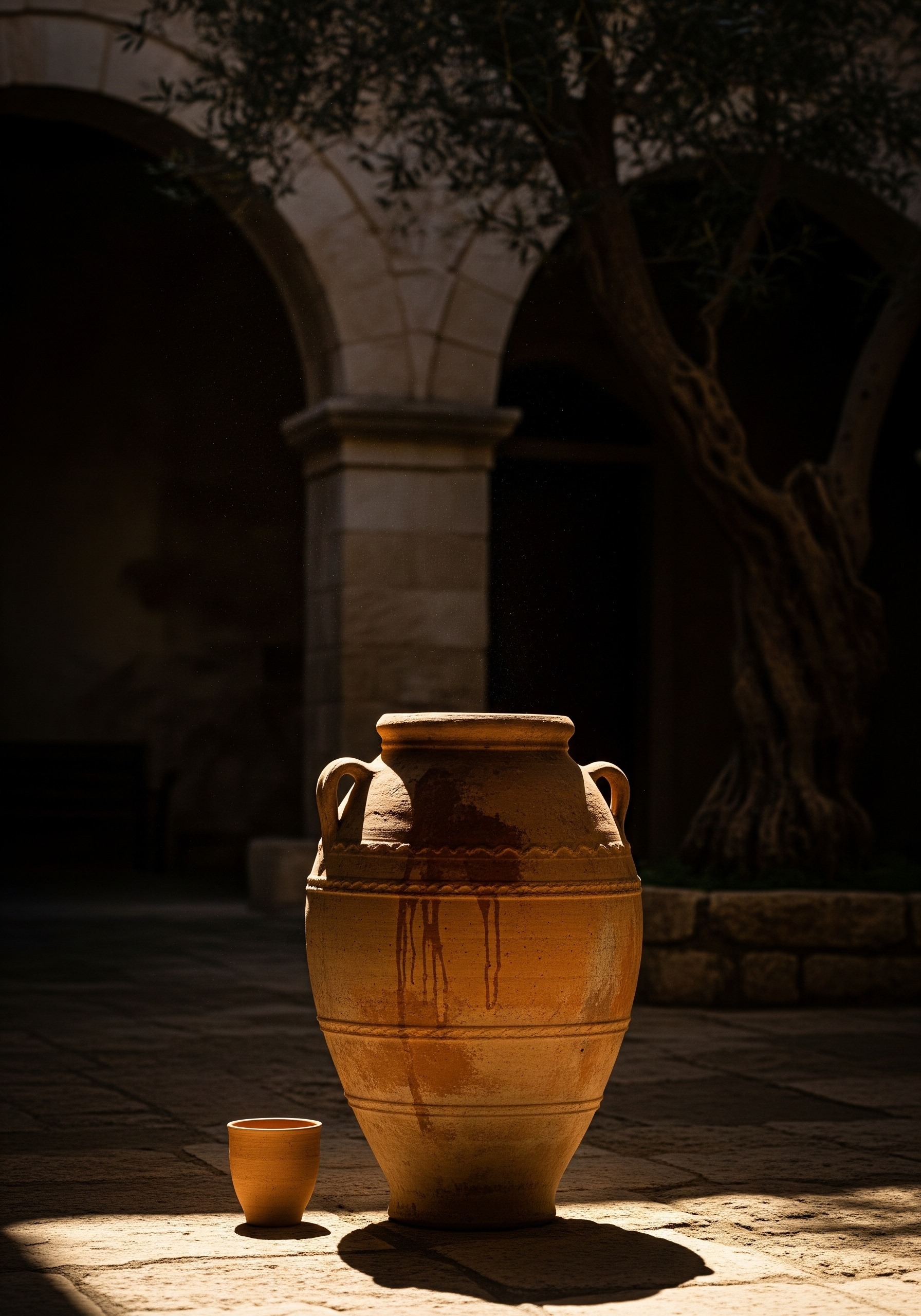
Across nearly every ancient civilisation, the first purification step was the same and required no equipment beyond a large jar: let the water sit. Sediment-laden river water, poured into a tall vessel and left undisturbed for a day, separates by gravity. Sand and silt sink. Some organic matter floats. The middle layer — visibly clearer — is gently decanted into a second vessel and used.
This sounds primitive, but it works for an important modern reason: many waterborne pathogens, particularly the eggs and cysts of parasites such as Ascaris, Giardia and the guinea worm, ride on suspended particles. Remove the particles and you remove a significant share of the disease load. The Spartans were said to drink from a special two-handled cup called a kothon, designed so mud and sediment caught against an internal ridge while the user drank the clearer top. Ancient Greek and Roman manuals routinely instructed travellers to “give the water a night to rest” before drinking.
Sand, gravel and charcoal: the original purification stack
If settling cleared the worst, filtration cleared the rest. Ancient filter columns — recognisable to anyone who has built an aquarium filter — appear independently in many cultures. The classic stack is layered: coarse pebbles at the bottom, then finer gravel, then sand, sometimes capped with a layer of charcoal. Water poured in at the top emerges at the bottom mechanically clearer and chemically improved.
Sanskrit medical writers, including the compilers of the Sushruta Samhita, explicitly recommended this method, along with boiling and exposure to sunlight. Egyptian households kept water in porous clay jars; as moisture seeped through the walls and evaporated, the jar cooled the contents and trapped particles in its pores — a passive sand-filter on a single vessel scale. Etruscan and Roman housewives strained water through porous terracotta vessels for the same effect.
Charcoal was the secret weapon. The Egyptians placed charred wood in their water-storage jars at least 3,500 years ago, and the same trick appears in early Chinese, Indian and Phoenician practice. Activated carbon — the modern version of the same idea — works by adsorption: organic molecules, dissolved gases and many off-flavours stick electrostatically to charcoal’s enormous internal surface area. The ancients had no chemistry to explain it, but they could taste the difference, and they knew it removed the smell of stagnation.
Alum, copper and ancient chemistry
The most chemically advanced ancient technique was coagulation. Alum — potassium aluminium sulphate — was mined in Egypt’s Western Desert oases and traded across the Mediterranean. When stirred into cloudy water it dissolves, releasing positive aluminium ions that neutralise the negative charges holding fine clay and microbial particles in suspension. The particles clump together (a process called flocculation) and settle out within hours, leaving water visibly clearer.
Egyptian tomb art from the reigns of Amenhotep II and Ramesses II shows servants pouring water through tall vessels in a way that strongly suggests this kind of clarification. Aristotle, writing around 340 BCE, described “earth-like substances” that purified murky water — almost certainly alum or something close to it. The same idea reached Han-dynasty China and the Indian subcontinent independently. Modern municipal water plants still use aluminium sulphate to coagulate raw water; the ancients simply discovered the recipe two and a half millennia early.
Copper was a second quiet hero. The Rig-Veda and later Ayurvedic texts recommend storing drinking water overnight in copper vessels. Modern microbiology has shown that copper ions are genuinely antimicrobial: E. coli, Salmonella typhi and Vibrio cholerae populations all drop dramatically after several hours of contact with copper surfaces. It is one of the rare cases where ancient practice maps almost perfectly onto modern science.
Aqueducts and qanats: clean water at industrial scale
For a city of one million people — and Rome reached that mark in the first century CE — household filtration was not enough. The Romans solved the problem with monumental hydraulic engineering. The first aqueduct, the Aqua Appia, opened in 312 BCE and ran roughly 16 kilometres, almost entirely underground. By the early third century CE, eleven aqueducts fed Rome with water from springs in the Apennines, delivered by gravity along channels with slopes as gentle as one part in a thousand.
The engineering choice to bury most of the channel was not aesthetic. Buried, lead-lined or stone-vaulted channels were cooler, darker and far less exposed to contamination from animals, runoff and human dumping. At delivery points the water passed through settling tanks (piscinae limariae) that allowed remaining sediment to drop out before the water entered the urban distribution network. By the height of empire, Roman engineers were delivering, on a conservative estimate, several hundred litres per person per day to the city — more than many modern systems.
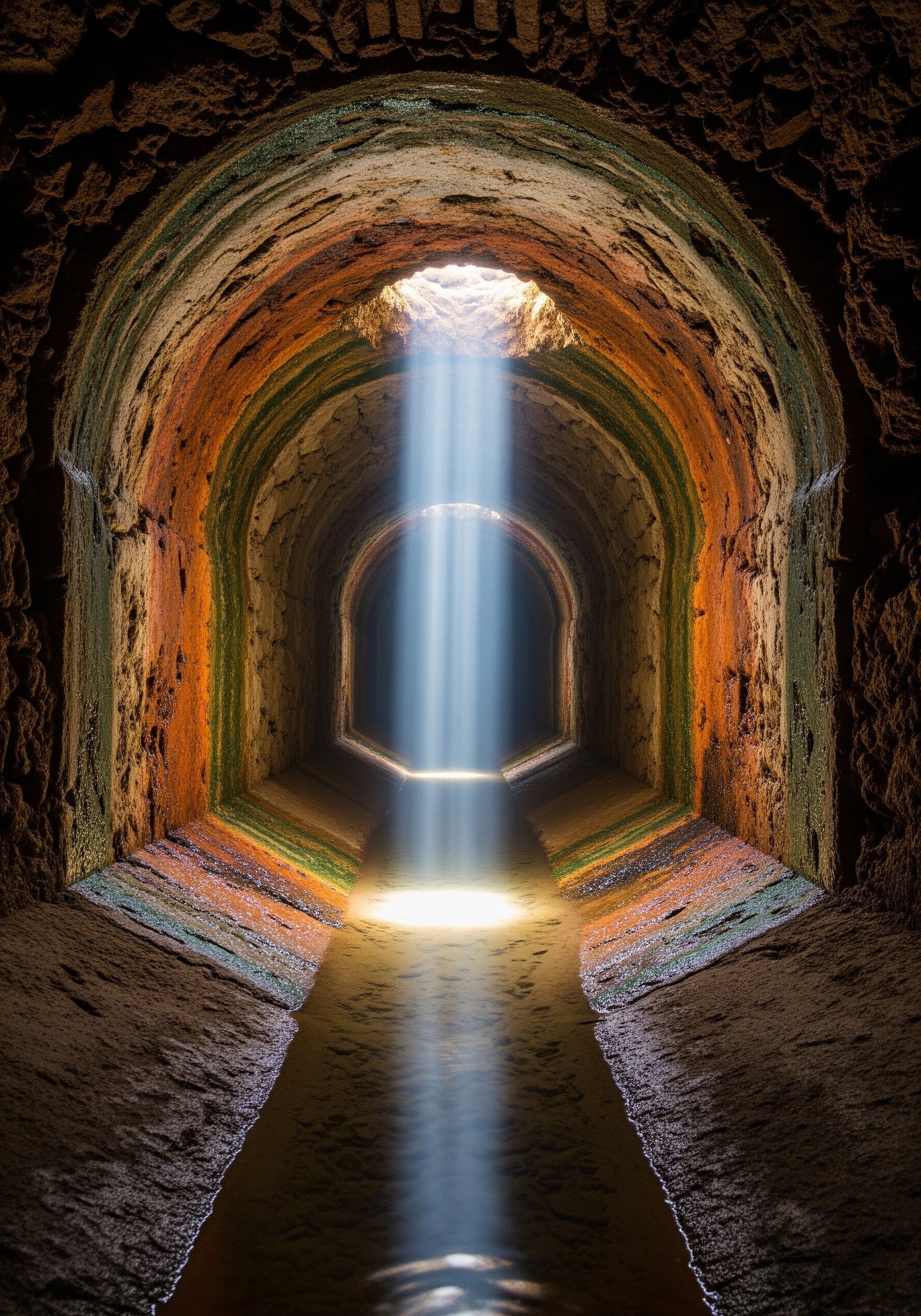
The Persian solution was different but in some ways more elegant. A qanat begins as a vertical “mother well” dug into an aquifer at the foot of a mountain. From there a hand-dug horizontal tunnel — sloped just steeply enough to allow gravity flow but not erosion — carries groundwater for kilometres into farmland and villages. Vertical shafts every 20 to 50 metres along the route provide air and access for maintenance. Some qanats run more than 70 kilometres in total, with mother wells reaching depths of 300 metres. Because the water never sees the open sky between source and use, it arrives cool, low-evaporation and remarkably clean.
The ancient water-purification toolkit at a glance
- Sedimentation — universal; removes suspended solids and many parasite eggs
- Sand & gravel filtration — India, Egypt, Greece, Rome; mechanical removal of fine particles
- Charcoal — Egypt, India, China from c. 1500 BCE; adsorbs organic compounds and odours
- Alum coagulation — Egypt c. 1500 BCE onward; clumps colloidal particles for settling
- Copper storage — India, Mesopotamia; ions kill many waterborne pathogens within hours
- Boiling — first prescribed in Sanskrit and Greek texts; reliably kills bacteria, viruses, protozoa
- Aqueducts & qanats — Rome c. 312 BCE, Persia c. 1000 BCE; engineered, covered conveyance from clean sources
Did ancient people really drink beer instead of water?
One of the most repeated claims about ancient and medieval life is that people drank beer or wine because the water was too dangerous. The story is half true and badly distorted. Historians who have actually combed the textual record — including studies summarised by the Wine & Spirit Education Trust and analyses such as those in The World of Fine Wine — find that medical authorities like Hippocrates, Galen and Arnaldus de Villanova praised wine as nutritious and warming, not as a water substitute.
Most ancient and medieval people drank water as their main beverage, every day. They drew it from springs, wells and household cisterns and judged it by sight, smell and taste. Beer and wine were preferred at meals, at festivals, and by those who could afford them, but daily hydration came from water. Where the “safer than water” idea has a kernel of truth is in dense, polluted late-medieval and early-industrial cities, where local wells genuinely became unsafe and weak ale brewed with boiled water became a rational substitute. In ancient Rome, Athens, Memphis or Pataliputra, the engineering and the filtration stack were doing the real work.
It is also worth noting why brewing helps: the wort is boiled, which pasteurises it; the low pH and alcohol of the finished beer inhibit pathogens; and hops, used widely from the early Middle Ages onwards, are mildly antimicrobial. None of this means ancient people thought of beer as medicine — but the process itself made it safer than warm, untreated river water on a hot day.
When ancient water still failed: the lesson of Tikal
For all this ingenuity, ancient water systems sometimes failed catastrophically. A 2020 study published in Scientific Reports analysed sediment cores from the central reservoirs of the Maya city of Tikal, in modern Guatemala. The researchers found severe contamination of two of the city’s main drinking reservoirs in the layers corresponding to the city’s ninth-century decline — including toxic levels of mercury (probably leached from cinnabar pigment used in murals and burials) and the genetic signatures of harmful cyanobacteria that produce hepatotoxins and neurotoxins. In dry years, when reservoir levels fell and temperatures rose, the water that should have sustained the city likely became dangerous to drink.
The Tikal study is a quiet reminder that ancient water engineering, however clever, depended on assumptions about climate, runoff and contamination that could be broken. The Romans, too, suffered chronic low-level lead exposure from their pipes. The Maya stored water in plaster-lined reservoirs that concentrated whatever flowed in. The toolkit was good — sometimes startlingly good — but it was not magic.
Frequently Asked Questions
Q: How did ancient civilizations get clean water without modern filters?
A: They used a layered approach: choose the best available source (spring, well or harvested rain rather than river), let sediment settle, filter through sand or porous clay, sometimes add charcoal or alum, occasionally boil, and — in major cities — pipe water in from distant mountains via aqueducts or qanats.
Q: When did people first start purifying drinking water?
A: Written instructions for boiling, filtering and sun-exposing water appear in Sanskrit texts dating to roughly 2,500–3,000 years ago, and Egyptian tomb art suggests water clarification was practised at least 3,500 years ago. The behaviour of preferring running over stagnant water is almost certainly far older still.
Q: Did people in ancient Rome drink straight from the aqueducts?
A: Most Romans drew water from public fountains and basins fed by the aqueduct system. Before reaching the city, the water passed through settling tanks; wealthy homes had additional household cisterns and ceramic filters. The system was engineered to deliver pre-clarified water at scale.
Q: Was ancient water actually safe to drink?
A: It varied enormously. Spring water, qanat water and properly settled and filtered household water could be very safe. Open city wells in dense settlements and stagnant cisterns in dry years could be deadly — as recent science on the Maya city of Tikal has shown.
The story of how did ancient people drink water is, in the end, the story of careful observation passed down across thousands of years: choose moving water over still, settle before you sip, run it through sand and charcoal, store it in copper or porous clay, and — when your civilisation grows beyond what a single well can serve — build channels through mountains. The techniques were empirical, but they were not accidental, and modern hydrology has confirmed almost every one of them. The next time clean water comes out of a tap, it is worth remembering that the basic recipe is older than the alphabet.
Illustrations are AI-generated. Article fact-checked and human-edited.