Hummingbird Migration: The 500-Mile Gulf Crossing, Explained
Hummingbird migration is the closest thing in nature to a magic trick — a 3-gram bird crosses 500 miles of open water without stopping, and most people watching their backyard feeder have no idea it happened.

Key Facts
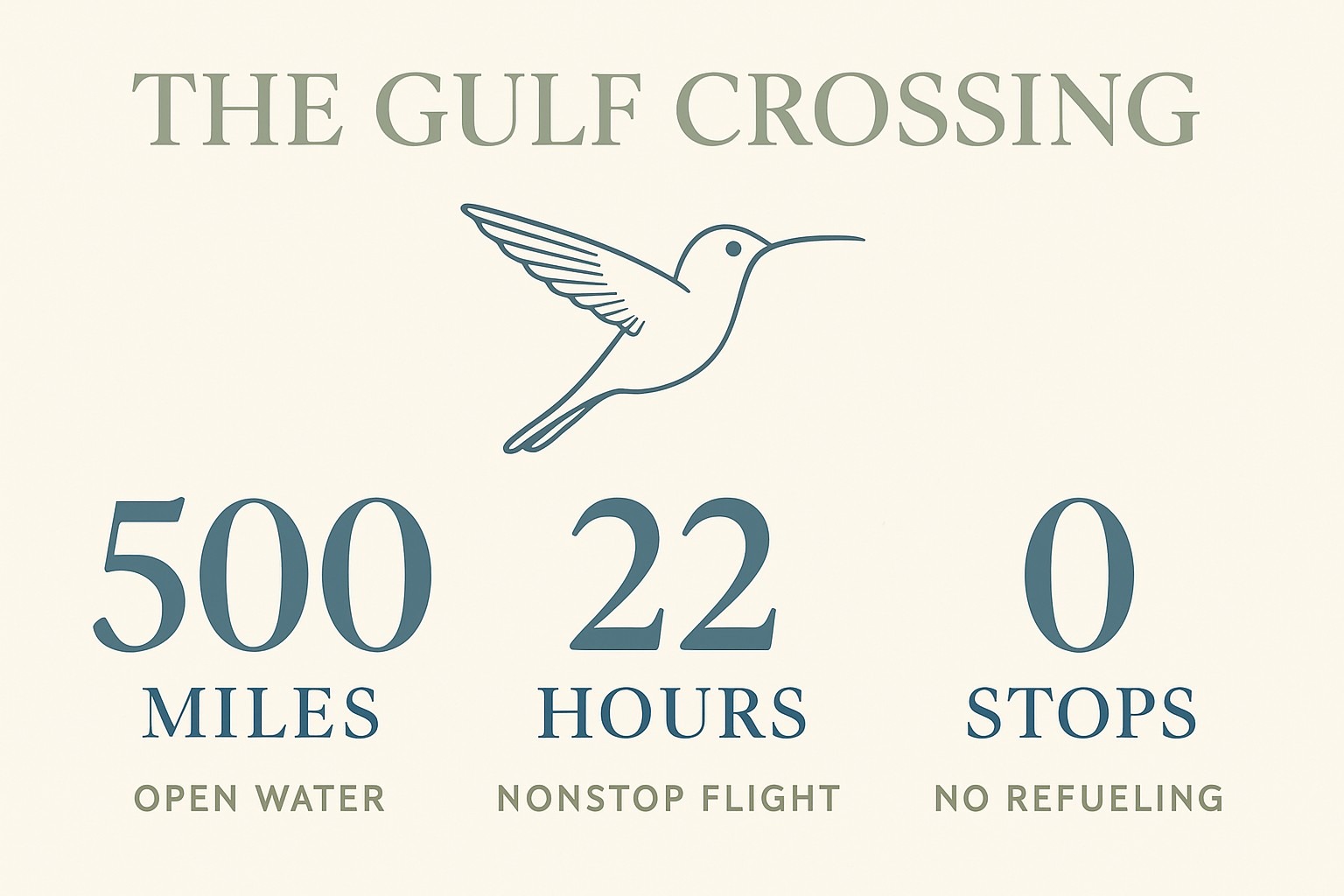
- The shortest open-water crossing of the Gulf of Mexico is roughly 500 miles, and most ruby-throated hummingbirds fly it nonstop in 18 to 22 hours.
- Before the crossing, a hummingbird nearly doubles its body weight in a week, from about 3.25 grams to over 6 grams of stored fat.
- That fat carries fuel for nearly 600 miles of nonstop flight — a thin safety margin over the Gulf, but a real one.
- In hovering flight, a hummingbird’s heart can hit 1,200 beats per minute; in nightly torpor, it falls to as low as 50.
- The rufous hummingbird makes the longest hummingbird migration on record — about 3,900 miles between Alaska and Mexico, the longest of any bird measured in body lengths.
In short: Twice a year, the smallest birds in North America make one of the most extreme journeys in the animal kingdom. The classic ruby-throated route across the Gulf of Mexico is real, but not universal — some birds skirt the coast — and the whole feat depends on a metabolic engineering job that pushes vertebrate physiology to its theoretical limit.
Key Facts
- The shortest open-water crossing of the Gulf of Mexico is roughly 500 miles, and most ruby-throated hummingbirds fly it nonstop in 18 to 22 hours.
- Before the crossing, a hummingbird nearly doubles its body weight in a week, from about 3.25 grams to over 6 grams of stored fat.
- That fat carries fuel for nearly 600 miles of nonstop flight, a thin safety margin over the Gulf.
- In hovering flight a hummingbird’s heart can hit 1,200 beats per minute, falling to as low as 50 in nightly torpor.
- The rufous hummingbird makes the longest hummingbird migration on record, about 3,900 miles between Alaska and Mexico, the longest of any bird measured in body lengths.
In short: Twice a year the smallest birds in North America make one of the most extreme journeys in the animal kingdom. The classic ruby-throated route crosses roughly 500 miles of open Gulf of Mexico nonstop in 18 to 22 hours, though some birds skirt the coast, and the whole feat depends on a metabolic engineering job that pushes vertebrate physiology to its limit.
The Gulf, at dusk

On a still April evening on Mexico’s Yucatán coast, a male ruby-throated hummingbird about the weight of a US nickel lifts off from a flowering shrub, climbs to maybe a thousand feet, and aims north. Below him: open water. Ahead: a hard line of Texas or Louisiana coastline he has never seen and will have to find, somehow, before sunset the next day.
That bird weighs around 3.25 grams in ordinary times. He fattens to about 6 grams in the days before he leaves, and lands in the United States lighter than he started. The shortest distance across the Gulf is roughly 500 miles. Direct flight takes 18 to 22 hours. There is no resting on the way, no following an older bird, no GPS. One animal, one tank of fat, one direction.
And here’s the thing: nobody who hangs a feeder in Tennessee ever sees this. They see the result.
Doubling weight: the hyperphagia engine
Before any of this is possible, the bird has to eat itself fat. Ornithologists call this hyperphagia — a frenzy of round-the-clock feeding that, in a Gulf-bound ruby-throat, very nearly doubles body mass in a week. From about 3.25 grams, the bird climbs to over 6 grams of mostly subcutaneous fat tucked under the skin in tiny golden deposits a bander can see by holding the bird up to the light.
Fat is the right currency for the job. Gram-for-gram, it carries more than twice the chemical energy of carbohydrates or protein, and a hummingbird burns it with brutal efficiency. Bird researchers have calculated that the fat layer a migrating ruby-throat puts on is enough to fuel nearly 600 nonstop miles — barely a hundred-mile safety margin over the Gulf. Hit a stiff headwind, and the bird dies in the water.
This is why those suddenly swarmed feeders in late August matter more than the spring rush. The southbound birds are filling the tank. Empty feeders in August probably won’t kill a hummingbird outright — there are still flowers — but every minute spent searching is a minute not feeding.
{IMAGE_2}
The 1,200-beat heart (and why it slows at night)
What lets a 3-gram bird do any of this is a metabolism that essentially has no equal among vertebrates. Hovering — the species’ signature trick — costs roughly ten times more energy than ordinary forward flight. A hovering hummingbird’s heart rate climbs above 1,200 beats per minute, wings beat 50 to 80 times per second, and oxygen consumption per gram of body weight is the highest measured in any vertebrate.
So a bird that needs to fly 500 miles in one shot does not hover on the way. It locks into level forward flight at maybe 25 to 30 miles per hour — an order of magnitude cheaper than hovering — and rides that for the entire crossing.
At rest at night, the trick reverses. The bird drops into a state called torpor: body temperature plummets, metabolism falls by as much as 95 percent, and the heart slows from a daytime average near 250 to as low as 50 beats per minute. Sara Hiebert Burch, an animal physiologist at Swarthmore College who has spent decades studying torpor in rufous hummingbirds, has shown that migrating birds use torpor more often in autumn, when every saved calorie goes straight into the migration fat depot. Torpor is, in a real sense, how the fueling actually works.
Hummingbird migration timeline: when to expect them in 2026
In eastern North America the calendar runs on the ruby-throat; the West runs on rufous, Anna’s, black-chinned, and a handful of others. For ruby-throats, the answer to when do hummingbirds migrate is surprisingly tight, and citizen-science data from Journey North and the volunteer-fed hummingbird migration map at Hummingbird Central confirm the same pattern year after year.
Ruby-throated hummingbird — typical spring arrival window (2026)
- Late February: First males reach south Texas, Louisiana, and the Gulf coast of Florida.
- Mid-March: Arrivals spread through Alabama, Georgia, and the Carolinas.
- Early April: Tennessee, Kentucky, southern Virginia.
- Late April: Ohio Valley, southern Midwest, Mid-Atlantic.
- Early May: New England, the Great Lakes, southern Ontario.
- Mid-to-late May: Northernmost breeding range in central and eastern Canada.
A safe rule for hanging feeders: two to three weeks before the average arrival date for your latitude. Mid-March in the Gulf states. Early April in the Carolinas and Tennessee. Late April in the Midwest. The first week of May for southern Ontario. In the fall, leave feeders up until you have seen no birds for two full weeks. You will not “trap” a hummingbird into staying — their migration is photoperiod-driven, triggered by day length, not by your sugar water.
Land or water? An honest fight over the route
Here is where the familiar story gets messier than most articles let on. The heroic 500-mile Gulf crossing has a quieter rival. Robert J. Reber, an emeritus faculty member at the University of Illinois at Urbana–Champaign, has argued in print that ruby-throated hummingbirds mostly do not make that flight at all, instead following a continuous land route around the western Gulf through coastal Mexico. His reasoning is physiological: a bird whose heart can race past 1,200 beats per minute has no margin for a 22-hour flight with zero chance to refuel, and the safer overland route gives access to flowers all the way.
But the counter-evidence is real too. Long-running banding data, coastal radar detections of small birds making landfall after night flights, and ground observations of exhausted hummingbirds dropping onto Gulf oil platforms all point to a genuine, substantial trans-Gulf passage. The honest answer in 2026 is that both routes are used, the proportions are not well measured, and the strategy probably differs between spring and fall — northbound birds may catch tailwinds across the water, while southbound birds, fattened and unhurried, may take the coastal route home. Most popular accounts skip the controversy entirely. They shouldn’t.
Beyond the ruby-throat: four species, four strategies
Most coverage of hummingbird migration is really coverage of one bird, the ruby-throated. Step west of the Mississippi and the picture changes completely.
| Species | Migration distance | Route | Notable trait |
|---|---|---|---|
| Ruby-throated | ~1,000–2,000 mi each way | Eastern North America ↔ Central America; Gulf or overland | Only widespread hummingbird east of the Mississippi |
| Rufous | Up to ~3,900 mi each way | Alaska/Pacific NW ↔ Mexico; Pacific north, Rockies south | Longest hummingbird migration on record |
| Anna’s | Largely resident; short altitudinal moves | US Pacific coast; range expanding north | Now year-round into Washington and British Columbia |
| Black-chinned | ~1,500 mi each way | US interior West ↔ western Mexico | Ruby-throat’s western cousin; similar size and shape |
Rufous in particular makes a journey that almost beggars belief — roughly 3,900 miles from southern Alaska to central Mexico, the longest migration of any bird on Earth measured in body lengths, according to the Cornell Lab of Ornithology. Researchers at Oregon State University have shown that the route also varies by age and sex, with adult males peeling off from the coastal northbound corridor earlier than females and juveniles. A bird banded in Florida and recaptured in Alaska — a 3,500-mile feat tracked through records held by the Alaska Department of Fish and Game — is the longest individual hummingbird trip ever documented.
And not every hummingbird leaves. Anna’s hummingbirds, expanding fast up the Pacific coast as gardens and feeders spread north, are now resident year-round in much of California and into Washington State — a species that, a century ago, barely reached Oregon.
What’s actually changing in 2026
The data are mixed but consistent: across the eastern flyway, ruby-throated arrivals have been shifting earlier by roughly a week to two over the last several decades, according to Journey North’s volunteer reports compared against long-running records at the Cornell Lab of Ornithology. The risk is the classic phenological mismatch — birds arriving before the wildflowers they evolved to track. So far there is no clear evidence the species is suffering for it, but the system is tightening.
Anecdotal reports of Anna’s and rufous hummingbirds wintering further north than they used to, partly fed by backyard feeders, are everywhere now. Whether that is good for the birds — or whether we are quietly tethering them to a food supply they cannot survive without — is an open question that nobody, including the researchers, can answer yet. Honest uncertainty is part of the story.
Frequently Asked Questions
Q: Do hummingbirds really fly nonstop across the Gulf of Mexico?
A: Many do. Banding data, coastal radar detections of overnight arrivals, and observations of exhausted birds dropping onto offshore oil platforms all confirm that trans-Gulf flight happens routinely, taking 18 to 22 hours over roughly 500 miles. A meaningful share also takes the longer overland route through Mexico, and the precise split between the two is not yet well measured.
Q: When should I put out my hummingbird feeder in spring?
A: About two to three weeks before the historical first-arrival date for your area — mid-March in the Gulf states, early April through the Carolinas and Tennessee, late April in the Midwest, and early May in southern Canada. Use a 1-to-4 ratio of plain white table sugar to water; no red dye, no honey.
Q: When does fall hummingbird season start, and when do they leave?
A: Most ruby-throats begin moving south in late July, with peak fall migration in August and early September. Stragglers can still pass through the southern US into October. Adult males tend to leave first; juveniles last.
Q: Will leaving my feeder up keep them from migrating?
A: No. Migration is triggered by shortening day length, not food availability. Leaving feeders up actually helps late stragglers — keep them up for at least two weeks after you see your last bird.
Sources
- Cornell Lab of Ornithology — All About Birds species accounts and range maps for ruby-throated and rufous hummingbirds.
- Journey North citizen-science migration database, ruby-throated hummingbird records.
- Sara Hiebert Burch (Swarthmore College), research on torpor and energy regulation in rufous hummingbirds.
- Robert J. Reber (University of Illinois at Urbana–Champaign), commentary on overland migration routes in Outdoor Illinois Journal.
- Oregon State University and the Alaska Department of Fish and Game, banding studies of long-distance rufous hummingbird movements.
The next time a hummingbird hovers at your window in May, remember: this animal that weighs less than a coin almost certainly just crossed 500 miles of open water in the dark to be there. The miracle isn’t the migration. The miracle is that the bird made it back.
Illustrations are AI-generated. Article fact-checked and human-edited. Our editorial standards.