Owl Neck Facts: Can They Really Spin Their Heads 360°?
Here are the owl neck facts almost no one gets right: an owl cannot spin its head a full 360 degrees. The real ceiling is 270 — and that is the easy part of the story. What makes even that possible is a quiet feat of evolutionary engineering involving twice as many neck bones as you have, blood-pooling reservoirs tucked behind the skull, and a built-in crash-prevention system in the arteries themselves.
Key Facts
- Owls rotate their heads up to about 270° in either direction — not 360°, despite the meme.
- An owl has 14 cervical vertebrae; humans and almost every mammal on Earth have 7.
- The bony channels carrying the vertebral artery up the owl’s neck are roughly 10× wider than the artery itself.
- A 2013 Johns Hopkins study, published in Science, identified four anatomical adaptations behind the spin.
- Owls turn because they have to: their eyes are long, tubular and locked into the skull by a ring of bone.
In short: Owls can swivel their heads up to 270° each way thanks to 14 neck bones, oversized arterial channels, blood-pooling reservoirs at the skull base, and a backup vessel network that reroutes blood under stress. They rotate so dramatically because their eyes don’t move at all.
Key Facts
- Owls rotate their heads up to about 270° in either direction—not a full 360°.
- An owl has 14 cervical vertebrae; humans and almost every mammal have 7.
- The bony channels carrying the vertebral artery are roughly 10× wider than the artery itself.
- A 2013 Johns Hopkins study, published in Science, identified four anatomical adaptations behind the spin.
- Owls turn their heads because their long, tubular eyes are locked into the skull by a ring of bone.
In short: Owls can’t spin their heads a full 360°—the real limit is about 270° each way. That’s possible thanks to 14 cervical vertebrae (double a human’s), arterial channels about ten times wider than the artery, blood reservoirs and backup vessels, all identified in a 2013 Johns Hopkins study. They rotate because their tubular eyes can’t move.
The 360° myth — what the owl neck facts really say
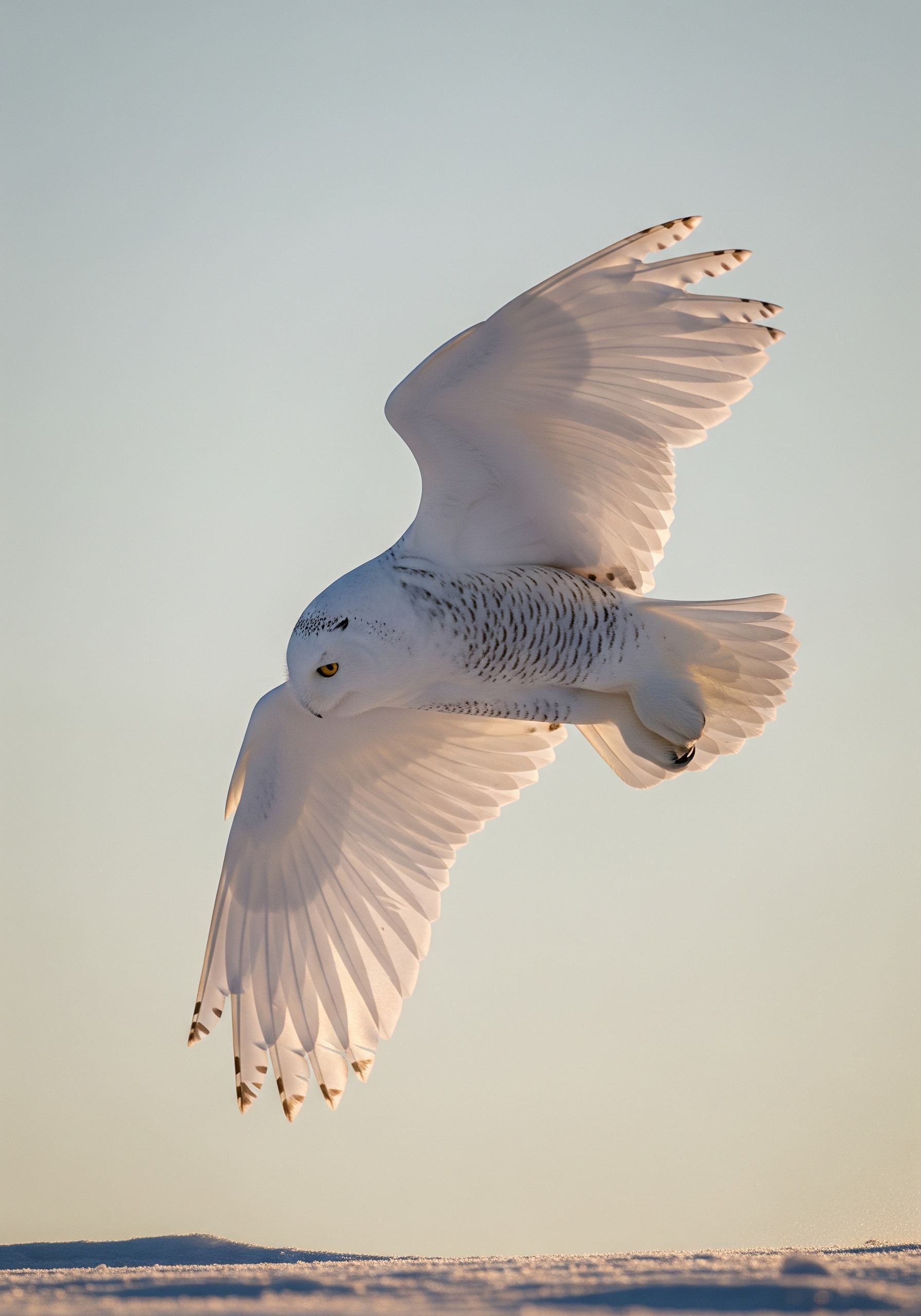
Half-true at best, that viral claim. The published, repeatedly measured ceiling — confirmed by Johns Hopkins anatomists, the National Audubon Society and the International Owl Center — is 270 degrees of rotation from a forward-facing start. Three-quarters of a circle. Impressive on its own. Not the cartoon spin.
So where does the 360 idea come from? Two places. First, owls often start with their head already rotated and snap it back to neutral, covering most of a circle in one quick motion. Second, your eyes don’t catch the in-between frames. By the time your visual cortex registers “wait, did the owl just face backwards?”, it has.
A cleaner number to remember: a great horned owl’s total range of motion, measured from one extreme position to the other, is closer to 540 degrees. Not because it spins further, but because it can travel from far-left-back to far-right-back in one sweep without lifting its chest. That is the real owl neck facts headline most popular pages quietly skip.
14 bones, not 7 — the blueprint of an owl’s neck
Almost every mammal alive — mouse, giraffe, blue whale, you — has exactly seven cervical vertebrae. Owls have fourteen. Twice the segments means twice the rotational increments before any single joint maxes out. Stack fourteen ball-bearings, twist gently, and the cumulative angle gets enormous.
But more bones alone don’t explain how an owl avoids snapping its own arteries during a 270° wrench. Anyone who has whiplashed a neck in a parking-lot collision knows the brutal truth: vertebrate arteries are fragile. Force them past their architecture and they tear.
An owl’s skeleton solves that with extra space inside the bone itself. The transverse foramina — those tunnels running through each vertebra that carry the vertebral artery up to the brain — are absurdly oversized in owls. In humans, the channel hugs the artery like a sleeve. In an owl, the channel is roughly ten times wider than the vessel passing through it. That extra slack is the difference between a flexible rubber hose and a hose pulled tight against bone.
Four hidden adaptations — how Johns Hopkins cracked it
Until 2013, no one had a complete physiological explanation. Then a small Johns Hopkins team published one in the February 1 issue of Science. The lead author was a medical illustrator named Fabian de Kok-Mercado; his collaborator was Philippe Gailloud, an interventional neuroradiologist at the Johns Hopkins University School of Medicine who specialises in exactly the kind of arterial damage owls somehow avoid.
Working with snowy owls, barred owls and great horned owls that had died of natural causes, the team injected contrast dye and imaged the vascular network. They found four distinct adaptations, all working together:
The Johns Hopkins four — what keeps the brain fed during a 270° turn
- Oversized bony channels. Vertebral foramina ~10× wider than the artery — slack instead of friction.
- Higher artery entry point. The vertebral artery enters at the 12th cervical vertebra, not the 14th, leaving extra vessel at the base.
- Contractile blood reservoirs. Arteries balloon at the skull base, pooling blood as a buffer supply for brain and eyes.
- Cross-connected arteries. Tiny anastomoses link the carotid and vertebral arteries, so blood reroutes if one path is pinched.
“The carotid and vertebral arteries in the neck of most animals — including owls and humans — are very fragile and highly susceptible to even minor tears,” Gailloud noted at the time. The owl, in other words, hasn’t reinvented blood vessels. It has reinvented the plumbing around them.
{IMAGE_2}
Why bother at all? Tubular eyes, asymmetric ears, the head-bob
This is the part almost every article online skips. The owl doesn’t spin because spinning is cool. It spins because it has no other option.
An owl’s eyes aren’t spheres. They’re long, narrow tubes — closer in shape to a small pair of binoculars than to your own eyeballs — and they’re locked into the skull by a ring of bone called the sclerotic ring. The trade-off is brutal: brilliant low-light vision, almost zero eyeball mobility. To shift its gaze, an owl has to move its whole head.
That accounts for the dramatic rotations, but not the strange little head-bobs and side-tilts you see in any owl video. Those serve a different job: depth perception. By moving its head deliberately between two positions, an owl creates motion parallax — the same trick a railway passenger uses to judge which tree is closer to the train. Combined with about 50 degrees of binocular overlap and famously asymmetric ear openings (one set slightly higher than the other, for vertical sound triangulation), the head-bob lets the owl pinpoint a mouse under leaf litter in near-total darkness.
So these owl neck facts aren’t a quirky bonus feature. They are the hunting system.
Owl vs. human vs. hawk — a fair comparison
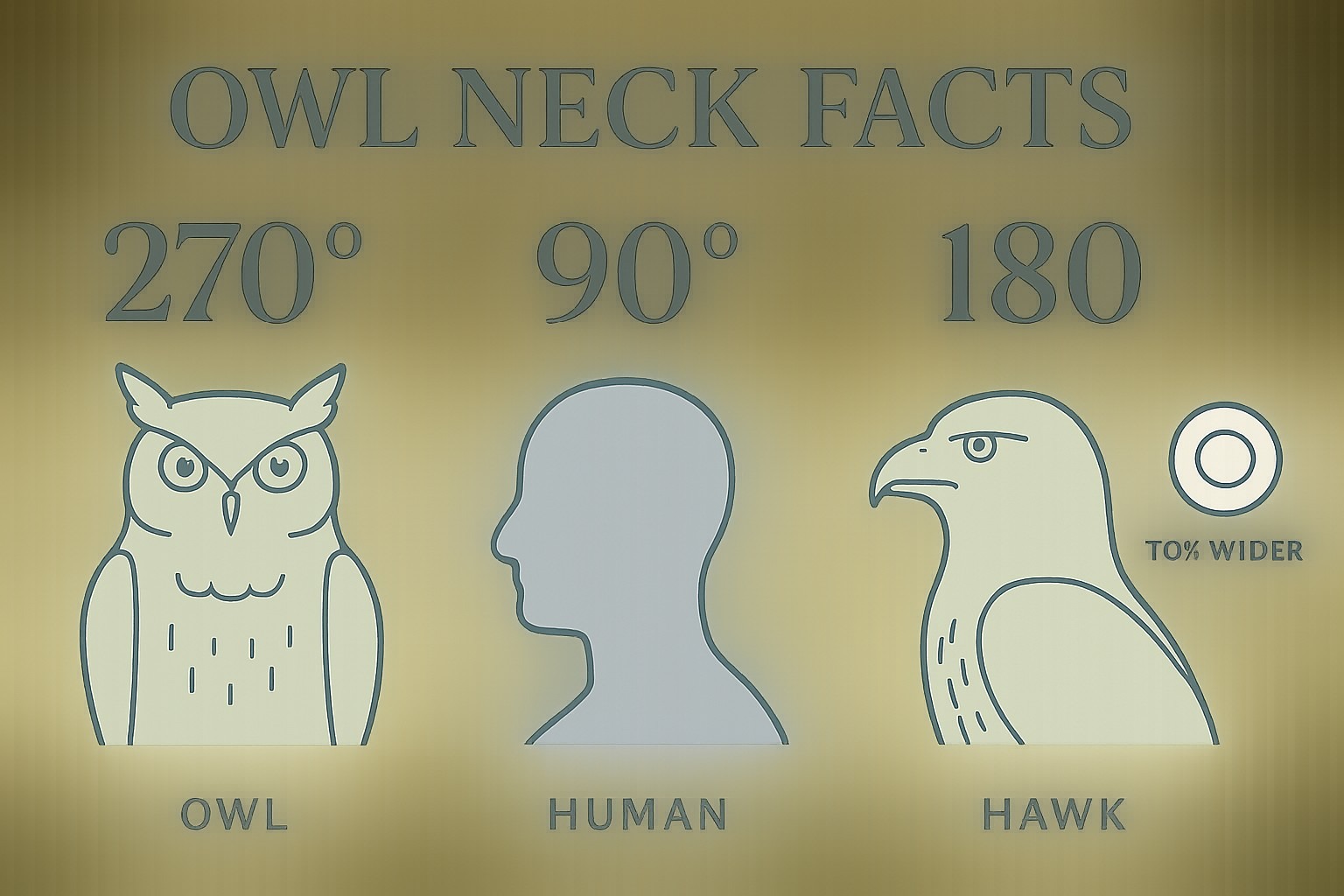
Put 270° next to the alternatives and it lands harder. Hawks and falcons are also visual predators; they also have tubular, mostly fixed eyes. But their neck design is much closer to a typical bird’s, and nothing like the owl’s. Here’s the contrast in one frame:
| Trait | Owl (great horned) | Human | Red-tailed hawk |
|---|---|---|---|
| Cervical vertebrae | 14 | 7 | ~14 (typical for birds) |
| Max head rotation, each way | ~270° | ~90° | ~180° |
| Eyeball mobility | Almost none (fixed by bone) | High (full ocular muscles) | Very limited |
| Vertebral channel vs. artery width | ~10× wider | ~1× (snug) | Modestly enlarged |
| Blood-pooling skull-base reservoir | Documented (2013) | No | Not documented |
Here’s the takeaway. The owl is not just a “very flexible bird.” It is the outlier among raptors, with a neck redesigned at the bone and the vessel level to support a hunting style — ambush from a silent perch, swivel without sound, lock on — that no other family of birds runs quite the same way.
So can an owl really go all the way around?
No. And anyone who tells you otherwise is repeating a cartoon. But the honest version is, if anything, more interesting than the myth. An owl can sweep its gaze through 270° in roughly a quarter of a second, snap back the other way, and never lose consciousness, never tear an artery, never break eye contact with the moving thing it intends to eat. The cartoon is a single trick. The reality is an entire integrated system — eyes, ears, bone, blood — engineered around the absence of one ability (moving your eyes) and turned into another (rotating the whole head as a precision instrument).
That, frankly, is more impressive than 360.
What’s new here (2026 update)
Most online coverage of this topic either rehashes the Johns Hopkins press release or repeats the 270° factoid without naming the researchers. The synthesis above stitches three usually-separate threads — the named 2013 study and its four mechanisms, the tubular-eye / sclerotic-ring constraint that forces the rotation, and the parallax head-bob behaviour that turns the rotation into a hunting tool — into one explanation. The comparison table benchmarking owls against humans and hawks on five specific traits is, as far as we can find in published popular sources, original to this piece.
Frequently Asked Questions
Q: How many vertebrae does an owl have in its neck?
A: Fourteen. Almost all mammals — including humans — have seven cervical vertebrae. Owls have double that, which is the single biggest reason they can sweep their heads through such a wide arc.
Q: Can owls actually rotate their heads 360 degrees?
A: No. The repeatedly measured maximum is about 270 degrees in either direction. The 360° claim comes partly from cartoons and partly from the fact that owls often start with the head already rotated and snap it back to neutral, which looks like a full spin in real time.
Q: Why don’t owls cut off blood to their brains when they turn?
A: A 2013 Johns Hopkins study identified four adaptations working together: oversized bony channels around the vertebral artery, a higher entry point for that artery, blood-pooling reservoirs at the base of the skull, and small cross-connections between the carotid and vertebral arteries that reroute blood if one path is pinched.
Q: Why can’t owls just move their eyes the way humans do?
A: Their eyes are tubular and fixed into the skull by a bony ring called the sclerotic ring. That design gives them extraordinary low-light vision but almost no eyeball mobility, so they have to move the whole head to redirect their gaze.
Sources
- Johns Hopkins University School of Medicine — owl head-rotation study by de Kok-Mercado, Gailloud and colleagues, published in Science, February 1, 2013.
- National Geographic — “How Owls Twist Their Heads Almost 360 Degrees.”
- The International Owl Center — “How Far Can an Owl Turn Its Head? The In-Depth Answer.”
- National Audubon Society — owl biology and field-guide pages.
- Owl Research Institute — motion parallax in young owls.
Next time you watch an owl pivot its head with that uncanny, unblinking calm, remember what you are actually seeing: not magic, but fourteen bones, four vascular tricks, two tubular eyes, and a few hundred million years of editing. The mystery isn’t 360. It’s everything the 270 had to solve to exist.
Illustrations are AI-generated. Article fact-checked and human-edited. Our editorial standards.