The Jungle Cat: Ancient Egypt’s Almost-Tame Wild Feline
A reed shifts in the dark, and for a moment nothing happens. Then everything does — a lean body moves through water, ears rotating toward sound no human ear could detect, a predator built for margins rather than certainty. The jungle cat of ancient Egypt was never fully tamed, never fully wild, and that jungle cat existence in between may be exactly why it survived for millennia inside one of history’s greatest civilizations.
Meet Felis chaus. It’s roughly the size of a large house cat, but leaner, longer-legged, built for water edges rather than windowsills. Its range stretches from the Nile Delta to southern China — one of the widest distributions of any small wild felid on Earth.
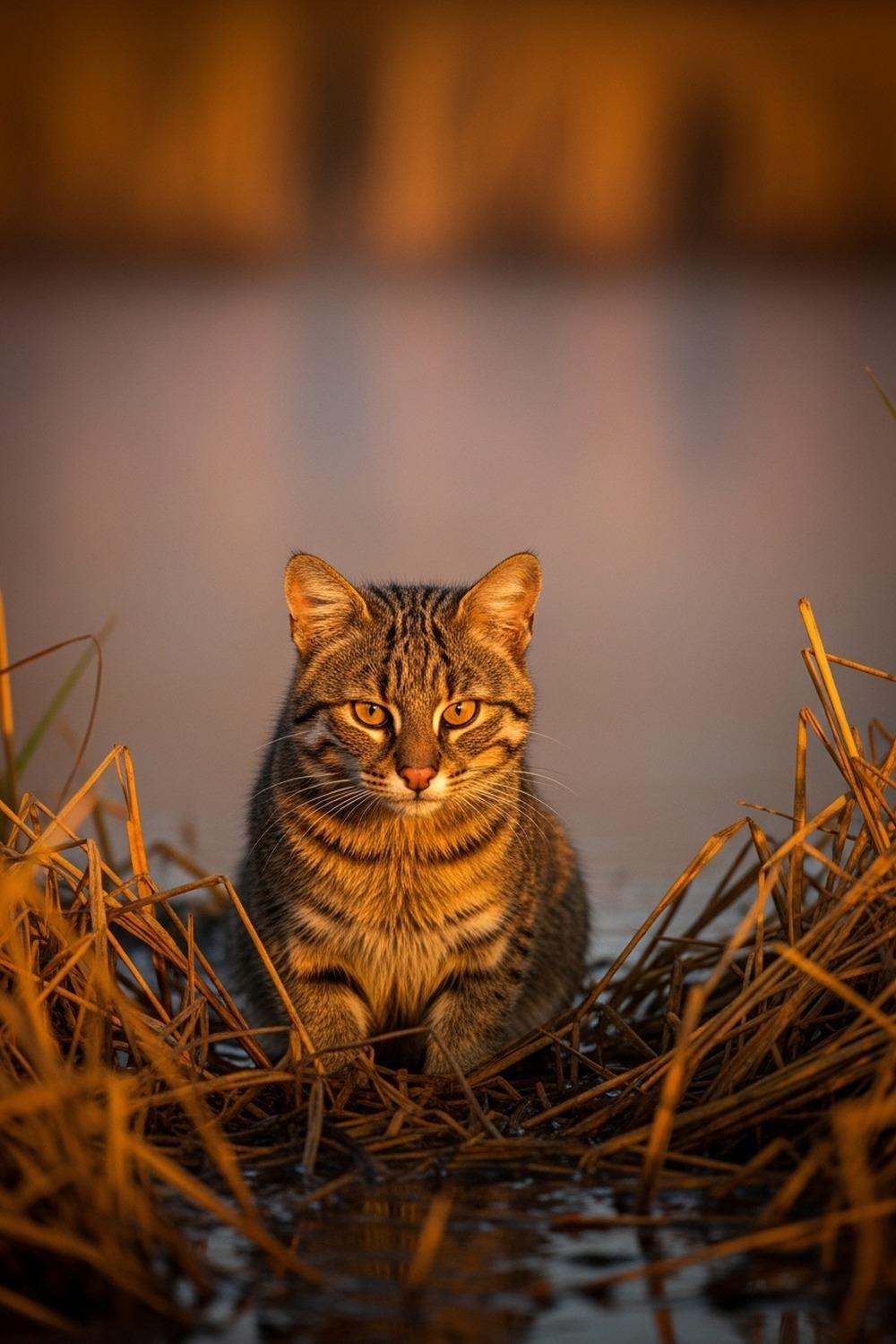
Ancient Egyptians left us mummified specimens. Modern wetland engineers are quietly erasing the marshes it needs. The gap between those two facts is where this story lives.
Key Facts
- The jungle cat (Felis chaus) ranges from Egypt’s Nile Delta to southern China’s Yunnan Province, spanning the Caucasus to Sri Lanka.
- At least 3 mummified jungle cats were positively identified from Egyptian collections via CT scan and isotopic analysis in a 2014 Universite Paul Sabatier study.
- Egypt’s Nile Delta has lost an estimated 70 percent of its natural wetland area since the Aswan High Dam construction in 1970.
- A single jungle cat can cover up to 6 kilometers in one night, per Wildlife Institute of India tracking studies in 2015.
- Approximately 35 percent of the world’s wetlands have been lost since 1970, three times faster than forest loss, per the Ramsar Convention.
In short: Mummified jungle cats found in Egyptian tombs reveal that the jungle cat ancient Egypt hosted was never fully domesticated but lived commensally alongside humans for millennia. Today Felis chaus is vanishing from Egypt as the Nile Delta has lost 70 percent of its wetlands since the 1970 Aswan High Dam.
Egypt’s Other Cat: Wild, Wary, and Worshipped
When most people think of cats in ancient Egypt, they picture the African wildcat (Felis lybica), the direct ancestor of every domestic cat alive today. But excavations at sites including Hierakonpolis and Bubastis have turned up something less expected: mummified jungle cats, placed deliberately in tombs alongside humans.
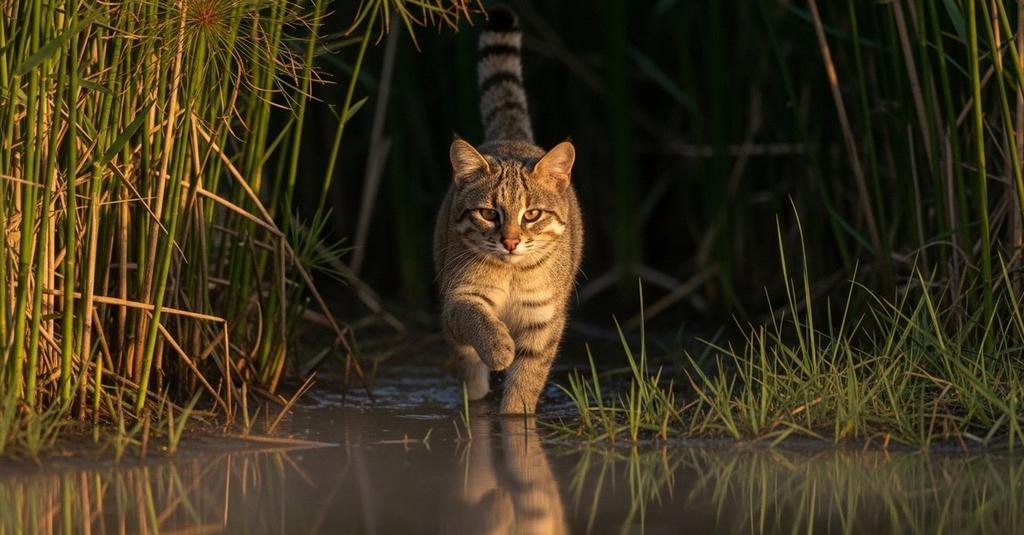
A 2012 analysis published by researchers at the Smithsonian Institution confirmed that several feline mummies held in museum collections across Europe and North America belonged not to Felis lybica but to Felis chaus — the jungle cat, a species most Egyptologists hadn’t prioritized. The find reframed a long-standing assumption: that ancient Egypt had essentially domesticated one cat and ignored the rest. It hadn’t. The jungle cat was present, valued, and deliberately preserved — which raises an uncomfortable question about what “domestication” even means.
The Egyptian relationship with animals was never simple. Cats of various species were associated with the goddess Bastet, with protection, and with the liminal space between the human world and the divine. A jungle cat, with its tall tufted ears, its ghostly marsh movements, its ability to vanish into Nile-side reeds within seconds, would have seemed to any Egyptian observer like a creature that belonged to both worlds. Not a pet. Not prey. Something else entirely — a companion you didn’t quite own.
What those tomb placements suggest isn’t full domestication. It’s something rarer — a managed coexistence. Jungle cats were probably tolerated, perhaps encouraged, around grain stores and waterways where rodents were a constant threat. And here’s the thing: they stayed wild. Humans let them.
How the Jungle Cat Actually Hunts and Moves
Understanding why the jungle cat occupied such an unusual place in Egyptian life requires understanding what it actually does in the dark — and it does quite a lot. The species is primarily crepuscular and nocturnal, covering up to six kilometers in a single night across wetland terrain that would exhaust most predators twice its size. Its ears rotate independently, functioning like directional microphones, capable of isolating the precise location of a vole moving through grass at thirty meters. That hearing, combined with a stalk-and-pounce hunting method documented in field studies by the Wildlife Institute of India between 2008 and 2015, makes it one of the most efficient small predators in its range.
Fish, frogs, waterfowl, small mammals, reptiles — the jungle cat takes what the water’s edge offers, shifting its diet by season with a flexibility that most felids can’t match.
It also swims. Willingly. Enthusiastically, even. Most members of the cat family avoid water when they can. The jungle cat moves through it as a matter of course, wading into shallow channels to catch fish or simply to cross from one reed bed to another. This amphibious tendency isn’t incidental — it’s core to the animal’s ecological identity. The Nile Delta in ancient times was a vastly wetter place than it is today, laced with channels, papyrus marshes, and seasonal flood zones. For a cat built exactly like this, that landscape wasn’t a challenge. It was a larder.
In the field, trackers in India’s Keoladeo National Park have recorded jungle cats entering water up to chest depth to stalk waterbirds. That’s not cautious wading. That’s hunting commitment. The behavior tells you something crucial about how this animal survived alongside humans for so long — it never needed us for food.
A Range That Spans Civilizations, Not Just Countries
From the Egyptian Delta in the west to the forests of Yunnan Province in southern China in the east, from the Caucasus in the north to Sri Lanka in the south, Felis chaus occupies a corridor of landscape that tracks human agricultural history almost exactly. Wherever people settled near water — along the Nile, the Tigris and Euphrates, the Indus, the Ganges — the jungle cat was already there.
A 2019 assessment by the IUCN Cat Specialist Group, detailed in a report covered by National Geographic, placed the species as “Least Concern” globally but flagged sharp population declines in the western portions of its range — particularly in Egypt, Turkey, and the countries of the Levant — where wetland drainage has been most aggressive. Globally stable on paper. Locally vanishing in practice.
That paradox deserves a pause. The jungle cat ancient Egypt hosted was part of a population that extended unbroken from the Nile to the Mekong. Today, those western populations are fragmenting.
Egypt’s Nile Delta — historically one of the richest wetland ecosystems in the northern hemisphere — has lost an estimated 70 percent of its natural wetland area since the construction of the Aswan High Dam in 1970. The cats didn’t move because the water table changed. They had nowhere to go. The jungle cat ancient Egypt once knew in abundance is now, in Egypt itself, effectively rare.
Agriculture created rodent populations. Rodents drew the cats. The cats reduced the rodents. It was a functional loop — unsanctioned, unmanaged, quietly beneficial. But the loop didn’t break because of predator-prey dynamics. It broke because we drained the marsh.
The Jungle Cat in Ancient Egypt: What the Mummies Tell Us
The mummified jungle cats found in Egyptian tombs aren’t isolated curiosities. A 2014 study conducted by researchers at the Université Paul Sabatier in Toulouse, using CT scanning and isotopic analysis on feline mummies from the collections of the Musée des Confluences in Lyon, identified at least three individuals as Felis chaus with high confidence.
More significantly, the isotopic signatures in their bones suggested these animals had eaten a diet partially subsidized by humans — grain-fed rodents, the occasional domestic bird, food that came from the edges of human settlement rather than pure wilderness. They weren’t pets. But they weren’t eating purely wild prey either. The jungle cat ancient Egypt produced seems to have occupied a specific, narrow band of existence: near enough to benefit from human activity, wild enough to vanish when it chose to.
That middle state has a name in biology: commensal. A commensal species is one that benefits from an association with another species without harming it — and without being controlled by it. The house cat crossed from commensalism into domestication over roughly ten thousand years, slowly enough that we can trace the genetic and behavioral changes across archaeological layers. The jungle cat never made that crossing.
Its bones in Egyptian tombs look anatomically wild. Its skull proportions don’t show the facial foreshortening that marks domestic cats. Whatever relationship it had with ancient Egyptians, it didn’t rewire the animal’s brain. It just got fed.
Researchers at the Natural History Museum in London are currently working on ancient DNA extraction from jungle cat mummy samples, aiming to determine whether Egyptian populations were genetically distinct from those further east. If they were, the loss of Egypt’s wetland jungle cats isn’t just ecological — it’s a loss of a lineage that lived alongside one of humanity’s foundational civilizations and left bones in its tombs.
What Disappears When the Marsh Does
Wetlands are the most threatened ecosystem on Earth. According to the Ramsar Convention on Wetlands, approximately 35 percent of the world’s wetlands have been lost since 1970 — a rate of decline three times faster than that of forests. But for a species whose entire evolutionary identity is built around water’s edge, that number isn’t just an environmental statistic. It’s an extinction sentence. The jungle cat doesn’t adapt to dry scrub. It doesn’t pivot to urban environments the way foxes do. When the reeds go, the cat goes with them.
Watching a species lose 70 percent of its living space in fifty years, you stop calling it a conservation challenge.
In Egypt specifically, the Nile Delta’s transformation has been dramatic and fast. Agricultural expansion, urban encroachment on the Delta’s northern fringes, and the downstream effects of the Aswan Dam — reduced seasonal flooding, altered sediment deposits, saltwater intrusion from the Mediterranean — have collectively restructured a landscape that evolved over millions of years. The species that depended on that landscape, including Felis chaus, are now squeezed into remnant patches. Small populations in isolated wetlands don’t behave like healthy metapopulations. They contract, inbreed, and eventually blink out. You can read more about the animals whose worlds are quietly shrinking at This Amazing World, where the intersection of natural history and habitat loss runs through almost every story worth telling.
In India’s Rann of Kutch, one of the last places where jungle cats can be observed with relative regularity, local conservation groups working with the Wildlife Conservation Society have documented population persistence in areas where traditional pastoral practices continue — wetlands managed by communities rather than drained by industry. That’s not a coincidence. It’s a template.
Where to See This
- Keoladeo National Park, Rajasthan, India — one of the most reliably documented sites for jungle cat sightings, particularly between October and March when migratory waterbirds concentrate prey along the wetland edges.
- The IUCN Cat Specialist Group (iucncsg.org) maintains updated range maps and conservation status assessments for Felis chaus, including regional population trend data.
- If you want to understand the wetland systems this cat depends on, the Ramsar Convention’s wetland site database (ramsar.org) lists protected areas across the jungle cat’s full range — many of which are open to responsible ecotourism.
By the Numbers
- 35% — estimated global wetland loss since 1970, according to the Ramsar Convention on Wetlands (2018 Global Wetland Outlook).
- Up to 6 km — maximum nightly range recorded for a single jungle cat individual in field tracking studies, Wildlife Institute of India, 2015.
- 70% — estimated reduction in natural wetland area in Egypt’s Nile Delta since 1970, linked to Aswan High Dam downstream effects.
- 10 subspecies — currently recognized across the jungle cat’s range, from Felis chaus chaus in the Caucasus to Felis chaus fulvidina in Southeast Asia.
- At least 3 mummified jungle cat individuals — positively identified from Egyptian collections via CT scan and isotopic analysis, Université Paul Sabatier study, 2014.
Field Notes
- In 2016, a camera trap survey conducted by the Snow Leopard Trust in Afghanistan’s Wakhan Corridor captured the first confirmed image of a jungle cat at 2,800 meters elevation — significantly higher than any previously recorded sighting and well outside the species’ assumed wetland range.
- The jungle cat’s tufted ear tips, often assumed to signal a close relationship with the caracal or lynx, are actually convergent evolution — Felis chaus is not closely related to either. The tufts appear independently in species that hunt in tall grass, where elevated auditory targets improve prey detection.
- Ancient Egyptian artwork depicting cats being used to hunt waterfowl — scenes found in New Kingdom tomb paintings — may actually show jungle cats rather than domestic cats, based on body proportion analysis conducted by zooarchaeologist Wim Van Neer at the Royal Belgian Institute of Natural Sciences.
- Researchers still can’t determine whether Egyptian jungle cats represent a naturally occurring western population or whether some individuals were transported deliberately along trade routes. The ancient DNA work currently underway may answer this — or may reveal a picture more complicated than either option suggests.
Frequently Asked Questions
Q: What is the connection between the jungle cat and ancient Egypt?
The jungle cat ancient Egypt relationship is documented through mummified specimens found in tombs dating back thousands of years. Unlike the African wildcat, which became the domestic cat, the jungle cat was never fully domesticated — but isotopic analysis of mummy bones suggests these cats ate food partially derived from human settlements. They appear to have occupied a commensal niche: wild animals that benefited from proximity to humans without being controlled by them (and this matters more than it sounds, because it shows humans lived alongside wildness rather than simply consuming it).
Q: Is the jungle cat dangerous to humans?
No. Felis chaus is a small wild felid — adults typically weigh between 4 and 16 kilograms depending on region and sex. Like most wild cats, it avoids human contact and relies on cover and concealment rather than aggression when threatened. There are no documented cases of jungle cats attacking humans unprovoked. In areas where they live close to villages, they’re generally regarded as beneficial because they control rodent populations around agricultural stores.
Q: Why is it called the jungle cat if it doesn’t live in jungles?
This is one of the most common misconceptions about the species. The word “jungle” here derives from the Sanskrit jangala, which referred broadly to rough, dense, or uncultivated terrain — not specifically to tropical rainforest. In historical usage, particularly in South Asian contexts where European naturalists first formally described the species, “jungle” meant any wild, thick vegetation — including the reed beds and riparian scrub that Felis chaus actually inhabits. The name has stuck, even though it consistently misleads people about where the animal actually lives.
Editor’s Take — Sarah Blake
What strikes me most about this animal isn’t the mummies — it’s the stasis. Ten thousand years ago, the jungle cat was doing exactly what it’s doing tonight: threading through wetland edges, taking what the water offers, staying close enough to human activity to benefit from it without surrendering a single wild instinct. We domesticated its cousin. We mummified it. We drained its marsh. And it just kept moving. The question isn’t whether it can survive us. It’s whether we’ll leave enough water for it to try.
Somewhere in a remnant reed bed at the edge of the Nile Delta, a jungle cat is probably hunting right now — moving through the same type of landscape it occupied when pharaohs built the monuments we still photograph. It doesn’t know that 70 percent of that landscape is gone. It only knows what remains. The real measure of what ancient Egypt understood about living alongside wild things isn’t in the temples or the hieroglyphs. It’s in those mummified cats — proof that for thousands of years, humans and something untamed shared the same water’s edge. What would it take to share it again?
Illustrations are AI-generated. Article fact-checked and human-edited. Our editorial standards.