Kawah Ijen Blue Fire: What Actually Burns at 600°C
Gas leaves the cracks at the edge of Kawah Ijen at up to 600°C, and the moment it touches the night air it lights — which is the whole of the kawah ijen blue fire, a phenomenon that has been photographed as “blue lava” more times than anyone can count and is not lava at all. It is a chemical fire, burning on the shore of the most acidic lake on the planet, inside a crater where men have been hauling yellow rock on their shoulders for a century. The flames reach five metres. They burn all day too. You simply cannot see them until the sun is gone.
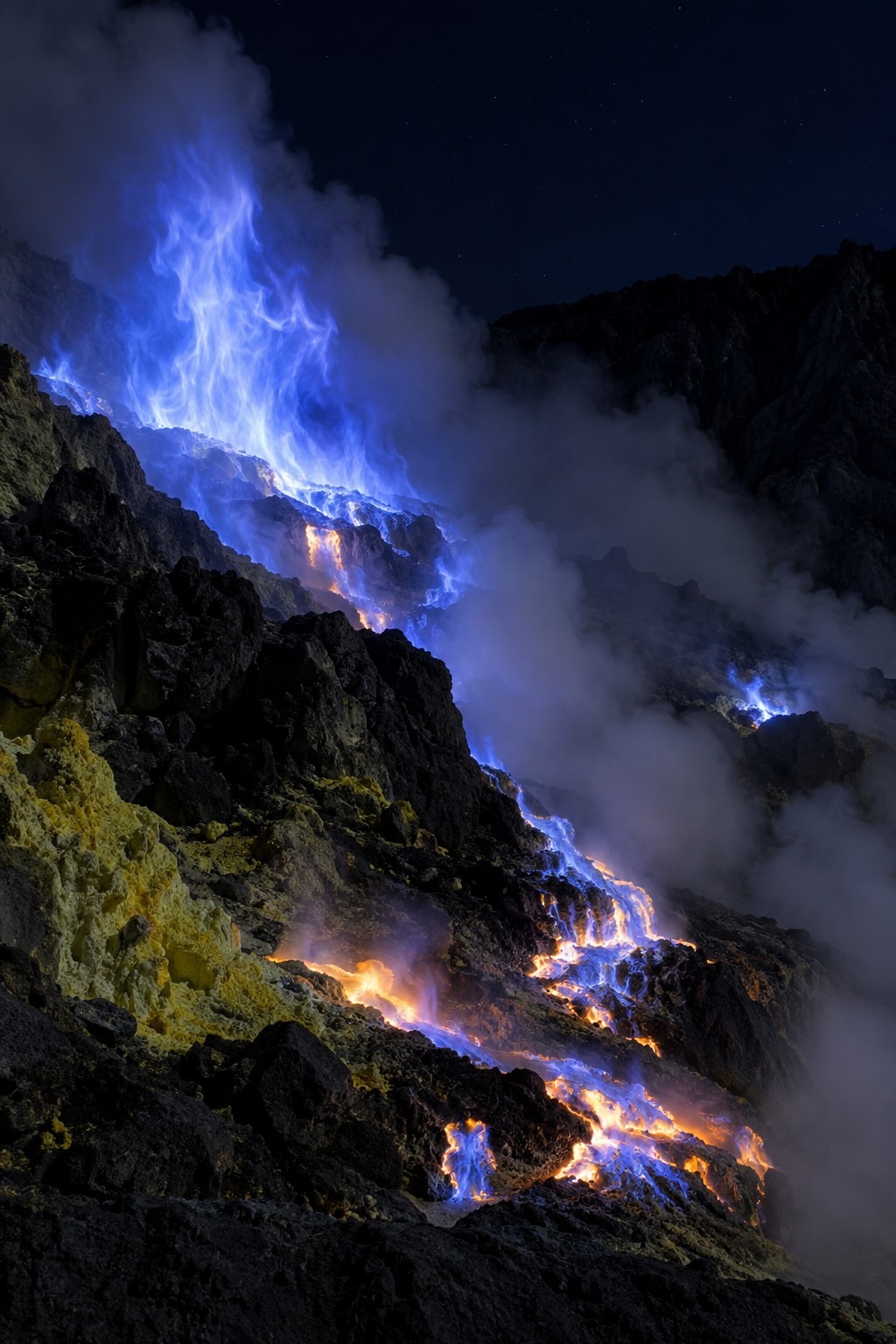
The short answer: the blue glow is sulfur-rich volcanic gas igniting in open air, and the blue comes from the chemistry of burning sulfur, not from heat, not from magma, and not from anything molten.
- 2,769 m — summit elevation, East Java, Indonesia
- up to 600 °C — temperature of the gas escaping the vents
- 360 °C — the point at which sulfur ignites in hot air
- 5 m — maximum reported height of the flames
- pH 0.13–0.5 — measured acidity of the crater lake
- 75–90 kg — a sulfur miner’s typical basket load, carried up a 45–60° slope
Key Facts
- Gas escapes Kawah Ijen’s vents at up to 600 °C, well above the roughly 360 °C at which sulfur ignites in hot air.
- The burning sulfur flames reach a maximum reported height of 5 metres, at a summit elevation of 2,769 m in East Java, Indonesia.
- The crater lake is the largest highly acidic lake known on Earth: about 722 m across, 200 m deep, holding on the order of 36 million cubic metres.
- A 2008 survey recorded pH 0.5 at the lake edges and 0.13 at the centre; published analyses report roughly 62 g/L sulfate, 23 g/L chloride, 5.5 g/L aluminium and 2 g/L iron at around 37 °C.
- Sulfur miners carry baskets of 75–90 kg up a 300-metre climb out of the crater at 45–60°, then about three kilometres downhill to the weighing station.
In short: The blue fire at Kawah Ijen is sulfur-rich volcanic gas igniting in open air, not lava. Gas leaves the vents at up to 600 °C, above sulfur’s 360 °C ignition point, and flames reach 5 metres. The blue colour comes from chemiluminescence of S₂ and SO molecules, not heat.
600 degrees: what is actually on fire
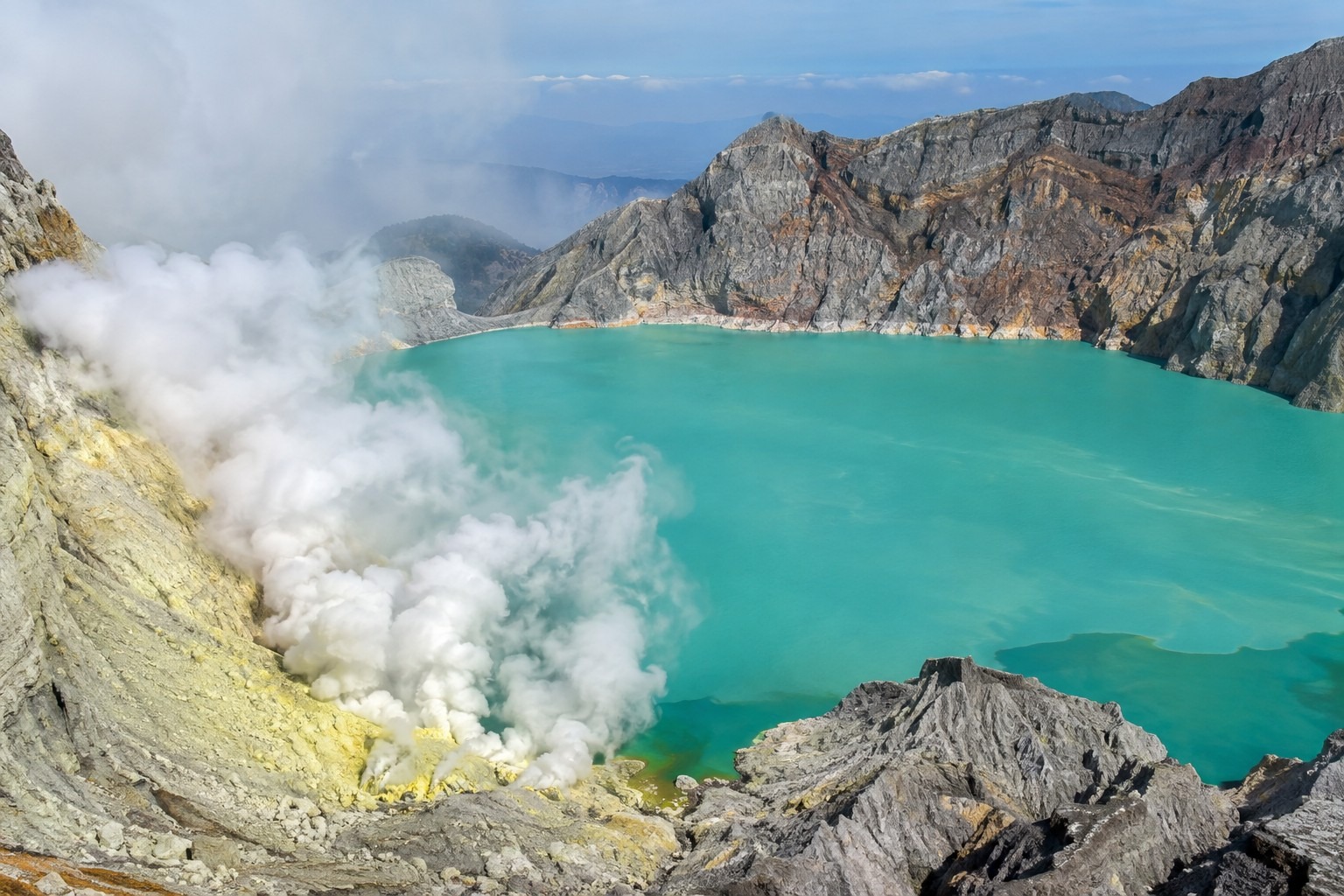
Ijen’s crater floor leaks gas. Not steam in the gentle sense — a hot, pressurised mixture heavy with sulfur dioxide and hydrogen sulfide, forced up through fractures from the magmatic-hydrothermal system below. Sulfur ignites in air at around 360°C. The gas arrives far hotter than that, so combustion is essentially automatic the moment oxygen is available.
Part of the gas does something stranger. It cools just enough to condense into liquid sulfur while still alight, so molten sulfur runs downslope carrying its own flame with it. That is the footage everyone has seen: a glowing blue rivulet crawling over black rock. It looks exactly like lava. Its temperature is a few hundred degrees; real basaltic lava runs closer to 1,100°C, and molten sulfur at these temperatures is nowhere near incandescent. It glows because it is burning, not because it is hot.
So why blue rather than the yellow of a campfire? Because there is no soot. A wood or candle flame looks yellow-orange thanks to glowing carbon particles — incandescence. Burning sulfur produces almost none. What you see instead is chemiluminescence: excited S₂ and SO molecules formed in the reaction shedding energy as light, and those emissions sit in the blue and violet end of the spectrum. Strip away the soot glow and the molecular light is all that is left.
Turns out the colour is a fingerprint of the chemistry, not a measure of the temperature. Hotter does not mean bluer here.
The human hand in the kawah ijen blue fire
Here is the part most travel write-ups leave out. Ijen is a working sulfur mine, and the mining infrastructure shapes what tourists photograph. Miners run ceramic and steel pipes into the hottest fumaroles to channel the gas, cool it, and harvest the condensed sulfur as solid slabs they then break up and carry out. Those pipes concentrate the outflow — and a concentrated jet of sulfur gas in open air is precisely what produces a tall, theatrical flame.
U.S. Geological Survey volcanologist John Pallister, describing the operation for National Geographic, went further: he said he had been told that miners sometimes ignite the sulfur or its gases themselves. He framed it as second-hand information, and it should be repeated that way — it is a report, not a measurement. The honest position is that Ijen’s vents genuinely self-ignite and have done so for as long as the site has been described, while the size, placement and reliability of the flames on any given night are entangled with human activity in the crater.
{IMAGE_2}
His colleague Cynthia Werner of the Alaska Volcano Observatory put the scale plainly after visiting: she had never seen that much sulfur flowing at a volcano. Similar melting happens around hydrothermal vents at Yellowstone, but not remotely on this scale. French photographer Olivier Grunewald, who spent years documenting the crater at night and whose images put Ijen on the global map, has been equally blunt that the glow is not lava.
Miners themselves are the least photogenic fact of the site and the most important one. Loads of 75 to 90 kilograms. A 300-metre climb out of the crater at 45 to 60 degrees, then roughly three kilometres downhill to the weighing station. Twice a day for many of them, on wages historically measured in single-digit US dollars. In recent years a large share of that labour has shifted to tourism — the same men now pull visitors up the trail in modified carts, which pays considerably better than sulfur. How many active miners remain is genuinely unclear; published figures range from a few hundred down to a handful, and no current official count is public.
pH 0.13: the world’s largest acid lake
Behind the flames sits roughly a kilometre of turquoise water, and it is the largest highly acidic crater lake known on Earth: about 722 metres across, 200 metres deep, holding on the order of 36 million cubic metres. Expeditions have measured pH below 0.3, with one 2008 survey recording 0.5 at the edges and 0.13 at the centre. Published analyses put the load at roughly 62 g/L sulfate, 23 g/L chloride, 5.5 g/L aluminium and 2 g/L iron, at around 37°C.
That combination is worth translating, because “acidic” is doing a lot of work in most articles.
| Liquid | Approximate pH |
|---|---|
| Kawah Ijen crater lake | 0.13 – 0.5 |
| Car battery acid | ~0.8 |
| Stomach acid | 1.5 – 3.5 |
| Lemon juice | ~2.0 – 2.6 |
| Black coffee | ~5 |
| Pure water | 7 |
The pH scale is logarithmic, so the gap is larger than it looks. At pH 0.3 the lake carries something like five million times the free hydrogen-ion concentration of pure water. One widespread claim does need correcting, though: Ijen is often called “the world’s largest hydrochloric acid lake”. Chemically it is a mixed brine — sulfuric acid dominates by mass, with hydrochloric acid, fluoride and dissolved metals alongside. Calling it hydrochloric is a simplification that has been copied from page to page for years.
Thirty kilometres downstream, where the acid goes
This is the story nobody sells tickets for. The lake does not sit sealed in its bowl — brine seeps through the western crater rim, reappears as streamlets, and forms the headwaters of the Banyupahit. Its name translates, roughly, as “bitter water”. The stream mixes with clean rivers and thermal springs inside the Ijen caldera and then runs down to irrigate a coastal agricultural plain about 30 kilometres from the summit.
Research published in the Journal of Volcanology and Geothermal Research traced the composition along that route: fields irrigated with water at pH 2.5 to 3.5, carrying metal concentrations above international quality guidelines, with iron reaching up to 1,600 mg/L and aluminium up to 3,000 mg/L at the acidic end of the system. A multidisciplinary team led by environmental scientist Ansje Löhr at the Open University of the Netherlands has studied the downstream consequences, and identified fluoride as the sharpest concern — levels in drinking water exceeding guideline values in affected subdistricts of East Java, where dental fluorosis is documented among residents.
The blue fire gets the photographs; the river gets none of them, and that is the wrong way round.
Life at pH 0.3
You would not expect anything alive in that water. Something is.
Löhr and colleagues sampled the lake and the acid river and found archaea present at every location — including the most extreme, where the water column contained no detectable bacteria at all. Bacteria appeared only downstream, along the river; eukaryotes only where pH climbed above about 2.6. More striking, the gene sequences recovered were not closely related to any known acidophile, with similarities below roughly 85–90 per cent, which suggests the system hosts extremophile species that have never been described.
(That last detail is why astrobiologists keep an eye on Ijen: acidic, metal-rich, sulfur-driven water is a reasonable analogue for parts of early Mars.)
1999, 2002, 2018, 2026: sorting out Ijen’s record
Search for Ijen’s last eruption and you will get 1999 from some sources and 2002 from others. Both refer to minor phreatic activity at a volcano whose normal state is not eruption but quiet, persistent degassing — the solfataric phase. Ijen has not produced a large magmatic eruption in the modern record. That is why a crater lake and an active mine can coexist there at all.
Quiet is not the same as harmless. On the evening of 21 March 2018, a gas release from the crater drifted into villages on the flanks; around 30 people were hospitalised with vomiting and breathing difficulties, roughly 200 were evacuated from Kalianyar village, and the trail from Paltuding to the crater was closed to tourists and miners alike. The Smithsonian Institution’s Global Volcanism Program logged the episode that week.
As of 2026, the Smithsonian’s reporting places Ijen at alert Level 1 (normal) on Indonesia’s four-level scale, still in its solfataric phase, with vigorous high-temperature fumaroles on the lake shore and crater walls and blue flames continuing at night. Access is managed rather than closed — and that status can change at short notice, which is the only reason the alert level exists.
Frequently asked questions
Is the kawah ijen blue fire really blue lava? No. It is burning sulfur gas, plus condensed molten sulfur that continues to burn as it flows. No magma is involved, and the glow is chemical light, not red-hot rock.
Why is it only visible at night? The flames burn continuously, day and night. Their light is simply too faint to compete with daylight — the same reason you cannot see a gas hob flame outdoors at noon.
Is Ijen the only place on Earth with blue flames? It is the only site known to produce them continuously, and the largest blue-flame area in the world. Sulfur-rich ground at Dallol in Ethiopia’s Danakil Depression has also been observed burning blue, but rarely and only for short periods.
Could the blue fire ever stop? Honestly, nobody can say. The flames depend on where the vents open and how freely gas escapes, and both change over time; some local reporting links declining mining activity to vents becoming buried. No published scientific projection exists, and anyone offering a confident date is guessing.
Sources and notes
- National Geographic — reporting on Ijen’s blue flames, with Olivier Grunewald, and comments from USGS volcanologists Cynthia Werner and John Pallister
- Smithsonian Institution, Global Volcanism Program — Ijen activity reports, including March 2018 and 2026 status
- Journal of Volcanology and Geothermal Research — downstream composition of acidic volcanic waters in the Banyupahit stream, Ijen caldera
- Open University of the Netherlands — Ansje Löhr and colleagues on natural pollution from the Kawah Ijen crater lake and on microbial communities in the lake and river
- U.S. Geological Survey — volcanic gas and sulfur behaviour at hydrothermal systems
Ijen is a rare case where the spectacle and the science point in opposite directions: the flames are the least consequential thing happening on that mountain. The acid draining west into farmland, the unnamed archaea surviving at pH 0.3, the men still measuring a day’s work in kilograms of yellow rock — those are the open questions. The blue fire is just the part that photographs well, and it is worth knowing what you are actually looking at when it does.
Illustrations are AI-generated. Article fact-checked and human-edited. Our editorial standards.