Oaxaca Women Save Native Corn Seeds: Zapalote Chico
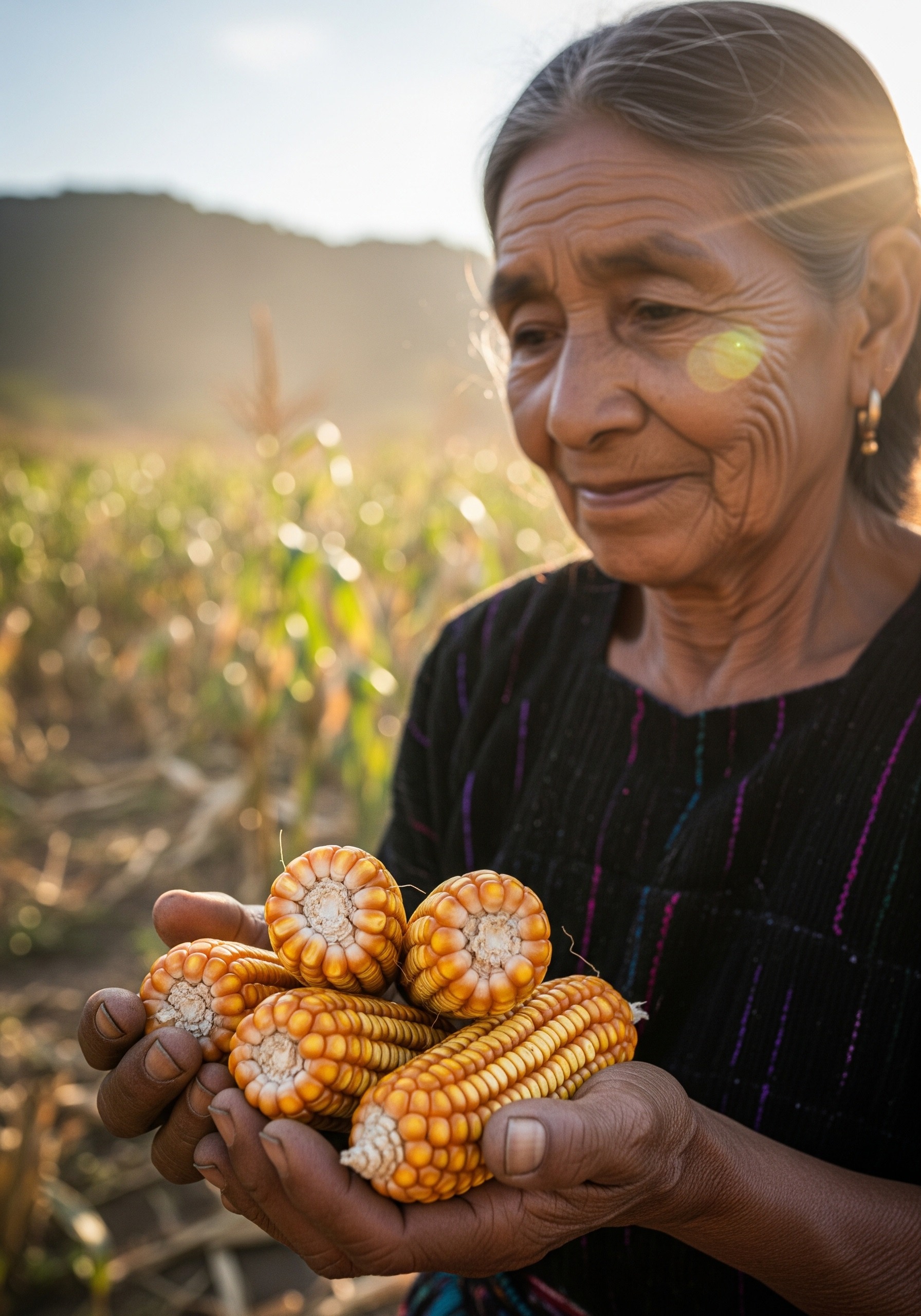
Oaxaca women save native corn seeds the way their great-grandmothers did — kernel by kernel, by hand, choosing next year’s harvest from the ears that survived the heat. In Juchitán de Zaragoza, on the wind-blasted plain of the Isthmus of Tehuantepec, that quiet act has become one of Mexico’s most consequential acts of defiance: a community seed bank guarding a corn that grows nowhere else on Earth.
Key Facts
- Mexico recognizes roughly 64 maize races — about 59 of them native — and the single state of Oaxaca grows around 35 of them, more genetic corn diversity than entire continents hold.
- Zapalote chico is endemic to the Isthmus of Tehuantepec: a short, stubby-eared, drought- and wind-tolerant landrace nicknamed the “King of the Isthmus.”
- After an 8.2-magnitude earthquake struck on 7 September 2017, 80 Zapotec women rebuilt their destroyed clay ovens and launched a totopo brand, “Tona Taati’ ¡Totopo Güero!”, now producing about 50,000 totopos a month sold across Mexico.
- The seed cooperative Xhuba ‘Binii (“corn seed” in Zapotec) runs a 50/50 rule: half of each harvest’s best seed restocks the community seed bank; half is eaten or sold.
- On 17 March 2025 Mexico made its constitution itself a seed guardian, amending Articles 4 and 27 to ban the cultivation of GMO corn nationwide.
In short: A women-led cooperative in Juchitán, Oaxaca, banks the seeds of a rare native maize called zapalote chico, splitting every harvest fifty-fifty between a community seed bank and the kitchen. What began as earthquake recovery in 2017 now sits at the center of a national movement — and as of 2025, a constitutional one — to keep Mexico’s native corn alive and GMO-free.
Key Facts
- Mexico recognizes roughly 64 maize races, about 59 of them native, and the single state of Oaxaca grows around 35 of them.
- Zapalote chico is endemic to the Isthmus of Tehuantepec, a short, stubby-eared, drought- and wind-tolerant landrace nicknamed the King of the Isthmus.
- After an 8.2-magnitude earthquake struck on 7 September 2017, 80 Zapotec women rebuilt their destroyed clay ovens and launched a totopo brand, Tona Taati’ Totopo Guero!, now producing about 50,000 totopos a month.
- The seed cooperative Xhuba ‘Binii, meaning corn seed in Zapotec, runs a 50/50 rule: half of each harvest’s best seed restocks the community seed bank, and half is eaten or sold.
- On 17 March 2025 Mexico amended Articles 4 and 27 of its constitution to ban the cultivation of GMO corn nationwide.
In short: A women-led cooperative in Juchitan, Oaxaca banks the seeds of a rare native maize called zapalote chico, splitting every harvest fifty-fifty between a community seed bank and the kitchen. What began as earthquake recovery in 2017 now sits at the center of a national, and as of 2025 constitutional, movement to keep Mexico’s native corn alive and GMO-free.
Why Oaxaca Women Save Native Corn Seeds by Hand
Begin with the ground itself. The Isthmus of Tehuantepec is the narrowest waist of Mexico, a furnace of a plain where the norte winds scream down off the mountains hard enough to flatten a cornfield. Most modern hybrid corn simply can’t take it. Zapalote chico can — and the Zapotec families here have spent centuries breeding it to.
Then came the night of 7 September 2017. An 8.2-magnitude earthquake — the strongest to hit Mexico in a century — tore through the Isthmus and collapsed the comixcales, the wood-fired clay ovens where Zapotec women bake totopos, the dense, blistered tortillas that are registered Zapotec culinary heritage. Homes fell. Ovens fell. Income fell with them.
Eighty women rebuilt anyway. They organized, fired up new ovens, and put their totopos under one banner — “Tona Taati’ ¡Totopo Güero!” — that today moves roughly 50,000 totopos a month to buyers nationwide. And here’s the part the recovery headlines missed: you cannot make a real totopo from supermarket corn. The brand created demand for native maize, and that demand gave the men in the fields a reason to keep planting the seed the women were saving.
{IMAGE_2}
Meet Zapalote Chico, the “King of the Isthmus”
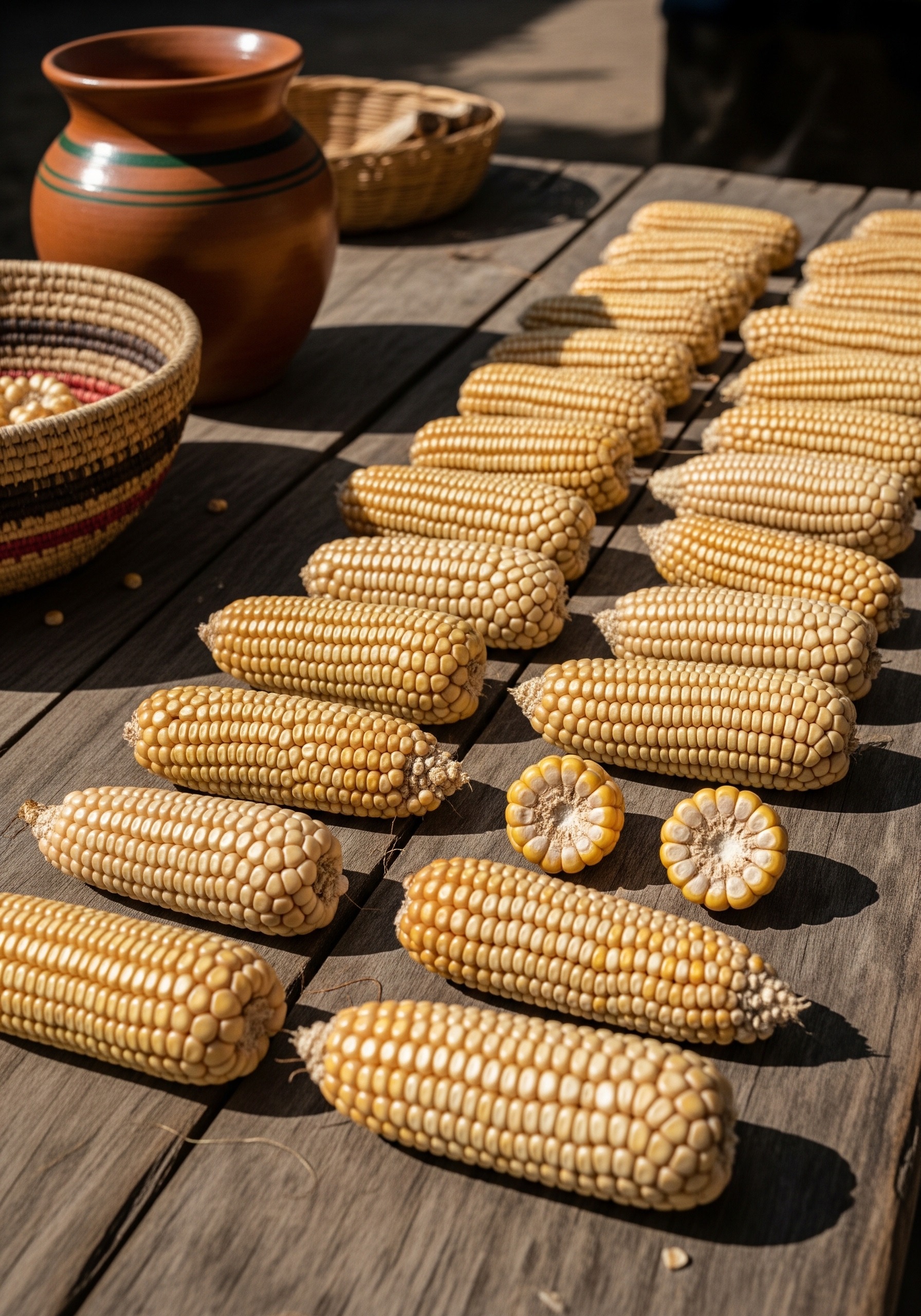
Zapalote chico is not impressive at first glance, and that’s rather the point. The ear is short and squat, the kernels small and tightly packed. Set beside a glossy yellow hybrid bred for industrial yield, it looks like the runt of the litter.
It is, instead, a survivor. Endemic to the Isthmus of Tehuantepec, the race is unusually drought-tolerant and wind-resistant, and it carries a deep, nutty flavor that totopo makers prize. Agronomists studying the tiny zapalote in the Isthmian region have catalogued exactly the traits the cooperative selects for by hand: short stature that resists lodging in fierce wind, and tolerance for a punishing dry season. Centuries of farmer selection, not a laboratory, built it.
Strip away the romance and the arithmetic is unsentimental: a landrace nobody plants is a landrace that dies, and the cooperative’s real innovation is making zapalote chico worth planting again. Honest caveat — figures for its yield per hectare get tossed around loosely and aren’t well documented, and like most landraces it almost certainly produces less raw tonnage than a commercial hybrid. Its value was never bulk. It’s resilience, flavor, cultural meaning, and a price premium for genuinely native corn.
Inside the 50/50 Rule: How a Community Banks Its Own Seed
The mechanics are beautifully simple. Xhuba ‘Binii — the name means “corn seed” in Zapotec — gathers around 250 member farmers who grow zapalote chico and then split their harvest by a single, replicable rule. Half of the best selected seed goes into a community seed bank that reproduces the stock for the next cycle. The other half is sold or eaten, becoming totopos, tamales, moles, and atole.
That split is the whole genius of it. A seed bank that only stores grain eventually fails, because seed loses viability and the knowledge of how to grow it fades. By forcing half the harvest back into the ground every season, the cooperative keeps the seed and the skill alive at the same time — a living archive rather than a frozen one.
The group was founded around 2015 by community organizer Tomás Chiñas Santiago to collectively improve and spread the zapalote seed through campesino hand-selection. Today its president is Rosario del Carmen Carrasco, a young campesina who trained as an engineer, inherited a love of the land from her father, and has cultivated more than 20 hectares of zapalote chico herself. Researchers at CIMMYT, the International Maize and Wheat Improvement Center, have documented a pattern playing out here too: in many Mexican households it is the women — the cooks, the ones who know which corn makes the best totopo — who effectively decide which ears become next year’s seed. Saving seed and selecting it are not separate jobs.
From a Contested 2001 Discovery to a Constitutional Ban
Why does any of this carry national weight? The answer starts with a scientific bombshell — and an honest one demands we tell you it was disputed.
In November 2001, researchers David Quist and Ignacio Chapela of the University of California, Berkeley published a paper in Nature reporting transgenic DNA — the 35S promoter used in genetically engineered crops — in traditional maize sampled from the highlands of northern Oaxaca, even though GMO corn had never been approved for planting in Mexico. It landed like a thunderclap. It also drew fierce criticism: Nature later published rebuttals questioning the methods, and a 2005 study in PNAS found no detectable transgenes in the same region. Later work again reported some presence. The honest summary is that the extent of contamination remains scientifically contested — but the underlying worry, that transgenes can flow into irreplaceable landraces through ordinary pollen drift, is real and never went away.
That worry hardened into law. On 17 March 2025, after votes in the Chamber of Deputies and the Senate, President Claudia Sheinbaum signed a decree amending Articles 4 and 27 of the Mexican Constitution to prohibit the cultivation of genetically modified corn. Article 27 now directs the state to promote traditional crops and the milpa system using local seeds — the exact practice the Juchitán women have been running all along. A cooperative’s kitchen-table rule had become constitutional principle.
- 1866 — Petrona Esteva helps defend Juchitán from French invaders; the totopo brand later takes her name.
- 2001 — Quist & Chapela report transgenes in Oaxacan maize in Nature (later contested).
- ~2015 — Xhuba ‘Binii seed cooperative founded in Juchitán.
- 7 Sep 2017 — 8.2 quake; 80 women rebuild and launch “Tona Taati’.”
- 17 Mar 2025 — Mexico amends its Constitution to ban GMO corn cultivation.
- Nov 2025 — National Native Corn Plan launched, rolling out in 2026.
The 2026 National Plan That Looks a Lot Like Juchitán
In November 2025 Mexico’s Ministry of Agriculture launched a National Native Corn Plan, and its opening phase reads like the cooperative’s model scaled to a map. Beginning in 2026, it aims to support 677,005 corn-growing families working 886,687 hectares across 437 municipalities in seven southern and southeastern states — Oaxaca, Chiapas, Guerrero, Yucatán, Campeche, Quintana Roo, and Tabasco — with technical help and region-specific machinery, targeting a roughly 20% lift in native-corn yields per hectare. By 2030 the government says it wants to reach 1.5 million small producers across 29 states.
Notice what the federal plan is really doing. It is taking the logic a handful of Zapotec women worked out after an earthquake — keep planting your own corn, eat from the milpa, save the seed — and trying to fund it at national scale. The template moved from the bottom up, not the top down.
Why This Matters Far Beyond Oaxaca
Here is the larger idea worth carrying away. Around the world, thousands of farmer-bred crop varieties — landraces — vanish quietly each decade as growers switch to a few uniform commercial seeds. Once a landrace is gone, the specific drought tolerance or flavor or disease resistance bred into it over centuries is gone too, and no gene bank freezer fully replaces a seed that is still being grown, selected, and adapted by the people who eat it.
The Juchitán 50/50 rule is, quietly, a blueprint anyone can copy: pair a living seed bank with a market that rewards the native crop, and put the people who cook it in charge of choosing it. It works for zapalote chico. There is no obvious reason it couldn’t work for an heirloom bean in the Andes or a drought-hardy millet in the Sahel. A few hundred cooperative farmers can’t preserve a nation’s corn alone — across the Isthmus, many thousands more grow maize. But they have shown the rest a method that scales.
And it began, fittingly, with a name. The women called their brand Tona Taati’ in honor of Petrona Esteva, who helped defend Juchitán from a French army in 1866. The weapon changed from rifle to seed. The posture — this is ours, and we will keep it — did not.
Frequently Asked Questions
Q: What is zapalote chico?
A: It’s a native Mexican maize race endemic to the Isthmus of Tehuantepec in Oaxaca, with short, squat ears and small kernels. Bred over centuries by Zapotec farmers, it is unusually drought- and wind-tolerant and is prized for making totopos — earning it the nickname “King of the Isthmus.”
Q: Is GMO corn banned in Mexico?
A: As of 17 March 2025, yes — for cultivation. Mexico amended Articles 4 and 27 of its Constitution to prohibit planting genetically modified corn nationwide, citing biodiversity, food sovereignty, and corn’s place in national identity. (The amendment focuses on cultivation; rules around imported corn grain remain a separate, evolving question.)
Q: How many corn varieties does Mexico have?
A: Mexico recognizes roughly 64 maize races, about 59 of them native — the way scientists count them varies slightly. The state of Oaxaca alone is home to around 35 of those races, making it one of the most corn-diverse places on the planet.
Q: Who runs the seed bank, and how does it actually work?
A: The cooperative Xhuba ‘Binii in Juchitán, founded around 2015 and led today by Rosario del Carmen Carrasco, gathers roughly 250 farmers. Each splits the harvest fifty-fifty: half of the best selected seed restocks the community seed bank for next season, half is sold or eaten. A separate women’s group, Tona Taati’, turns the corn into totopos sold across Mexico.
Sources
- Quist, D. & Chapela, I. H., “Transgenic DNA introgressed into traditional maize landraces in Oaxaca, Mexico,” Nature, vol. 414, pp. 541–543 (29 November 2001), and subsequent published critiques and follow-up studies.
- Resilience.org / Intercontinental Cry, “Zapalote Chico, The Corn that Fights Transgenics and the People Defending It” (September 2019) — primary English profile of the Xhuba ‘Binii / Tona Taati’ cooperative.
- CIMMYT (International Maize and Wheat Improvement Center) — research on Mexican maize landraces and farmer seed selection.
- Official Gazette of the Federation (Mexico) and the USDA Foreign Agricultural Service report on the 17 March 2025 constitutional amendment to Articles 4 and 27.
- Mexico Business News and Mexico’s Ministry of Agriculture (SADER) — coverage of the National Native Corn Plan launched November 2025.
The next time you bite into a totopo, remember it carries more than corn. It carries an earthquake, a constitution, a 19th-century heroine, and a seed that a few hundred families in Oaxaca refused to let disappear — proof that the most radical thing you can do with a handful of kernels is simply plant them again.
Illustrations are AI-generated. Article fact-checked and human-edited. Our editorial standards.