Pangolin Facts: The World’s Only Scaled Mammal
Among the strangest pangolin facts is this one: the planet’s only scaled mammal is not, as nearly every picture book suggests, a relative of the anteater or armadillo. Pangolins split from their closest living cousins — cats, dogs, bears, and weasels — roughly 75 million years ago, and they have been quietly walking their own evolutionary road ever since.
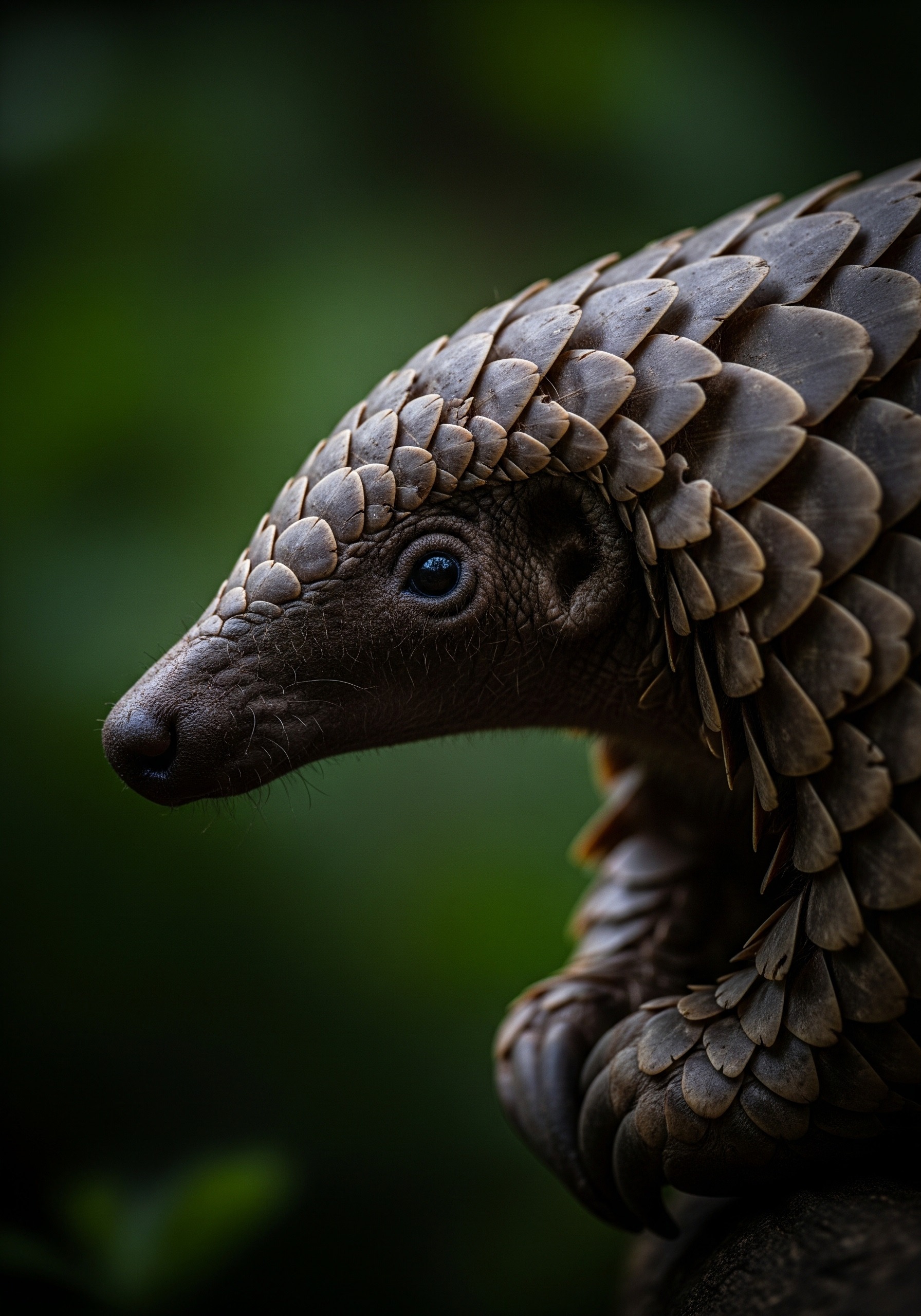
Key Facts
- There are eight recognized species of pangolin — four in Africa, four in Asia — and a possible ninth, Manis mysteria, identified from confiscated scales in 2023 and still known only from genetics.
- A pangolin’s scales are made of keratin — the same protein as your fingernails — and together account for roughly 20% of its body weight.
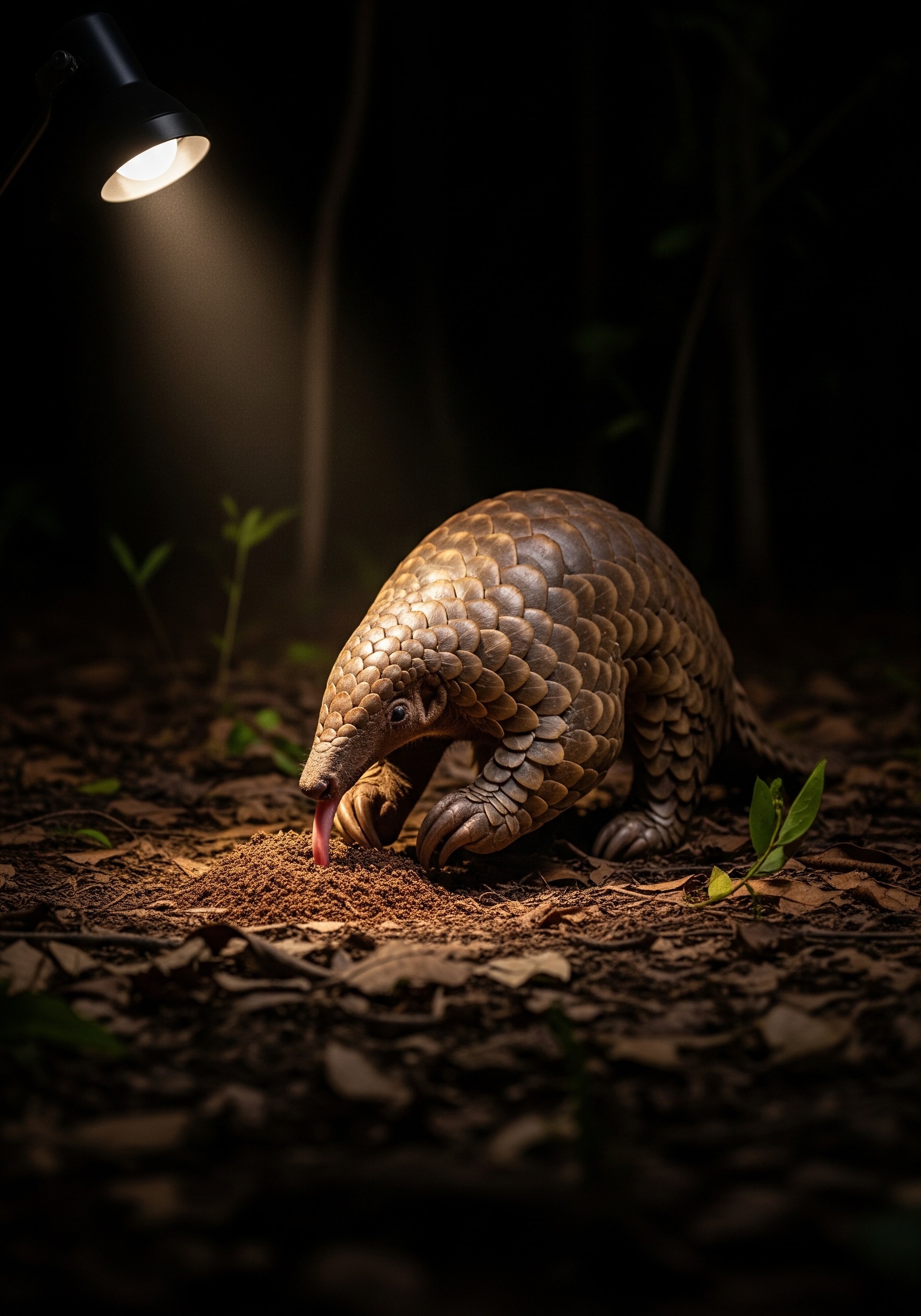
- One adult pangolin can eat up to 70 million ants and termites per year, making it a natural, free pest-control service in farming landscapes.
- The giant ground pangolin’s tongue can reach 70 cm — longer than its torso — and is anchored not in the mouth, but deep inside the pelvis.
- Between 2016 and 2024, seizures involved an estimated more than half a million pangolins across 75 countries and 178 trade routes, according to a CITES-trade analysis published in 2026.
In short: Pangolins are shy, nocturnal, ant-eating mammals wrapped in keratin armor — and they are the most heavily trafficked wild mammals on Earth. Eight species cling on across Africa and Asia, every one of them threatened, and the story of why is shifting fast: new research is rewriting what we thought we knew about who hunts them, and why.
Key Facts
- There are eight recognized pangolin species four in Africa, four in Asia plus a possible ninth, Manis mysteria, identified from confiscated scales in 2023.
- A pangolin’s scales are made of keratin, the same protein as fingernails, and together account for roughly 20% of its body weight.
- One adult pangolin can eat up to 70 million ants and termites per year.
- The giant ground pangolin’s tongue can reach 70 cm longer than its torso and is anchored deep inside the pelvis.
- Between 2016 and 2024, seizures involved an estimated more than half a million pangolins across 75 countries and 178 trade routes, per a CITES-trade analysis published in 2026.
In short: Pangolins are shy, nocturnal, ant-eating mammals covered in keratin scales the only scaled mammals, and the most heavily trafficked wild mammals on Earth. Eight species live across Africa and Asia, with a possible ninth identified from seized scales in 2023. Their closest relatives are cats, dogs and bears, from which they split about 75 million years ago.
What is a pangolin, really?
A pangolin looks like an evolutionary mash-up: anteater body, artichoke armor, kangaroo tail. The resemblance fools almost everyone. It fooled scientists, too, for the better part of two centuries.
Pangolins (order Pholidota, family Manidae) are placental mammals — warm-blooded, milk-producing, fur-covered animals whose hairs happen to have fused, on most of the body, into broad overlapping scales. Genetic work over the past two decades has placed them firmly inside the superorder Laurasiatheria, as the sister group to Carnivora. In plain English: their closest living relatives are cats, dogs, bears, hyenas, and seals. The split happened around 75 million years ago — before the dinosaurs went extinct.
The anteater-and-armadillo look is a textbook case of convergent evolution. When an animal eats nothing but ants and termites, evolution keeps reaching for the same toolkit: a long sticky tongue, powerful digging claws, no teeth worth mentioning, and either a thick hide or hard armor. Pangolins, anteaters, and aardvarks all sit on different branches of the mammal tree and all converged on the same solution.
Their oldest known fossils date to roughly 47.8 million years ago, in the Middle Eocene of Europe and North America, in extinct families like Eomanidae and Patriomanidae. The story is older and lonelier than the modern eight species suggest.
How many species of pangolins are there?
Eight living species, with strong genetic evidence for a ninth still waiting on a wild specimen. Four are African, four are Asian, and every single one is on the IUCN Red List.
The Eight Pangolin Species at a Glance
| Species | Range | IUCN Status |
|---|---|---|
| Chinese (Manis pentadactyla) | China, Himalayas, SE Asia | Critically Endangered |
| Sunda (Manis javanica) | Mainland & insular SE Asia | Critically Endangered |
| Philippine (Manis culionensis) | Palawan, Philippines | Critically Endangered |
| Indian (Manis crassicaudata) | South Asia | Endangered |
| White-bellied (Phataginus tricuspis) | Equatorial Africa | Endangered |
| Black-bellied (Phataginus tetradactyla) | West & Central African forests | Vulnerable |
| Giant ground (Smutsia gigantea) | Central Africa | Endangered |
| Temminck’s ground (Smutsia temminckii) | East & southern Africa | Vulnerable |
About that ninth species. In 2023, a research team analyzing tons of scales seized from smugglers found a distinctive genetic signature that did not match any known pangolin. They named it Manis mysteria — literally, the mystery pangolin. No living animal of this species has ever been documented in the wild. We know it exists only because poachers killed enough of them to leave a DNA trail. Read that sentence again.
{IMAGE_2}
Pangolin facts most articles get wrong (or skip)
Most lists you’ll find online — and we read a lot of them before writing this — recycle the same five points: scales are keratin, they roll into a ball, they eat ants, they’re trafficked, they’re shy. All true. All thin.
Here is what’s genuinely worth knowing, and rarely said.
The scales are modified hair. Each scale grew from the skin the way a hair does, and is replaced through life as it wears down. The edges are sharp enough to cut a predator’s tongue. They are also slightly mobile: the muscles beneath let a pangolin flick its armor like a venetian blind.
The tongue is not attached in the mouth. In the largest species, it anchors at the pelvis, threading through the chest cavity in a flexible sheath. When the pangolin deploys it, the tongue can extend up to 40 cm beyond the snout. It is also coated in extremely sticky saliva produced by a gland the size of a kiwifruit.
They have no teeth. Pangolins swallow small stones and bits of grit, and a muscular section of the stomach lined with keratinous spines grinds the insects up. It is essentially a gizzard, in a mammal.
They walk on their wrists. The front claws are so long and curved — built for tearing into rock-hard termite mounds — that pangolins cannot walk on their palms. They knuckle along on the backs of their forefeet, often rising onto their hind legs and using the tail as a tripod, like a tiny scaled bipedal dinosaur.
Pangolins are also one of the few mammals that are, in any meaningful sense, beautiful when they move — slow, deliberate, otherworldly.
What new research says about the trade — and why 2025 mattered
For more than a decade the public story has been simple: pangolins are killed for their scales, which are ground up for traditional Asian medicine. That story is partly true, and increasingly partial.
A 2025 study published in Nature Ecology & Evolution by Wangmo and colleagues examined hunting patterns in Nigeria — now one of the world’s largest export hubs for pangolin scales — and reached a different conclusion. Local hunters, the researchers found, were not primarily targeting pangolins for the international scale trade. They were taking them opportunistically, for meat, when they encountered them while hunting other animals. The scales, often, were a by-product that traders bought up afterward. The implication is uncomfortable for conservation strategy: shutting down scale demand abroad will not, on its own, save the African pangolin if subsistence hunting at home continues unchanged.
On the policy side, 2025 also saw the U.S. Fish and Wildlife Service formally propose listing seven pangolin species as Endangered under the Endangered Species Act — a move that would tighten restrictions on import into the United States and add legal teeth to enforcement. A 2026 analysis of CITES trade records by researchers at the Pangolin Specialist Group, working under the IUCN, estimated that between 2016 and 2024 seizures alone involved more than 500,000 pangolins, moving along 178 distinct trade routes through 75 countries. Seizures, of course, are only the animals that were caught in transit. The true toll is higher.
There is some real good news woven through this. In 2020, China removed pangolin scales from its official Pharmacopoeia, the state list of approved traditional medicine ingredients — a quiet but enormous policy step. Pangolins have been on CITES Appendix I, banning all international commercial trade, since 2017. Conservation groups including the Zoological Society of London (ZSL) and the African Wildlife Foundation now run dedicated pangolin programs. And in southern Africa, Temminck’s ground pangolin populations, while still under pressure, have proven more resilient than feared.
What we still don’t know
Quite a lot, honestly. Pangolins are nocturnal, solitary, and so secretive that field biologists go entire careers without seeing one in the wild. Their lifespan in nature is unknown — captive animals have reached about twenty years, but captive pangolins also famously fail to thrive, so that figure is probably low. We don’t have reliable population estimates for most species. We don’t fully understand how they navigate (they are nearly blind, and rely almost entirely on smell). We don’t know whether the “ninth” species, Manis mysteria, is one population or many, or where it lives.
This is unusual. Most large or medium-sized mammals have been catalogued, counted, and tracked. Pangolins remain genuine mysteries — and that mystery is, increasingly, working against them: it’s hard to protect what you cannot count.
Frequently Asked Questions
Q: Are pangolins related to anteaters or armadillos?
A: No. Pangolins look strikingly like anteaters and armadillos, but they belong to their own order, Pholidota. Their closest living relatives are the Carnivora — cats, dogs, bears, and seals. The resemblance is convergent evolution: similar diet, similar predators, similar shape.
Q: How many pangolins are left in the world?
A: Nobody knows a reliable global total. They are too secretive and too widely scattered. The IUCN Pangolin Specialist Group lists three species as Critically Endangered, three as Endangered, and two as Vulnerable. A 2025 IUCN press release noted that data gaps continue to hamper both population estimates and conservation planning.
Q: Why are pangolins the most trafficked mammals on Earth?
A: Demand for their scales (used in some traditional medicines, despite no scientific evidence of efficacy) and for their meat (sold as luxury bushmeat in parts of Asia and Africa) drives a vast illegal trade. CITES-records analysis through 2024 estimates more than half a million pangolins were seized over an eight-year window — and seizures represent only a fraction of total trafficking.
Q: Can pangolins survive in captivity or be farmed?
A: Captive breeding has been attempted for decades and remains extremely difficult. Pangolins are stress-prone, dietarily specialized, and often die of digestive or immune problems in captivity. Farming as a “solution” to poaching is widely considered unworkable by conservation biologists, and most welfare bodies oppose it.
Sources
- IUCN Pangolin Specialist Group, Species 2023 Annual Report
- U.S. Fish and Wildlife Service, 2025 proposed rule on Endangered Species Act listing of seven pangolin species
- Wangmo et al., 2025, Nature Ecology & Evolution (Nigerian pangolin hunting drivers)
- CITES global trade records, 1977–2024 (multi-model analysis published 2026)
- Zoological Society of London (ZSL) pangolin conservation programme
- Save Pangolins (savepangolins.org) reference materials on species biology
Pangolins are a 75-million-year-old experiment in being quietly extraordinary — armored mammals that pre-date the meteor that killed the dinosaurs and that still, somehow, walk through the night forests of two continents looking for ants. Whether they are still doing that in fifty years is, more than for almost any other large mammal, an open question. The honest answer is that it depends less on what happens in the rainforest than on what happens in courtrooms, markets, and customs halls — and on whether enough of us care that a creature this old and this strange is allowed to keep walking.
Illustrations are AI-generated. Article fact-checked and human-edited. Our editorial standards.