Are Velvet Worms Dangerous to Humans? An Honest Answer
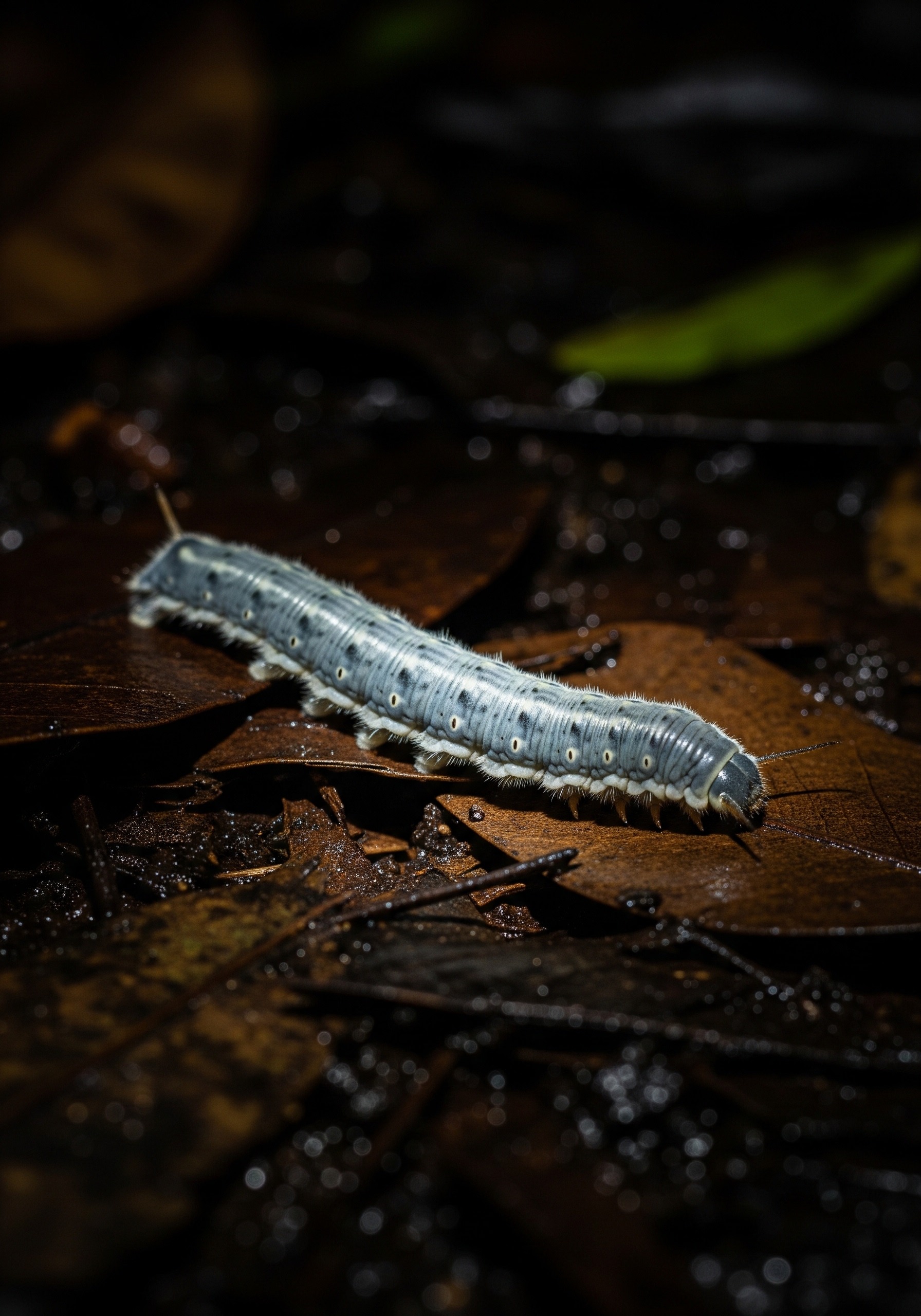
Pick up a velvet worm and it curls into a tight comma in your palm. The same animal, twelve milliseconds later if a cricket strolls past, will fire a jet of liquid glue at five meters per second. So are velvet worms dangerous to humans? The honest answer, taken straight from the published research, is no — and the reason is more interesting than the answer.
Key Facts
- There are no documented cases of a velvet worm causing meaningful harm to a person; they are not venomous in any way that affects mammals.
- The defensive slime is roughly 90 percent water and a mix of proteins, with no recorded toxic effect on human skin.
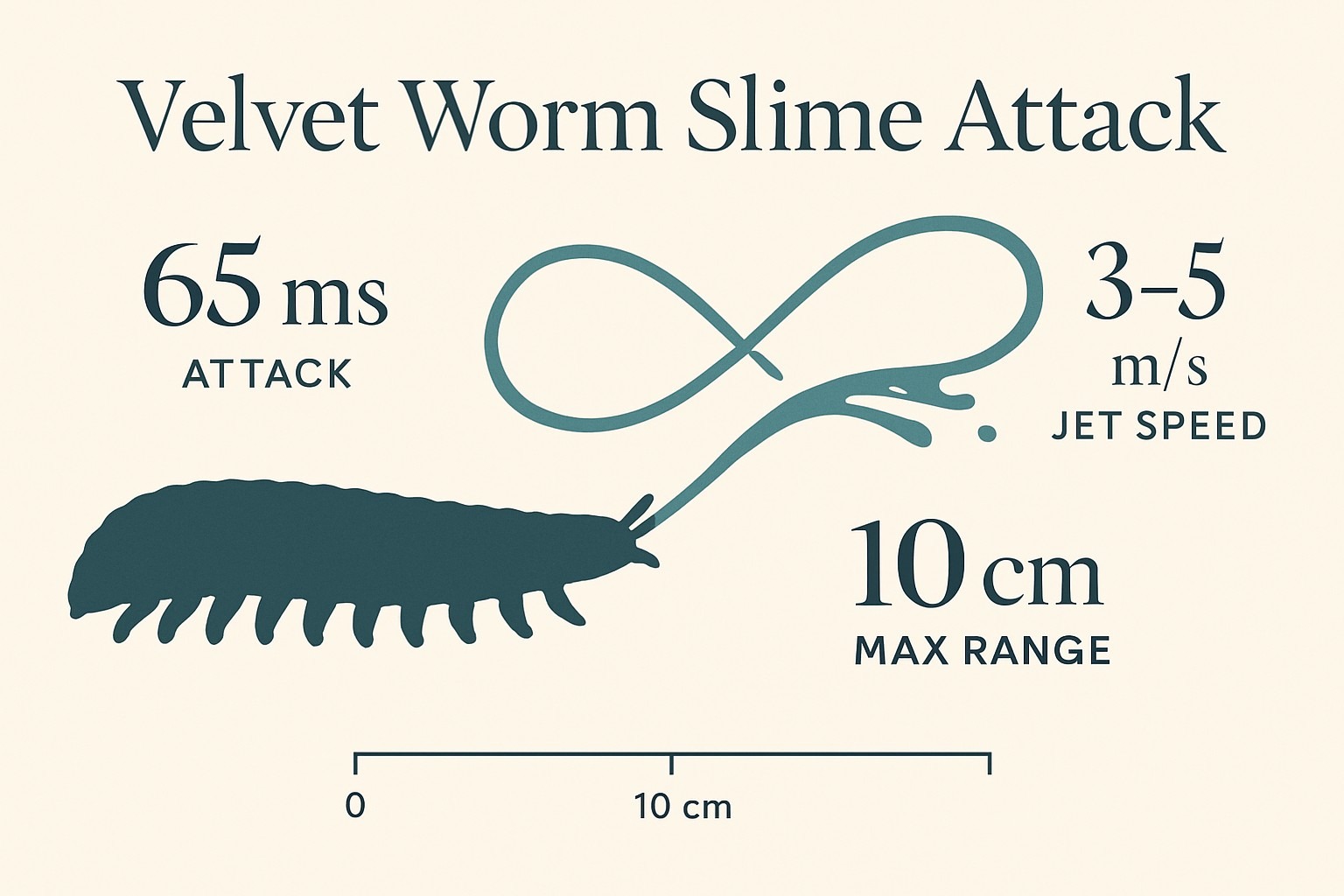
- A slime jet oscillates at 30–60 Hz and exits the mouth at about 3–5 m/s — the entire attack finishes in roughly 65 milliseconds.
- Maximum slime range is reported at about 10 cm (roughly four inches), well short of a standing person’s face.
- The phylum Onychophora has existed for over 500 million years; many living species are now threatened by deforestation.
In short: Velvet worms are precision predators with one of the fastest weapons in the invertebrate world, but it is a weapon scaled to crickets, not to people. They do not attack humans unprovoked, their slime is non-toxic, and no peer-reviewed source reports a real injury. If we have to use the word “dangerous” at all, it runs the other way.
Key Facts
- There are no documented cases of a velvet worm causing meaningful harm to a person; they are not venomous in any way that affects mammals.
- The defensive slime is roughly 90 percent water and a mix of proteins, with no recorded toxic effect on human skin.
- A slime jet oscillates at 30-60 Hz and exits the mouth at about 3-5 m/s; the entire attack finishes in roughly 65 milliseconds.
- Maximum slime range is reported at about 10 cm (roughly four inches), well short of a standing person’s face.
- The phylum Onychophora has existed for over 500 million years, with roughly 200 species formally described.
In short: Velvet worms (phylum Onychophora) are not dangerous to humans. Their defensive slime is roughly 90% water and non-toxic to mammals, with no peer-reviewed report of real injury. The slime jet fires at about 3-5 m/s and finishes in roughly 65 milliseconds, but its maximum range is only about 10 centimetres scaled to crickets, not people.
The short answer — and what “dangerous” really means
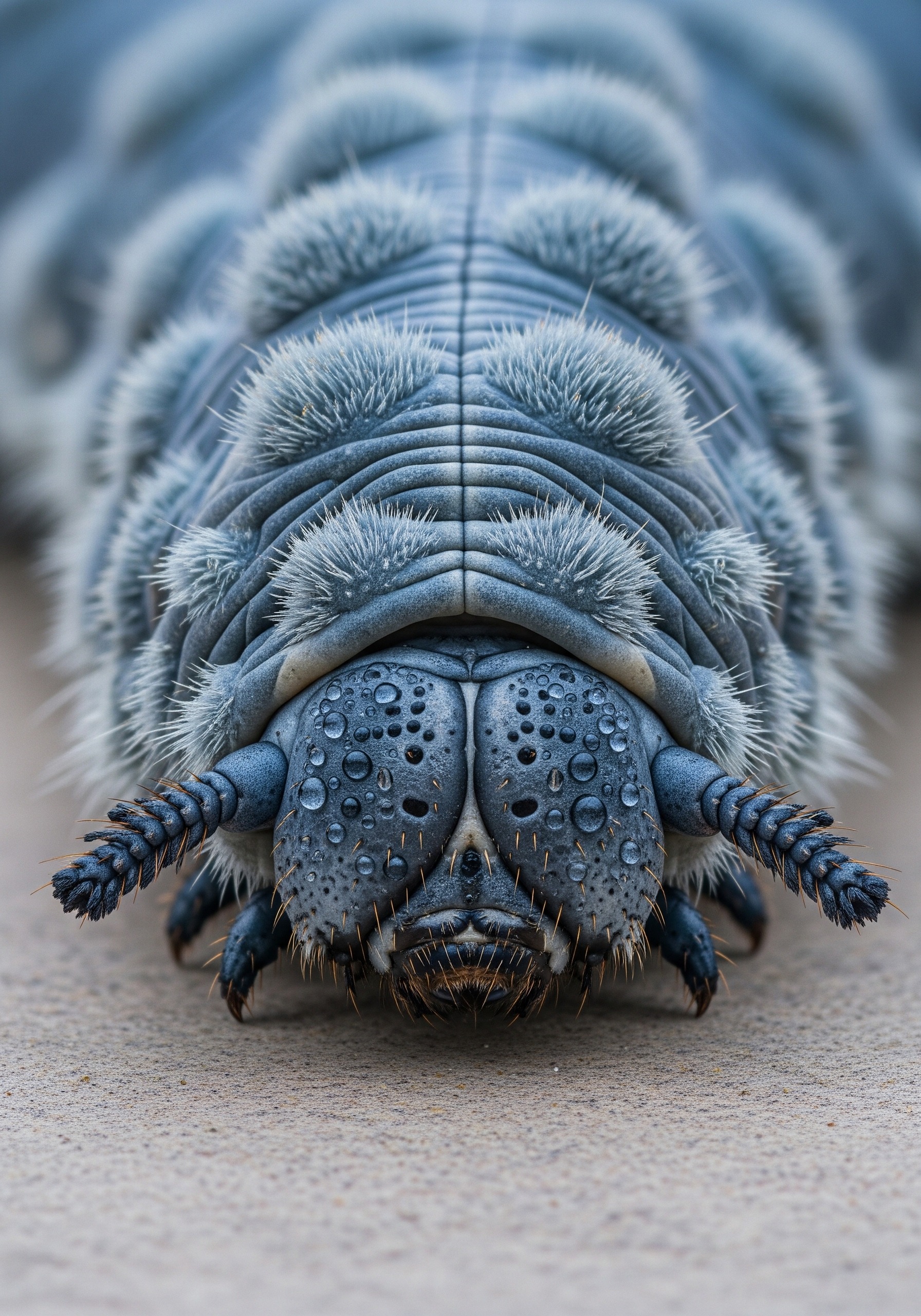
Type the question into a search bar and a thousand pages will tell you “no.” Most stop there. That isn’t quite enough. To say an animal is or isn’t dangerous, you need to know what it secretes, how hard it can bite, what range it has, and what its chemistry actually does to mammalian tissue. The reassuring half of the answer comes from real measurements, not vibes.
Velvet worms — the phylum Onychophora — are small, soft-bodied terrestrial invertebrates that look like a cross between a caterpillar and a slug, with stubby unjointed legs ending in tiny paired claws. Roughly 200 species are formally described, almost all of them in damp tropical or southern-temperate forests: Central America, the Caribbean, Australia, New Zealand, southern Africa, parts of Southeast Asia. The Australian Museum and the standard zoological references describe them as harmless. The Animal Diversity Web puts it bluntly: there are no known adverse effects of onychophorans on humans.
{IMAGE_2}
What velvet worm slime actually is
The famous slime is the centerpiece of the danger question, so it is worth being specific. According to recent biochemistry from Georg Mayer’s group at the University of Kassel and collaborators — the team that has done most of the modern work on this — onychophoran slime is a protein-rich liquid that is roughly 90 percent water in its wet state. It hardens into stiff fibers within seconds of contact with air. The proteins themselves are unusual: large repetitive sequences held together by disulfide bonds, with low-complexity regions that drive a fast liquid-to-fiber transition almost the moment the jet leaves the mouth.
A 2023 paper in the Journal of the American Chemical Society identified peculiar phosphonate modifications on the slime’s sugar chains — chemistry rare in the animal kingdom, and unrelated to any known toxin pathway. A 2022 study in Scientific Reports found tiny encapsulated salt particles inside the slime that help drive its hardening. The picture that emerges is a sophisticated bioadhesive, not a venom. Its job is to glue a fast prey item to the ground in a quarter of a second. That is exactly what it does, and that is all it does.
Turns out there is no mammalian toxin in any published velvet worm slime proteome. Not a trace. Even the chemistry, when read carefully, is a story about engineering, not poison.
Can a velvet worm bite you? Technically yes
The other half of the danger question is the bite. Velvet worms do have jaws — small paired blades inside the mouth that they normally use to slice a tiny dose of saliva into glued prey before sucking it dry. Could those jaws nip a finger if you pressed one hard against the animal’s mouth? In principle, yes. Have we got documented cases of injury? Not in the literature.
In the rare anecdotal accounts that do exist, the bite is described as a pinch — closer to a thorn-prick than to anything you would call an attack. There is no neurotoxin, no spreading swelling, no systemic effect. Mild local irritation is the worst plausible outcome, mostly because any small wound can be irritated by saliva-borne enzymes. If you are handling tropical invertebrates, basic hygiene is the sensible precaution — exactly the same as you would use after handling any animal — and that is the limit of what the honest evidence supports. This article is not medical advice; if any animal contact concerns you, ask a clinician.
The attack, by the numbers
How fast is a velvet worm’s slime attack?
- Jet speed: approximately 3–5 meters per second
- Oscillation frequency: 30–60 Hz (the jet sprays in a figure-eight)
- Total attack duration: ~65 milliseconds
- Typical squirt distance: ~1 cm (against close-range prey)
- Maximum reported range: ~10 cm (≈ 4 inches)
- Repeat shots: up to ~30 in one defensive bout
- Slime tube diameter: 50–200 microns
Sources: Concha et al., Nature Communications, 2015; Animal Diversity Web; Australian Museum.
What those numbers mean in practice: a velvet worm fires its slime almost faster than a high-speed camera can resolve, but it does so over a distance shorter than a credit card. Andrés Concha and colleagues showed in a 2015 Nature Communications paper that the wild figure-eight motion of the jet is not muscular at all — it is a passive elastohydrodynamic instability, the same kind of fluttering you see when a garden hose is turned on at full pressure and left to whip itself. The worm provides the pressure; physics does the aim. It is a beautiful piece of engineering, and it is scaled to prey the size of a fingernail.
Forty-five centimeters is the wingspan of a kestrel. Ten centimeters is the length of a paperclip. Whatever a velvet worm can do, it cannot do it from across the room.
What happens if a velvet worm slimes you
If you ever startle one and catch a hit — most likely if you are a field biologist turning damp leaf litter — the slime will dry on your skin in seconds and form a peelable film. There is no recorded chemical burn, no recorded allergic reaction, no recorded toxic effect. The most thorough recent review of velvet worm slime composition lists no mammalian toxin among its components. Wash the area with soap and water and you are done. The dried slime peels off cleanly the way a thin layer of PVA glue would.
Here’s the thing the listicles tend to skip: a velvet worm almost never sprays a human in the first place. Their first defensive response to anything much larger than themselves is to curl up tight and stay still, conserving their slime — which is metabolically expensive to refill, and takes roughly three weeks to fully replenish — for things they can actually eat or things that might actually eat them.
A boot is neither.
The real danger runs the other way
If we have to use the word “dangerous,” the case for danger leans the other way — toward us — and it isn’t close. Velvet worms are obligate inhabitants of damp, undisturbed forest floor. They cannot tolerate desiccation; a few hours in open sun will kill them. Their populations are slow-growing, fragmented, and tightly localized — some species are known from a single hillside or a single cave system. Logging, agricultural conversion, and even the trampling of footpaths are documented threats. A 2018 conservation assessment of Costa Rican onychophorans found multiple species effectively confined to small protected reserves, with no observed population outside.
For an animal lineage older than dinosaurs, older than insects, older than vertebrates as we know them — surviving the Permian extinction, the K-Pg impact, the ice ages — being driven extinct by topsoil disturbance is the real story. We covered that 500-million-year history in a separate article, and the verdict is the same: the velvet worm is not the threat in this relationship.
Myth versus evidence
A handful of claims about velvet worms circulate online and are worth correcting plainly.
Myth: the slime is venomous. Evidence: it is a protein-based adhesive. No venom component has been identified in any published proteomic study. The hardening agents are salt particles and disulfide bonds, not toxins.
Myth: a velvet worm can spray a meter or more. Evidence: the maximum range reported in peer-reviewed and museum sources is roughly 10 centimeters. Reports of “spraying across the room” are folklore.
Myth: they are worms, or related to caterpillars. Evidence: they are their own phylum, more closely related to arthropods than to either. They are the closest living relatives of a Cambrian lineage that includes the famous Burgess Shale fossil Hallucigenia.
Myth: their bite is painful and dangerous. Evidence: there is no documented case of meaningful injury. The jaws are small and built for cutting saliva ducts into glued prey, not for inflicting wounds.
Frequently Asked Questions
Q: Are velvet worms poisonous if touched?
A: No. Touching a velvet worm is harmless. Their slime is a protein adhesive, not a toxin, and their skin secretes no poison. The Animal Diversity Web records no adverse effects on humans from any species.
Q: Has anyone ever been seriously injured by a velvet worm?
A: There is no published record of a serious injury caused by a velvet worm. The animal is small, slow, and shy. The worst plausible outcome is a minor pinch from the small jaws or a smear of sticky slime on the skin.
Q: Are velvet worms dangerous to pets like dogs or cats?
A: No documented cases of pet injury exist. The slime is not toxic, and the animal is far too small and far too rare in most regions to be a meaningful risk. Velvet worms live mostly inside intact rainforest, where domestic pets rarely go.
Q: Where do velvet worms live and could I encounter one?
A: Most species inhabit moist tropical and southern-temperate forests — Central America, the Caribbean, southern Africa, parts of Southeast Asia, Australia, and New Zealand. They hide under rotting logs and inside leaf litter. Casual encounters are unusual; deliberate searches by entomologists, after dark and in the rain, are usually how they are found.
Sources
- Concha, A. et al. “Oscillation of the velvet worm slime jet by passive hydrodynamic instability.” Nature Communications, 2015.
- “Complete Sequences of the Velvet Worm Slime Proteins Reveal that Slime Formation is Enabled by Disulfide Bonds and Intrinsically Disordered Regions.” Open-access proteomics paper, 2022.
- “Peculiar Phosphonate Modifications of Velvet Worm Slime Revealed by Advanced NMR and Mass Spectrometry.” Journal of the American Chemical Society, 2023.
- “Encapsulated salts in velvet worm slime drive its hardening.” Scientific Reports, 2022.
- Animal Diversity Web (University of Michigan), Onychophora account.
- The Australian Museum, Velvet Worm reference page.
- Mayer Lab, Department of Zoology, University of Kassel — research program on velvet worm biology and slime biochemistry.
Velvet worms are one of the strangest, oldest, and most quietly extraordinary animals on the planet — and they pose effectively no danger to a human being. The slime is glue. The bite is a pinch. The real story is that something this ancient is still alive in a few square miles of rainforest, and the question we should really be asking is whether we will let it stay that way.
Illustrations are AI-generated. Article fact-checked and human-edited. Our editorial standards.