The Midge That Survives 18 Years Without Water
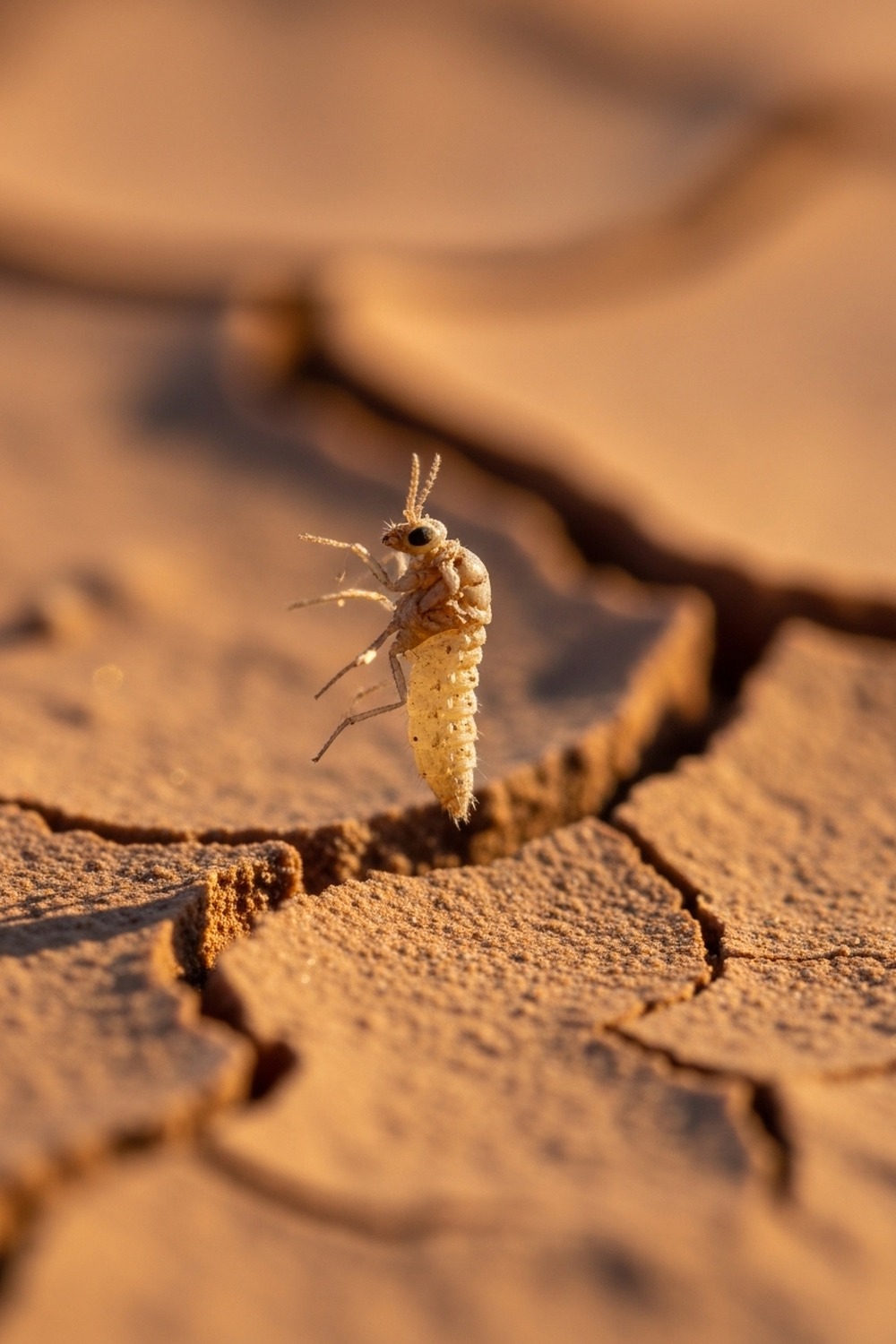
Here’s the thing about Polypedilum vanderplanki cryptobiosis: the larva doesn’t slow down to survive. It stops. Completely. A two-centimetre midge in Africa’s Sahel loses virtually all its water, registers no respiration, no cellular signalling, no measurable metabolism — and then, sometimes seventeen years later, wakes up when it rains. Not a reduced version of itself. The whole animal, resumed.
Rock pools in northern Nigeria and Uganda flood briefly after seasonal rains, then bake to nothing under the Sahel sun. For most organisms, that’s a death sentence. For Polypedilum vanderplanki, it’s a waiting room. How a creature barely two centimetres long learned to cheat time — and what that means for the rest of us — is one of biology’s most astonishing open questions.
When Life Stops: The Science of Cryptobiosis
Cryptobiosis describes a state in which an organism’s metabolic activity drops so close to zero it becomes essentially undetectable — no respiration, no cellular signalling, no measurable energy consumption. Polypedilum vanderplanki cryptobiosis is a specific, extreme form of this, driven by a process called anhydrobiosis: survival through near-total water loss. Researchers at the National Institute of Agrobiological Sciences (NIAS) in Tsukuba, Japan, have spent over two decades dissecting exactly how this larva pulls it off. Their work, published in journals including Nature between 2005 and 2022, confirmed something that strains comprehension — specimens stored in dry conditions for 17 years rehydrated successfully and resumed normal larval behaviour within hours of water contact. Seventeen years. No food. No water. No measurable life signs. Then: movement.
What makes Polypedilum vanderplanki cryptobiosis distinct from ordinary dormancy is its completeness. A hibernating bear still breathes — its heart still beats, slowly, but it beats. This larva does none of that. When NIAS researchers measured oxygen consumption in fully desiccated specimens, the readings flatlined. Cell membranes, proteins, organelles — everything that would normally degrade without water is held in structural suspension. Time passes outside the body. Inside, nothing does.
Workers collecting specimens from dried Nigerian pools in the 1950s initially dismissed the crisp, papery husks as dead material. The rock pools dry over days, not hours, giving the larva time to respond — but nobody was looking closely enough to notice.
Trehalose: The Sugar That Replaces Water
The mechanism behind Polypedilum vanderplanki cryptobiosis is, at its core, a chemistry trick — elegant, ruthless, and precise. As water evaporates from the larva’s environment, it begins synthesising trehalose, a disaccharide sugar, in extraordinary quantities. At peak desiccation, trehalose can account for up to 20 percent of the larva’s dry body weight — a concentration unmatched in any other insect. Trehalose isn’t just a fuel reserve. It’s a structural replacement for water. At the molecular level, water molecules form hydrogen bonds with proteins and cell membranes, maintaining their shape. When water leaves, those structures collapse and denature. Trehalose molecules slot into the same bonding positions, holding proteins and membranes in their functional configurations. The cell doesn’t know the water is gone.
This principle — known as the water replacement hypothesis (researchers actually call this vitrification-assisted anhydrobiosis at its final stage) — was refined significantly by the NIAS team and their collaborators between 2006 and 2015, underpinning some of the most consequential applied research in preservation science today. It also echoes, strikingly, the biochemical gymnastics used by hibernating animals: the cellular survival strategies bears use during five months without food or water share surprising parallels with what this midge does year-round.
Why does the system work so reliably? Because the larva doesn’t wait to be caught off guard. Research published in 2010 by NIAS scientists Takashi Okuda and Minoru Watanabe showed the process is pre-emptive. As humidity drops below a critical threshold, a cascade of gene expression fires, upregulating trehalose synthesis enzymes and simultaneously suppressing normal metabolic pathways. The larva is reading the weather, making a calculated biochemical bet that dryness is coming — and preparing before the final drops of water vanish.
There’s also a glass-like quality to the dried larva’s interior. Trehalose at high concentrations doesn’t just replace water — it vitrifies. Cell contents transition into an amorphous solid, a biological glass that locks everything in place. Proteins can’t unfold. Membranes can’t rupture. The larva becomes, in effect, a piece of living amber.
Seventeen Years in a Test Tube: The Research Record
The record for verified Polypedilum vanderplanki cryptobiosis revival stands at 17 years, confirmed by NIAS researchers in a landmark 2006 paper. But the specimens weren’t discovered accidentally in some forgotten drawer. They were deliberately archived as part of a long-term desiccation study, checked at intervals, and stored under controlled, dry conditions at room temperature. When the 17-year-old samples were rehydrated, the revival rate wasn’t 100 percent — some larvae failed to recover, their cellular architecture degraded past the point of repair. A significant proportion did revive, however. They moved. They fed. One eventually pupated. According to coverage in Nature of early anhydrobiosis research, the implications for understanding the limits of biological time were immediate. If cells can remain structurally intact for 17 years without water, the theoretical ceiling for survival in this state remains unestablished. It may not be 17 years. It may be much, much longer.
That number — 17 years — deserves more weight than it typically gets.
Polypedilum vanderplanki cryptobiosis has also survived conditions well beyond simple drying. Laboratory experiments at NIAS exposed desiccated larvae to temperatures ranging from −270°C (near absolute zero) to +102°C, to vacuum conditions mimicking outer space, and to ionising radiation roughly 7,000 times the lethal dose for a human. In every case, a portion of the population survived rehydration. These aren’t just curiosities — they’re data points suggesting the trehalose vitrification system creates a physical state so stable it’s practically inert to environmental extremes. Researchers have started asking a genuinely unsettling question: if this larva can survive a near-space vacuum and extreme radiation in a desiccated state, could it theoretically survive transit on a meteorite? Astrobiology hasn’t ruled it out. Neither has anyone else.
Polypedilum vanderplanki Cryptobiosis and the Future of Preservation
Multiple biotech and pharmaceutical companies have been paying close attention to Polypedilum vanderplanki cryptobiosis since the mid-2000s, and the reason is straightforward. The challenge in preserving biological materials — vaccines, blood products, organs for transplant, even living cells — almost always comes down to water. Remove water from a cell incorrectly and it dies. Freeze it and ice crystals puncture membranes. The cold chain — the global refrigeration network that keeps vaccines viable from factory to patient — costs billions of dollars annually and still fails in remote and low-income regions, with devastating consequences for disease prevention.
The data here points in one direction, and the industry has been slow to follow it. If trehalose-based preservation could stabilise biologicals at room temperature in a dry state, the cold chain could be partially bypassed. Researchers at the University of Bristol and Cambridge in the UK have been working on exactly this, using synthetic trehalose formulations inspired directly by the midge’s chemistry. Clinical trials for trehalose-preserved platelets showed promising results in studies published between 2018 and 2022, with shelf life extended significantly beyond standard refrigerated storage.
And the gene expression profile that drives Polypedilum vanderplanki cryptobiosis has become a template for genetic engineering in its own right. In 2017, NIAS researchers successfully transferred key anhydrobiosis-associated genes from the midge into human cultured cells. The treated cells survived desiccation at levels that killed untreated controls — a proof of concept, not a therapy, but one demonstrating that the machinery is transferable across evolutionary distances of hundreds of millions of years. Takashi Okuda’s team at NIAS continues to map the full regulatory network behind the larva’s desiccation response, and collaborations with European biotechnology firms have accelerated since 2020. What started as curiosity about a dust-coloured insect in a dried-up puddle may yet change how humanity stores the molecules that keep people alive.
How It Unfolded
- 1951 — British entomologist H.E. Hinton first documented the desiccation survival capacity of Polypedilum vanderplanki larvae collected from dried rock pools in northern Nigeria, noting revival after rehydration.
- 2006 — NIAS researchers Takashi Okuda and Minoru Watanabe published the first molecular analysis of trehalose synthesis in desiccating larvae, formally establishing the water replacement mechanism in peer-reviewed literature.
- 2010 — The NIAS team confirmed 17-year revival in archived specimens and demonstrated survival under near-space vacuum conditions, elevating the larva to a model organism for astrobiology research.
- 2017 — Successful transfer of anhydrobiosis-associated genes from Polypedilum vanderplanki into human cultured cells, published by NIAS, marked the first direct proof-of-concept for mammalian cell preservation using midge-derived genetics.
By the Numbers
- 17 years — the longest confirmed period of survival in a desiccated state, verified by NIAS Japan (2010)
- 20% — trehalose as a proportion of the larva’s dry body weight at peak desiccation, the highest recorded concentration in any insect
- 7,000× — the human lethal radiation dose survived by desiccated Polypedilum vanderplanki larvae in NIAS laboratory trials
- −270°C to +102°C — the temperature range across which desiccated specimens have demonstrated survival and subsequent revival
- Less than 3% body water — the residual water content of a fully desiccated larva, compared to roughly 60–70% in an active specimen
Field Notes
- When H.E. Hinton first described the larvae in 1951, he kept dried specimens in an envelope for over a year before rehydrating them experimentally — and they revived. He published the finding with characteristic British understatement, describing it as “remarkable survival capacity.”
- Only shallow, temporary rock pools host these larvae — not rivers, not permanent ponds. The instability of their habitat is precisely what drove the evolution of cryptobiosis; permanent water would never have selected for it.
- Trehalose is also used commercially as a food preservative and cosmetic stabiliser, but the concentrations the midge achieves biochemically are far beyond anything currently achievable through food-grade synthesis.
- Researchers still can’t fully explain why some larvae in a revived cohort fail to recover while genetically identical siblings succeed — the threshold between repairable and irreparable cellular damage remains poorly understood, and no biomarker has been identified that predicts survival before rehydration.
Frequently Asked Questions
Q: What exactly is Polypedilum vanderplanki cryptobiosis, and how long can it last?
Polypedilum vanderplanki cryptobiosis is a form of anhydrobiosis — survival through near-complete water loss — in which the larva’s metabolism ceases almost entirely. The longest confirmed survival is 17 years in a desiccated state, verified by the National Institute of Agrobiological Sciences in Japan. No confirmed biological upper limit exists yet. The larvae aren’t frozen or chemically preserved — they’re simply dry, stable, and waiting.
Q: How does trehalose actually keep the larva’s cells from dying without water?
Water molecules maintain the three-dimensional shape of proteins and cell membranes through hydrogen bonding. When water leaves, those structures collapse and denature — usually fatally. Trehalose molecules carry the same hydrogen-bonding capacity as water and occupy the same structural positions, essentially tricking proteins and membranes into holding their functional shapes. At very high concentrations, trehalose also vitrifies — turning the cell interior into an amorphous biological glass that physically prevents molecular movement and degradation. The cell is frozen in time without being frozen in temperature.
Q: Does this mean the larva is technically dead while desiccated?
This is one of biology’s genuinely contested definitions. A fully desiccated Polypedilum vanderplanki larva shows no measurable metabolic activity — no respiration, no cellular signalling, no energy expenditure. By most clinical and physiological definitions, that’s death. But the larva isn’t dead in any permanent sense, because the structural integrity of its cells is intact and reversible. Many researchers prefer the term “ametabolic” rather than dead, because “dead” implies irreversibility. The larva sits in a grey zone biology doesn’t have clean language for yet.
Editor’s Take — Dr. James Carter
What strikes me most about Polypedilum vanderplanki isn’t the 17-year revival — it’s the gene transfer experiment. When NIAS researchers inserted midge anhydrobiosis genes into human cells in 2017 and those cells survived desiccation, something shifted. This stopped being a story about a remarkable insect and became a story about the negotiability of biological limits. We tend to treat water as non-negotiable for life. This larva — and now those engineered human cells — suggest that’s a constraint we’ve built around ourselves, not one built into the universe.
Somewhere in northern Nigeria right now, a rock pool is baking under a cloudless sky. In the dust at its base, what looks like dead organic matter is waiting — patiently, perfectly, without hunger or fear or any biological urgency whatsoever — for rain that might not arrive for months, or years, or longer. Whether that constitutes living is a question we haven’t answered. But when the water comes and the larva moves again, it forces something uncomfortable: a reckoning with how narrowly we’ve defined what life is allowed to do.