The Monkey With the Ridiculous Nose That Actually Works
There’s a monkey in Borneo with a nose so ridiculously oversized that it literally gets in the way of eating. The males have to push it aside to take a bite. And it turns out — this wasn’t some cosmic joke. Evolution built it on purpose.
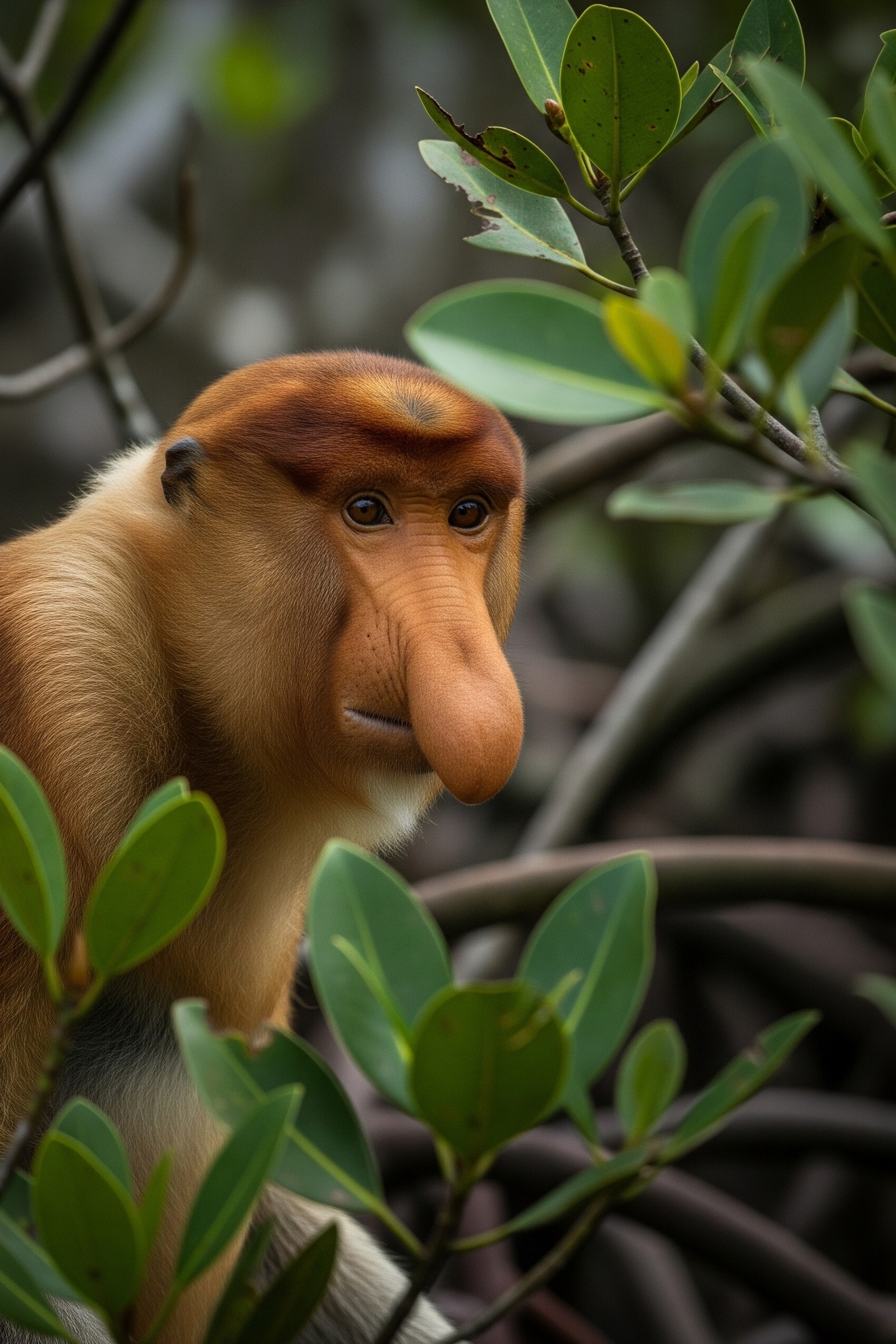
Deep in the mangrove forests of Borneo, something peers through the leaves that stops you cold. A face that seems too strange to be real. Bulbous. Pendulous. Almost comical. This is Nasalis larvatus, the proboscis monkey, and once you understand what that nose actually does, the whole thing clicks into focus and suddenly it’s not funny anymore — it’s terrifying how perfectly it makes sense.
Key Facts
- The proboscis monkey (Nasalis larvatus) lives in the mangrove and riverine forests of Borneo, where males must push their oversized nose aside to eat.
- The enlarged nasal cavity functions as a resonating chamber that amplifies and lowers the pitch of male vocalizations so they carry across dense forest canopy.
- Primatologist Elizabeth Bennett documented how male proboscis monkey calls travel remarkable distances through riverside vegetation where visual signals are nearly useless.
- Recordings have shown that nose size correlates with both the volume and the lower frequency of male calls, and that larger-nosed males also tend to be heavier and dominant.
- A single male proboscis monkey leads a harem of females and young, and females consistently prefer larger-nosed males, driving nose size to extremes through runaway sexual selection.
In short: The proboscis monkey’s oversized nose is not a random mutation but a product of sexual selection, acting as a biological resonating chamber that lowers and amplifies male calls in noisy riverside forests. Females prefer larger-nosed, louder, more dominant males, creating a runaway-selection feedback loop—the same process behind the peacock’s tail—until the trait’s reproductive benefit barely outweighs its survival cost.
Why the Proboscis Monkey Nose Is No Accident
That oversized nose isn’t random mutation gone haywire. It’s evolution doing exactly what it’s supposed to do. The enlarged nasal cavity functions as a resonating chamber, amplifying vocalizations so they carry across dense, noisy forest canopy. Primatologist Elizabeth Bennett, who spent years studying Bornean primates, documented how male calls travel remarkable distances through riverside vegetation where visual signals are nearly useless.
The bigger the nose, the louder the call.
Proboscis monkeys have essentially built a biological megaphone onto their faces. So why do females care so much about volume? Because loud means healthy. Loud means dominant. In a species where a single male leads a harem of females and young, the ability to project authority across water and through tangled roots isn’t a quirk — it’s literally the entire game. Sexual selection doesn’t always produce beauty. Sometimes it produces this.
The Acoustics of a Living Megaphone
To appreciate why the nose works, it helps to think like a sound engineer. Any hollow space filled with air behaves like a resonator — it favours certain frequencies and lets them ring out longer and louder than others. A guitar body, a trumpet’s flared bell, the human sinus cavities: all of them shape and project sound. The proboscis monkey’s nose is the same principle, scaled up to the point of absurdity. The pendulous flesh and the enlarged chamber behind it lower the pitch of the male’s honking call and add resonance, the way a larger drum produces a deeper, more carrying boom.
That matters in the specific world these animals inhabit. Riverside forest is acoustically cluttered: leaves absorb high frequencies, the air is thick and humid, and rival calls from other groups compete for attention across the water. Lower-pitched, fuller sounds punch through that environment better than thin, high ones — they bend around obstacles and lose less energy over distance. So a male with a bigger resonating chamber isn’t just louder; he sounds bigger, deeper, more imposing. Recordings of male proboscis monkeys have shown that nose size correlates with both the volume and the lower frequency of their calls, and that larger-nosed males also tend to be heavier and dominant. The nose, the call, and the body size all advertise the same underlying message at once: I am a serious animal, and you should listen.
There’s an elegant honesty to this. A small, weak male cannot fake a big-nosed, deep-voiced display — the equipment isn’t there. The nose is a billboard that cannot lie.
Females Choose Loudness Over Looks Every Time
Female proboscis monkeys consistently show preference for larger-nosed males, and researchers believe this preference has driven nose size to genuinely absurd extremes over generations. It’s a feedback loop that compounds: bigger nose attracts more mates, offspring inherit the trait, the feature amplifies across the population over millennia. What starts as a slight advantage becomes something that looks designed for comedy.
If you’ve ever wondered how evolution produces such theatrical results, this is your answer.
There’s something almost poignant about it. An animal shaped by millions of years of female preference, wearing that preference visibly on its face. The nose isn’t decoration. It’s biography. And there are more examples on this-amazing-world.com that follow the exact same logic.
Runaway Selection and the Cost of Being Conspicuous
The proboscis monkey belongs to a small club of animals whose most famous features are products of what biologists call runaway sexual selection. The peacock’s tail is the textbook example: a shimmering fan so large it hampers flight, kept aloft purely because peahens prefer it. The Irish elk’s enormous antlers, the long-tailed widowbird’s streaming feathers, the deep red of a healthy cardinal — all of these exist because one sex developed a preference, and that preference rewarded ever-more-extreme versions of the trait until they pressed up against the limits of survival.
Once such a preference takes hold, it can feed on itself. Females who choose big-nosed males have sons with big noses and daughters who inherit the same taste — so the gene for the ornament and the gene for liking the ornament travel together, reinforcing each other generation after generation. Left unchecked, the trait races ahead of any practical purpose. The result is a feature that looks extravagant to us precisely because it was never built for our eyes; it was built to win mates.
But runaway selection always runs into a wall. A nose that interferes with feeding, a tail that makes you slower to flee a predator, antlers that get tangled in branches — these are real costs. Evolution settles into an uneasy compromise where the reproductive payoff of the ornament just barely outweighs the survival penalty. The proboscis monkey sits right on that knife-edge: the nose helps a male win and hold a harem, but it is also heavy, conspicuous, and physically in the way. That tension is exactly what makes the species such a vivid lesson in how natural and sexual selection pull against each other.
These Monkeys Live a Life Built Around Water
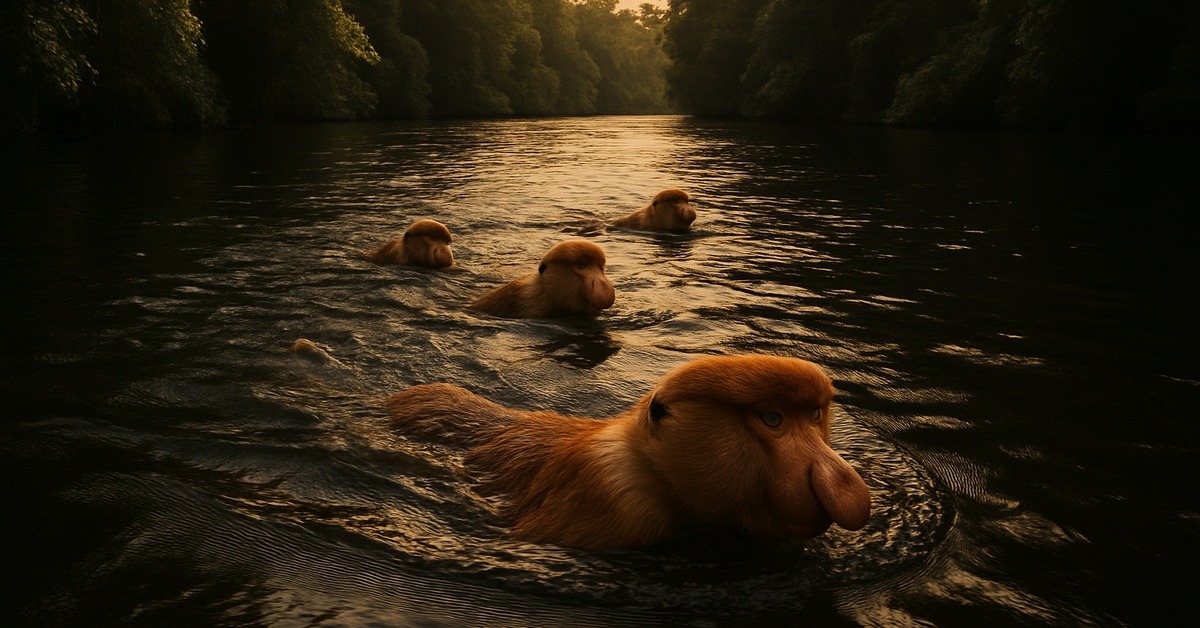
Proboscis monkeys aren’t just defined by their faces — their entire lifestyle is shaped by the coastal and riverine forests they inhabit. They’re strong swimmers, crossing rivers to escape predators or move between foraging sites with a confidence most primates simply don’t have. They’ve even developed partially webbed feet. Found almost exclusively in Borneo — shared between Malaysia, Indonesia, and Brunei — they tend to gather near water at dusk, sleeping in riverside trees where a crocodile-free crossing might be needed at any moment.
Their diet is another oddity entirely: they prefer unripe fruit and leaves, specifically because their complex, multi-chambered stomachs can ferment tough plant material that would cause dangerous bloating in other primates. They literally can’t eat ripe fruit without getting sick. Which makes them extraordinarily dependent on one very specific kind of forest.
That digestive system deserves a closer look, because it explains almost everything about where these animals can and cannot live. Like a cow’s rumen, the proboscis monkey’s stomach hosts colonies of specialized bacteria that break down cellulose and neutralize the toxic compounds many plants pack into their leaves as a defence. This lets the monkeys exploit a food source — mature, fibrous foliage — that most fruit-loving primates can’t touch. But it comes with a strict rule: sugary ripe fruit ferments too violently in that microbial environment, producing gas that can be fatal. So the same adaptation that opens up the leafy canopy also locks the animal into a narrow dietary lane, tied to particular tree species in particular forests. Specialists like this thrive when their habitat is intact and collapse the moment it changes.
And that forest is disappearing.
The Numbers Behind the Decline Are Hard to Sit With
Here’s the thing about proboscis monkeys: they can’t adapt their way out of this. They need mangrove forests, peat swamp forests, and lowland riparian habitat — precisely the ecosystems most targeted by palm oil expansion, logging, and coastal development across Borneo. The IUCN lists them as Endangered. Population estimates suggest as few as 7,000 individuals remain in the wild.
That’s a number small enough to hold in your head. Small enough to feel wrong.
Deforestation in Borneo has accelerated dramatically since the 1980s, and proboscis monkey populations have tracked that destruction closely — declining by an estimated 50% over the past 36 to 40 years. What makes this particularly stark is the species’ biology. They live in harems — one dominant male, multiple females — which means a single successful male represents a disproportionate share of future breeding. Lose enough dominant males to habitat fragmentation, and the reproductive math collapses faster than population counts suggest.
By the Numbers
- Population decline: 50% reduction over three to four decades, driven almost entirely by habitat loss in IUCN 2023 assessments.
- Adult male noses exceed 10 centimeters and sometimes interfere with eating, requiring the male to push the nose aside to take a bite.
- Borneo has lost an estimated 30% of its forest cover since 1973, with lowland and coastal forests — critical proboscis monkey habitat — vanishing at the highest rates.
- Social structure means each dominant male’s survival has outsized consequences. A single harem typically consists of one adult male and between two and seven females.
Field Notes
- Proboscis monkeys are one of the few non-human primates known to swim regularly across open water. They’ve been observed crossing rivers over 20 meters wide with surprising speed and efficiency.
- Their stomach bacteria are so specialized for fermenting leaves that captivity is notoriously difficult — zoos struggle to replicate the diet, and most captive individuals don’t survive long-term.
- Young proboscis monkeys are born with vivid blue faces. These gradually fade to the adult pinkish-tan coloring over the first few months of life, making an already-strange species look even more otherworldly in infancy. That last fact kept me reading for another hour.
A Flagship Species and the Fight to Keep It
Because the proboscis monkey is so unmistakable, conservationists often treat it as a flagship species — an animal charismatic enough to rally public attention and funding for the wider ecosystem it represents. Protect the forests these monkeys need, and you also protect the orangutans, hornbills, sun bears, crocodiles, and countless smaller creatures that share the same mangroves and peat swamps. The strange nose, in other words, can become a banner for an entire endangered landscape.
There are reasons for cautious hope. Several protected areas across Borneo now safeguard key riverine forests, and wildlife river cruises — where tourists drift past troops settling into the treetops at dusk — give local communities a direct financial stake in keeping the habitat standing. A living monkey watched by paying visitors year after year can be worth far more than a one-time clearing for plantation. Reforestation projects along degraded riverbanks aim to reconnect the fragmented patches of forest that isolate breeding groups, while researchers continue to map remaining populations to focus protection where it counts most.
None of this is a guarantee. The pressures driving deforestation — global demand for palm oil, timber, and land — are enormous, and a specialist that cannot relocate has little room for error. But the same trait that makes the proboscis monkey look like a punchline is precisely what makes people care. That is not nothing. In conservation, attention is often the first thing a species needs in order to survive.
What We Lose When the Forest Goes Silent
The proboscis monkey nose took millions of years to build. Evolution shaped it call by call, generation by generation, because the forest was dense enough and loud enough that a bigger resonating chamber made a real difference to survival. That nose is, in a very literal sense, a record of the ecosystem that created it.
When the mangroves are cleared and the peat swamps are drained, that record doesn’t just become harder to read. It disappears entirely. There’s no bringing back a species whose habitat has been converted to plantation. The adaptation and the environment it adapted to are a package deal.
That’s the part that’s easy to miss when you’re laughing at the nose. This animal is a precise fit for a precise place. The place is shrinking faster than the species can relocate, adapt, or survive.
We talk about biodiversity loss in abstractions — species counts, extinction rates, percentage declines. But sometimes the clearest way to understand what’s at stake is to look at one face, shaped by one long evolutionary story, staring back at you through leaves that are running out of forest to grow in. The proboscis monkey is proof that nature doesn’t do anything without reason — even when the reason looks absurd. That nose is a megaphone built by time, shaped by choice, and now quieting in forests that are being taken apart piece by piece.
Frequently Asked Questions
Q: Why do male proboscis monkeys have such enormous noses? The nose acts as a resonating chamber that makes a male’s calls louder and lower-pitched, helping them carry across dense riverside forest. Females prefer larger-nosed males, and over many generations sexual selection has pushed nose size to extremes. A bigger nose signals a bigger, more dominant, healthier male.
Q: Where do proboscis monkeys live, and can you see them in the wild? They live almost exclusively on the island of Borneo, shared between Malaysia, Indonesia, and Brunei, in mangrove, peat swamp, and lowland riverine forests. They are often spotted on guided river cruises at dusk as troops gather to sleep in waterside trees.
Q: Why are proboscis monkeys endangered? Their specialized diet and digestion tie them to specific coastal and riverine forests, which are exactly the habitats cleared for palm oil, logging, and development. The IUCN lists them as Endangered, with populations estimated to have fallen roughly 50% over the past few decades and perhaps only around 7,000 individuals remaining.
It deserves more than a laugh. It deserves attention.
Illustrations are AI-generated. Article fact-checked and human-edited. Our editorial standards.