The Most Venomous Animal on Earth (Not a Snake)
Ask anyone to name the most venomous animal on earth and the answer comes back fast — a snake. The answer is wrong by a wide margin. The title belongs to something with no spine, no brain, and no malice toward you: the Australian box jellyfish, Chironex fleckeri. Its venom can stop a human heart in two minutes, and a single adult animal carries enough of it to kill sixty people.
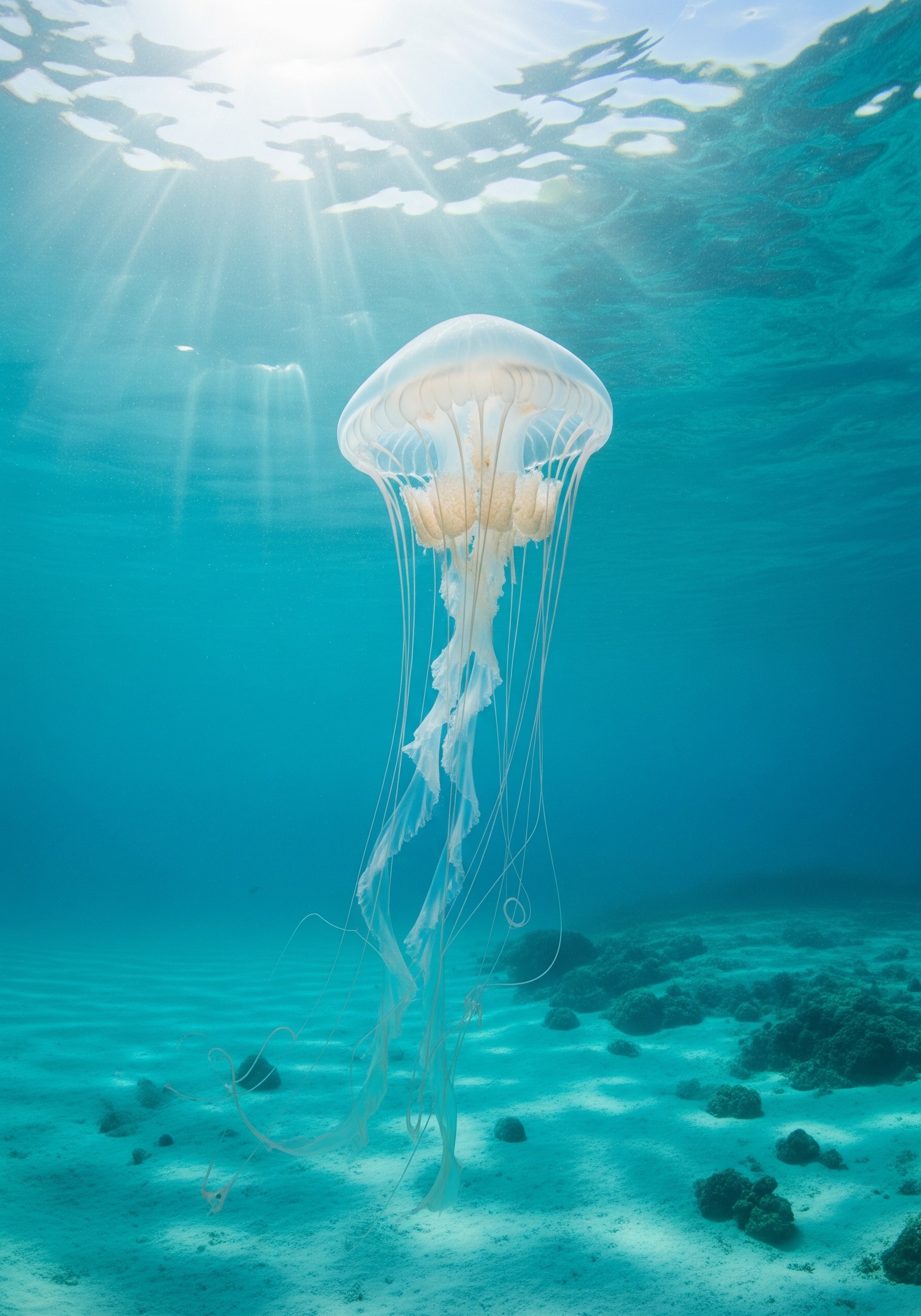
Key Facts
- The Australian box jellyfish (Chironex fleckeri) is officially recognized by NOAA as the most venomous marine animal on Earth, with venom potent enough to cause cardiac arrest within minutes.
- Each of its up-to-15 tentacles is lined with roughly 500,000 nematocysts — microscopic spring-loaded darts that fire on contact and deliver more than 170 distinct toxic proteins.
- At least 79 deaths have been formally attributed to Chironex fleckeri since the first recorded fatality in 1883; an estimated 20–40 people die from box-jellyfish stings every year in the Philippines alone.
- The inland taipan has more potent venom drop-for-drop than the box jellyfish, yet it has never killed a person in the wild. Potency is only one of three things that matter.
- In 2019, researchers at the University of Sydney identified the first viable molecular antidote — a repurposed cholesterol-targeting drug — using CRISPR to find the venom’s weak spot.
In short: “Most venomous” is not the same as “most deadly.” When you separate raw toxicity from how much venom an animal carries and how easily it injects you, one species pulls ahead of every snake on every list. It lives in shallow Australian water and weighs about as much as a bag of rice.
Key Facts
- The Australian box jellyfish (Chironex fleckeri) is recognized by NOAA as the most venomous marine animal on Earth, with venom potent enough to cause cardiac arrest within minutes.
- Each of its up-to-15 tentacles is lined with roughly 500,000 nematocysts and delivers more than 170 distinct toxic proteins.
- At least 79 deaths have been formally attributed to Chironex fleckeri since the first recorded fatality in 1883; an estimated 20-40 people die from box-jellyfish stings every year in the Philippines alone.
- The inland taipan has more potent venom drop-for-drop, yet it has never killed a person in the wild.
- In 2019, University of Sydney researchers identified the first viable molecular antidote, a repurposed cholesterol-targeting drug, using CRISPR.
In short: The most venomous animal on Earth is not a snake but the Australian box jellyfish (Chironex fleckeri), recognized by NOAA as the most venomous marine animal. Its venom can cause cardiac arrest within minutes. Each of its up-to-15 tentacles carries about 500,000 nematocysts and over 170 toxic proteins. At least 79 deaths have been attributed to it since 1883.
Three numbers, one title
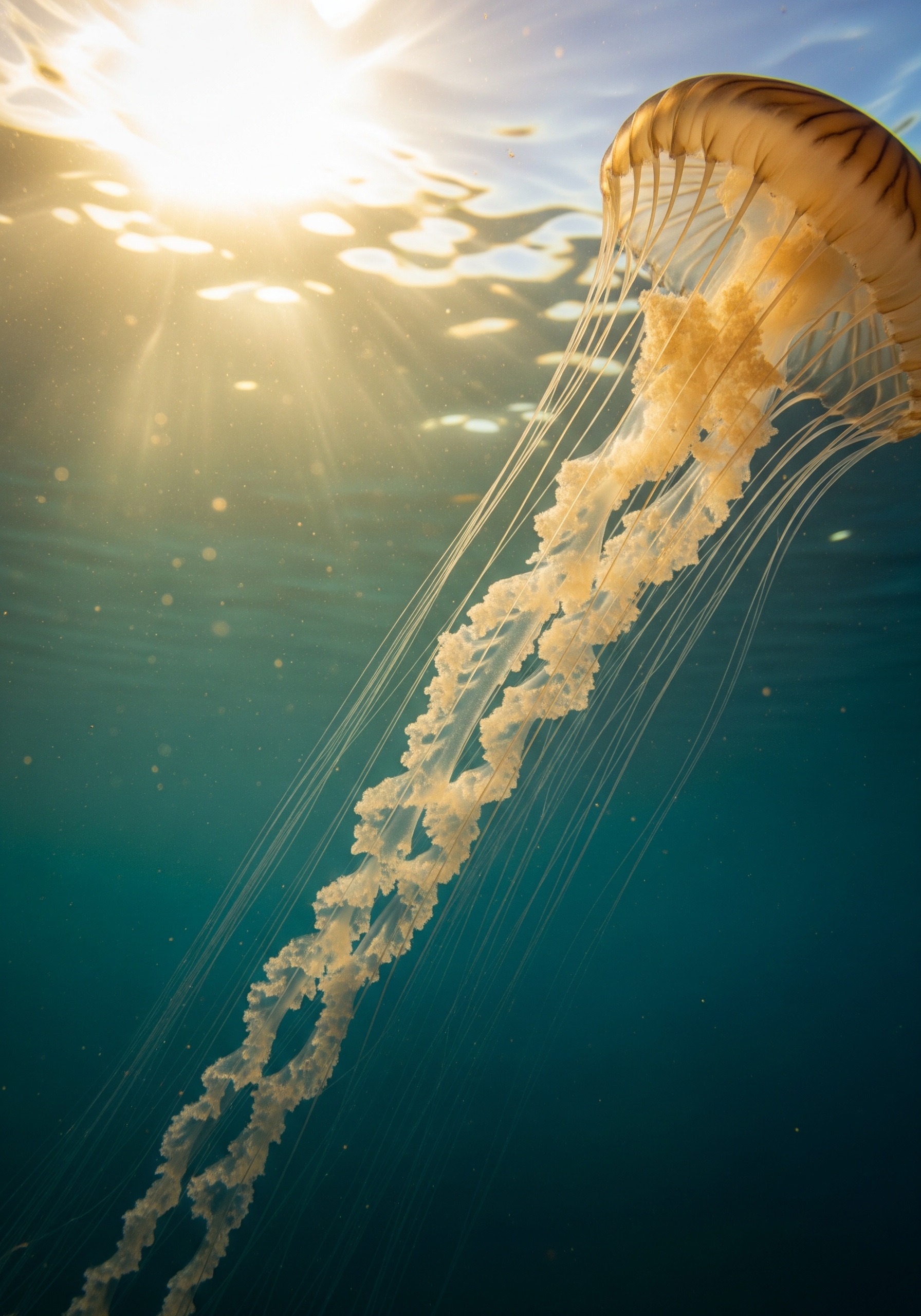
The phrase “most venomous animal” hides a sloppy comparison. Three different numbers all get called “venom strength,” and they don’t agree.
The first is potency — the LD50, or the dose required to kill half a test population, usually expressed in milligrams of toxin per kilogram of body weight. Lower is more dangerous. By LD50 in mice, the inland taipan’s neurotoxin sits near 0.025 mg/kg. That is why it tops the snake charts.
The second is yield — how much venom the animal actually injects in a real strike. A taipan bite might deliver 44 to 110 mg of dry venom. A full-body box-jellyfish contact, by contrast, can offload hundreds of thousands of nematocysts at once across square meters of skin.
The third is delivery and encounter: how aggressive the animal is, how often it meets people, and how fast the toxin reaches a vital organ. A snake that lives a thousand kilometres from any town is not killing anyone.
Stack all three. Only one animal scores at the dangerous end on every axis.
The snakes never had a chance.
Meet the heart-stopper: Chironex fleckeri
Chironex fleckeri is a pale, almost invisible cube of jelly the size of a basketball, trailing up to fifteen ribbon-tentacles that can each stretch three metres. NOAA, in a flat one-line statement, calls it “the most venomous marine animal.” It lives off northern Australia, through the Philippines, and across much of the tropical Indo-Pacific — in the warm, shallow water swimmers and snorkellers love.
It is not a passive drifter. Unlike the moon jellies you’ve seen on aquarium walls, the box jellyfish swims actively — up to 1.5 metres per second, around four knots — and it hunts. It has 24 eyes, arranged in clusters of six around the corners of its bell. Some of those eyes have lenses, retinas, and corneas, like ours; others are simple light sensors. There is no brain behind them, only a ring of nerves, which makes the animal’s behaviour all the stranger when you watch it: it dodges obstacles, turns toward prey, and avoids dark objects placed in tanks. Nobody is quite sure how.
{IMAGE_2}
Its weapon is built into the tentacles. Each one is studded with hundreds of thousands of cnidocytes, individual cells holding a coiled, harpoon-tipped thread under enormous internal pressure. When a trigger hair brushes skin, the thread fires in a few millionths of a second and injects the toxin directly into capillaries and nerves. Professor Jamie Seymour, who heads the Tropical Australian Stinger Research Unit at James Cook University and is one of the few people on the planet who routinely extracts Chironex venom, has described the firing mechanism as one of the fastest known biomechanical events in nature.
Chironex fleckeri — by the numbers
- Bell diameter: up to 30 cm (about one foot)
- Tentacles: up to 15, each up to 3 m long
- Nematocysts per tentacle: ~500,000
- Top swim speed: 1.5 m/s (~4 knots)
- Eyes: 24, in four clusters of six
- Toxic proteins identified in venom: 170+
- Time from sting to cardiac arrest in severe cases: 2 to 5 minutes
What the venom actually does inside you
For decades, the cocktail was a black box. Then in 2019, a team led by Dr Raymond (Man-Tat) Lau at the University of Sydney’s Charles Perkins Centre used CRISPR gene-editing to systematically knock out human genes one by one and see which mutations made cells immune to the venom. The answer, published in Nature Communications, was unexpected: the venom needed cholesterol in the cell membrane to do its damage.
That detail changed everything. There are already approved cholesterol-targeting drugs, in use safely for years in unrelated patients. The Sydney team showed that one of those existing drugs blocked the necrosis, the scarring and the pain in lab tests when applied to skin within fifteen minutes of envenomation. A real candidate for a molecular antidote — something the field had not had in 130 years of trying — appeared more or less by accident, out of cancer-screening tools.
The venom itself contains more than 170 distinct toxic proteins: porins that punch holes in red blood cells, cardiotoxins that trigger massive potassium release inside cardiac cells, and pain-signalling agents whose function we still don’t fully understand. The proteins act synergistically. That is why C. fleckeri can do, in under five minutes, what most venoms need hours to accomplish.
Why the inland taipan loses, even though its venom is more potent
Here’s the thing. On a microgram-for-microgram basis, several snakes — the inland taipan above all, plus the hook-nosed sea snake and Dubois’s reef sea snake — have venoms more lethal than C. fleckeri. The inland taipan’s single bite is widely reported to contain enough toxin to kill an estimated 100 adult humans. So why isn’t it the answer?
Three reasons. First, the inland taipan is famously, almost comically shy. It lives in the cracked clay of Australia’s Channel Country, where almost no one goes; it bites only when cornered; and despite its extraordinary toxicity, there is no confirmed wild-bite human fatality from the species. Second, when it does bite, it injects a fixed dose — a snake cannot escalate the way a multi-tentacle sting does. Third, modern antivenom for taipan envenomation is effective and widely stocked across Australia.
The box jellyfish, by contrast, lives where people swim, is nearly invisible in the water, and its sting covers wide stretches of skin all at once. Every variable that protects the taipan’s victims fails for the jellyfish’s.
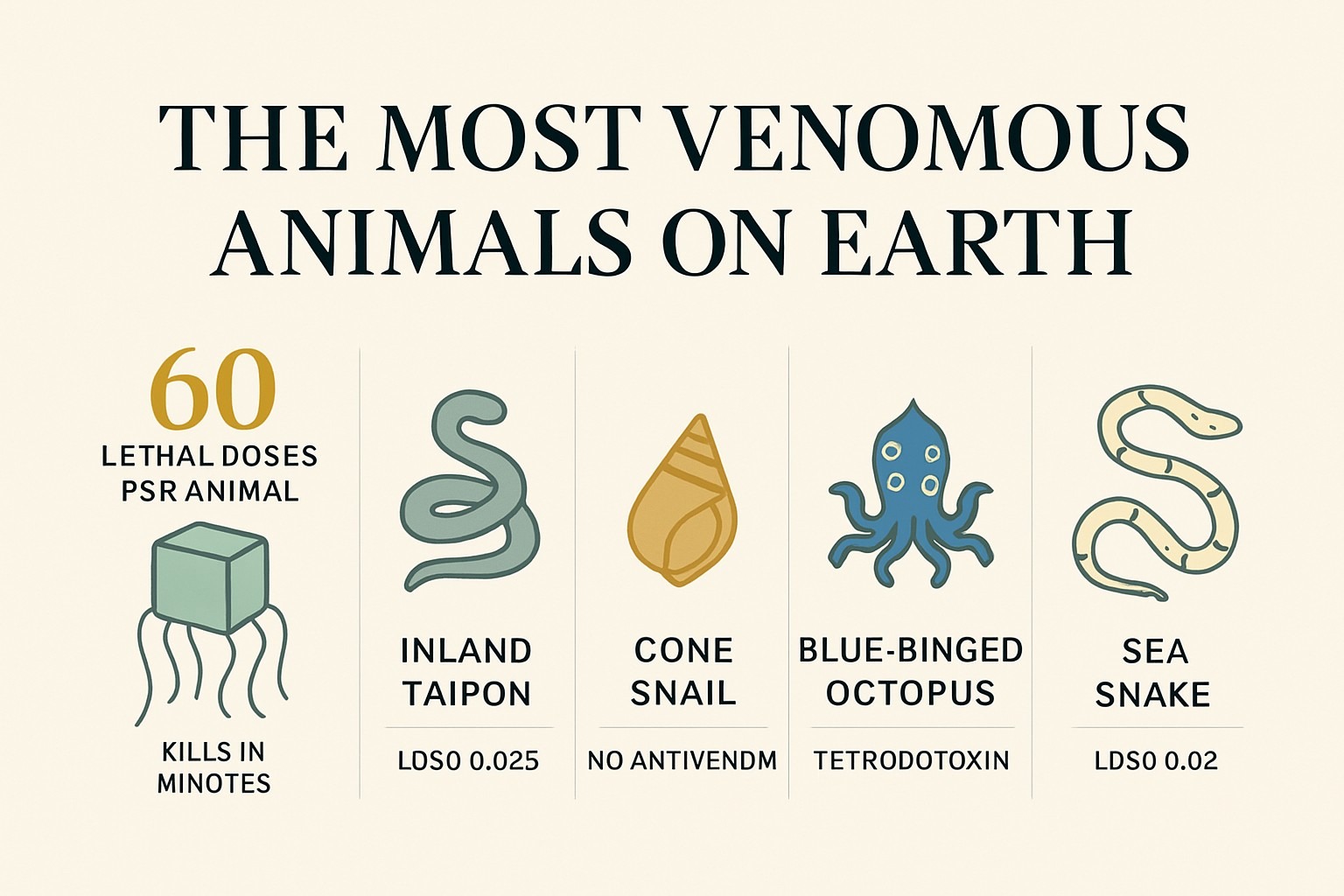
The five-way comparison
Putting the headline contenders side by side makes the trade-offs clear. The numbers below are widely reported in toxinology references; exact LD50 values vary by route of administration and target species, and should be read as orders of magnitude, not precise rankings.
| Animal | Habitat | Venom potency | Per-strike danger | Confirmed human deaths |
|---|---|---|---|---|
| Box jellyfish (Chironex fleckeri) | Shallow tropical seas, Indo-Pacific | ~170 toxin proteins, cardiotoxic in minutes | Whole-body sting; up to 60 lethal doses per animal | 79+ since 1883; ~20–40/yr in Philippines |
| Inland taipan | Remote arid central Australia | LD50 ~0.025 mg/kg (highest of any land snake) | 44–110 mg per bite; antivenom available | 0 in the wild |
| Geography cone snail | Indo-Pacific reefs | Cocktail of thousands of conotoxins; no antivenom | One sting can kill ~20 adults | ~30+ historical (estimates vary) |
| Blue-ringed octopus | Tide pools, Pacific | Tetrodotoxin (TTX), no antidote | Bite often painless; paralysis within minutes | ~3 confirmed |
| Hook-nosed sea snake | Indo-Pacific coastal waters | LD50 ~0.02 mg/kg | Small dose per strike; rarely bites | Very few |
Read across the rows and the pattern is the same one. The animals with the highest LD50 don’t kill people. The animal that kills people scores well on potency, off the chart on yield, and lives in our holiday water.
Surviving a sting — what science says, what folklore got wrong
Box-jellyfish first aid has shifted over the last decade in ways the public conversation has not entirely caught up with. The long-standing field advice on Queensland beaches — pour vinegar on the wound — was confirmed to deactivate undischarged nematocysts and is still endorsed by Australian lifesavers. But Seymour’s team at JCU published evidence that vinegar may, in some circumstances, push already-discharged stinging cells to release more venom they were still holding. The result is a more nuanced picture, not a clean instruction: vinegar likely helps in the first seconds, but it is not magic, and removing tentacles by hand without gloves is dangerous because the cells keep firing on contact.
This is not the place for medical instruction. The honest takeaway is that, on the coastlines where C. fleckeri lives, stinger nets enclose swimming zones during the season, every lifeguard station carries vinegar bottles, and stings are treated as full medical emergencies — not first-aid problems — because cardiac collapse can happen in under five minutes. The defence is geography and respect, not heroics.
What is genuinely new in 2026
Three things have moved since the textbook accounts most websites copy from. First, the 2019 Sydney antidote work has matured into ongoing pre-clinical development of topical formulations — not yet a finished product, but a real candidate where there was none. Second, James Cook University announced in 2025 new sensor technology designed to detect stinger venom in seawater, an early step toward beach warning systems. Third, climate-driven warming has begun pushing Chironex populations further south along Australia’s east coast and into new pockets of the Indo-Pacific — a slow trend that, decade by decade, will increase human exposure.
None of this changes the title. It does change the next ten years of how humans share water with the animal that wears it.
Frequently Asked Questions
Q: Is the box jellyfish the most venomous animal — or only the most venomous marine animal?
A: Strictly, NOAA calls it “the most venomous marine animal.” Most toxinologists, when you account for venom yield, delivery and recorded human deaths together, accept it as the most venomous animal overall. The inland taipan beats it on raw LD50, and loses on every other axis.
Q: How fast can a box jellyfish kill someone?
A: In severe envenomation from Chironex fleckeri, cardiac arrest has been recorded within two minutes of contact. Most fatalities occur within five.
Q: Is there an antivenom?
A: Australia has produced a sheep-derived antivenom against C. fleckeri venom since 1970, but its clinical effectiveness is debated; in critical cases, supportive care and CPR matter more. The 2019 cholesterol-pathway discovery is the first candidate for a true molecular antidote and is still in development.
Q: What is the difference between venomous and poisonous?
A: Venom is injected (bite, sting, spine). Poison is absorbed or ingested. A box jellyfish is venomous; the golden poison frog is poisonous. The two words get mixed up constantly, but the distinction matters in toxinology — and on a multiple-choice exam.
Sources
- NOAA National Ocean Service — “What is the most venomous marine animal?”
- Lau, M.-T. et al., Nature Communications, 2019 — “Molecular dissection of box jellyfish venom cytotoxicity highlights an effective venom antidote”
- Tropical Australian Stinger Research Unit, James Cook University (Prof. Jamie Seymour)
- Encyclopaedia Britannica — entries on Chironex fleckeri, the inland taipan, and the geography cone snail
- Australian Institute of Marine Science — box jellyfish biology and distribution data
The snake-versus-jelly question is, in the end, a question about what we mean by danger. Venom is chemistry; danger is chemistry plus geography plus chance. Chironex fleckeri sits at the unhappy intersection of all three, in warm water people love. It is also a reminder that nature’s most efficient killers are rarely the ones we fear by reflex.
Illustrations are AI-generated. Article fact-checked and human-edited. Our editorial standards.