Ancient Technology Still Used Today: 10 Lasting Designs
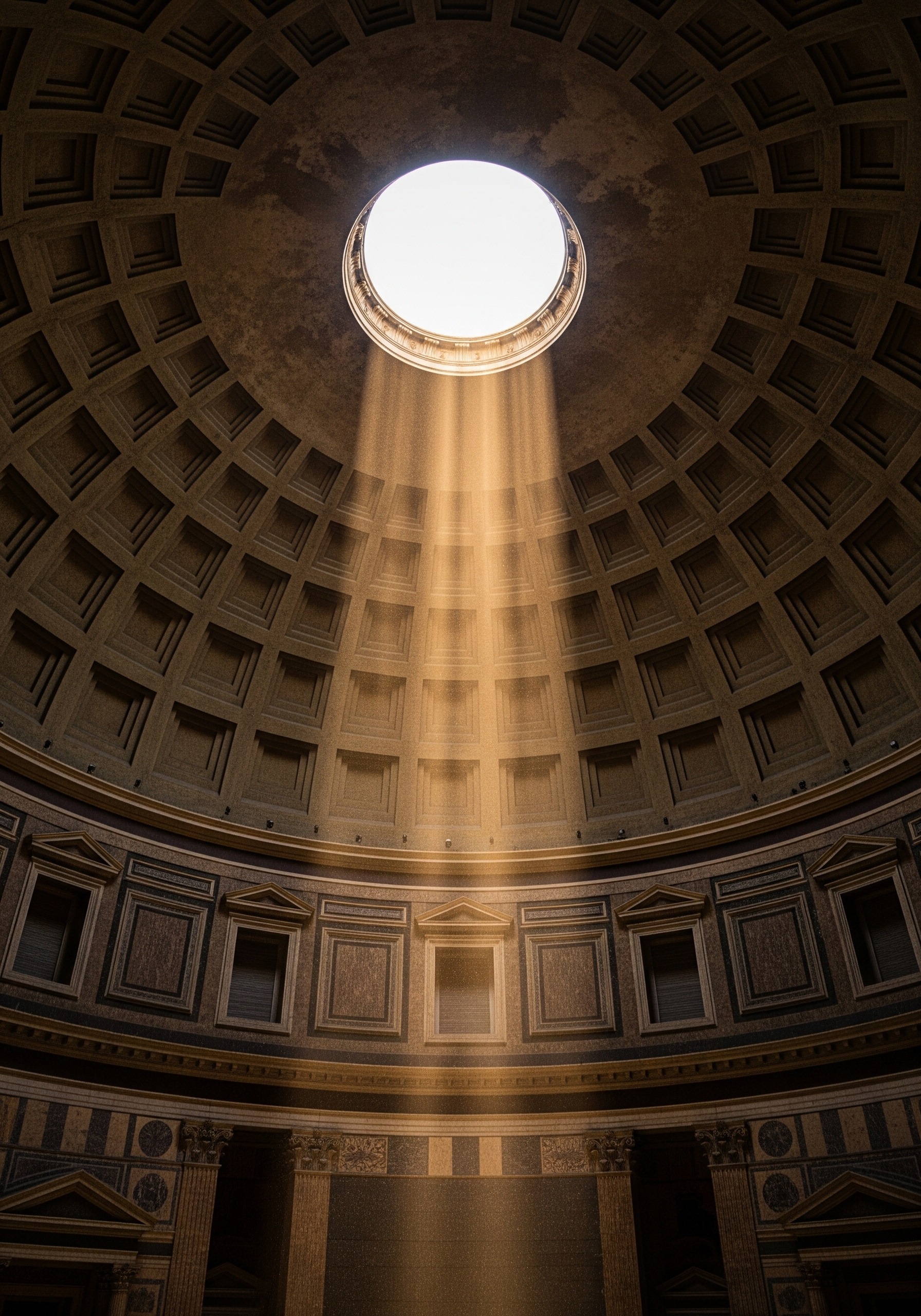
Walk into the Pantheon in Rome and look up: the ancient technology still used today is not in a museum case, it is the ceiling above your head. The 43.3-metre concrete dome, finished around 128 CE, is still the largest unreinforced concrete dome on Earth — and it is just one example of an ancient design quietly doing real work nineteen centuries later. From the Roman cement holding it up, to the Archimedean screw turning in an English river to light Windsor Castle, to the base-60 numbers on your wristwatch, our world is laced with technologies far older than the empires that invented them.
Key Facts
- The Pantheon’s 43.3-metre unreinforced concrete dome, completed around 128 CE under Emperor Hadrian, is still the largest of its kind in the world.
- A wooden wheel-and-axle assembly excavated from Slovenia’s Ljubljana Marshes is roughly 5,150 years old — the oldest known wheel ever found, and almost identical in geometry to a modern cart wheel.
- The Archimedes screw, invented in the 3rd century BCE, today powers reverse-flow hydroelectric turbines on the Thames, including a 320-kilowatt installation at Romney Weir that has supplied Windsor Castle since 2013.
- Persian qanats — gently sloping underground irrigation tunnels first dug roughly 3,000 years ago — still deliver drinking and irrigation water to dozens of Iranian towns and were inscribed as UNESCO World Heritage in 2016.
- Every digital clock on Earth runs on a base-60 (sexagesimal) numbering system the Sumerians and Babylonians were already using around 2000 BCE.
In short: The ancient technology still used today is not the curiosity-cabinet stuff — not Greek fire or Baghdad batteries — but a quiet handful of designs so close to optimal that 2,000+ years of innovation has never improved on them. Below are ten of them, the mechanisms that make them work, and the fresh research that keeps surprising the engineers who use them.
Key Facts
- The Pantheon’s 43.3-metre unreinforced concrete dome, completed around 128 CE under Emperor Hadrian, is still the largest of its kind in the world.
- A wooden wheel-and-axle assembly excavated from Slovenia’s Ljubljana Marshes is roughly 5,150 years old, the oldest known wheel ever found.
- The Archimedes screw, invented in the 3rd century BCE, today powers reverse-flow hydroelectric turbines on the Thames, including a 320-kilowatt installation at Romney Weir that has supplied Windsor Castle since 2013.
- Persian qanats, gently sloping underground irrigation tunnels first dug roughly 3,000 years ago, still deliver water to dozens of Iranian towns and were inscribed as UNESCO World Heritage in 2016.
- Every digital clock on Earth runs on a base-60 (sexagesimal) numbering system the Sumerians and Babylonians were already using around 2000 BCE.
In short: The article catalogues ten ancient technologies still in working use today, from the Pantheon’s concrete dome and the Archimedes screw to Persian qanats and the base-60 clock. It argues these designs survived because each solved its problem so completely that later innovation only added cost, reinforced by path dependence. The mechanisms are explained alongside fresh research, such as the 2023 discovery of why Roman concrete self-heals.
Why these ancient designs outlived their empires
Technologies survive for the same reason species do: ruthless fit. Each design on this list solved a problem so completely that every later attempt added cost without adding capability. A Sumerian baker leavening dough with wild yeast in 1500 BCE and a Brooklyn artisan baker doing it in 2024 are running the same biology. A 4th-century Roman surveyor laying a cambered, gravel-cored road and a county engineer paving a B-road in Devon are arranging the same layers in the same order. The shape is correct.
The other reason is what economists call path dependence. Once a base-60 clock face exists, every later technology — railway timetables, broadcasting, GPS, the global stock exchanges — is built on top of it. Replacing it would cost more than living with it. So the ancient choice quietly becomes a permanent one.
This is the filter we used. Mysteries (the Antikythera mechanism, the Baghdad battery, Greek fire) are wonderful, but they are museum objects or disputed reconstructions. The technologies below are still earning their keep in 2025.
Roman concrete: a 2,000-year-old recipe modern science just cracked
The Romans poured opus caementicium — a paste of slaked lime, volcanic ash from the Bay of Naples (a material later called pozzolana, after the town of Pozzuoli), and aggregate — for harbours, aqueducts, the Colosseum’s substructures and the Pantheon’s roof. Their maritime concrete is the strange one: piers and breakwaters submerged in seawater since the 1st century BCE have, by every reasonable expectation, no business still being there. Modern Portland-cement marine structures begin to spall and corrode within decades.
For most of the 20th century the durability was credited to the pozzolanic reaction: silica-rich volcanic ash reacts with calcium hydroxide to form an extraordinarily stable calcium-aluminium-silicate-hydrate gel. True, but incomplete. In January 2023, a team led by MIT’s Admir Masic, with collaborators at Harvard and laboratories in Italy and Switzerland, published in Science Advances a finding that overturned a century of assumptions about a flaw in the Roman recipe. The small white “lime clasts” peppering Roman concrete — long dismissed as evidence of sloppy mixing — turned out to be the secret ingredient.
The Romans, the team showed, were “hot mixing”: adding quicklime (calcium oxide) directly, rather than pre-slaked lime, so the mixture briefly reached very high temperatures. The result was a concrete shot through with reactive calcium-rich nodules. When a crack opens centuries later and water seeps in, those nodules dissolve and recrystallise, sealing the fracture from the inside. Roman concrete is, in a genuine sense, alive. Masic has since spun the discovery into a company called DMAT, now selling a self-healing concrete based on the ancient recipe. It is one of the few cases in modern materials science where the past is teaching the present.
Read more on the cluster: how Roman aqueducts moved water across continents.
The Archimedes screw: from ancient irrigation to today’s hydropower
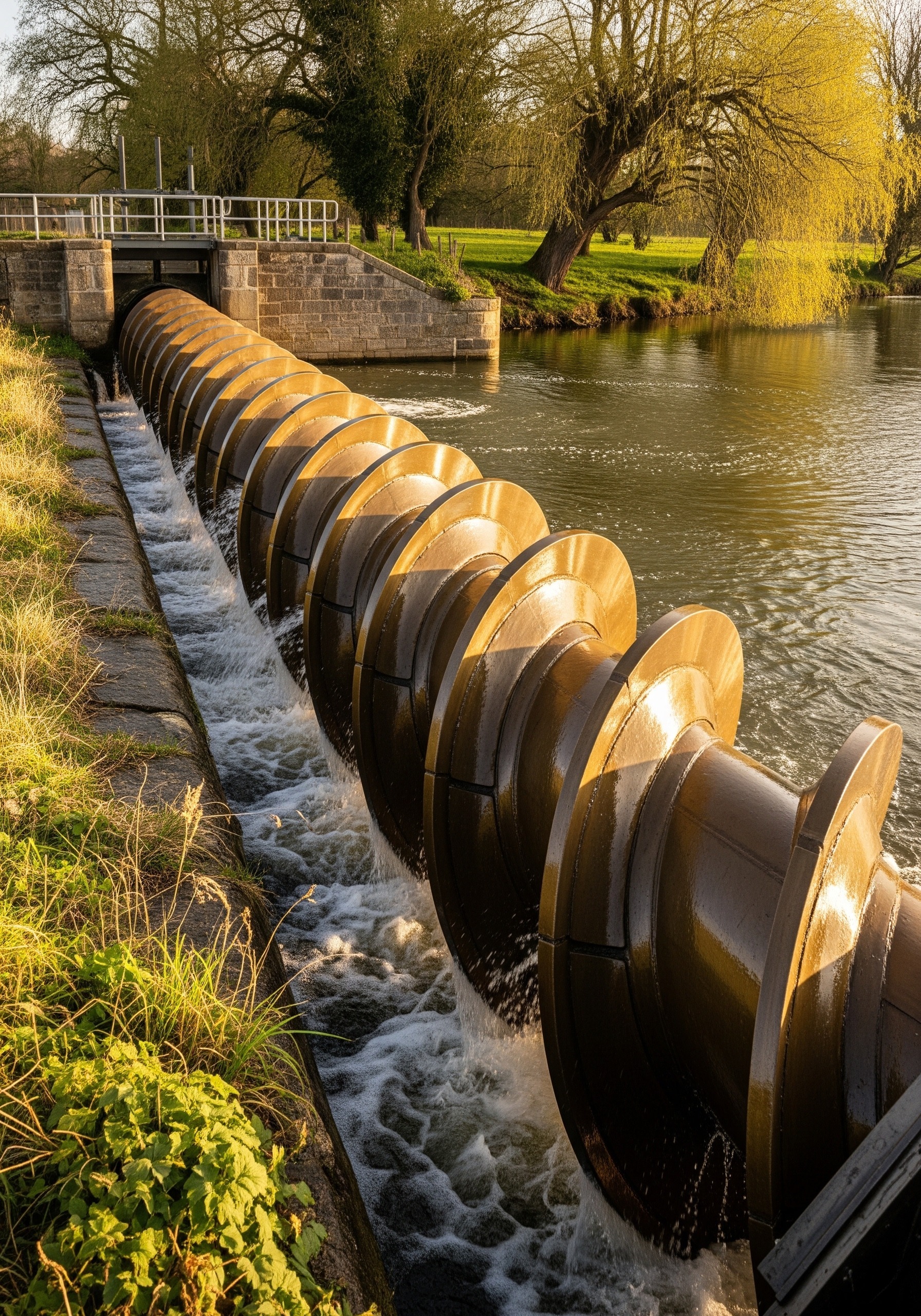
Sometime in the 3rd century BCE the engineer Archimedes of Syracuse — or possibly an unknown Egyptian predecessor whose work he refined — wrapped a helical blade around a wooden core, slid it into an inclined cylinder, and built a machine that lifts water by being turned. It has never gone out of service. Egyptian farmers still use hand-cranked screws to flood fields from the Nile. Almost every large sewage treatment plant on Earth uses huge motorised Archimedes screws to lift wastewater between treatment stages, because the screw is gentle enough to handle solids, debris and even live fish without damaging them.
{IMAGE_2}
The unexpected modern chapter is that you can run an Archimedes screw backwards. Drop a screw into a river where there is a usable head of water — usually two to ten metres — and the falling water turns the screw, which turns a generator. These “Archimedean screw turbines” are now scattered along European rivers. At Romney Weir, just below Windsor Castle on the Thames, two 40-tonne screws have been spinning since July 2013, delivering up to 320 kilowatts at peak flow and supplying electricity directly to the castle. Osney Lock in Oxford has run a 49-kilowatt unit since 2015. Because the screws turn slowly and water flows along the helix rather than through a high-speed runner, fish pass through them largely unharmed — a property that lets them be licensed on rivers where conventional turbines cannot. A 2,300-year-old machine is, very quietly, one of the most fish-friendly renewable-energy technologies we have.
The Persian qanat: gravity-fed water still flowing after 3,000 years
Long before there was reinforced concrete or pumped pressure, the highland communities of the Iranian plateau solved the problem of how to bring mountain groundwater to a dusty town several kilometres downhill, without pumps and without evaporative loss. The answer was the qanat: a gently sloping underground tunnel, hand-dug from a “mother well” tapping a high-elevation aquifer, traveling sometimes tens of kilometres beneath the desert and emerging as a steady surface stream where the land levelled out. Vertical access shafts at regular intervals — visible from the air as neat lines of dimples in the landscape — gave the diggers ventilation and a way to lift out spoil.
The technology is at least 3,000 years old. It spread along the trade routes from Iran across to Morocco (where they are called foggara or khettara), to Spain, to Xinjiang in western China (the karez), and as far as the Atacama in Chile. UNESCO inscribed eleven Iranian qanats jointly as a single World Heritage Site in 2016; many of them are still in everyday use, supplying drinking water and irrigating fields. The Qasabeh qanat of Gonabad has been delivering water continuously for around 2,700 years. No moving parts. No external energy. Just gravity, geology and an extraordinary feat of subsurface surveying.
The 60-minute hour: why a Bronze Age number system still rules time
Look at your watch. The reason there are sixty minutes in an hour, sixty seconds in a minute, and 360 degrees in a circle is that the Sumerians, then the Babylonians, kept their accounts in base 60. They picked 60 because it is divisible cleanly by 1, 2, 3, 4, 5, 6, 10, 12, 15, 20 and 30 — a property that turns long division into mental arithmetic when you have no paper and no zero. By around 2000 BCE the system was standard across southern Mesopotamia.
Greek astronomers, working from Babylonian observational records, divided the sky into 360 degrees and the day into 24 hours of 60 minutes. The Roman world inherited it. Medieval Arab mathematicians refined it. By the time mechanical clocks appeared in 14th-century European belfries, the dial they were marking out was already a Sumerian one. Stock exchanges, airline schedules, broadcast feeds and the GPS satellites circling overhead all run on the same Bronze Age count. It is the longest unbroken piece of working software in human history.
The wheel and the alphabet: invisible ancient technology still used today
The oldest known wheel is not a Mesopotamian potter’s wheel or a Sumerian chariot disc but a humble wooden disc-and-axle assembly pulled out of a peat bog at the Ljubljana Marshes in Slovenia. Radiocarbon-dated to roughly 3150 BCE, it is about 5,150 years old and was the wheel of a simple two-wheeled cart. What is uncanny about it is how modern it looks: a circular disc made of two pieces of ash wood, joined by oak crosspieces, and a fixed axle of oak rotating with the wheel. A wheelwright today would recognise every detail. (You can see it in person at the National Museum of Slovenia.)
The other invisible survivor is the alphabet you are reading. Around 1050 BCE the Phoenicians, a trading people on the Levantine coast, perfected a writing system of 22 consonant signs — small, fast, learnable in days rather than years, and stripped of the hundreds of logograms used in Egyptian and Mesopotamian scripts. Greek traders borrowed it, added vowels, and produced the alphabet that became Etruscan, then Latin, then virtually every Western script. Hebrew and Arabic descend from the same Phoenician parent. Roughly four billion people today read and write in alphabets whose underlying logic — one sign per sound — is a Phoenician trade tool from before the Iron Age.
The sourdough loaf and the lateen sail: living workshops of antiquity
Bread leavened by wild yeast and lactic-acid bacteria is the oldest biotech still on supermarket shelves. Archaeological residue analysis has shown that flat breads were being baked at Shubayqa in Jordan around 14,400 years ago — before agriculture itself. By the New Kingdom of Egypt, around 1500 BCE, wall paintings show fully recognisable bakeries producing leavened loaves; chemical analysis of beer and bread residues confirms the microbial cultures involved. A San Francisco sourdough starter and a tomb-painting baker at Thebes are running the same fermentation. The microbes have changed strains many times; the technology has not.
Step from the bakery to the harbour, and you find another living antique: the lateen sail. The triangular fore-and-aft rig — a tall mast, a long sloping yard, a single sweeping triangle of canvas — first appears in Roman-period Mediterranean iconography by the 2nd century CE. It allows a ship to sail much closer to the wind than the older square rig, which is why it dominated the Indian Ocean trade for over a millennium. Today you can still watch lateen-rigged Arabian dhows running cargo between Oman and East Africa, and lateen-rigged feluccas tacking up the Nile at Aswan. Modern Bermuda rigs are direct descendants. The geometry of windward sailing was solved in late antiquity and never genuinely improved upon until the carbon-fibre America’s Cup boats of the 21st century.
Roman roads and arches: the structural grammar of every modern highway
At its 2nd-century peak the Roman road network ran to roughly 80,000 kilometres of paved trunk routes, plus several times that in secondary roads. The recipe was four layers: a statumen of large stones at the bottom for drainage; a rudus of crushed stone and lime; a nucleus of fine concrete or compacted gravel; and a summum dorsum of fitted paving stones, slightly cambered so rain ran off into ditches at the verge. Modern road engineering uses bitumen instead of lime mortar and asphalt instead of basalt paving, but the layered, well-drained, gently cambered cross-section that highway engineers in every country specify today is, layer for layer, the Roman one. Some Roman roads — the Via Appia outside Rome, sections of Watling Street in England — still bear local traffic.
And the structure that lets you put a road over a valley, a window into a wall, or a dome over a temple is the voussoir arch. Earlier corbel arches existed from around 4000 BCE in Mesopotamia, but the Romans systematised the true semicircular arch of wedge-shaped stones, and from it derived the barrel vault, the groin vault and the dome. The compressive load path that those arches discovered — pushing every block into its neighbour, so that the whole structure stands up by leaning against itself — is the same load path used by the concrete arches under every motorway flyover. Sibling reading: how ancient builders moved megaton stones without machines.
The survivors at a glance
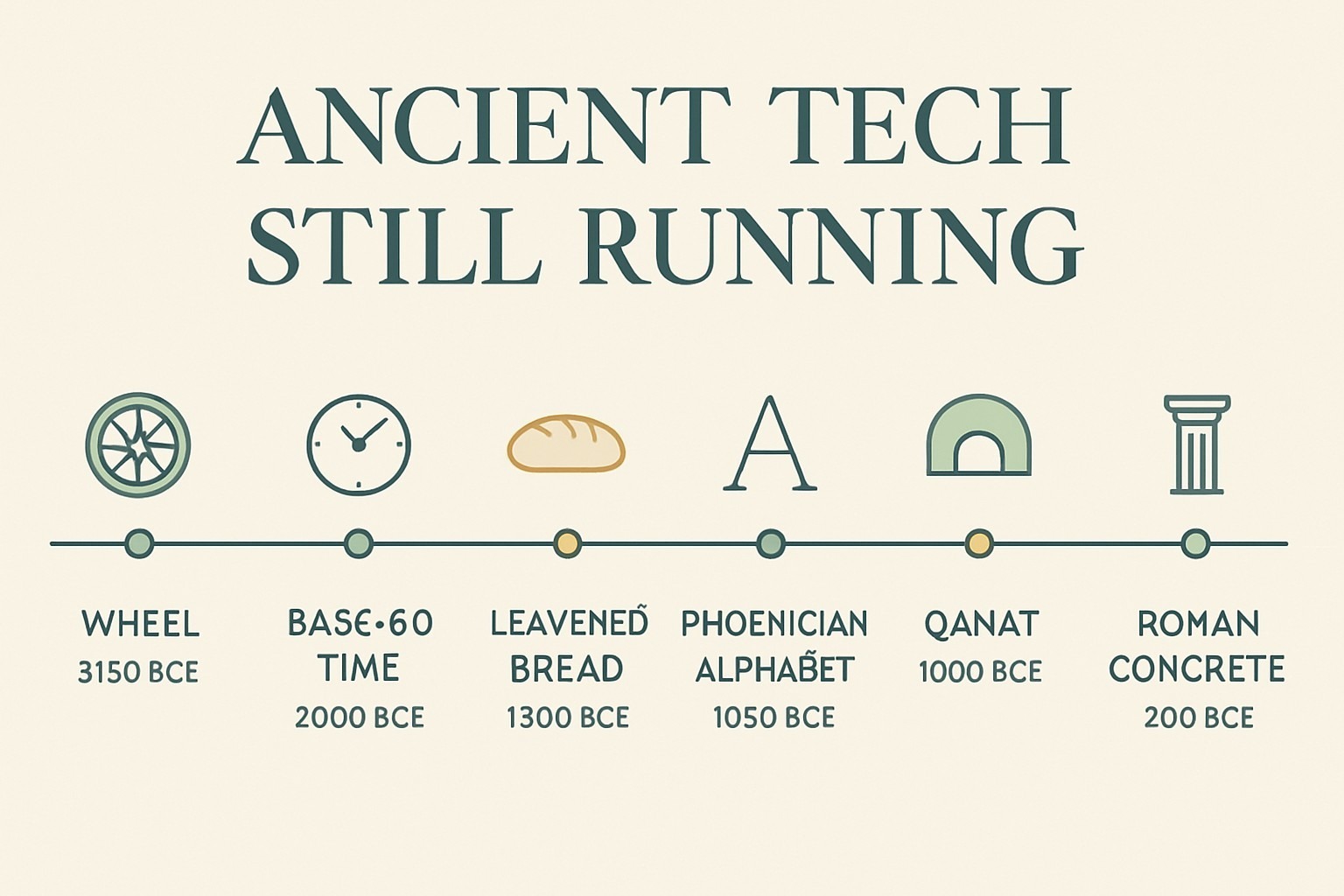
| Technology | First documented | Originating culture | Modern use |
|---|---|---|---|
| Wheel & axle | ~3150 BCE | Copper Age Europe | Virtually every vehicle on Earth |
| Base-60 time | ~2000 BCE | Sumer / Babylon | Every clock, GPS, navigation |
| Leavened bread | ~1500 BCE | Ancient Egypt | Sourdough, beer, yoghurt cultures |
| Phoenician alphabet | ~1050 BCE | Phoenicia (Levant) | ~4 billion alphabet readers |
| Qanat | ~1000 BCE | Persia (Iran) | Active town water supply, Iran & beyond |
| Lateen sail | ~2nd c. CE | Roman Mediterranean | Dhows, feluccas, modern sailing rigs |
| Archimedes screw | ~250 BCE | Hellenistic Sicily / Egypt | Sewage plants, fish-safe hydropower |
| Opus caementicium | ~200 BCE | Roman Republic | Self-healing modern concrete (DMAT, 2023+) |
Frequently Asked Questions
Q: What is the oldest piece of ancient technology still used today?
A: Among well-attested, continuously-used technologies, the wheel-and-axle is arguably the oldest, with the Ljubljana Marshes wheel dated to around 3150 BCE. If you include biology-based technologies, the leavening of bread and brewing of beer with wild microbial cultures predates the wheel; sourdough-style fermentation in some form is at least 5,000 years old.
Q: Is Roman concrete really better than modern concrete?
A: For some uses, yes — particularly in salt-water environments where Portland-cement structures corrode quickly. The 2023 MIT–Harvard study by Admir Masic and colleagues showed Roman opus caementicium has a self-healing mechanism, driven by “hot-mixed” lime clasts, that modern formulations lack. Modern concrete is far stronger in compression and faster to cure; the Roman version is more durable. Hybrid formulations are now being commercialised.
Q: Why do we still divide the day into 24 hours and 60 minutes?
A: Because the Sumerian and Babylonian scribes who first standardised time-keeping used a base-60 (sexagesimal) number system around 2000 BCE. Sixty is the smallest number divisible by every integer from 1 to 6, which made calculation easy without a positional zero. Greek and Arab astronomers passed the system on; every later timekeeping technology, from sandglasses to atomic clocks, kept it because changing it would be more expensive than keeping it.
Q: Are Persian qanats still actually used, or are they tourist sites?
A: Both. Iran still has thousands of qanats in active service supplying drinking water and irrigation, particularly in arid central provinces like Yazd and Kerman. The Qasabeh qanat of Gonabad has been delivering water for roughly 2,700 years. Eleven of the most important were jointly inscribed on the UNESCO World Heritage list in 2016, but their primary role is not heritage — it is water.
None of this is nostalgia. The cargo ship leaves harbour on a numerically refined Phoenician triangle of sail. The pumping station upstream raises sewage with a Hellenistic screw. The cement under the runway you took off from is descended, by way of MIT laboratories, from a recipe Vitruvius would recognise. The most striking thing about the ancient technology still used today is that we did not preserve it out of reverence. We kept it because, two or three thousand years later, no one has built anything better.
Illustrations are AI-generated. Article fact-checked and human-edited.