Göbekli Tepe: The Oldest Civilization Older Than Civilization
The phrase “oldest civilization Gobekli Tepe” hides one of the strangest sentences a historian can write: a people who had not yet invented pottery, the wheel, or farming somehow quarried ten-tonne limestone pillars, arranged them in concentric rings on a windswept ridge in southern Anatolia, and carved them with foxes, snakes and vultures — and they did this more than 11,500 years ago, before any city, any king, any king-list existed anywhere on Earth.
Key Facts
- Göbekli Tepe’s earliest exposed structures were built between roughly 9500 and 9000 BCE, in the Pre-Pottery Neolithic A period — about 11,500 years ago.
- That makes the site some 6,000 years older than Stonehenge and roughly 7,000 years older than the Great Pyramid of Giza.
- Geophysical surveys reveal at least 20 enclosures and around 200 T-shaped limestone pillars, the tallest about 5.5 metres high and weighing up to 10 tonnes.
- It was built by hunter-gatherers: no domesticated plants, no domesticated animals and no pottery have been recovered from its earliest layers.
- Only an estimated 5–10% of the 8-hectare mound has been excavated. The German Archaeological Institute and Istanbul University now treat Göbekli Tepe as one node in a network — the Taş Tepeler (“stone hills”) — of at least a dozen contemporaneous sites.
In short: Göbekli Tepe is not the oldest civilization in the textbook sense of cities, writing and kings — it is older than all of that. It is the place that forced archaeology to admit complex monumental ritual and organised labour existed thousands of years before civilization as we used to define it, and recent digs at its sister sites are now rewriting even the rewrite.
Key Facts
- Göbekli Tepe’s earliest exposed structures were built between roughly 9500 and 9000 BCE, in the Pre-Pottery Neolithic A period, about 11,500 years ago.
- The site is some 6,000 years older than Stonehenge and roughly 7,000 years older than the Great Pyramid of Giza.
- Geophysical surveys reveal at least 20 enclosures and around 200 T-shaped limestone pillars, the tallest about 5.5 metres high and weighing up to 10 tonnes.
- It was built by hunter-gatherers: no domesticated plants, animals, or pottery have been recovered from its earliest layers.
- Only an estimated 5–10% of the 8-hectare mound has been excavated, and the site was inscribed as a UNESCO World Heritage Site in 2018.
In short: Göbekli Tepe in southeastern Türkiye is a complex of carved limestone pillars and circular enclosures built by hunter-gatherers more than 11,500 years ago, before pottery, the wheel, farming, cities, or writing existed. Its discovery forced archaeology to accept that monumental ritual architecture and organised labour predate civilization as previously defined. Recent digs at sister sites in the Taş Tepeler network are now rewriting the timeline further.
How a Shepherd Found the Oldest Temple on Earth
In 1994, a Kurdish shepherd told visiting archaeologists about strange, T-shaped stones poking out of the soil on a low hill north of the city of Şanlıurfa, in what is today southeastern Türkiye. Surveys in 1963 had already noted flint and limestone fragments at the mound, then dismissed them as a medieval cemetery. The German archaeologist Klaus Schmidt looked at the same fragments and saw, in his own words, “either no one had been here for thousands of years — or someone had been here doing something we did not yet understand.” Schmidt began excavating in 1995. Within months he understood he was standing on the oldest monumental architecture ever discovered.
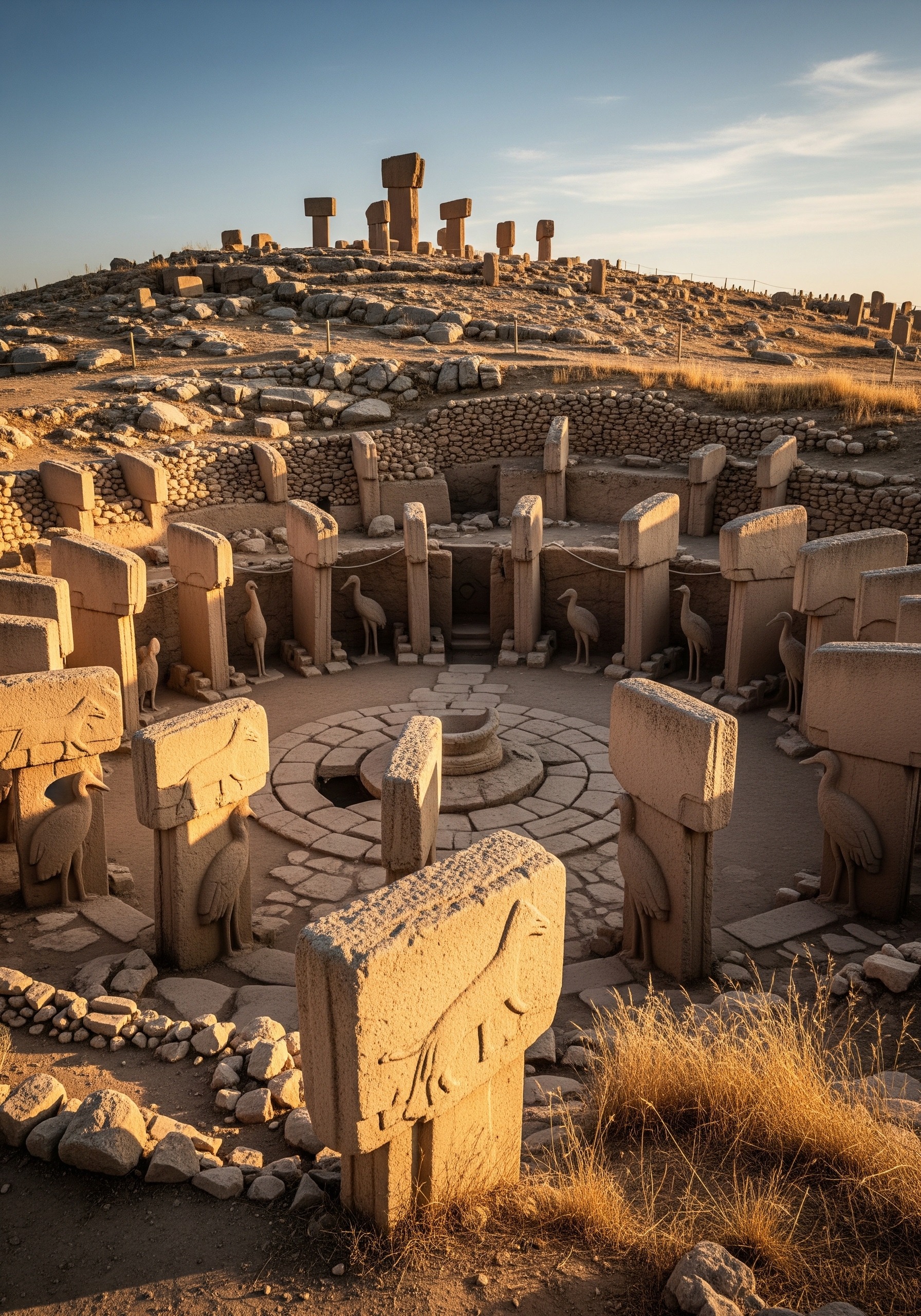
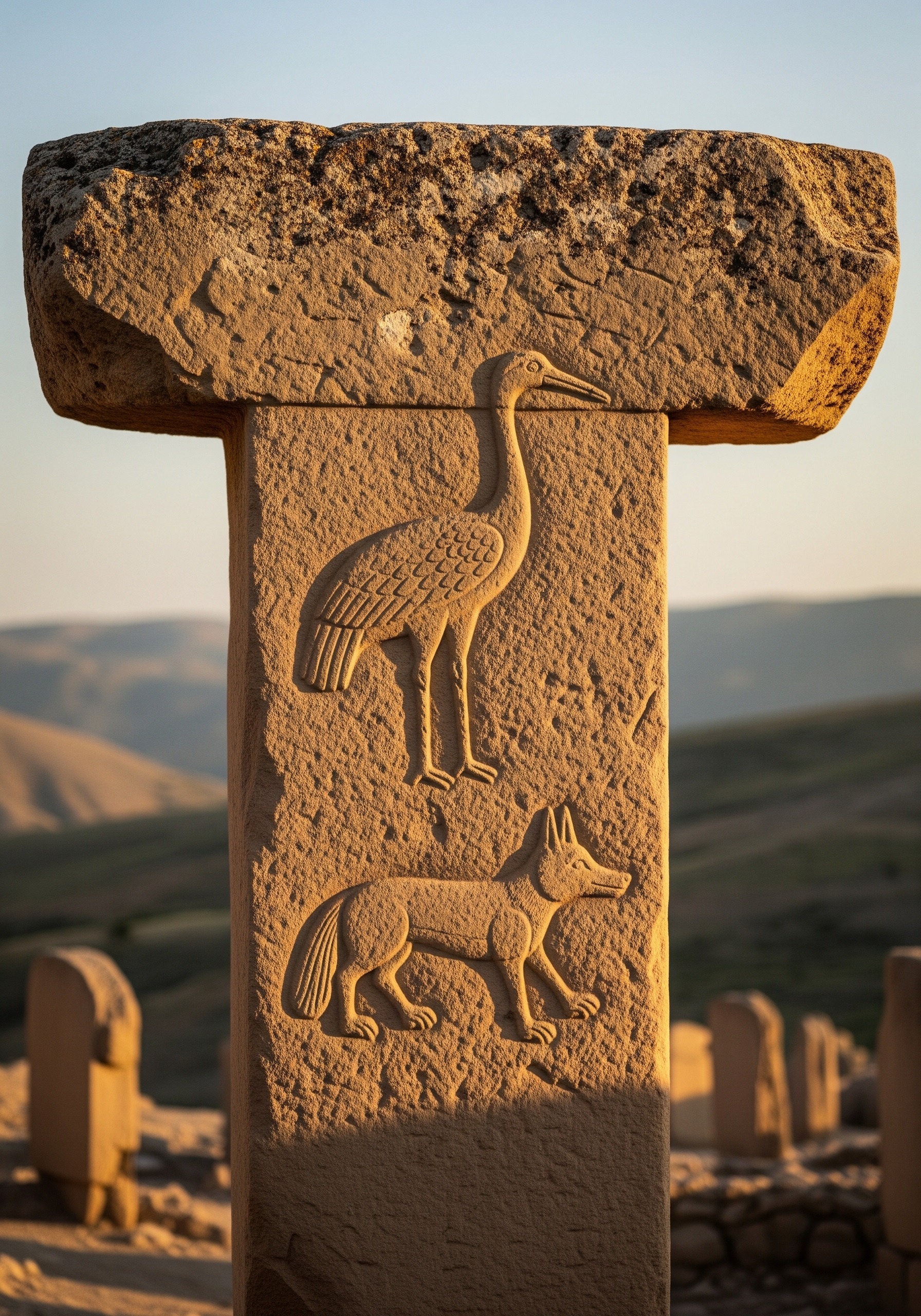
What Schmidt’s team gradually uncovered are circular enclosures, 10 to 30 metres across, each ringed by carved limestone pillars and dominated by two larger central pillars facing one another like a pair of stone giants. Some of the pillars are T-shaped because they are stylised humans: the shaft is the body, the cross-bar the head; arms run down the sides; hands meet over a carved belt; fingers, fox-pelt loincloths and even necklaces are sculpted in low relief. They are the oldest known monumental human figures in the world.
Dating Göbekli Tepe: Numbers That Reset the Timeline
The Göbekli Tepe age that broke the field is anchored by radiocarbon. Charcoal and bone collagen from the lowest secure contexts cluster between roughly 9600 and 8200 BCE, with the most monumental round enclosures (the famous Buildings A, B, C and D) sitting in the older half of that range. The site was occupied, in one form or another, for about 1,500 years across at least eight phases before being deliberately buried and abandoned around 8000 BCE.
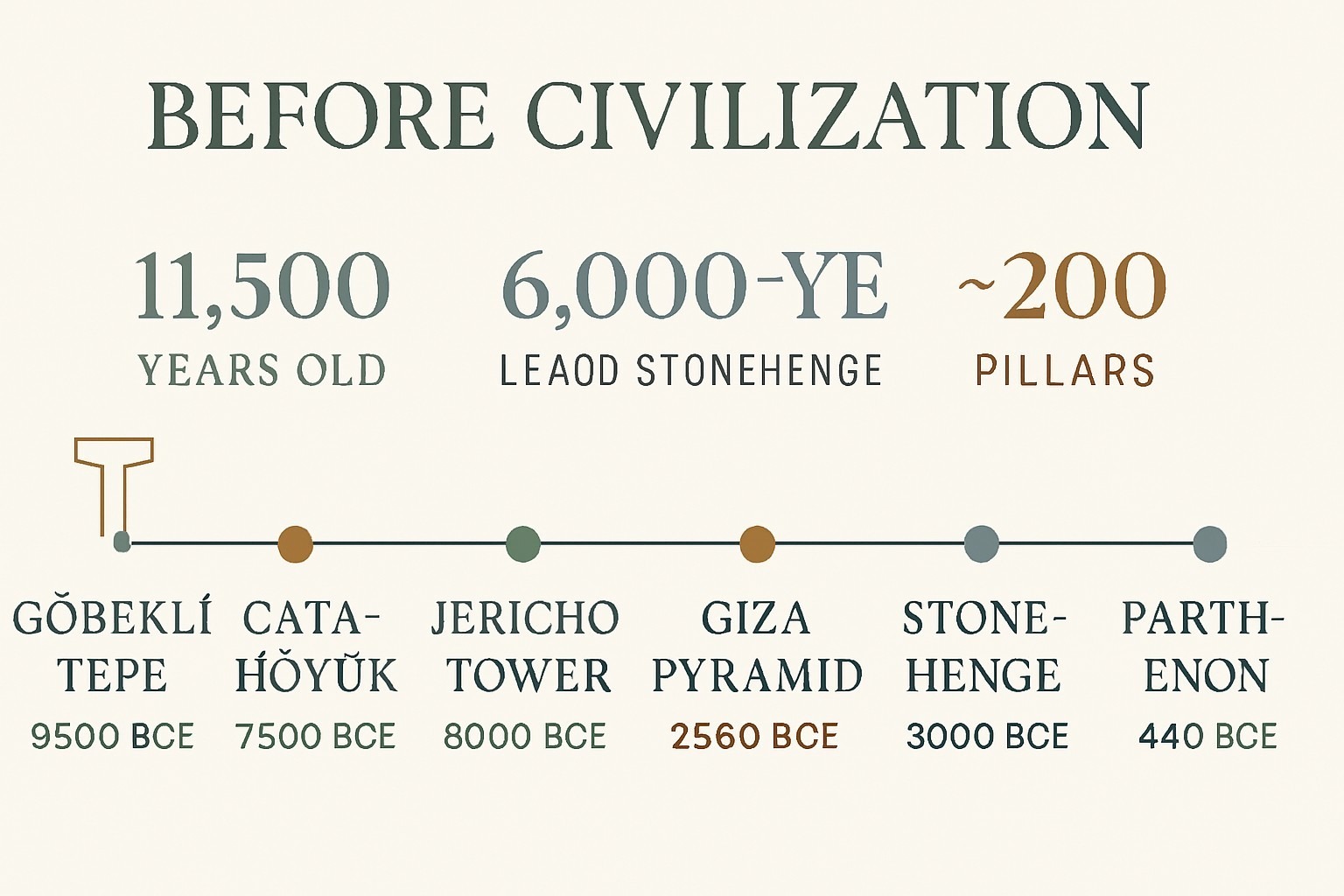
To translate those numbers into something readable: Göbekli Tepe was already 2,500 years old when the first farmers of Jericho built their famous tower. It was 4,000 years old by the time the first cuneiform tablets were pressed at Uruk. It was 6,000 years old when Salisbury Plain saw its first bluestone — Stonehenge — and roughly 7,000 years old when the Great Pyramid rose at Giza. For 99% of the history of Homo sapiens, Göbekli Tepe had already been built, used and forgotten.
{IMAGE_2}
The Builders: A People Without a Pot or a Plough
The single most disorienting fact about Göbekli Tepe is who built it. Until its discovery the textbook order ran: humans invent agriculture → surpluses appear → villages grow → temples and monuments follow. Göbekli Tepe is monumental architecture before any of that.
Excavators have recovered enormous quantities of gazelle, aurochs, wild boar and Asiatic wild ass bone — all hunted. They have found wild einkorn, wild barley and wild almond — none domesticated at this layer. There is no pottery in the earliest phases (it had not been invented). There is no metal (it would not arrive in the region for another 4,500 years). The pillars were quarried, dressed and carved using flint and limestone tools. Cut-marks on the limestone benches in the local bedrock show the quarry trenches where the giants were levered out of the ground; some unfinished pillars still lie in those quarries, snapped during transport.
Conservative labour estimates suggest that moving and erecting one 10-tonne pillar would require several hundred people working together for at least several days; building a single enclosure with a dozen pillars would imply repeated, organised mobilisation of perhaps 500 individuals — and there is no evidence any of them lived permanently on the hill. They came, they built, they feasted (the site has yielded thousands of grinding stones and signs of large-scale meat processing), and they went home.
Göbekli Tepe by the Numbers
- ~11,500 years — age of the earliest exposed structures (c. 9500 BCE).
- ~6,000 years — how much it predates Stonehenge.
- ~7,000 years — how much it predates the Great Pyramid of Giza.
- ~20 enclosures, ~200 pillars — total estimated from ground-penetrating radar.
- 5.5 m / 10 t — tallest pillar height and approximate weight.
- ~5–10% — share of the 8-hectare mound excavated to date.
- 2018 — year Göbekli Tepe was inscribed as a UNESCO World Heritage Site.
Göbekli Tepe Is Not Alone: The Taş Tepeler Network
For two decades after its discovery, Göbekli Tepe was treated as a unique anomaly — a single, inexplicable monument in an empty landscape. The 2020s have ended that picture. Türkiye’s “Taş Tepeler” (“Stone Hills”) project, coordinated by the Şanlıurfa Museum, now actively investigates at least 12 contemporaneous sites scattered across a roughly 200-kilometre arc of Upper Mesopotamia: Karahan Tepe, Sayburç, Sefer Tepe, Kurt Tepesi, Harbetsuvan Tepesi and others.
Karahan Tepe, about 35 kilometres east of Göbekli Tepe, has produced its own T-shaped pillars, an enigmatic room with eleven phallic pillars carved out of the bedrock, and — in 2023 — a 2.3-metre tall naturalistic statue of a human male, set into a niche, that may be the oldest life-sized human figure ever found. At Sayburç, excavators in 2021 uncovered a wall relief showing two leopards flanking a male figure holding his own genitals — a scene archaeologists describe as the oldest narrative composition in human history.
The lesson is uncomfortable for any tidy headline: Göbekli Tepe is not the oldest civilization in southern Türkiye. It is the most famous, best-excavated and richest member of a regional culture that built monumental ritual landscapes across hundreds of kilometres of hill country, in the same centuries, with the same architectural grammar. Whatever happened here, it was a movement, not a miracle.
The Riddle of the Deliberate Burial
Sometime around 8000 BCE the people who built Göbekli Tepe did something archaeologists still cannot fully explain: they filled the entire site in. Each enclosure was packed with a deliberate, sorted backfill — limestone chips from the quarries, animal bone, flint tools, and large quantities of human and animal remains — until the pillars were buried up to their cross-bars and the rings were sealed. Then they walked away.
There is no fire, no destruction layer, no sign of attack. The fill is not the slow accumulation of soil; it is human work, on an industrial scale, that must have taken nearly as much labour as the original construction. Schmidt called it “ritual closure.” Others have proposed an ageing of the gods — that an enclosure, like a person, had a lifespan and was respectfully laid to rest before a new one was built. A more recent hypothesis links the burial to a regional shift toward settled farming villages: with agriculture established, the old hunter-gatherer ritual landscape had become spiritually obsolete, and the community sealed it the way a culture might decommission a holy book.
Whatever the reason, that burial saved Göbekli Tepe. The fill protected the pillars and their carvings from weathering for 100 centuries. Without it, there would be nothing left to dig.
Pillar 43 and the Question of the Sky
No single carving from Göbekli Tepe has generated more debate than Pillar 43 in Enclosure D — the so-called “Vulture Stone.” It shows a vulture lifting a disc on its outstretched wing, a scorpion, a headless human figure, and rows of animals and abstract signs. In 2017 a team from the University of Edinburgh argued, on statistical grounds, that the carvings encode the constellations as they would have looked over Anatolia around 10,950 BCE, and may commemorate a comet impact tied to the climate event known as the Younger Dryas.
Most archaeologists currently working at the site, including the German Archaeological Institute team, are sceptical. They note that the pillar’s date is closer to 9500 BCE than to 10,950, that there is no independent evidence of a comet impact at that date in the local stratigraphy, and that vultures, scorpions and headless figures appear in Neolithic art across the Levant in unmistakably funerary contexts. The simpler reading is that Pillar 43 is a death-and-rebirth scene — the vulture as carrier of the soul, the scorpion as a creature of the underworld — repeated in stone the same way medieval tympana repeat the Last Judgement. The “sky map” debate is unresolved; what is certain is that even the cautious reading makes the pillar one of the earliest pieces of figurative storytelling humans ever produced.
Was Göbekli Tepe Really a “Civilization”?
The phrase that brought you here — the first civilization Göbekli Tepe — is doing a lot of work, and the work is worth examining. By the classical archaeological definition (V. Gordon Childe, 1950), a civilization requires cities, monumental public architecture, full-time specialists, social stratification, writing, long-distance trade and a centralised authority. Göbekli Tepe has the monumental architecture and the organised labour. It almost certainly had specialists — those carvings did not produce themselves. It shows signs of long-distance contact (obsidian from central Anatolia and Cappadocia). But there is no city, no writing, no king. It is not a civilization on Childe’s list.
What it is, instead, is the strongest evidence we have that the capacities that produce civilization — co-operation across hundreds of people, shared symbolic systems, long-term planning, hierarchical organisation of labour — existed thousands of years before the urban package those capacities eventually produced. Göbekli Tepe is the oldest known civilization not because it ticks the boxes, but because it forces us to admit the boxes were drawn in the wrong place. The temple came before the city. The shared story came before the harvest.
What Still Lies Beneath
Roughly nine-tenths of Göbekli Tepe has not yet been touched. Geophysical surveys have already mapped at least 16 enclosures that no archaeologist has ever entered. The current excavation strategy, under Lee Clare and Necmi Karul, has deliberately slowed the pace of new digging in favour of conservation, documentation and study of the Taş Tepeler network. The expectation is no longer that Göbekli Tepe will deliver a single revelation, but that it will keep slowly rewriting the late Pleistocene for as long as we keep asking it questions.
For a curious reader, the most useful thing to carry away is this: the deepest layer of the human story is not the one you were taught in school. Before the first city, before the first king, before the first written word, a society of hunter-gatherers in southern Anatolia decided that some things — gods, ancestors, the shape of the cosmos, the difference between life and death — were worth quarrying mountains for. They were right, and they built the proof.
Frequently Asked Questions
Q: How old is Göbekli Tepe in years?
A: Radiocarbon dates place the earliest exposed structures between roughly 9500 and 9000 BCE, making them about 11,500 years old. The whole site was in use for around 1,500 years before being deliberately buried around 8000 BCE.
Q: Is Göbekli Tepe older than the pyramids and Stonehenge?
A: Yes, by enormous margins. Göbekli Tepe predates Stonehenge by roughly 6,000 years and the Great Pyramid of Giza by roughly 7,000 years. It is the oldest known monumental ritual architecture on Earth.
Q: Who built Göbekli Tepe?
A: It was built by Pre-Pottery Neolithic hunter-gatherers of Upper Mesopotamia. They had no agriculture, no pottery, no metal and no domesticated animals. They quarried, transported and carved 10-tonne limestone pillars using flint tools and organised group labour. Klaus Schmidt and, after his death in 2014, Lee Clare and Necmi Karul have led the excavations.
Q: Why was Göbekli Tepe buried?
A: We do not fully know. The fill is deliberate, sorted and on the scale of the original construction. The leading hypotheses are ritual “closure” of enclosures at the end of their religious lifespan, and a cultural shift to settled agriculture that retired the old hunter-gatherer sanctuary. Whatever the reason, the burial preserved the carvings for 10,000 years.
Göbekli Tepe does not give us a king, a city or a written name. It gives us something older and stranger: a hill where, before any of those things existed, people met to build something that mattered more than survival. To stand among its T-shaped giants today is to understand that civilization did not begin with the plough. It began the moment a few hundred humans decided to lift a stone together — and to agree, in advance, what it would mean.
Further reading: UNESCO World Heritage Centre — Göbekli Tepe, Wikipedia overview, and Smithsonian Magazine on Klaus Schmidt’s discovery. Explore more in our Oldest Civilizations cluster: Karahan Tepe and the Taş Tepeler stone hills, Çatalhöyük — the world’s first town, and Uruk and the birth of cities in Sumer.
Illustrations are AI-generated. Article fact-checked and human-edited.