The Rarest Animals in the World Right Now (2026)
The rarest animals in the world right now are not numbers on a chart — they are creatures you could fit, in some cases, on a single small boat or inside one fenced paddock guarded around the clock. Two female rhinos in Kenya. Maybe eight porpoises in the Gulf of California. A forest ungulate so elusive that scientists honestly cannot tell you whether it still exists. This is the strange edge of the living world in 2026: a place where rarity stops being abstract and starts being personal.
Key Facts
- Only two northern white rhinos (Ceratotherium simum cottoni) remain — Najin and Fatu, a mother and daughter living under 24-hour armed guard at Ol Pejeta Conservancy in Kenya.
- The latest May–September 2025 vaquita survey by Mexico’s CONANP and Sea Shepherd estimated just 7–10 individuals (Phocoena sinus) left — but spotted at least one newborn calf, the first in two years.
- The saola (Pseudoryx nghetinhensis), nicknamed the “Asian unicorn,” has not been confirmed alive by camera trap since 2013; its population may be under 100, or zero.
- The kākāpō (Strigops habroptilus) climbed from 51 birds in the 1990s to 236 adults in 2026, after a record 95 chicks fledged in a single breeding season.
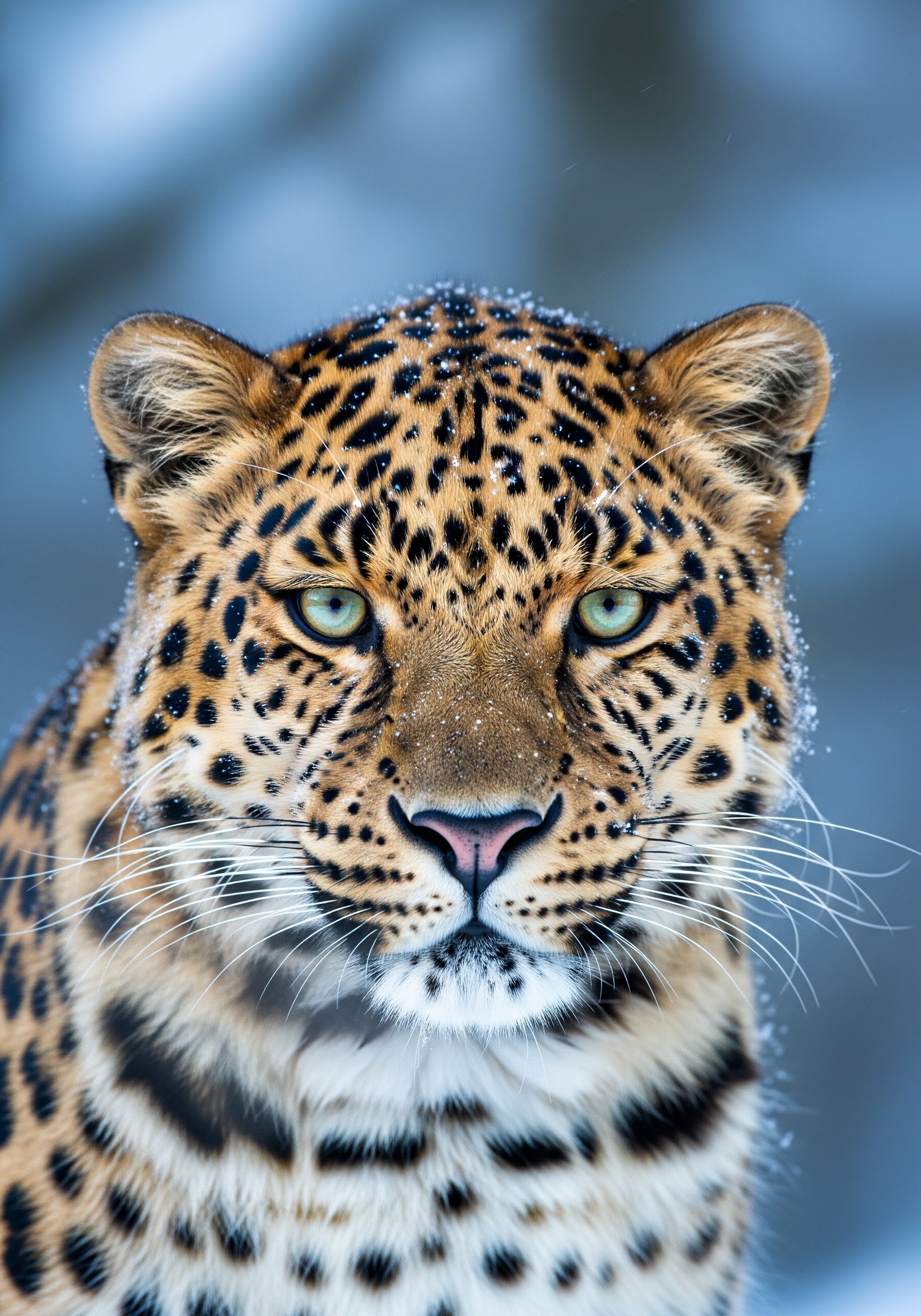
- The Amur leopard (Panthera pardus orientalis) — the world’s rarest big cat — has rebounded from roughly 25 individuals in the late 1990s to around 130 today.
In short: When people search for the rarest animals in the world, they usually want a tidy list. The honest answer is harder and more interesting — “rarest” can mean lowest population, narrowest range, or last-of-its-kind. By every definition, a small handful of species sits on a ledge most of us will never personally see them step back from.
Key Facts
- Only two northern white rhinos (Ceratotherium simum cottoni) remain Najin and Fatu, a mother and daughter under 24-hour armed guard at Ol Pejeta Conservancy in Kenya.
- The May-September 2025 vaquita survey by Mexico’s CONANP and Sea Shepherd estimated just 7-10 individuals (Phocoena sinus) left, but spotted at least one newborn calf, the first in two years.
- The saola (Pseudoryx nghetinhensis) has not been confirmed alive by camera trap since 2013; its population may be under 100, or zero.
- The kakapo (Strigops habroptilus) climbed from 51 birds in the 1990s to 236 adults in 2026, after a record 95 chicks fledged in a single season.
- The Amur leopard, the world’s rarest big cat, has rebounded from roughly 25 individuals in the late 1990s to around 130 today.
In short: The rarest animals in 2026 include just two northern white rhinos, Najin and Fatu, under armed guard in Kenya; an estimated 7-10 vaquita porpoises in Mexico’s Gulf of California; and the saola, unconfirmed by camera since 2013. Some, like the kakapo (236 birds) and Amur leopard (around 130), are slowly recovering.
What “rarest” actually means
Most lists of the rarest animals in the world skip the hardest question: rarest by what? Conservation biologists use at least three definitions, and they don’t always line up.
The first is sheer headcount. A species with two known adults — the northern white rhino — is rarer than one with thirty. The second is range. A bird like the Araripe manakin, confined to a single Brazilian valley, is rare in geographic terms even if individuals number in the hundreds. The third — functional rarity — is the cruellest. A species can have a handful of survivors and still be “functionally extinct” if no viable breeding pair remains.
Here’s the thing about that last category: it is where most of the species below live. They exist, technically. Whether they have a future is a separate, harder, often unanswered question.
The two rhinos in Kenya
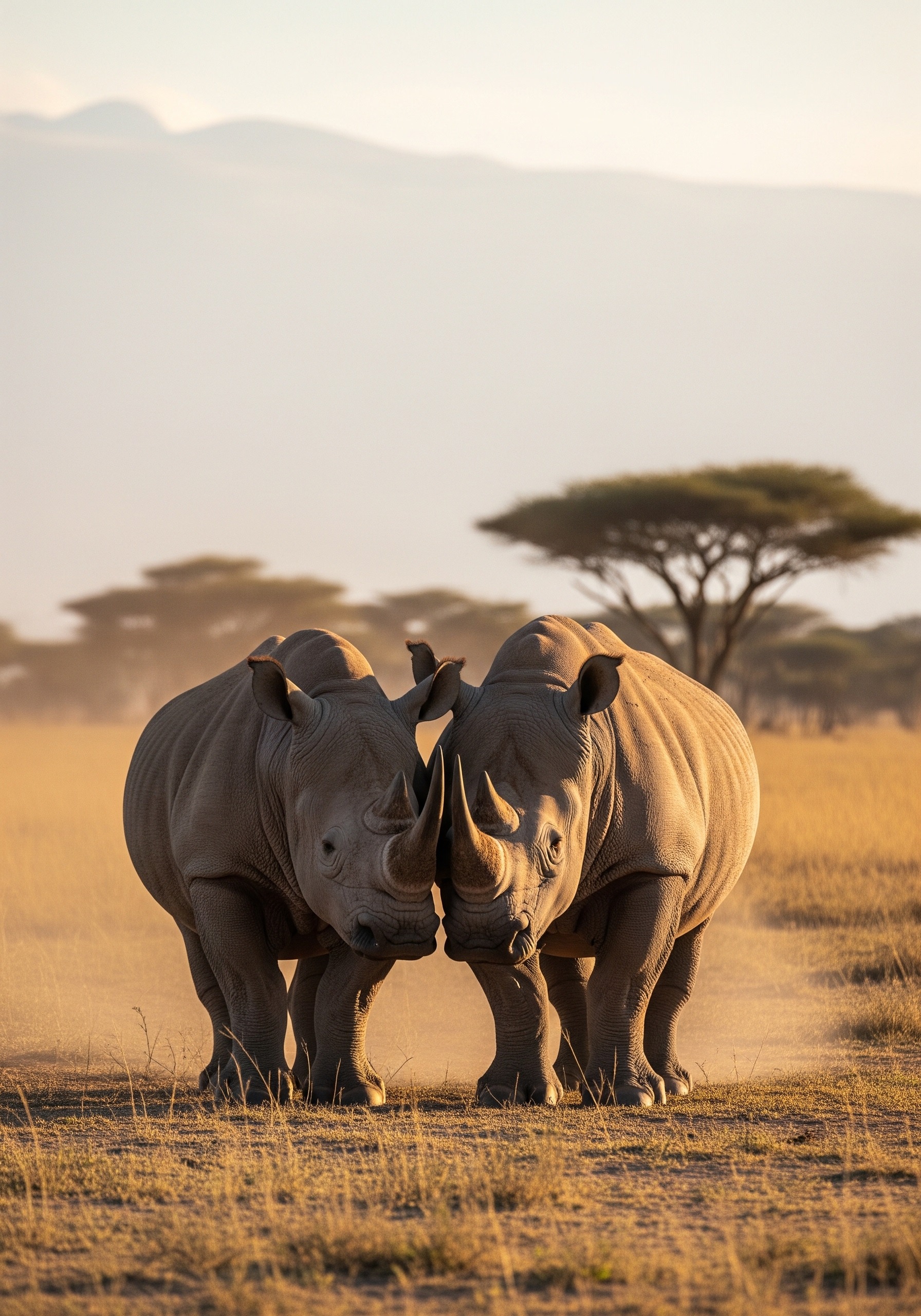
Najin was born in 1989. Fatu, her daughter, in 2000. They are the only two northern white rhinos left on Earth, and they live behind electric fencing at Ol Pejeta Conservancy in central Kenya, where armed rangers escort them every hour of every day. The last male, Sudan, died in March 2018; with him died any ordinary chance of natural reproduction.
Neither female can carry a pregnancy. Najin has ovarian tumors and was retired from the breeding program in 2019; Fatu’s uterus is too damaged to sustain a fetus. The species’ survival now depends on an audacious German-Italian-Kenyan biotech project called BioRescue, led by reproductive biologist Thomas Hildebrandt at Berlin’s Leibniz Institute for Zoo and Wildlife Research. As of 2025, the BioRescue consortium has frozen 38 pure northern white rhino embryos, created by combining Fatu’s eggs with sperm banked from deceased males.
{IMAGE_2}
The plan is to transfer those embryos into southern white rhino surrogates. The first such pregnancy, in 2023, ended at 70 days when the surrogate died of a bacterial infection. In 2025 BioRescue partnered with the de-extinction company Colossal Biosciences to push a stranger second route: turning preserved stem cells from museum specimens into eggs and sperm, then engineering in genetic diversity from old skulls. It sounds like science fiction. For this subspecies, science fiction is the conservation plan.
The porpoise that won’t leave the Gulf
The vaquita is shy in a way few cetaceans are. It surfaces briefly, breathes once, and is gone. It lives in only one place on the planet — a small, warm pocket of Mexico’s upper Gulf of California, roughly the size of metropolitan Los Angeles.
In 1997, the first acoustic-and-visual survey estimated 567 vaquitas. By 2018: 19. By 2024: eight, with no calves recorded. The latest joint survey by Mexican federal scientists and Sea Shepherd, conducted between May and September 2025, sighted between seven and ten animals — and, crucially, at least one newborn. It was the first confirmed birth in two years. Conservationists called it fragile hope.
The killer is not direct hunting. It is gillnets set illegally for the totoaba, a fish of similar size whose swim bladder fetches, on some Asian black markets, more per gram than cocaine. Vaquitas drown in those nets as bycatch. In February 2026, Mongabay reported that Mexico was considering shrinking the vaquita’s protected “Zero Tolerance Area” — a move conservationists warned would almost certainly tip the species the wrong way.
The “Asian unicorn” that may not be there
The saola was new to Western science as recently as 1992, when biologists in the Annamite Mountains between Vietnam and Laos saw the trophy horns of an unfamiliar bovid on a hunter’s wall. A cow-sized forest dweller with two parallel, dagger-straight horns, it has been camera-trapped only a handful of times since — most recently in 2013, in central Vietnam. Twelve years of intensive search since, including 2025 expeditions by Laos’s WWF team and snare-removal campaigns across the Annamites, have produced no new images.
Whether the saola still exists, in 2026, is genuinely unknown. Researchers writing in Discover Wildlife in 2025 put it plainly: its existence “can neither be proven nor disproven.” In May 2025, a team led by Genís Garcia-Erill at the University of Copenhagen published the saola’s full genome, sequenced from preserved tissue — partly so that, if the animal turns up tomorrow in a remote valley, conservationists will already know what genetic diversity they have left to work with. That is what hoping for a unicorn looks like in the laboratory.
The rarest animals in the world right now — a comparison
The species below are the ones biologists most often name when pressed. The figures are the best public estimates as of mid-2026; for fast-moving cases (vaquita, saola), they shift constantly.
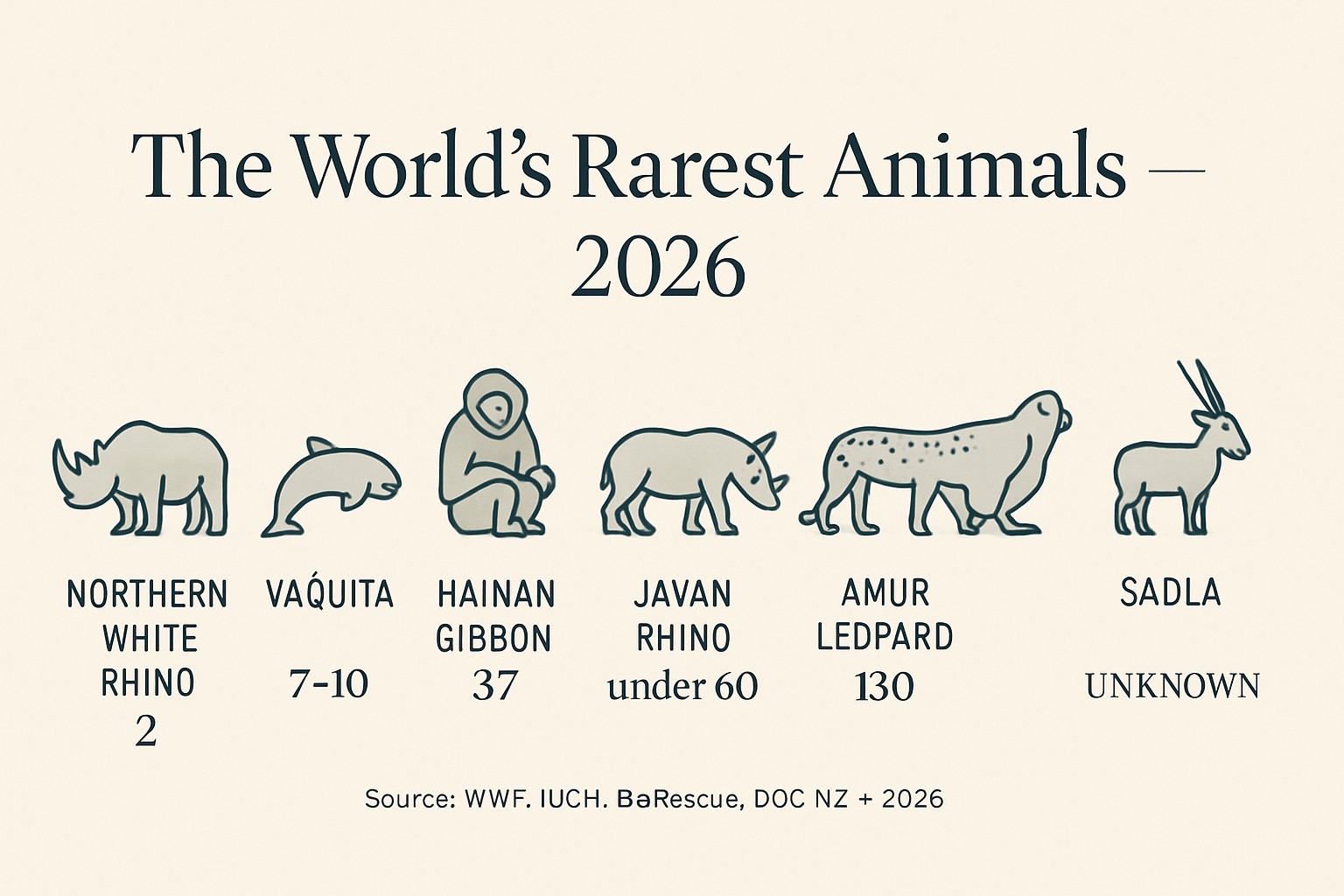
| Species | Where it lives | Estimated count | IUCN status |
|---|---|---|---|
| Northern white rhino | Kenya (captive) | 2 (both female) | Functionally extinct |
| Vaquita porpoise | Gulf of California, Mexico | ~7–10 | Critically endangered |
| Saola | Annamite Mts., Vietnam/Laos | Unknown; possibly < 100 or 0 | Critically endangered |
| Hainan gibbon | Hainan Island, China | ~37 (in 6 family groups) | Critically endangered |
| Amur leopard | Russian Far East / NE China | ~130 | Critically endangered |
| Javan rhino | Ujung Kulon, Indonesia | fewer than 80 | Critically endangered |
| Kākāpō | Predator-free islands, NZ | 236 adults (2026) | Critically endangered |
Three rare species pulling back from the edge
Not every story on this list is dark. A few species, against the odds, are visibly recovering — slow, hard-won, and worth naming.
The Hainan gibbon dropped to roughly nine animals in the 1980s after rainforest clearance on China’s Hainan Island. By 2026 there are about 37, in six known family groups, all in Bawangling National Nature Reserve. They are the world’s rarest primate. They are also, slowly, climbing.
The Amur leopard in the Russian Far East is the rarest of the world’s big cats — comparable in scarcity only to the Arabian leopard on the other side of the continent. The creation of Land of the Leopard National Park in 2012 fenced in nearly every known breeding territory, and a 200-camera-trap monitoring grid run by ANO Far Eastern Leopards and the Wildlife Conservation Society has tracked the population from about 25 in the late 1990s to roughly 130 today. A growing number now cross the border into China.
And the kākāpō — New Zealand’s flightless, nocturnal, slightly absurd green parrot — had a record 2026 breeding season. Triggered by a once-in-four-years mass fruiting of the rimu tree, at least 95 chicks fledged, smashing the previous best (73, in 2019) and bringing the population to 236 adults. (For comparison, in 1995 the count was 51.) Every bird is named. Every bird carries a transmitter. Every bird matters.
Why these particular species — and not others
Plenty of websites publish “rarest animals” lists running to 28 or 37 species. Most of those entries are critically endangered, but few qualify as truly the rarest. The species above share a harder-edged distinction: their populations are not in the hundreds of thousands or thousands — they are in the dozens. A handful are in the single digits. One has zero confirmed sightings in over a decade.
Rarity, at this point, is partly a function of the human attention that follows it. The northern white rhino is famous; the Albany adder, a tiny South African viper rediscovered after decades thought-extinct, mostly is not. The brutal honest truth is that conservation funding tracks charisma. A photogenic mammal pulls eyes and dollars; a small brown reptile, no matter how scarce, often does not. That bias is a real part of why some species are coming back and others quietly are not.
Frequently Asked Questions
Q: What is the single rarest animal in the world right now?
A: By population, the northern white rhino — with only two living individuals, both female, both unable to carry a pregnancy. Functionally, the subspecies now exists only in frozen embryos and in the bodies of Najin and Fatu at Ol Pejeta Conservancy in Kenya.
Q: What are the rarest animals still alive in the wild?
A: The vaquita porpoise (about 7–10 in Mexico’s Gulf of California as of 2025–26) is the rarest cetacean. The saola may number under 100 or none at all — its last confirmed wild sighting was a camera-trap image in Vietnam in 2013. The Hainan gibbon (around 37) is the rarest primate, and the Amur leopard (around 130) is the rarest big cat.
Q: Are any of the world’s rarest animals actually recovering?
A: Yes. The Amur leopard has rebounded from about 25 individuals in the late 1990s to roughly 130 today after the creation of Land of the Leopard National Park. New Zealand’s kākāpō climbed from 51 birds in the 1990s to 236 in 2026, including a record 95 chicks in the most recent breeding season.
Q: Can the northern white rhino actually be brought back?
A: It is being attempted. BioRescue, led by Thomas Hildebrandt at Berlin’s Leibniz-IZW, has created 38 pure northern white rhino embryos from Fatu’s eggs and frozen sperm, and in 2023 achieved a 70-day pregnancy in a southern white rhino surrogate before the surrogate died of an infection unrelated to the embryo. A parallel stem-cell program with Colossal Biosciences began in 2025. The outcome remains genuinely uncertain.
Sources
- BioRescue Consortium (Leibniz Institute for Zoo and Wildlife Research, Berlin) — research updates 2023–2025
- Comisión Nacional de Áreas Naturales Protegidas (CONANP) & Sea Shepherd vaquita survey, May–September 2025
- WWF and IUCN Red List species assessments
- New Zealand Department of Conservation (DOC) — Kākāpō Recovery Programme, 2026 breeding season report
- Garcia-Erill et al., saola genome study, University of Copenhagen (2025)
The rarest animals in the world are not a list to scroll past. They are individuals — Najin, Fatu, a kākāpō chick named after a relative, a leopard wearing GPS collar number 47. Whether any of them are still here in twenty years depends, in a way it almost never used to, on choices we are making right now.
Illustrations are AI-generated. Article fact-checked and human-edited. Our editorial standards.