The Animal That Can Live Forever: The Immortal Jellyfish
The animal that can live forever is smaller than a grain of rice. Turritopsis dohrnii — a jellyfish you could lose on the tip of a fingernail — has been quietly walking past biology’s expiration date for more than a hundred and forty years, and most marine biologists agree that, left alone in a tank with steady food, it has no programmed end.
Key Facts
- Size: Adults reach about 4.5 millimetres in bell diameter — roughly the head of a pin.
- First described: By the German biologist August Weismann in 1883, named for Anton Dohrn of the Stazione Zoologica in Naples.
- The trick: A process called transdifferentiation lets fully grown cells switch identity and re-specialize as a different body plan.
- Reversal time: A stressed adult can dissolve, settle, and reform as a juvenile polyp in roughly 24 to 36 hours.
- Real cause of death: Predation and disease. The clock can be rewound; the food chain cannot.
In short: The immortal jellyfish is “biologically immortal,” not literally immortal. When injured, starved, or aged, it does not die — it rewinds. Its specialized adult cells transdifferentiate into a brand-new juvenile polyp, the same individual restarted from the beginning. In the wild, anemones, sharks, and disease still get most of them long before they ever perform the trick.
Key Facts
- The immortal jellyfish (Turritopsis dohrnii) reaches only about 4.5 millimetres in bell diameter, roughly the size of a pinhead.
- It was first described by German biologist August Weismann in 1883 and named for Anton Dohrn of the Stazione Zoologica in Naples.
- Its trick is transdifferentiation: fully grown cells switch identity and re-specialize as a different body plan.
- A stressed adult can dissolve, settle, and reform as a juvenile polyp in roughly 24 to 36 hours.
- It is biologically immortal, not invulnerable; in the wild, predation and disease kill the vast majority before they ever perform the trick.
In short: The immortal jellyfish, Turritopsis dohrnii, is biologically immortal rather than literally immortal. When injured, starved or aged, it rewinds its adult cells transdifferentiate into a new juvenile polyp, the same individual restarted. Adults are about 4.5 mm across. In the wild, predators and disease still kill most before they ever perform the trick.
What is the animal that can live forever?
Its proper name is Turritopsis dohrnii, a hydrozoan jellyfish first described by the German biologist August Weismann in 1883 and named in honor of Anton Dohrn, founder of the Stazione Zoologica in Naples. For almost a century, nobody noticed anything unusual about it. Then, in the late 1980s, researchers in Italy realized that adult medusae in their tanks were not dying. They were collapsing back into the polyp stage and starting over. Same animals. Younger.
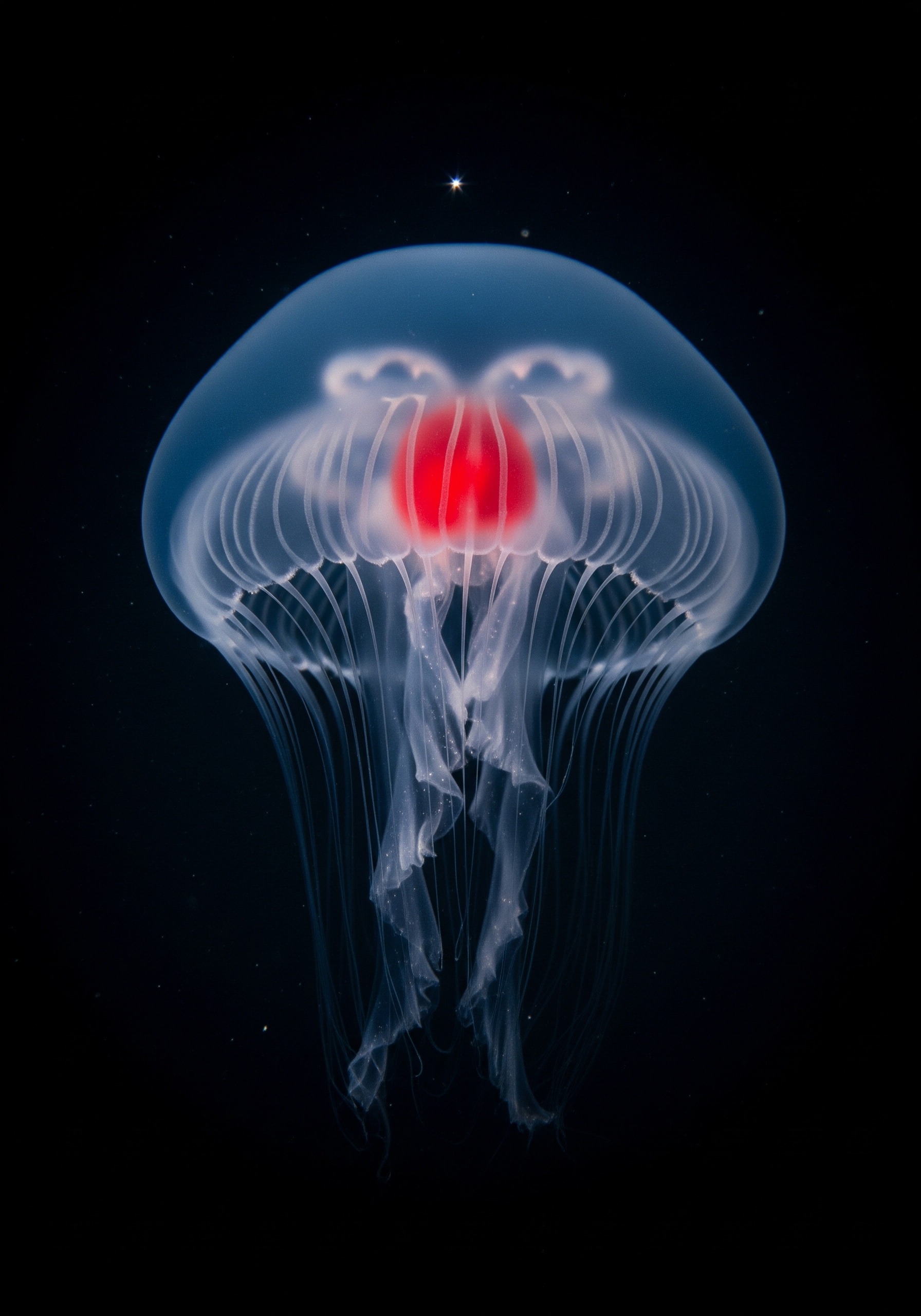
Bell-shaped and transparent, the body is pinpricked by a bright red stomach visible straight through it — about as small as a multicellular animal can usefully be. T. dohrnii lives in temperate and tropical waters worldwide, tolerating salinities from 18 to 40 PSU. That tolerance is part of why it has hitchhiked, via ship ballast water, from the Mediterranean to Florida, Japan, Panama, and Spain. Wherever a ship goes, the jellyfish can follow — and start over there too.
How transdifferentiation actually works
Most animals only get one shot at being a body. Stem cells make specialized cells (muscle, nerve, skin); those specialized cells stay specialized; eventually they wear out, and so does the animal. Transdifferentiation breaks that one-way arrow. A finished, mature cell — already a muscle cell, already a nerve cell — directly converts into a different specialized cell. No reset through a stem-cell stage. No starting over from scratch. The cell simply rewrites its instructions.
That is the key thing. Most regeneration in nature, from a salamander limb to a planarian worm, runs through a population of stem-like progenitors. T. dohrnii mostly skips that. Its mature cells switch on a coordinated suite of genes for DNA replication, DNA repair, and chromatin reorganization — and then become someone else.
Here’s the thing: this is not abstract. We can watch it happen in a dish, in about two days.
The two-day rewind, from medusa to polyp
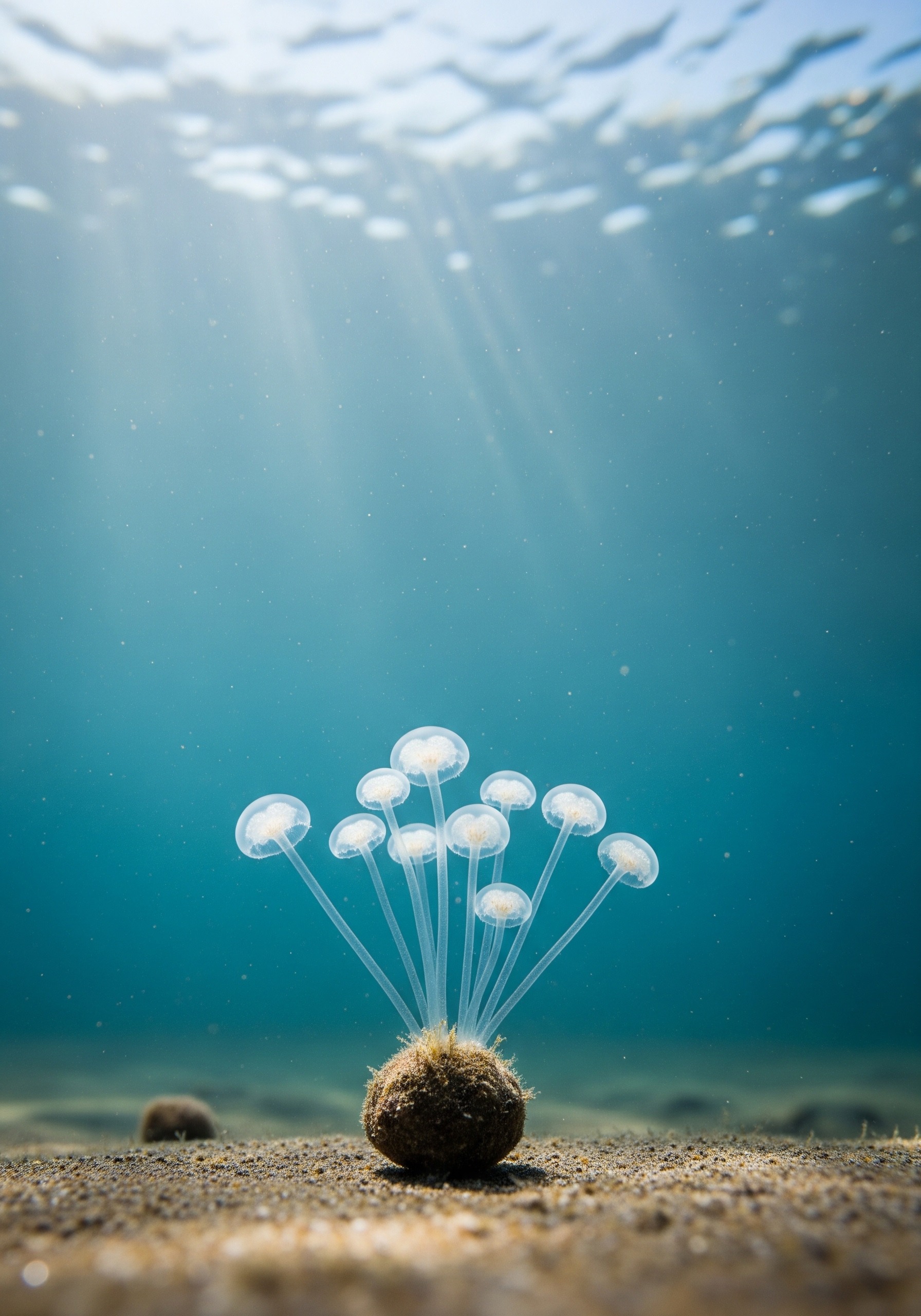
When a Turritopsis is injured, starved, or simply old, the medusa stage collapses on itself. The tentacles shorten and dissolve. The bell contracts into a tight cyst that sinks to the seafloor. Over the next 24 to 36 hours, the cyst’s specialized adult cells transdifferentiate into the cells of a polyp — a small, stalked, plant-like form attached to a hard surface. From there, the polyp begins budding again, and each bud detaches as a brand-new immature jellyfish. The animal has not died and been replaced. The same individual has started its life over.
{IMAGE_2}
In nature, the trigger is usually trauma: temperature shock, mechanical damage, starvation. In Dr. Maria Miglietta’s lab at Texas A&M University at Galveston, the team has tested the limits and found them startling. “Even if you starve it, bring it to 100 degrees Celsius, cut it, or even use UV light — things that would kill an animal — it doesn’t die,” Miglietta has said of her colonies. It just folds back into a polyp and tries again.
So is it really the animal that can never die?
No, and the honest answer is more interesting than the headline. Turritopsis dohrnii is what biologists call biologically immortal: it does not carry a fixed maximum lifespan written into its cells. It does not appear to accumulate the slow, irreparable damage — telomere collapse, senescence, organ failure — that kills the rest of us on a schedule. In a sealed lab with steady food and clean water, it can, in principle, reset forever.
In a real ocean it cannot. Sea anemones eat it. So do tuna, sharks, swordfish, sea turtles, and penguins. Disease takes more. The vast majority of wild immortal jellyfish die — eaten, sick, crushed — long before they ever get to perform the trick. “Immortal,” in the biological literature, is a statement about aging, not about invulnerability. The clock can be rewound; the food chain still wins.
Only one researcher, Shin Kubota of Kyoto University’s Seto Marine Biological Laboratory, has kept a colony cycling continuously for years in the lab — and even he loses individuals constantly. In his own description, keeping them alive is painstaking daily work.
Other contenders for biological immortality
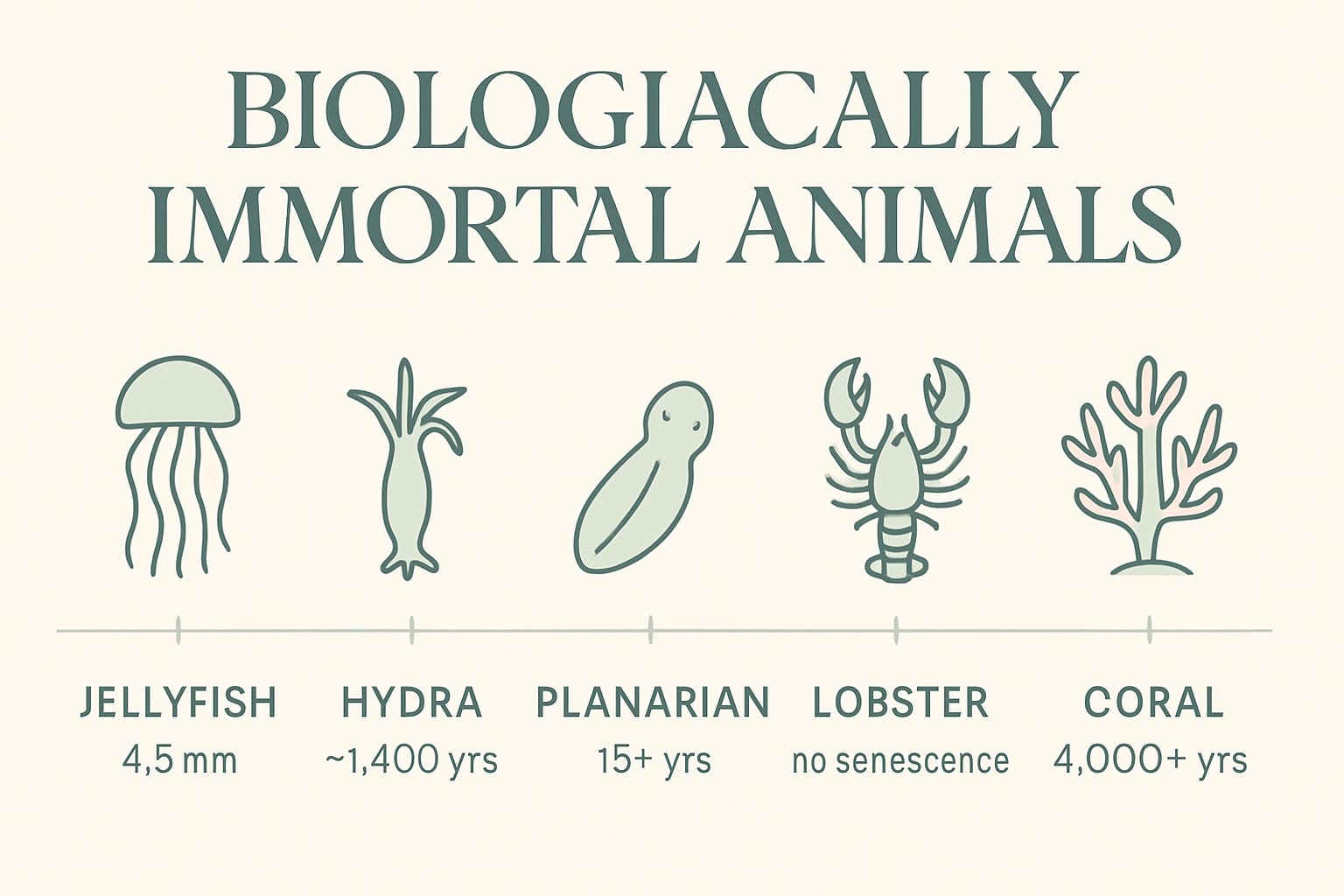
Famous as it is, the immortal jellyfish is not alone. A small group of animals — and a few colonies — either show no detectable aging at all or recover so completely that the line between “old” and “young” blurs. Here is how they compare.
| Animal | Mechanism | What “immortal” really means here |
|---|---|---|
| Turritopsis dohrnii (immortal jellyfish) | Transdifferentiation — rewinds to polyp | No fixed lifespan; predation still ends most lives |
| Hydra (freshwater polyp) | Constant stem-cell renewal driven by FoxO gene activity | No detected senescence; predicted lab lifespan around 1,400 years |
| Planarian flatworms (Schmidtea mediterranea) | Neoblast stem cells that keep replenishing telomeres | Clonal lines kept alive over 15 years with no aging signal |
| Lobsters | Telomerase that keeps repairing DNA into adulthood | Do not senesce in the normal sense; eventually die from molting failure |
| Some coral colonies | Continual modular regrowth at the colony level | Living colonies thousands of years old; individual polyps replaced |
It’s worth pausing on the lobster, because the lobster is usually misreported. Lobsters do not age the way we do — their DNA-repair machinery, including telomerase, stays switched on through adulthood. But they cannot escape their own shells. Each molt costs more energy than the last; eventually one fails, and the lobster dies of exhaustion or infection. The cells are not the limit. The exoskeleton is.
What scientists are actually learning
Why the immortal jellyfish has gone, in twenty years, from a marine-biology curiosity to a serious research subject is not romance. It is the genome. In 2022, an international team led by Maria Pascual-Torner and colleagues at the University of Oviedo published the most detailed analysis yet of T. dohrnii’s rejuvenation program in the Proceedings of the National Academy of Sciences. They identified hundreds of genes — many involved in DNA replication, DNA repair, and chromatin remodeling — that switch on during the medusa-to-polyp reversal. The pathways overlap with the ones humans use to repair stressed cells.
That overlap is what makes the species more than a curiosity. As Miglietta’s group at Texas A&M has put it, the jellyfish performs cellular reprogramming in less than 24 hours — the same kind of reprogramming that takes a human research lab months in a Petri dish with engineered transcription factors. Studying how a 4.5 mm animal does it for free, on demand, is suddenly extremely useful.
What it means for human medicine, and what it doesn’t
Honestly: nobody is going to extract immortality from a jellyfish. Humans are not modular hydroids. Our brains, in particular, are made of cells whose specific wiring is our memory; rewinding them is not a feature — it is amnesia, dementia, the end of the self. A reset that works for a 4.5 mm animal with a few thousand cells is exactly the opposite of what a 1.4 kg human brain needs.
But specific tricks travel. Researchers studying the immortal jellyfish are mapping which genes shepherd a mature cell back through cellular plasticity, which protect chromosomes from damage, and which suppress senescence. The same vocabulary already shows up in cancer biology and in regenerative medicine — bone, cartilage, possibly retina. The animal’s value is not as a fountain of youth. It is as the cleanest natural experiment we have on what “reset” looks like at the cell level.
If you are looking for one practical takeaway from this jellyfish, here it is: aging in nature is not a law. It is a strategy. A few species have solved around it; most of us never will. We probably won’t either — but we may borrow the parts.
Frequently Asked Questions
Q: Is the immortal jellyfish actually immortal?
A: Biologically yes — it has no fixed aging timeline and can reset its own life cycle. Practically no. Most wild Turritopsis are eaten or killed by disease long before they ever rewind. “Immortal” here means “does not die of old age,” not “cannot be killed.”
Q: How does the immortal jellyfish reset its age?
A: Through transdifferentiation. Its mature adult cells convert directly into different specialized cells without first going back through a stem-cell stage, allowing a stressed medusa to collapse into a polyp and start its life over within roughly 24 to 36 hours.
Q: Are there other animals that can live forever?
A: A small group qualifies as “biologically immortal” in the sense of showing no detectable aging — including Hydra, some planarian flatworms, and certain coral colonies. Lobsters age very slowly but ultimately die from failed molting, not from senescence.
Q: Could humans use the immortal jellyfish’s secret to live forever?
A: Not directly. Human bodies, and especially human brains, are not built for that kind of full reset. The real value lies in the specific genetic pathways the jellyfish uses to repair DNA and reprogram cells, which overlap with pathways being studied in cancer biology and regenerative medicine.
Sources
- Pascual-Torner et al., Proceedings of the National Academy of Sciences, 2022 — comparative genomics of Turritopsis dohrnii rejuvenation.
- Natural History Museum, London — public science writing on biological immortality and Turritopsis dohrnii.
- Texas A&M University at Galveston — ongoing immortal-jellyfish research led by Dr. Maria Miglietta.
- American Museum of Natural History — explainer on transdifferentiation and the immortal-jellyfish life cycle.
- Encyclopædia Britannica — entry on the immortal jellyfish.
The immortal jellyfish is not a promise. It is a reminder. Somewhere inside the soft, almost invisible body of an animal we keep losing in the water, evolution has already written a paragraph that human medicine spends careers trying to translate. The animal that can live forever is mostly busy getting eaten — and quietly, in the gaps, showing us that the rules we thought were biology were only ever one way of doing biology.
Illustrations are AI-generated. Article fact-checked and human-edited. Our editorial standards.