How Humpback Whales Recovered After the 1986 Whaling Ban
The story of how humpback whales recovered after the 1986 whaling ban starts with a single brutal number: one population in the eastern South Pacific had been cut to roughly 450 animals. Not 450 thousand. Four hundred and fifty whales — the last survivors of a stock that once numbered in the tens of thousands. Four decades after commercial whaling was paused, that same population swims past 25,000, and the global total has climbed from a few scattered thousands back toward an estimated 84,000. It is the most-cited proof that large-mammal conservation can work at the scale of a whole ocean. It is also, on closer inspection, a far stranger and less tidy story than the anniversary headlines suggest.
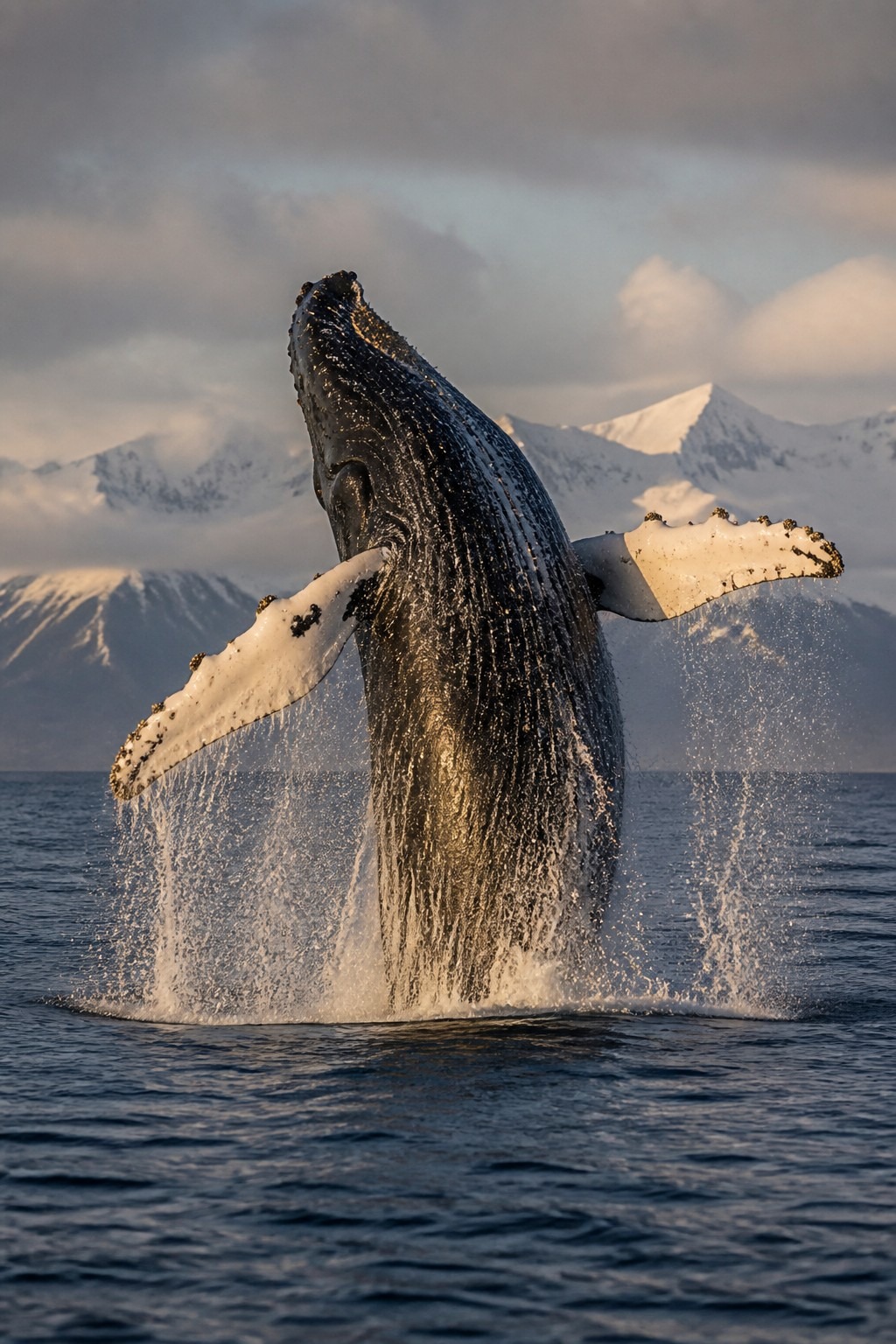
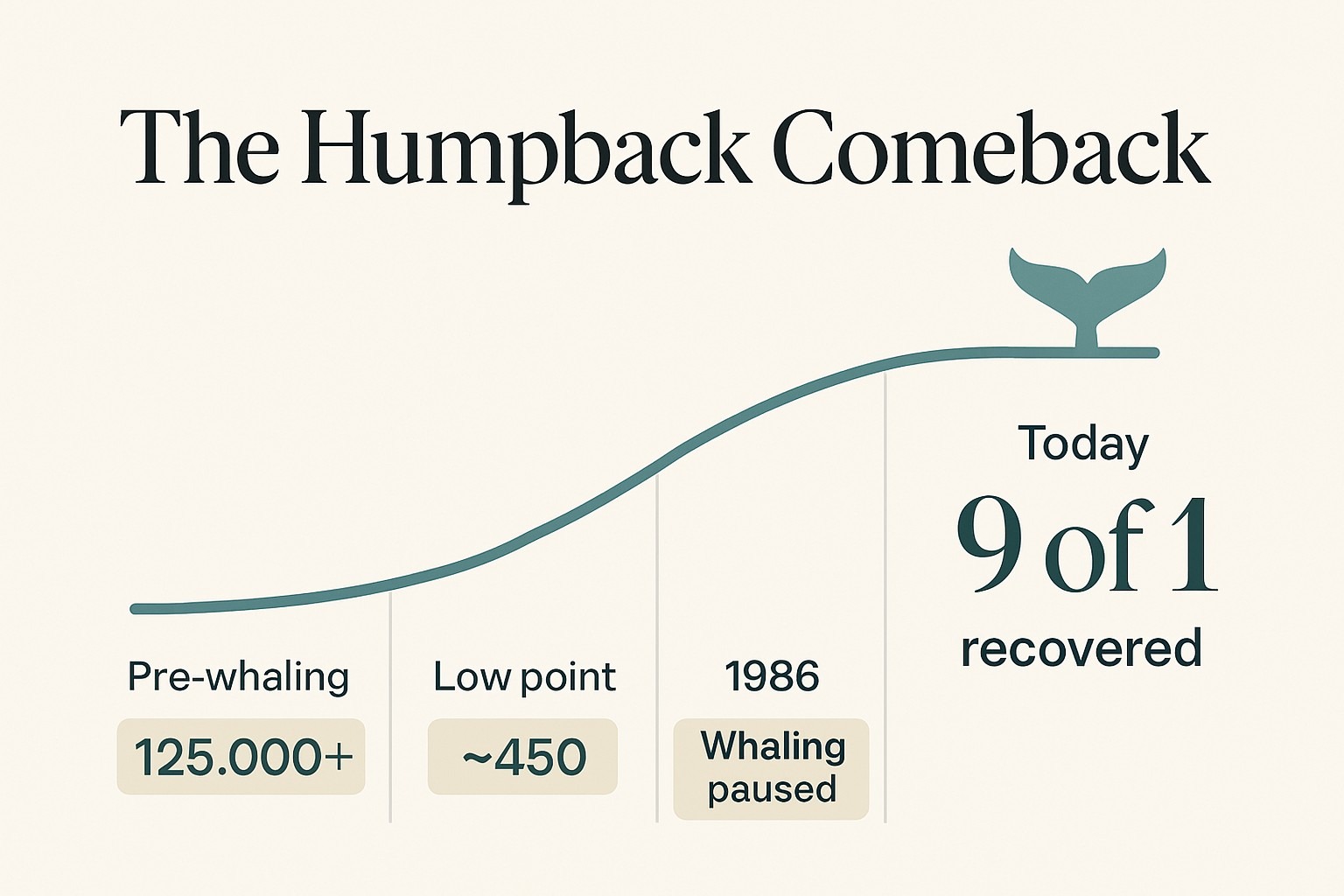
- 125,000+ — estimated humpbacks worldwide before industrial whaling
- ~450 — low point of one eastern South Pacific population; now above 25,000
- 25 to 7 — the 1982 IWC vote that created the moratorium (5 abstained)
- ~84,000 — estimated humpbacks alive today, several stocks near pre-whaling levels
- 9 of 14 — humpback populations NOAA judged recovered enough to delist in 2016
The short answer: humpbacks rebounded because the 1986 moratorium stopped the killing at the same moment their biology — flexible diet, fast breeding, coastal nurseries — let them cash in on the reprieve. Most other great whales got the same protection and did not.
Key Facts
- One eastern South Pacific humpback population was cut to roughly 450 animals and now swims past 25,000.
- The pre-whaling global total was 125,000+, collapsed to a few thousand (about 95% loss), and is an estimated 84,000 today.
- The IWC moratorium was adopted on 23 July 1982 by a 25-7 vote with 5 abstentions and took force from the 1985/86 season.
- The West Indies breeding population grows at about 3.1% a year and the East Australian population at close to 11%.
- In 2016 NOAA judged 9 of 14 humpback populations recovered enough to delist.
In short: Humpback whales rebounded from near-collapse, one population had just about 450 animals, after the 1986 whaling moratorium. Their flexible diet, fast breeding and protectable coastal nurseries let them recover to an estimated 84,000 today, while slower-breeding species like the North Atlantic right whale did not.
From 125,000 to a Few Hundred: How Whaling Almost Emptied the Oceans
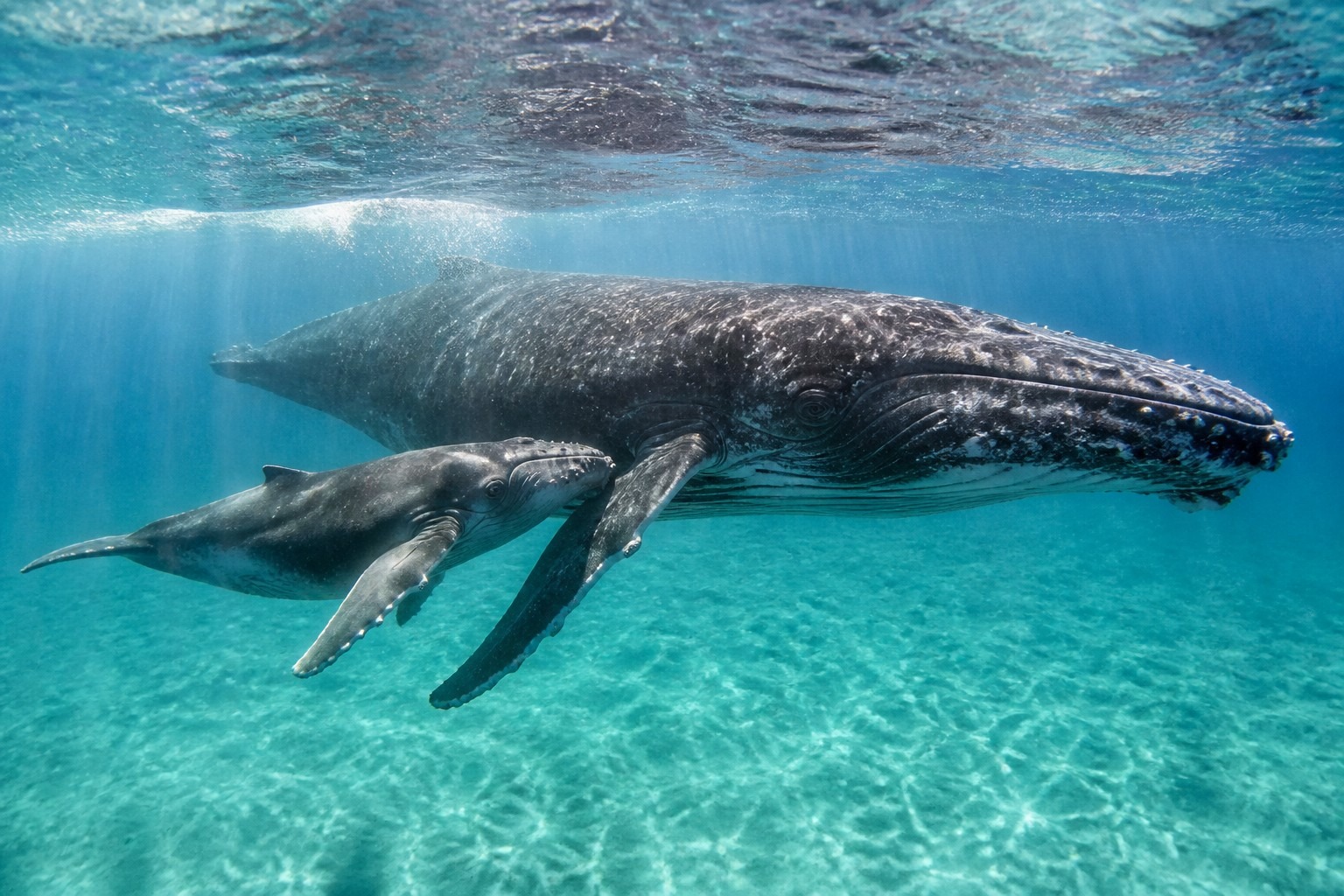
For most of human history, humpbacks were too fast and too likely to sink when killed for early whalers to bother with. The exploding harpoon gun and steam-powered catcher boats of the late 1800s ended that reprieve. By the 20th century, factory ships could process a whale in under an hour, anywhere on Earth.
The arithmetic was merciless. Somewhere north of 125,000 humpbacks had cruised the world’s oceans before industrial whaling; by the time the killing wound down, the global population had collapsed to a few thousand — a loss on the order of 95 percent. Whole breeding groups were reduced to remnants you could count in an afternoon. The Southern Hemisphere took the worst of it, with the Soviet fleet alone killing tens of thousands of protected whales and falsifying the records for decades afterward.
By the early 1960s, the species that would later become the poster animal for recovery looked, in many regions, like the next candidate for extinction.
The 1982 Vote That Very Nearly Failed
Here’s the part almost no anniversary piece tells you: the moratorium was not a foregone conclusion. It was a political knife-fight.
On 23 July 1982, the International Whaling Commission voted on a pause to all commercial whaling. Passing it required a three-quarters majority of the members casting a vote — a high bar, and the whaling powers knew it. The Soviet Union and Japan led the resistance, joined by Norway, Iceland, Brazil, Peru and South Korea. What tipped the balance was an unlikely coalition of newer members — small island and coastal states like the Seychelles and Oman among them — that had joined the Commission and swung it toward conservation.
The final tally was 25 in favour, 7 against, 5 abstaining. It cleared the threshold. The pause took force from the 1985/86 season, which is why 1986 is the date carved into the story. And a crucial technicality survives to this day: it was adopted as a moratorium — a renewable pause, reviewed and re-affirmed at IWC meetings — not a permanent, irreversible ban. Norway and Iceland lodged formal objections and still hunt; Japan left the IWC in 2019 to resume commercial whaling in its own waters. The treaty that saved the humpback was, and remains, a truce rather than a verdict.
{IMAGE_2}
How Humpback Whales Recovered After the 1986 Whaling Ban, Region by Region
Stop the killing, and a humpback population does something remarkable: it grows fast, often at or near the biological ceiling for a large whale. The US agency NOAA Fisheries tracks two of the clearest examples. The West Indies breeding population — the humpbacks most North Americans see — has been climbing at roughly 3.1 percent a year. The East Australian population has done even better, expanding at close to 11 percent annually, roughly the fastest a whale species can reproduce.
Those percentages compound into staggering totals. Australia’s east-coast humpbacks were hunted down to a few hundred survivors by the early 1960s; today the same migration is counted in the tens of thousands. In the Pacific Northwest’s Salish Sea, humpbacks were essentially gone for most of the 20th century and are now a routine sight again, part of a broad North Pacific rebound. The single eastern South Pacific stock that bottomed out near 450 animals has multiplied more than fiftyfold.
This is what a species doing well looks like when we simply get out of the way — no captive breeding, no feeding programs, no gene banks. Just the removal of the one pressure that mattered.
Same Treaty, Very Different Fates
And yet the moratorium is not a magic switch. Handed the identical protection in 1986, the great whales split into winners and losers — which is the question the celebratory coverage keeps skipping. Why did the humpback surge while others stalled or kept sliding?
| Species | Status since the ban | Why |
|---|---|---|
| Humpback | ~84,000; several stocks near pre-whaling levels | Coastal nurseries, flexible diet, fast calving |
| North Atlantic right whale | ~370 left and still declining | Slow breeding; ship strikes and entanglement in crowded waters |
| Antarctic blue whale | A few percent of its pre-whaling numbers | Reproduces slowly; open-ocean; single-prey krill dependence |
The lesson is uncomfortable but clear: the moratorium did not save whales so much as give biology and geography the chance to decide which whales it could save. Four traits gave humpbacks the edge — they breed in shallow coastal waters that are easy to protect and monitor, calve every two to three years (fast, for a giant), sing a culture of songs that survived the population crash intact, and, crucially, eat almost anything.
Polar Cod One Year, Krill the Next
That last trait is where the freshest science lands. In a 2025 study in the journal Marine Mammal Science, a team working from the University of Southern Denmark — including cetacean biologist Olga Filatova — documented humpbacks in the Senyavin Strait off Chukotka, in the Russian Far East, doing something no textbook diet chart captures neatly.
In 2017, around a hundred humpbacks packed into the strait to gorge on polar cod. The next year the cod simply weren’t there. Rather than starve or leave, the whales switched to hunting krill — and the researchers could see it in three independent signals at once: the animals moved to different feeding spots, changed how they hunted, and carried a different chemical isotope signature in their tissue. Humpbacks, the study notes, already have the most varied diet of any rorqual. This is the mechanism behind that fact, caught in the act.
A right whale cannot do this. It is a specialist, tied to particular copepod patches; when those shift with a warming ocean, the whale follows into danger or goes hungry. The humpback just orders something else off the menu.
The 14 Populations Behind That One Big Number
“Humpback whales are recovered” is the headline. It is also an oversimplification, and the real picture is more useful. In 2016, NOAA formally split the species into 14 Distinct Population Segments and judged each on its own merits. Nine of the fourteen were found to no longer warrant protection under the US Endangered Species Act — a genuine conservation milestone. But four remain listed as endangered: the Central America, Western North Pacific, Cape Verde/Northwest Africa and Arabian Sea populations. One more, the Mexico segment, is listed as threatened.
The Arabian Sea humpbacks are the quiet tragedy inside the triumph — a small, genetically isolated group of perhaps a few hundred whales that, uniquely, never migrate. When someone tells you the humpback is “off the endangered list,” the honest reply is: most of them are. Some are still hanging on.
The New Threats Nobody Puts on the Anniversary Poster
Recovery creates its own problems. As humpback numbers rebuild, more whales are moving back into busy coastal shipping lanes, and ship strikes and fishing-gear entanglement are now leading causes of injury and death for large whales along both US coasts. The next bottleneck may be food itself: humpbacks lean heavily on krill, and krill stocks are sensitive to warming and ice loss, which is one reason scientists watch the animals as an early-warning indicator for whole ecosystems.
Even the whales’ own genetics are shifting under the recovery. A 2026 study in Current Biology, led by the Sea Mammal Research Unit at the University of St Andrews, found that as a New Caledonian population rebuilt, its age structure normalised — and older males began fathering a growing share of the calves, apparently out-competing younger rivals through experience in singing and sparring. Success, in other words, is quietly rewriting who gets to pass on their genes. The comeback is not a finish line; it is a moving target.
What the Humpback Teaches Us About Saving Anything Big
There is a bracing economic footnote to all this. The commercial whaling the world gave up in 1986 has been dwarfed by what replaced it: whale-watching now generates on the order of $2 billion a year worldwide and supports thousands of jobs, according to figures compiled by the International Fund for Animal Welfare. A living humpback, it turns out, is worth far more than a dead one — repeatedly, to whole coastal economies.
But the deepest lesson of how humpback whales recovered after the 1986 whaling ban is about honesty. Protection is necessary and it is not sufficient. It bought time; the whale’s own biology spent it well. Where an animal breeds slowly, eats one thing, or lives out of our sight, the same law can be passed and the same species can still slip away. Save the pressure and the place, and let a resilient animal do the rest — that is the humpback’s real instruction manual, and it applies to a great deal more than whales.
Questions Readers Ask
When was commercial whaling banned?
The IWC voted for a moratorium on 23 July 1982, and it took effect from the 1985/86 season — which is why 1986 is the date usually cited. It is a renewable pause, not a permanent ban, and a few nations still object or hunt outside it.
How many humpback whales are there today?
Recent estimates put the global population around 84,000, up from more than 125,000 before industrial whaling and only a few thousand at the low point. Several regional populations are now near their pre-whaling levels.
Why did humpbacks recover faster than other whales?
Four reasons: they breed in shallow coastal waters that are easy to protect, they calve relatively often (every two to three years), they eat a wide range of prey, and their song culture survived the population crash. Slower-breeding, specialist whales like the North Atlantic right whale lacked these advantages.
Are humpback whales still endangered?
Some are. NOAA recognises 14 distinct populations; nine no longer warrant listing, but four (Central America, Western North Pacific, Cape Verde/Northwest Africa and Arabian Sea) remain endangered and one (Mexico) is threatened.
Sources and Notes
- NOAA Fisheries — Humpback Whale species assessment and the 14 Distinct Population Segments listing (2016)
- International Whaling Commission (IWC) — Commercial Whaling Moratorium, adopted 23 July 1982
- Marine Mammal Science — Titova, Filatova et al., “Changing the Menu: Humpback Whale Diet Switching in Senyavin Strait, Chukotka” (2025)
- Current Biology / Sea Mammal Research Unit, University of St Andrews — age-related sexual selection in a recovering humpback population (2026)
- International Fund for Animal Welfare (IFAW) — global whale-watching economic estimates
The humpback did not come back because we healed it. It came back because we stopped hurting it, and then a fast, adaptable, ocean-crossing animal took the opening and ran. That is the hopeful part — and the warning. The next great whale we try to save may not be so forgiving of half-measures, which is exactly why the humpback’s story is worth telling correctly.
Frequently Asked Questions
Q: How much did humpback whales recover?
Dramatically. One eastern South Pacific population that bottomed out near 450 animals now exceeds 25,000, and the global total has climbed from a few thousand back toward an estimated 84,000. In 2016 NOAA judged 9 of 14 humpback populations recovered enough to delist, and several stocks are now near their pre-whaling numbers.
Q: What was the 1986 whaling ban?
On 23 July 1982 the International Whaling Commission voted 25 to 7, with 5 abstaining, for a pause on all commercial whaling, which took force from the 1985/86 season, hence 1986. It was adopted as a renewable moratorium, not a permanent ban; Norway and Iceland lodged objections and still hunt, and Japan left the IWC in 2019 to resume whaling.
Q: Why did humpbacks recover when other whales didn’t?
Biology and geography. Humpbacks breed in shallow coastal waters that are easy to protect, calve every two to three years, which is fast for a giant, and have a flexible diet. The North Atlantic right whale, at about 370 left and still declining, breeds slowly and faces ship strikes and entanglement; the Antarctic blue whale depends on open-ocean krill.
Q: How fast can a humpback population grow?
Close to the biological ceiling for a large whale. NOAA tracks the West Indies breeding population climbing at roughly 3.1% a year and the East Australian population at close to 11% annually, about the fastest a whale species can reproduce. Those rates compound: Australia’s east-coast humpbacks went from a few hundred survivors to tens of thousands.
Illustrations are AI-generated. Article fact-checked and human-edited. Our editorial standards.