Hummingbird Heart Rate: From 1,260 BPM to 50 Overnight
A ruby-throated hummingbird hovers at a salvia bloom, and inside its thumb-sized chest the hummingbird heart rate is doing something almost mechanically impossible — roughly 1,200 beats every minute, twenty per second, faster than a sewing machine and faster than any other vertebrate heart on the planet.

Key Facts
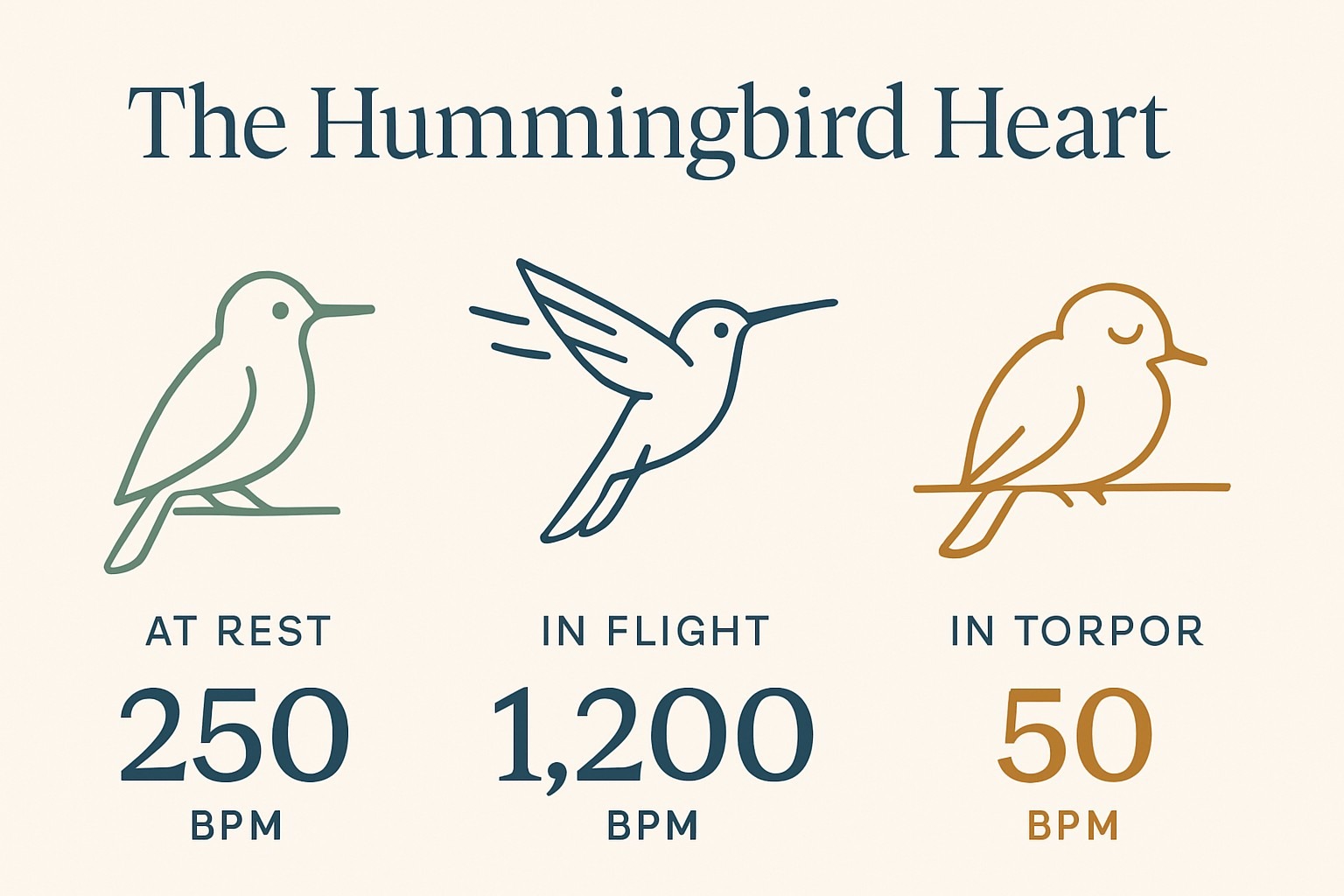
- In hovering flight, a hummingbird heart can beat about 1,200 times per minute, with individual recordings reaching 1,260 bpm — the highest documented heart rate of any vertebrate.
- At quiet rest on a perch, that same heart typically slows to roughly 250–500 bpm, depending on species, temperature, and how the measurement was made.
- During overnight torpor, the heart can collapse to as low as 50 bpm and metabolism drops by up to 95% — a 24-fold range in a single organ.
- The hummingbird heart is enormous for its body: about 2.5% of total body mass, versus roughly 0.3% in humans.
- Only three bird groups are known to enter deep torpor: hummingbirds, nightjars, and a single mousebird species.
In short: The hummingbird heart rate isn’t one number — it’s a range from about 50 to 1,260 beats per minute that the bird walks up and down every single day. That elasticity, not the top speed, is the real marvel.
Key Facts
- In hovering flight a hummingbird heart can beat about 1,200 times per minute, with individual recordings reaching 1,260 bpm – the highest documented heart rate of any vertebrate.
- At quiet rest on a perch the same heart typically slows to roughly 250-500 bpm, depending on species, temperature, and measurement method.
- During overnight torpor the heart can collapse to as low as 50 bpm and metabolism drops by up to 95%, a 24-fold range in a single organ.
- The hummingbird heart is about 2.5% of total body mass, versus roughly 0.3% in humans.
- Only three bird groups are known to enter deep torpor: hummingbirds, nightjars, and a single mousebird species.
In short: The hummingbird heart rate is not one number but a range that runs from about 50 to 1,260 beats per minute, which the bird adjusts up and down every single day. The 1,260 bpm record comes from a captured blue-throated hummingbird in active flight, while resting rates fall to roughly 250-500 bpm and deep torpor drops the heart to as low as 50 bpm. That elasticity, not the top speed, is the real marvel.
The number everyone quotes — and why it’s slippery
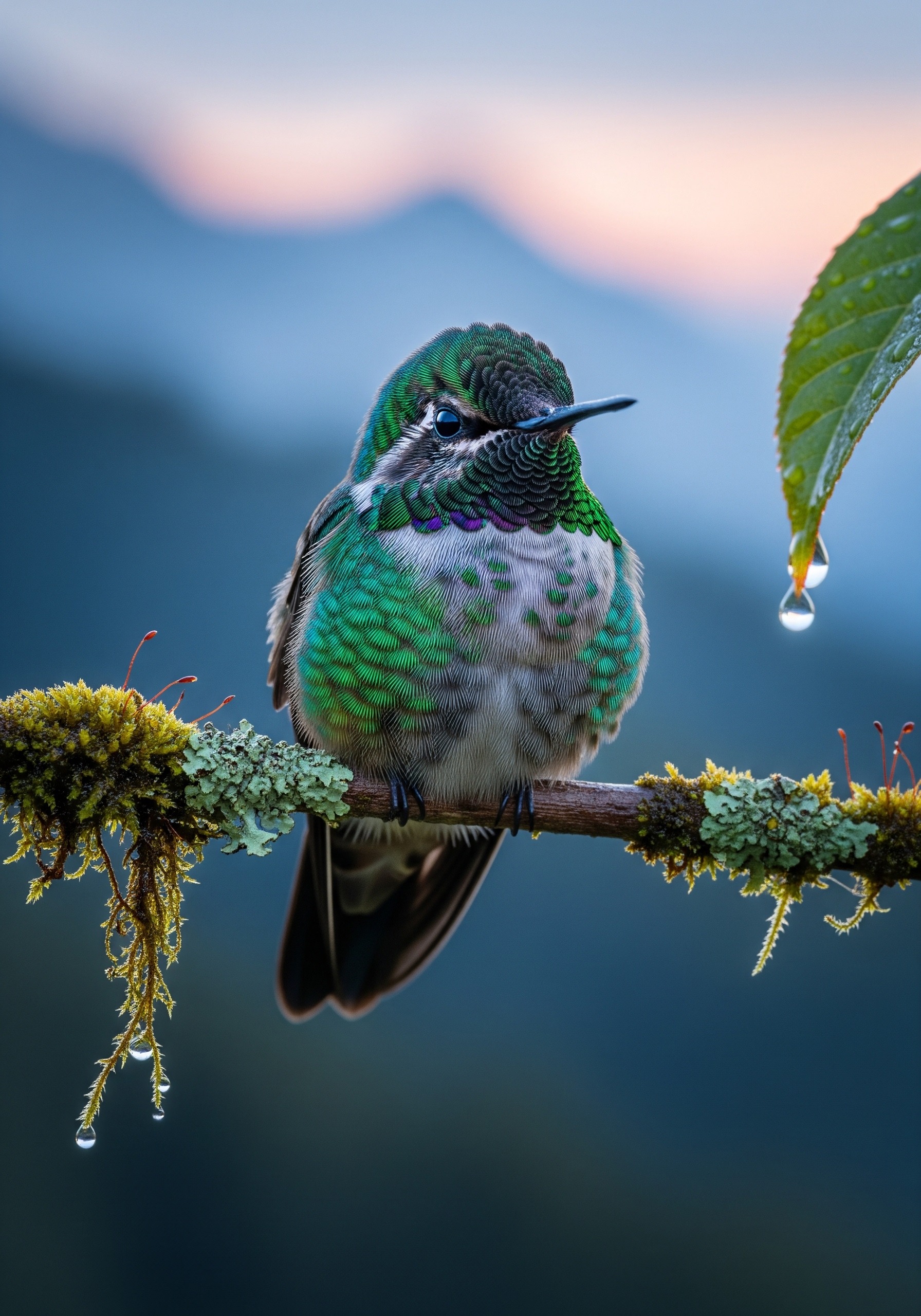
Open ten articles about hummingbirds and you’ll see ten different “definitive” heart rate numbers. 1,200. 1,260. 500. 250. They are all, in their way, correct. The hummingbird heart rate is not a fixed property of the bird; it’s a moving dial the bird itself adjusts, sometimes by an order of magnitude, within a single hour.
The widely cited 1,260 bpm figure comes from a captured blue-throated hummingbird measured in active flight, and remains the record. Around 1,200 bpm is a typical hovering value for several common species. Resting rates in the literature scatter between roughly 250 and 500 bpm, partly because “resting” is harder to define than it sounds — a perched bird that has just spotted a rival is not really resting. And the bottom of the range, around 50 bpm in deep torpor, is itself a moving floor depending on how cold the night gets.
Honest version: pick a number for a headline if you must, but the truth is a curve, not a point.
Three lives in one heart
It helps to think of a hummingbird as living three physiological lives every twenty-four hours, each with its own cardiac signature.
The Hummingbird Heart, by State
| State | Heart rate | Body temperature | Metabolism |
|---|---|---|---|
| Hovering flight | ~1,200 bpm (peak 1,260) | ~40 °C (104 °F) | Highest of any vertebrate, gram for gram |
| Perched / resting | ~250–500 bpm | ~38–40 °C | Still extreme — about 10× a human athlete |
| Nocturnal torpor | As low as 50 bpm | Can drop ~28 °C (50 °F) below normal | Down ~95% — close to suspended |
Ranges synthesised from Cornell Lab of Ornithology, the Smithsonian, and peer-reviewed work cited below. Values vary by species and method.
{IMAGE_2}
How a heart can possibly beat that fast
An adult human heart fills, contracts, and ejects roughly once a second. A hovering hummingbird heart does the same thing, completely, twenty times in the span of that single human beat. The obvious question is the right one: how is this not anatomically impossible?
Three things make it work.
First, the engine itself is oversized. Relative to body mass, the hummingbird heart is about eight times larger than ours — roughly 2.5% of body weight against humans’ 0.3%. In absolute terms it is microscopic; in proportion it is monstrous. Birds in general also enjoy a four-chambered heart inherited deep along the line from theropod dinosaurs, which keeps oxygen-rich and oxygen-poor blood strictly separated and lets every beat do useful work.
Second, the flight muscles around that heart are loaded with mitochondria — the microscopic factories that turn sugar and oxygen into the molecule cells actually burn. Hummingbird flight muscle has among the highest mitochondrial densities ever measured in a vertebrate, which is why a hummingbird can convert the nectar it just drank into hover thrust within minutes.
Third, the supply chain is built for it. A hummingbird’s lungs and air sacs flow oxygen in a near-continuous one-way circuit, not the in-out tidal arrangement mammals use, so the blood arriving at that frantic heart is exceptionally saturated. This is the part most “how fast does a hummingbird heart beat” articles skip, and it is the part that actually answers the question.
The 95% off-switch: torpor and the new science
For all that engineering, the hummingbird has a problem: a metabolism this fierce will starve overnight. A bird that weighs less than a nickel cannot store much fuel, and it cannot eat in the dark. So it does something extraordinary — it turns most of itself off.
Torpor is a controlled, reversible collapse of body temperature and metabolism, deeper than sleep, lighter than hibernation. A hummingbird in deep torpor feels cold, stiff, and unresponsive; an unlucky observer who finds one in the morning may assume it has died. It hasn’t. It is running on roughly five percent of its normal energy budget, waiting for sunrise to climb back into the world.
The science here has moved noticeably in the last few years. A 2022 study led by Anusha Shankar at the Cornell Lab of Ornithology, published in the Journal of Experimental Biology, showed that hummingbirds don’t simply have an on/off torpor switch — they choose between shallow torpor (body temperature down about 20 °F) and deep torpor (down roughly 50 °F), depending on the night’s conditions and their own fat reserves. Shankar’s team found that the smallest birds in the dataset used deep torpor every night, while larger species often opted for the shallower, less risky version.
A second piece of recent work pushed that further. In 2023, biologists Justin Baldwin (Washington University in St. Louis) and Gustavo Londoño (Universidad Icesi, Colombia), publishing in Proceedings of the Royal Society B, tracked 249 hummingbirds across 29 species in the Colombian Andes. They found that torpor isn’t a one-size-fits-all reflex but a flexible toolkit: birds in good physical condition began rewarming about an hour before sunrise so they could feed at first light, while birds in poor condition often waited for the sun itself to do the work. In the high Andes, the species most willing to use deep torpor were also the ones colonizing the coldest, highest elevations — strong evidence that this physiology is what let hummingbirds conquer the mountain.
The price of running at red-line
Engineering this aggressive comes with a bill. A hummingbird must drink something on the order of its own body weight in nectar every day, and supplement that with small insects for protein. Miss a few meals and the math goes red almost immediately.
The cardiovascular load itself is not free either. Researchers at the University of Nebraska, including evolutionary biologist Jay Storz, have spent years studying how high-altitude hummingbird species evolved subtly different hemoglobin molecules to squeeze more oxygen out of thin mountain air — a quiet adaptation that lets the same impossible heart keep working at 4,000 meters.
And then there is the trade most people don’t think about: living fast does not, in hummingbirds, mean dying young. A wild ruby-throated hummingbird that survives its first year can reach five, even nine years of age. That is biologically strange. By the rough rule that smaller and faster-metabolizing animals die sooner, hummingbirds should be lucky to see two summers. Torpor — those nightly metabolic pauses — appears to be one of the reasons they cheat the curve. A bird that spends a third of its life almost-not-running ages, in some sense, more slowly than the daytime math predicts.
What this looks like from the window
Standing two meters from a feeder, you can’t hear a hummingbird’s heart. You can almost see it. Watch the throat of a hovering bird closely and the iridescent feathers there flicker in a steady, very fast pulse — not from any single muscle but from the whole tiny body vibrating in time with what’s happening inside. You are looking at twenty heartbeats a second, in real time, in your garden.
The peregrine falcon may own the headline for the fastest animal on Earth, hitting more than 300 km/h in its hunting stoop. But the hummingbird, hovering quietly at a flower three meters from your kitchen window, holds an arguably stranger record — the most extreme cardiovascular system any backboned animal has ever evolved, running across a 24-fold range, day and night, without breaking.
That is worth a minute of attention the next time one shows up.
Frequently Asked Questions
Q: What is the fastest recorded hummingbird heart rate?
A: The highest figure widely cited in the scientific literature is approximately 1,260 beats per minute, measured in a blue-throated hummingbird during active flight. A typical hovering value across common species is around 1,200 bpm, which is still the fastest documented heart rate of any vertebrate.
Q: How does a hummingbird heart slow down so much at night?
A: It enters torpor — a controlled, reversible drop in body temperature and metabolism. Body temperature can fall by tens of degrees Fahrenheit, metabolism by up to 95%, and the heart rate can fall to roughly 50 bpm. The bird is not asleep; it is in a state much closer to brief hibernation, lasting only one night.
Q: Why is the hummingbird heart so large relative to body size?
A: Because the flight is so expensive. Hovering — generating lift from a near-standstill — burns more energy per second than almost anything else a vertebrate does. A heart that’s about 2.5% of body mass, paired with high-density mitochondria in the flight muscles and bird-style one-way lungs, is what makes the fuel-to-thrust math work.
Q: Do all hummingbird species have the same heart rate?
A: No. Smaller species generally run faster (the tiny bee hummingbird of Cuba is a particularly extreme case), and species at higher elevations have evolved subtly different hemoglobin to handle thinner air. The 250–1,260 bpm range is a useful envelope, not a single setting.
Sources
- Cornell Lab of Ornithology — Anusha Shankar et al., Journal of Experimental Biology (2022), on shallow vs. deep torpor in hummingbirds.
- Justin Baldwin (Washington University in St. Louis) and Gustavo Londoño (Universidad Icesi), Proceedings of the Royal Society B (2023), torpor flexibility in 249 Andean hummingbirds.
- University of Nebraska–Lincoln — Jay Storz lab, on hummingbird hemoglobin and high-altitude adaptation.
- Smithsonian National Zoo & Conservation Biology Institute — public reference material on hummingbird physiology and metabolism.
- National Audubon Society / BirdNote — popular-science reference on avian cardiovascular physiology.
The hummingbird heart is the clearest argument in vertebrate biology that “small” and “slow” are different words. The next one you see at a feeder is running an engine no human technology has matched — and tonight, very quietly, it will turn most of it off.
Illustrations are AI-generated. Article fact-checked and human-edited. Our editorial standards.