The Spinifex Hopping Mouse That Never Drinks Water
The spinifex hopping mouse never drinks water, and that single fact rewrites what most of us assume a mammal can survive. Meet Notomys alexis: a palm-sized Australian desert rodent with outsized ears, a long tufted tail, and two springy hind feet that carry it across the dunes in kangaroo-style hops. It weighs less than a chocolate bar. It lives where months can pass without rain — and it pulls off the impossible-sounding trick of drawing every drop of water it needs from dry seeds, then guarding that water with a kidney so efficient it holds a world record.
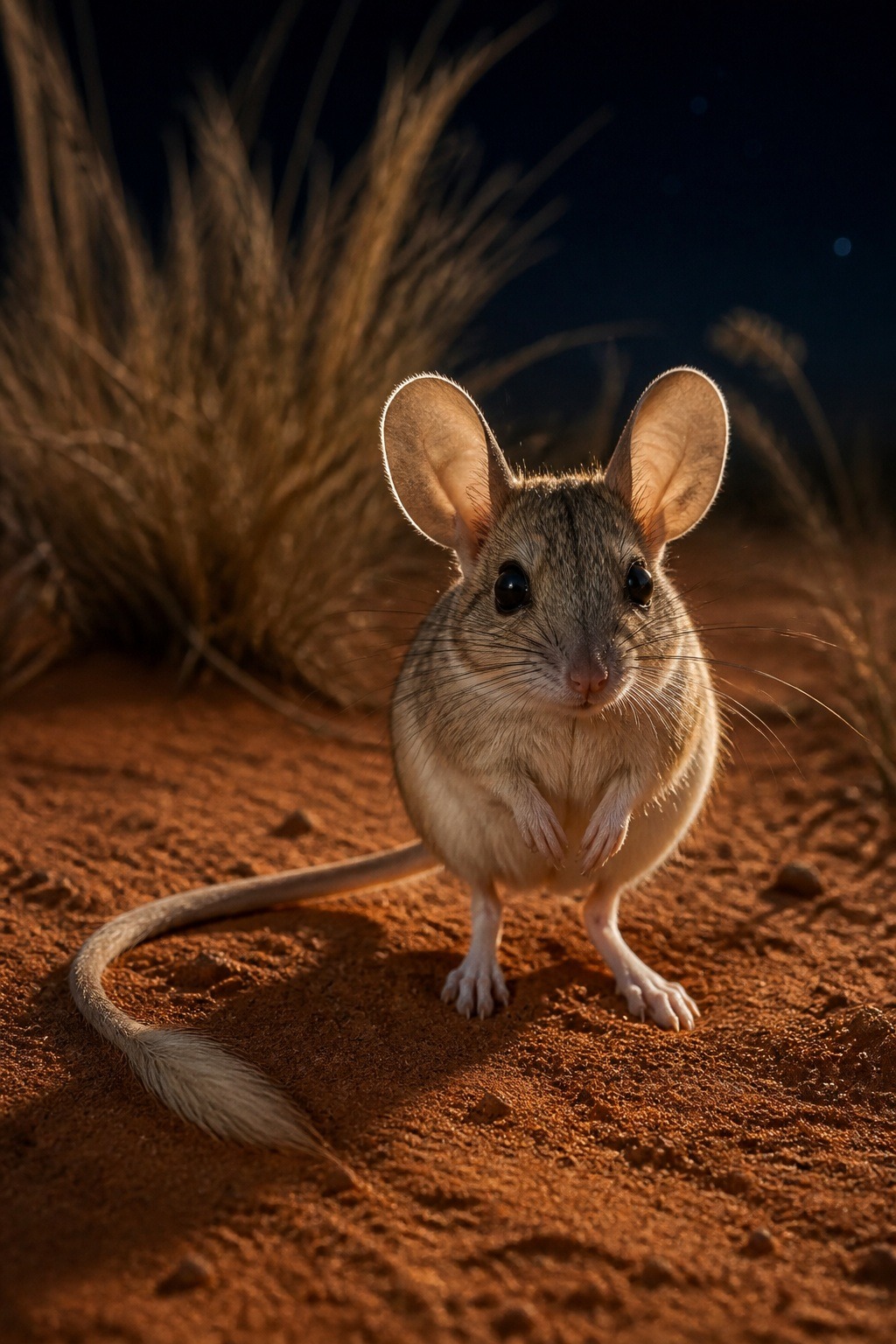
- Species: Notomys alexis — the spinifex hopping mouse, a nocturnal desert rodent
- Home range: arid spinifex grasslands and sand dunes of central and western Australia
- Build: roughly 27–45 g, big ears, a long tail with a tufted tip, hops on two hind feet
- The record: urine measured up to 9,370 mOsm/L — the most concentrated of any mammal ever recorded
- The water trick: can complete its life without drinking; survived 28 days of total water deprivation in the lab with no change in blood salt
Key Facts
- The spinifex hopping mouse (Notomys alexis) can complete its life cycle without ever drinking water.
- Its urine has been measured up to 9,370 mOsm/L — the most concentrated of any mammal on record.
- That concentration is about nine times the osmolality of seawater and roughly eight times maximum human urine.
- In a 2007 University of Western Australia study (Bradshaw and Bakker), the mice survived 28 days of total water deprivation with no change in blood salt.
- The mouse weighs roughly 27-45 grams and lives in arid spinifex grasslands of central and western Australia.
In short: The spinifex hopping mouse (Notomys alexis), a small Australian desert rodent, can live without ever drinking. It extracts water from dry seeds and guards it with a record-breaking kidney that produced urine measured at 9,370 mOsm/L — about nine times seawater. In a 2007 study it survived 28 days of total water deprivation without its blood salt rising.
The desert rodent that runs on dry seeds
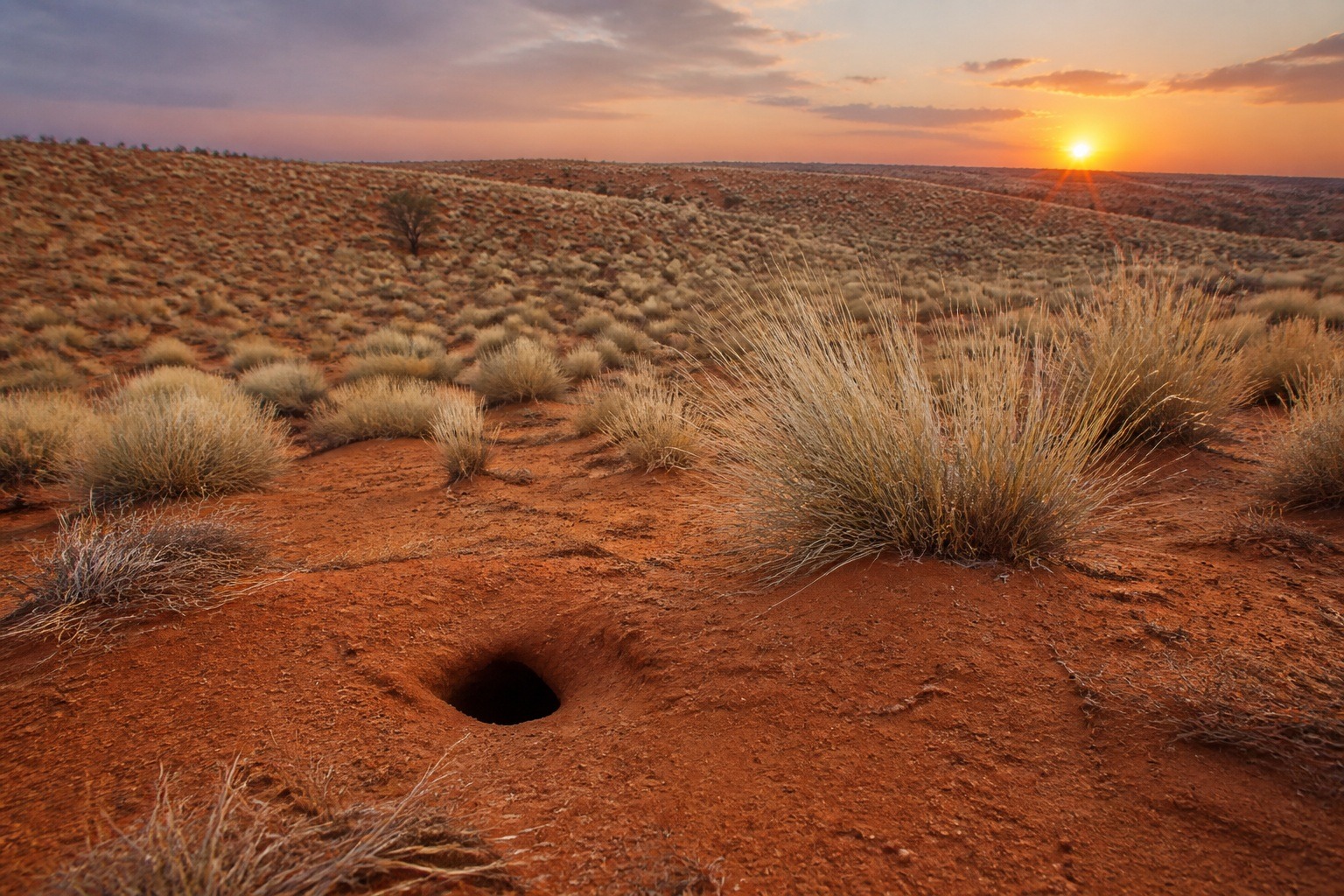
Picture the red sand country of central Australia after a long dry spell. The spinifex — spiky, tussocky grass that gives the mouse its name — stands bleached and brittle. Daytime heat is brutal, and open water is a rumour. This is where Notomys alexis makes its living, mostly on a diet of seeds, with the odd shoot or insect when the season allows.
Look closely and it reads like a small kangaroo redrawn as a mouse: elongated hind feet, a balancing tail longer than the body, and a bounding, two-footed gait that eats up ground between sparse food patches. The University of Michigan’s Animal Diversity Web notes that these mice are strictly nocturnal and highly social, sheltering by day in deep communal burrows and emerging after dark to forage across the cooling sand.
And here is the thing that stops biologists in their tracks. A seed is not a glass of water. A dry seed is, by definition, dry. So how does an animal build and run a warm-blooded body — heart, brain, kidneys, all of it thirsty for fluid — on a diet with almost no free water in it?
How the spinifex hopping mouse never drinks water
The answer is not one trick but a stacked system, and each layer buys back water the others would lose. There is a chemistry layer, a plumbing layer, and a behaviour layer, working in concert.
First, the mouse manufactures water from its food — a process called metabolic water production. Second, its kidney reclaims almost every usable drop before waste ever leaves the body, producing that record-breaking, near-solid urine. Third, it hides underground in humid air that lets it breathe without exhaling its reserves into the desert. Remove any one of these and the animal would fail; together, they close the loop so tightly that drinking becomes optional.
Of all the desert’s survival strategies, this one is the most quietly audacious — an animal that treats thirst not as a hardship to endure but as an engineering problem to solve.
{IMAGE_2}
Urine saltier than the sea: what 9,370 mOsm/L means
In 2007, physiologist Don Bradshaw and colleague H.R. Bakker, working at the University of Western Australia, published a study in Comparative Biochemistry and Physiology that put a hard number on the mouse’s kidney. Their measurement — urine concentration up to 9,370 milliosmoles per litre — remains the highest recorded for any mammal on Earth.
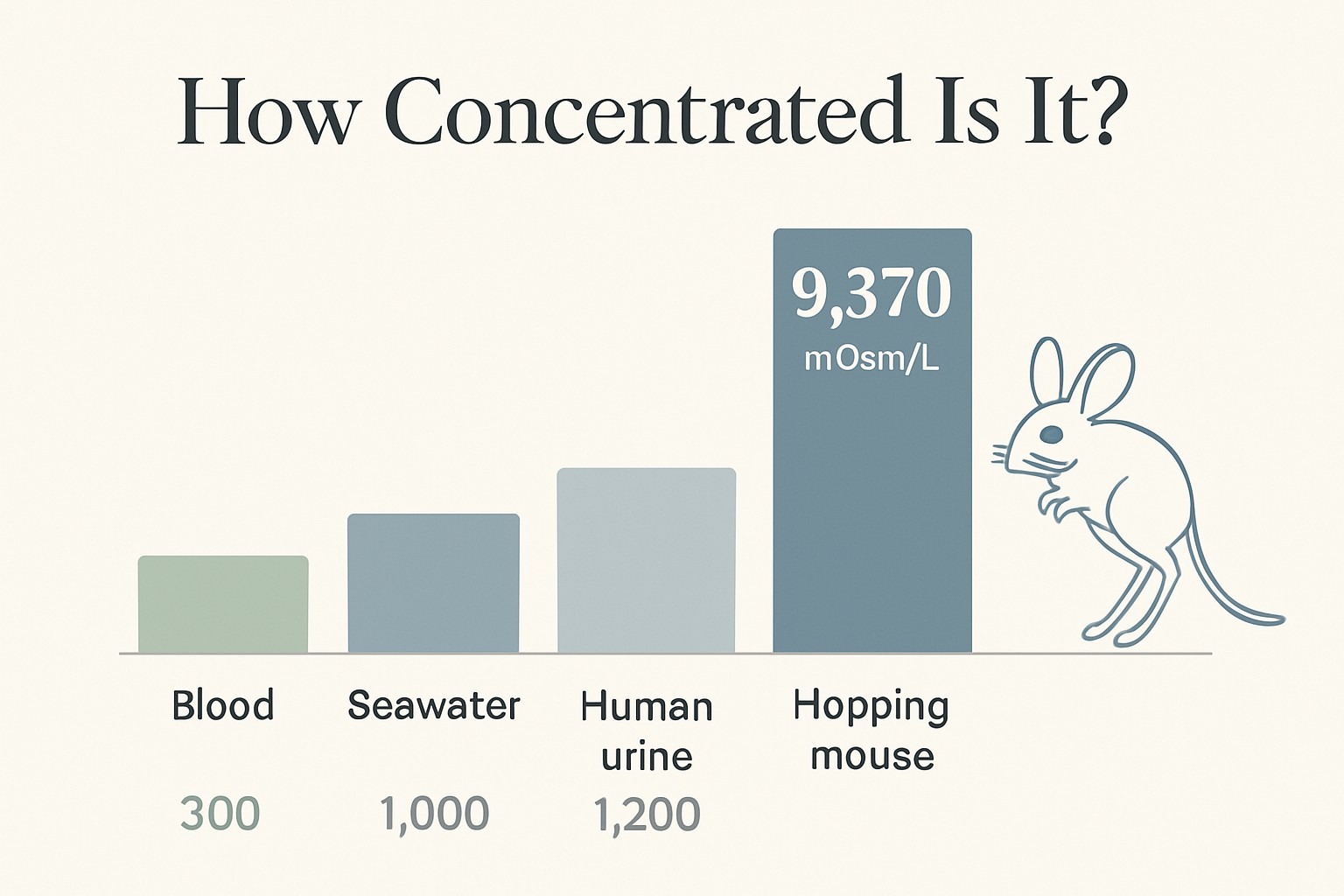
That number is abstract until you line it up against fluids you already know. Osmolality measures how many dissolved particles a fluid carries; the more particles, the more powerfully water is held. Here is the comparison the popular coverage almost never lays out:
| Fluid | Osmotic concentration (mOsm/L) |
|---|---|
| Human blood plasma (reference) | ~300 |
| Seawater | ~1,000 |
| Human urine (maximum) | up to ~1,200 |
| Spinifex hopping mouse urine (record) | up to 9,370 |
You will often read that this mouse makes urine “four times saltier than seawater.” That framing undersells it in one sense and overstates it in another, so let’s be precise: by osmotic concentration, 9,370 mOsm/L is closer to nine times the value of seawater, and roughly eight times the most concentrated urine a well-adapted human can squeeze out. The “salt” wording is a rough shorthand for dissolved-salt content rather than total osmolality — a small honest distinction that turns out to make the animal sound less extreme than it actually is.
- 9,370 mOsm/L — record urine concentration; highest of any mammal
- ~9× the osmolality of seawater; ~8× maximum human urine
- 28 days — total water deprivation survived with no rise in blood salt
- ~27–45 g — adult body weight
- 0 — drops of liquid water required to complete its life cycle
Inside the world’s most efficient kidney
Squeezing water out of waste comes down to a piece of anatomy called the loop of Henle — a hairpin tube inside the kidney that runs down into the organ’s inner region, the renal medulla, and loops back up. The longer and deeper that loop, and the thicker the medulla around it, the more powerfully the kidney can pull water back out of urine before it drains away.
In Notomys alexis, these structures are pushed to an extreme. The mouse has an unusually long loop of Henle set inside a thick, well-insulated renal medulla, working like a countercurrent wringer that recovers water down to the last practical drop. Reporting for Australian Geographic in 2018, landscape ecologist Dr Alex Kutt of Bush Heritage Australia described the result in memorable terms — urine so concentrated it approaches a paste, produced by what he characterised as one of the most efficient kidneys in the animal kingdom.
There is a molecular layer to this too. Research published in the Journal of Experimental Biology in 2008 traced how, under water stress, the mouse’s kidney cells ramp up a control protein known as TonEBP, which switches on genes that let the cells pile up protective osmolytes and keep functioning in punishing salt conditions that would wreck ordinary tissue. The plumbing is remarkable; the cellular chemistry keeping that plumbing alive is arguably more so.
Water made out of dry seeds
Saving water is only half the story. The other half is stranger: the mouse makes water it never drank.
When any animal burns carbohydrate for energy, oxidising it inside its cells, one of the by-products is water — so-called metabolic water. It is a trickle in most creatures, easily overlooked. In a seed-eating desert specialist, that trickle becomes a lifeline. By digesting and oxidising dry seeds, Notomys alexis tops up its internal reserves from food that a chemist would call bone-dry.
The most striking evidence came in 2012, when a University of Western Australia team including Don Bradshaw published in the Proceedings of the Royal Society B. Cut off from water, the mice did not simply ride out the shortage — they shifted strategy and ate more, driven by changes in the appetite hormones leptin and ghrelin. More dry food meant more fuel to oxidise, which meant more metabolic water. The animal’s response to having no water was, in effect, to manufacture its own supply.
Twenty-eight days without a drop, and the humid burrow
That same 2012 study delivered the headline that still surprises physiologists: the mice tolerated 28 days of complete water deprivation with no measurable change in the osmolality of their blood plasma. Their internal salt balance held rock-steady for a month while they took in nothing but dry food. Most mammals would be in serious trouble within days.
Behaviour seals the deal. Through the searing day, the mouse stays roughly a metre underground in a communal burrow where the trapped air is cool and humid — kept moist, in part, by the animals’ own breathing. Why does that matter? Because every exhaled breath normally carries water out of the body. Breathe humid air instead of hot desert wind, and far less moisture escapes with each breath. The burrow is not just shelter; it is a water-recycling chamber.
Other desert animals lean on their own extreme fixes for the same problem — the sandgrouse of Africa’s drylands, for instance, soaks water into specially structured belly feathers to carry it home to its chicks. The hopping mouse’s answer is quieter and entirely internal, but it solves the same brutal arithmetic: in the desert, water lost must never exceed water gained.
What a desert mouse can teach human medicine
Here is where a small nocturnal rodent reaches beyond natural history. The human kidney concentrates urine using the very same architecture — the loop of Henle, the renal medulla, the countercurrent system — just far less powerfully. Notomys alexis is essentially a living, breathing demonstration of that machinery run at its physical limit.
That makes it a valuable natural model for researchers studying how kidneys concentrate urine and how bodies cope with dehydration. The nephrology community has taken enough notice that the species featured in NephMadness, an annual kidney-education event run by the American Journal of Kidney Diseases blog, precisely because its biology throws the ordinary mechanism into sharp relief. To be clear, this is basic comparative science, not a treatment or therapy — but understanding an organ pushed to its extreme is often how researchers come to understand the same organ working normally, or failing.
It is a good reminder that the strangest corners of the animal world are frequently where the most useful questions hide.
Questions Readers Ask
Does the spinifex hopping mouse ever drink water at all?
If you offer it water in captivity, it will drink. The remarkable part is that it doesn’t need to: in the wild it can grow, breed and complete its life cycle drawing moisture entirely from food, which is why it thrives where standing water may be absent for months.
Which animal has the most concentrated urine?
The spinifex hopping mouse holds the mammal record, with measurements up to 9,370 mOsm/L — well beyond any other mammal tested, including other desert rodents.
How can it make water without drinking?
Through metabolic water: burning (oxidising) the carbohydrate in dry seeds releases water inside its cells. Combined with a record-efficient kidney and a humid burrow that cuts breathing losses, this internally produced water is enough to keep it in balance.
Is it the same as a kangaroo mouse or kangaroo rat?
No — and it’s a common mix-up. Kangaroo mice and kangaroo rats are North American rodents. The spinifex hopping mouse is Australian and only distantly related. Their similar hopping build and desert-water skills are a case of convergent evolution: separate lineages arriving at the same solution.
Sources and Notes
- Bakker, H.R. & Bradshaw, S.D. — “Kidney function in the Spinifex hopping mouse, Notomys alexis,” Comparative Biochemistry and Physiology, 2007 (record urine concentration of 9,370 mOsm/L)
- Heimeier, Bradshaw and colleagues — “Water deprivation induces appetite and alters metabolic strategy in Notomys alexis,” Proceedings of the Royal Society B, 2012 (28-day deprivation; metabolic water and appetite-hormone shift)
- “The effect of water deprivation on TonEBP… in the kidney of Notomys alexis,” Journal of Experimental Biology, 2008 (cellular osmolyte regulation)
- Australian Geographic (2018), reporting from Dr Alex Kutt, Bush Heritage Australia
- Animal Diversity Web, University of Michigan Museum of Zoology — Notomys alexis species account
- American Journal of Kidney Diseases Blog — NephMadness “Animal House” region
For all we now know about this mouse, the deepest question is still open: exactly how its kidney cells survive salt concentrations that would kill ordinary tissue — and whether the genetic switches behind that feat could one day inform how we understand our own kidneys under stress. A creature that never takes a sip may yet have plenty to tell us about thirst.
Frequently Asked Questions
Q: How does the spinifex hopping mouse survive without drinking water?
Through a stacked system of adaptations. First, it manufactures water from its dry-seed food via metabolic water production. Second, its extraordinarily efficient kidney reclaims almost every usable drop before waste leaves the body, producing near-solid urine. Third, it shelters by day in deep, humid communal burrows, so it breathes without exhaling its reserves into the desert air. Remove any one layer and the animal would fail; together they make drinking optional.
Q: How concentrated is the hopping mouse’s urine?
It has been measured up to 9,370 milliosmoles per litre — the highest recorded for any mammal, in a 2007 University of Western Australia study by Don Bradshaw and H.R. Bakker. For scale, human blood plasma is about 300 mOsm/L, seawater about 1,000, and maximum human urine up to about 1,200. So the mouse’s urine is closer to nine times the value of seawater and roughly eight times the most concentrated urine a human can produce.
Q: How long can it go without water?
Indefinitely under natural conditions — it can complete its entire life cycle without drinking. In the laboratory, the mice survived 28 days of total water deprivation with no rise in blood salt, a sign the kidney was keeping their internal chemistry perfectly balanced. They live in arid spinifex grasslands where months can pass without rain, subsisting mostly on dry seeds plus the occasional shoot or insect.
Q: What makes its kidney so efficient?
A piece of anatomy called the loop of Henle — a hairpin tube that runs into the kidney’s inner region and loops back. The longer and deeper the loop, and the thicker the surrounding renal medulla, the more powerfully the kidney pulls water back from urine. In Notomys alexis these structures are pushed to an extreme, working like a countercurrent wringer. A control protein called TonEBP also helps the cells cope with water stress.
Illustrations are AI-generated. Article fact-checked and human-edited. Our editorial standards.