How a Honeyguide Bird Leads Humans to Honey
The story that a honeyguide bird leads humans to honey sounds like a folk tale someone invented around a fire — a small brown bird that flies up, chatters at you, and waits for you to follow it to a hidden hive. It is not a tale. It is one of the best-documented cooperative relationships between a wild animal and our species, running for at least four centuries and probably far longer. And the truth underneath it is stranger than the legend: the same bird that guides you to breakfast is a cheat, a brood parasite, and — on a bad day — capable of leading you straight to a snake.
Key Facts
- The greater honeyguide (Indicator indicator) leads humans to wild bees’ nests, a partnership first recorded in writing in 1588.
- Among the Yao people of Mozambique, honey hunters and honeyguides find roughly 75% of the community’s annual wild-honey harvest together.
- A 2016 Science study showed the Yao brrr-hm call raised the chance of being guided from about 33% to about 66%, and of reaching a nest from about 16% to about 54%.
- A 2024 study led by Brian Wood (UCLA) and Claire Spottiswoode found honeyguides respond about three times more strongly to their own community’s local signal.
- The greater honeyguide is a brood parasite whose chicks kill their foster siblings.
In short: The greater honeyguide genuinely leads humans to wild bees’ nests, one of only two known human-wild-animal foraging partnerships. It gets beeswax it cannot reach alone; humans get honey. A 2016 study showed the Yao brrr-hm call more than tripled success, and a 2024 study found birds tuned to local human dialects. The bird is also a brood parasite.
Can a wild bird really call a human to dinner?
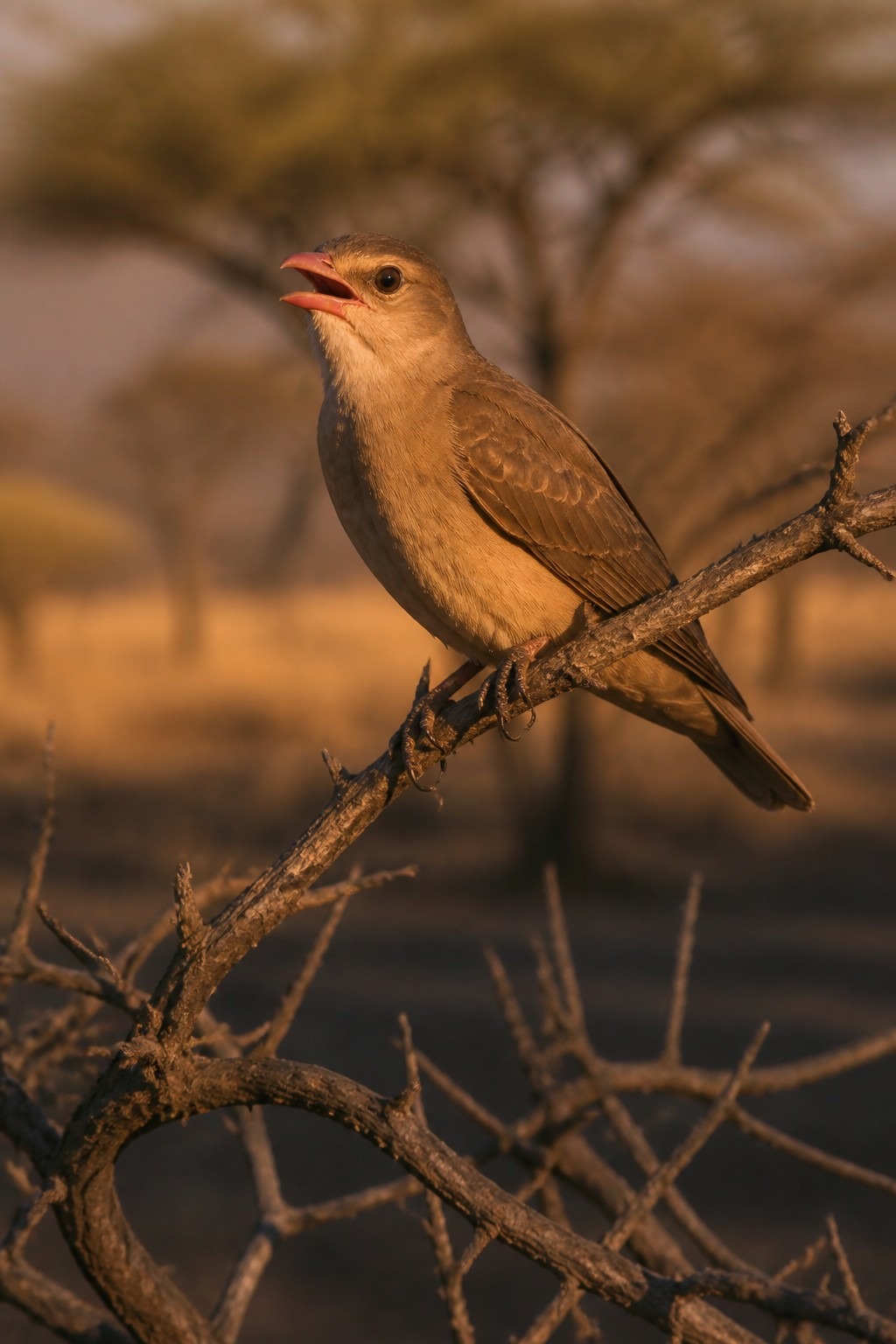
Yes, and it does it on purpose. The greater honeyguide (Indicator indicator) is a sparrow-sized bird of the African savanna and woodland, found across Mozambique, Tanzania, Kenya and much of sub-Saharan Africa. When it wants to work, it seeks out a person, flies close, and produces a distinctive chattering call while flitting from tree to tree in the direction of a bees’ nest. Follow it, and it will lead you — sometimes for several hundred metres, sometimes over a kilometre — to a colony of wild honeybees.
What makes this remarkable is that it is a genuine two-way deal, not a bird accidentally revealing food. The honeyguide loves beeswax — one of very few birds on Earth able to digest wax — but it cannot open a hardwood hive, and it cannot survive a mass stinging. Humans can do both. So the bird finds the honey, the human opens the nest and takes the sweet comb, and the bird gets the wax and larvae left behind. Turns out cooperation like this, between people and a free-living wild animal, is almost unheard of. Biologists know of only one other clear case: the mullet-herding dolphins of Laguna, in southern Brazil, which drive fish toward waiting fishermen.
How the honeyguide bird leads humans to honey — the actual mechanism
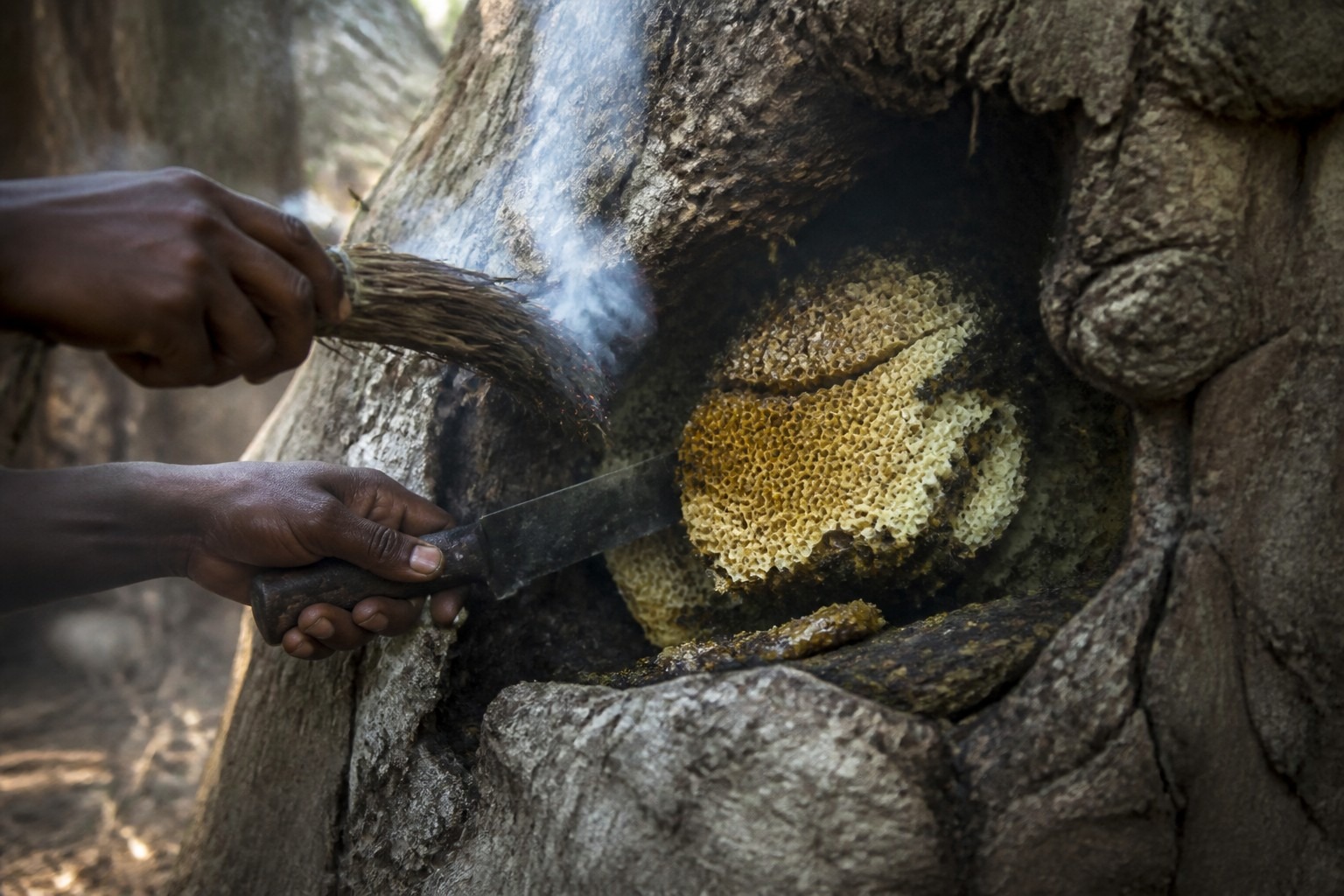
The partnership works because each side does exactly what the other cannot. A wild colony of Apis mellifera honeybees will defend its nest ferociously; a bird that lingered at the entrance would be stung to death. But honeyguides are superb at finding nests — they range widely, watch bees, and remember locations. People, armed with smoke and an axe or machete, can subdue the bees and break into a hive that a bird could never crack.
Among the Yao people of the Niassa Special Reserve in northern Mozambique, honey hunters and honeyguides find roughly three-quarters of the community’s annual wild-honey harvest together. The hunter smokes the bees into torpor, cuts out the comb, and — crucially — leaves the wax and the grub-filled remnants for the bird. Break that bargain too often and the relationship frays. Honesty, it turns out, is load-bearing on both sides of this arrangement.
{IMAGE_2}
Is the “brrr-hm” call really a two-way conversation?
This is where the science gets precise. In a 2016 study published in the journal Science, evolutionary biologist Claire Spottiswoode of the University of Cambridge and the University of Cape Town, working with Mozambican honey-hunters Carlos Augusto Bomba and colleagues, tested whether the birds respond to a specific human signal. The Yao hunters use a loud trilled grunt — written as “brrr-hm” — that they say summons honeyguides.
Spottiswoode’s team played the Yao brrr-hm call to wild honeyguides and compared it against control sounds (arbitrary words and other animal noises). The difference was large. The specialised call roughly doubled the chance that a bird would guide the hunters at all — from about a third of trips to two-thirds — and more than tripled the overall probability of being led to a bees’ nest, from around 16 percent with control sounds to about 54 percent with the real call. In her words, the birds treat the call as a message that means, in effect, “I am looking for honey — will you help?” The animal answers.
- ~75% — share of the Yao community’s annual wild-honey harvest found with a honeyguide’s help (Mozambique)
- 33% → 66% — the specialised “brrr-hm” call roughly doubled the chance of being guided (2016 Science study)
- 16% → 54% — and more than tripled the overall chance of reaching a bees’ nest
- ~3× — how much more responsive birds are to their local human signal vs. a foreign one (2024 study)
- 1588 — first written record of the partnership, by missionary João dos Santos
- 2 — known wild-animal foraging partnerships with humans (honeyguides; Brazil’s mullet-herding dolphins)
Do honeyguides have local “accents”? The 2024 twist
Here is the freshest and most surprising layer, and one almost no older article covers. Different human cultures call honeyguides in different ways — the Yao in Mozambique use their trilled brrr-hm, while the Hadza hunter-gatherers of Tanzania use a melodic whistle. Do the birds simply respond to any human noise, or do they learn the specific signal of the people they grew up around?
A 2024 study led by anthropologist Brian Wood of UCLA and Claire Spottiswoode found that the birds are tuned to the local dialect. Honeyguides in Yao country responded far more strongly to the Yao trill than to the Hadza whistle, and vice versa — roughly three times more responsive to their own community’s signal. That is cultural co-evolution across a species boundary: two different traditions, human and avian, learned in tandem in each place. A bird raised where people whistle learns to trust a whistle; a bird raised where people trill learns to trust a trill. Few facts in animal behaviour make the word “partnership” feel this literal.
The dark secret: a helpful bird that murders its foster siblings
Now for the part the guidebooks leave out. The greater honeyguide is a brood parasite. The female never builds a nest or raises her own young. Instead she slips into the underground burrow of another bird — often a bee-eater or a kingfisher — and lays her egg among the host’s clutch.
What hatches is not a grateful guest. The honeyguide chick emerges with sharp hooks on the tips of its bill, and it uses them to puncture and kill the host’s own newly hatched nestlings, eliminating the competition so it alone is fed. The same species that will guide a human family to food with apparent generosity begins life by quietly executing its nest-mates. It is a jarring reminder that “helpful” and “ruthless” are our categories, not nature’s — the honeyguide is simply, thoroughly, itself.
Does the bird ever lead people to danger — out of spite?
An old and widespread folk belief holds that a honeyguide cheated of its beeswax will take revenge, deliberately guiding the ungrateful hunter to a lion, a leopard, or a venomous snake instead of a hive. It is a good story. The evidence says it is wrong.
A 2025 study in the journal Ecology and Evolution by researchers including Jessica van der Wal and Claire Spottiswoode’s group examined real cases where honeyguides led people to dangerous animals — a snake, once even a dead galago (a small primate). The pattern pointed not to malice but to honest mistakes: the birds appear to rely on spatial memory of where a resource was, and occasionally guide to the wrong spot, or to an animal near a remembered site. There is no revenge in it. The bird is not punishing anyone; it is a small brain doing a hard job and sometimes getting the address wrong.
How old is this friendship, really?
Older than almost any other recorded relationship between humans and a wild animal. The first written account comes from 1588, when the Portuguese missionary João dos Santos, living in what is now Mozambique, noticed small birds slipping into his church to nibble the wax of the altar candles. Local people, he recorded, followed these same birds to find wild honey. His account, later published in his book Ethiopia Oriental, is the earliest documented description of the partnership — a written trail more than 430 years long.
And the true origin is almost certainly far deeper. Because the relationship benefits both species and requires no domestication, many researchers suspect it stretches back thousands of years, perhaps to early members of our own genus who used fire and tools to raid bees’ nests. We cannot date its beginning with any confidence — that part is genuinely unknown — but the honeyguide may be a living link to how our ancestors ate.
Common misconceptions
| Common belief | What the evidence shows |
|---|---|
| The bird stumbles onto food and humans just notice. | The honeyguide actively seeks out people and signals to them; playback experiments show it responds to a specific human call. |
| Honeyguides lead cheaters to lions or snakes as revenge. | A 2025 study attributes the rare “dangerous” guides to spatial-memory errors, not spite. |
| The bird eats the honey. | It’s after the beeswax and larvae — honeyguides are among the few birds that can digest wax. |
| Any human sound will summon one. | Birds respond about three times more strongly to their local community’s call than to a foreign one. |
Why the partnership is quietly disappearing
Something learned can also be unlearned. In many regions, cheap store-bought sugar has replaced the labour of wild honey-hunting, and fewer young people learn the calls, the tracking, or the etiquette of leaving wax for the bird. Where the human half of the tradition fades, the birds have fewer partners to guide — and because their guiding behaviour and their recognition of local calls are learned, not just instinctive, the whole two-way skill can erode within a generation or two.
That is the real stakes here. This is not a fragile species on the brink; the greater honeyguide is not endangered. What is fragile is the relationship — a piece of shared human-and-animal culture, possibly older than agriculture, that survives only where people still answer the bird. Lose the practice, and we lose one of the only conversations our species has ever managed to hold with a wild one.
Sources and notes
- Spottiswoode, C. N., Begg, K. S., & Begg, C. M. — “Reciprocal signaling in honeyguide-human mutualism,” Science (2016), University of Cambridge / University of Cape Town
- Wood, B. M., Spottiswoode, C. N., et al. — study of local human-call recognition (Yao trill vs. Hadza whistle), reported by UCLA and the University of Cambridge (2024)
- van der Wal, J., Spottiswoode, C. N., et al. — “honeyguides leading to dangerous animals,” Ecology and Evolution (2025)
- FitzPatrick Institute of African Ornithology, University of Cape Town — reporting on the ~75% Mozambique harvest figure (2025)
- João dos Santos — Ethiopia Oriental (1588/1609), earliest written record of the partnership
The short answer: A honeyguide bird really does lead humans to honey, on purpose, in a genuine two-way deal confirmed by playback experiments — one of only two wild-animal foraging partnerships known with our species. Just remember that the same helpful bird is a nest-invading brood parasite whose “revenge” is a myth, and whose 430-year-old friendship with us is now quietly fading.
Somewhere in the Niassa woodland tomorrow morning, a hunter will trill into the trees, and a small brown bird will answer and fly ahead. It has done this, in one form or another, since before we wrote anything down. Whether it still does it a century from now depends less on the bird than on whether we keep showing up to listen.
Frequently Asked Questions
Q: Can a wild bird really lead a human to honey?
Yes, on purpose. The greater honeyguide, a sparrow-sized African bird, seeks out a person, flies close, and gives a distinctive chattering call while flitting tree to tree toward a bees’ nest. It is a genuine two-way deal: the bird loves beeswax but cannot open a hardwood hive or survive mass stinging, while humans can do both. So the bird finds the honey, the human opens the nest, and the bird gets the leftover wax and larvae.
Q: Is the honeyguide’s call really a two-way conversation?
The science says yes. In a 2016 Science study, Claire Spottiswoode played the Yao hunters’ trilled brrr-hm call to wild honeyguides and compared it against control sounds. The specialised call roughly doubled the chance a bird would guide at all — from about a third of trips to two-thirds — and more than tripled the chance of reaching a nest, from around 16% to about 54%. The birds treat the call as a message meaning I am looking for honey.
Q: Do honeyguides have local accents?
Apparently so. Different cultures signal differently — the Yao in Mozambique use a trilled brrr-hm, while the Hadza of Tanzania use a melodic whistle. A 2024 study led by Brian Wood of UCLA and Claire Spottiswoode found birds respond about three times more strongly to their own community’s signal than to a foreign one. It is cultural co-evolution across a species boundary: birds raised where people trill learn to trust a trill.
Q: Is the honeyguide also a brood parasite?
Yes — the same helpful bird has a dark side. The female greater honeyguide never builds a nest or raises her own young. Instead she slips into the underground burrow of another bird, often a bee-eater or kingfisher, and lays her egg among the host’s clutch. When the honeyguide chick hatches it kills its foster siblings, so the same species that guides you to breakfast is a cheat and a killer of its nest-mates.
Illustrations are AI-generated. Article fact-checked and human-edited. Our editorial standards.