Supermoon: How 30% More Brightness Rewrites Nature
Every 14 percent of brightness sounds like nothing until you’re a wood mouse deciding whether to cross open ground. That’s what a supermoon does — it doesn’t just light the sky, it rewrites survival calculations across species that have spent millions of years reading the Moon’s actual distance as a signal for danger. The supermoon effects on nature cascade through ecosystems in ways most humans never witness because we stopped living in darkness centuries ago. Predators sharpen their advantage. Prey animals tighten their routes. The ocean surges higher than usual. And thirty kilometers closer, the Moon pulls tides that reshape coastal feeding zones in ways science is only now learning to measure.
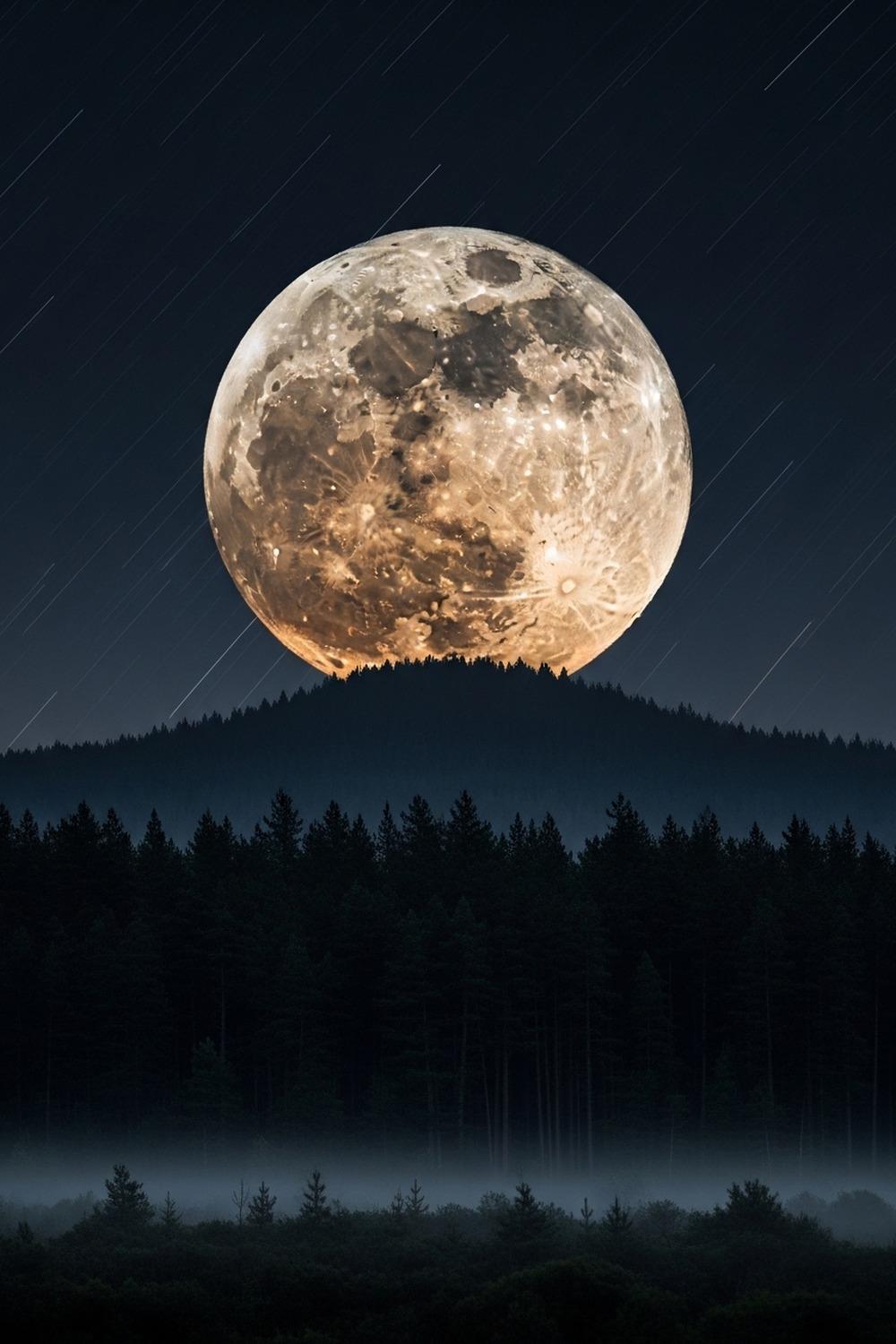
When the Moon reaches perigee — its closest orbital point, roughly 356,000 kilometers from Earth — and a full moon coincides with that moment, the result is what astronomers call a supermoon. The difference in apparent size is modest enough that most people miss it entirely. But the change in luminance is measurable, and measurable means consequential.
The deeper question isn’t whether the Moon looks bigger. It’s what happens in the forests, the estuaries, and the open ocean while we’re all looking up.
Key Facts
- At perigee the Moon sits roughly 356,000 km from Earth versus about 406,300 km at apogee, a difference of roughly 50,000 km.
- A supermoon produces approximately 30% more lunar luminance than a full moon at apogee due to the inverse-square law.
- University of Aberdeen research found wood mice reduce surface foraging time by up to 40% during full moon periods, intensifying during supermoons.
- Perigean spring tides during supermoons run 20 to 30 cm higher than typical spring tides, per NOAA’s 2017 study of 47 Pacific monitoring stations.
- Astrologer Richard Nolle coined the term supermoon in 1979 in Dell Horoscope magazine.
In short: The supermoon effects on nature are measurable: roughly 30% more lunar brightness sharpens predators like barn owls while wood mice cut foraging by up to 40%. Perigean spring tides rise 20 to 30 cm higher, reshaping intertidal feeding zones and altering nocturnal bird migration timing across species.
How Lunar Brightness Reshapes Nightly Survival
In 2019, researchers at the Max Planck Institute for Ornithology published findings from a long-running study on nocturnally migrating songbirds across Central Europe. Nights approaching a full moon, particularly a supermoon, saw measurable reductions in departure rates among several warbler species. Their data revealed something quietly startling: birds didn’t just migrate at night — they actively adjusted departure timing around lunar brightness. The birds weren’t confused. They were calculating risk. Bright nights mean predation pressure increases for small passerines traveling low over open ground. A supermoon doesn’t merely illuminate the journey — it exposes it.
At perigee, the Moon’s disk appears roughly 14 percent larger in diameter than at apogee. But brightness follows an inverse-square relationship with distance. The luminance gain is disproportionately larger than the size gain. Up to 30 percent more light hitting the ground below — that’s what the math produces. For a barn owl hunting a meadow vole, that difference is everything. The vole’s silhouette sharpens. Its pause between grass clumps becomes visible from 200 meters. The owl’s strike rate climbs.
In coastal Kenya, researchers tracking lioness hunting behavior across lunar cycles found that large-cat ambush success rates dropped sharply in the two weeks following a full moon. Prey animals were warier, moving less and keeping closer to cover. The supermoon effects on nature redistribute the balance of terror — and some nights, the light protects.
Tidal Forces and the Ocean’s Quiet Rearrangement
At perigee, the Moon’s gravitational pull on Earth’s oceans is measurably stronger than at apogee, producing what are known as perigean spring tides. These tides can run 20 to 30 centimeters higher than typical spring tides. For most coastal zones, that margin sounds minor. In shallow intertidal ecosystems — the layered world of barnacles, anemones, and foraging shorebirds — it’s the difference between a habitat flooded and a habitat exposed.
The redistribution of who feeds where on a given night can cascade through food chains in ways researchers are still cataloguing. The ecological reshuffling of intertidal zones during supermoon events was formally documented in a 2017 report by the National Oceanic and Atmospheric Administration (NOAA), which tracked tidal amplitude changes across 47 coastal monitoring stations in the Pacific basin. It’s a reminder that supermoon effects on nature aren’t confined to what’s visible from land. The deepest consequences happen where no human is watching.
Where does this tidal shift hit hardest? Here’s the thing: not the dramatic rocky coastlines of Iceland or Patagonia. It’s the low-gradient mudflats and estuaries of Southeast Asia and the Gulf of Mexico that see the most ecological disruption. A 25-centimeter tidal surge can expose or submerge hundreds of additional meters of feeding flat. Migratory shorebirds like bar-tailed godwits time their coastal refueling stops to tidal rhythms and have been documented arriving at staging grounds in altered numbers during supermoon events. Their internal clocks are calibrated to a Moon that’s usually a predictable distance away. A supermoon changes the geometry.
Fishermen in coastal Bangladesh have tracked these patterns for generations without any formal scientific framework. They call it the “big tide month.” Their catch patterns shift. Certain fish follow invertebrates that follow the tide line — and on supermoon nights, that line moves further than expected. Tradition, in this case, mapped ecology before science did.
The Predator’s Edge: Light as a Weapon
Few animals demonstrate the supermoon effects on nature more precisely than the barn owl. Tyto alba is already operating at the edge of what vision can do — its facial disc functions as a parabolic reflector for sound, and its asymmetrical ears allow triangulation of prey in complete darkness. Barn owls can detect prey movement at light levels 100 times lower than the human threshold, which means a supermoon pushes them deep into a sensory comfort zone most predators can’t access. But barn owls also hunt visually, and under a supermoon, their optical advantage multiplies.
A study published in the Journal of Zoology in 2021, led by researchers at the University of Exeter’s Centre for Ecology and Conservation, found that barn owl foraging trip duration shortened significantly during high-luminance nights. Not because they were working less, but because they were locating prey faster. The prey response is equally calibrated.
Wood mice in the UK showed statistically significant reductions in surface activity during full moon periods — and that suppression intensified during supermoon events when researchers at the University of Aberdeen tracked them over a decade. The mice didn’t simply hide. They foraged along tighter routes, hugged hedgerows more closely, and reduced total foraging time by up to 40 percent compared to new-moon nights. The energy trade-off is stark: less food gathered per night, but measurably better survival odds. Rodent populations that fail to adjust this behavior — in fragmented habitats where cover options are limited — show elevated predation rates during supermoon events.
A supermoon isn’t just a lunar event — it’s a selection event.
The mice that survive are the ones whose instincts are most tightly calibrated to light levels. Over generations, that pressure shapes behavior. The Moon, in its cycling orbit, has been editing animal behavior for millions of years.
Supermoon Effects on Nature: What the Data Actually Shows
Astrologer Richard Nolle coined the term “supermoon” in 1979, defining it as a full or new moon occurring within 90 percent of perigee. Astronomers initially resisted the label — it felt more tabloid than technical. But as ecological data accumulated, the underlying phenomenon earned serious scrutiny. In 2016, the Smithsonian Institution’s National Museum of Natural History convened a working group on lunar ecology, drawing together ornithologists, marine biologists, and behavioral ecologists to synthesize what was then a fragmented literature.
Their conclusion was direct: lunar brightness cycles, particularly supermoon events, produced statistically robust behavioral changes across a wide range of taxa. The effect size varied by species and habitat, but the signal was there, consistent, and larger than previously assumed. What the data keeps revealing is how tightly species are coupled to light levels that most humans no longer notice. Artificial light pollution has eroded our intuitive sense of what the Moon actually does to a landscape.
Stand in a genuinely dark field under a supermoon and the shadows are crisp — you can read a newspaper by it, an old naturalist’s benchmark that turns out to be literally true. That’s the environment that shaped bat foraging routes, moth flight timing, and the nocturnal movement of ungulates. (And this matters more than it sounds: the animals we study have never lived in the light conditions we inhabit.) The supermoon effects on nature aren’t anomalies. They’re amplifications of a system that’s been running for far longer than our cities have.
For species already under pressure from habitat fragmentation, a supermoon event can push population dynamics in ways that linger for weeks. Disrupted foraging translates to lower body mass heading into autumn. Lower body mass means reduced overwinter survival rates. Watching a species adjust its behavior because of gravitational mechanics from three hundred thousand kilometers away, you stop calling it a coincidence.
Migration, Moonlight, and the Decisions Nobody Sees
Billions of birds make navigational decisions every autumn and spring that still stagger researchers. They depart at night, using stars, magnetic fields, and, crucially, the Moon. A supermoon during peak migration season creates conditions that have no close analog in birds’ evolutionary history — a full moon coinciding with maximum brightness, pulling in multiple competing signals simultaneously. Cornell Lab of Ornithology’s BirdCast project uses Next Generation Weather Radar (NEXRAD) to track nocturnal migration in real time across North America. What have they logged? Measurable dips in migration traffic on supermoon nights during peak autumn passages.
Birds capable of delaying their departure by 24 to 48 hours appear to do so. Those that can’t afford to wait — species already late in the season, or those with shorter migration windows — fly anyway, and the energetic cost appears in their arrival condition at wintering grounds.
The dynamics get even more complex over open water. Shearwaters, albatrosses, and other pelagic seabirds navigate by moonlight reflected off ocean surfaces, using that cue to orient during overcast conditions when stars aren’t visible. A supermoon doesn’t just brighten the sky — it brightens the ocean. The reflected path shifts geometry in ways that are only now being modeled. Research published in 2022 by a team at the University of Auckland found that Buller’s shearwaters showed altered heading distributions on supermoon nights compared to standard full moons, suggesting the birds were compensating for the additional luminance rather than ignoring it. The Moon is a tool they’re actively using — and when it gets louder, they adjust the volume.
On a particular stretch of New Zealand’s South Island coastline near Kaikōura, shearwaters return to burrows after nights at sea. On a supermoon night, standing on that bluff above the kelp-dense water, you can watch them come in lower and faster than usual — skimming the surface to reduce their silhouette against the bright sky. It looks like grace. It’s actually caution.
Where to See This
- Kaikōura, New Zealand (South Island) — one of the world’s premier coastal wildlife corridors; supermoon tides push feeding activity close to shore between March and October, making nocturnal shearwater and dolphin activity visible from public clifftops.
- The Cornell Lab of Ornithology’s BirdCast platform (birdcast.info) provides real-time migration traffic maps for North America, updated nightly during migration season — an accessible way to watch supermoon disruption in the data as it happens.
- For those in the UK, the British Trust for Ornithology (BTO) maintains barn owl monitoring schemes that include habitat guidance — visiting managed meadow sites in Somerset or the Norfolk Broads on supermoon nights offers genuine probability of observing hunt behavior in open conditions.
How It Unfolded
- 1979 — Astrologer Richard Nolle defines the term “supermoon” in Dell Horoscope magazine, describing a full or new moon at 90 percent or closer to perigee; the term enters popular use decades later.
- 2016 — The Smithsonian Institution’s National Museum of Natural History convenes a cross-disciplinary working group on lunar ecology, producing the first synthesized framework for supermoon behavioral effects across multiple taxa.
- 2019 — Max Planck Institute for Ornithology publishes data showing statistically significant departure-timing shifts in migrating songbirds correlating with lunar brightness peaks, including supermoon events.
- 2022 — University of Auckland publishes peer-reviewed findings on altered heading distributions in Buller’s shearwaters during supermoon nights, the first rigorous open-ocean navigation study tied specifically to perigean full moons.
By the Numbers
- 30% — the approximate increase in lunar luminance during a supermoon compared to a full moon at apogee, driven by the inverse-square relationship between distance and brightness.
- 356,000 km — the Moon’s distance from Earth at perigee, compared to approximately 406,300 km at apogee, a difference of roughly 50,000 km.
- 20–30 cm — the extra tidal height generated by perigean spring tides during a supermoon event, documented across 47 Pacific monitoring stations by NOAA in 2017.
- 40% — the reduction in surface foraging time observed in wood mice at the University of Aberdeen during full moon periods, intensifying during supermoon events.
- 4–6 per year — the typical number of supermoons in any given calendar year, depending on the 90% perigee threshold definition used; some years produce as many as five full-moon supermoons.
Field Notes
- In 2014, a supermoon coinciding with a particularly high-amplitude spring tide in the Solent, UK, caused seagrass beds to be exposed for longer than usual during low tide — leading to documented seagrass bleaching in areas not previously considered at risk. The event prompted new intertidal vulnerability mapping by the University of Southampton’s Marine Biology department.
- Coral spawning events, which are triggered partly by lunar light cues, have been recorded occurring a night earlier than expected during supermoon years — suggesting that the additional surface luminance crosses biological thresholds before the usual timing clock completes its cycle.
- The supermoon effects on nature extend to insect populations: light-trap monitoring by the UK’s Rothamsted Research station has consistently shown lower moth catch numbers on supermoon nights, not because moths disappear, but because they reduce flight altitude and avoid open areas — a behavior that mirrors the wood mouse’s edge-hugging strategy.
- Researchers still can’t fully explain why some bat species show increased foraging activity during supermoon nights while others withdraw — the pattern seems to split along echolocation frequency, but the mechanism driving that split remains unresolved as of 2024.
Frequently Asked Questions
Q: What are the most significant supermoon effects on nature that scientists have confirmed?
The most robustly documented effects fall into three categories: altered predator-prey dynamics driven by increased luminance, disrupted nocturnal migration timing in songbirds and seabirds, and amplified tidal activity in intertidal ecosystems. Barn owl foraging efficiency increases measurably, while small mammals like wood mice reduce surface activity by up to 40 percent. Perigean tides run 20–30 cm higher than standard spring tides, redistributing feeding zones in shallow coastal habitats. These aren’t fringe findings — they’re consistent across multiple peer-reviewed datasets from institutions including the University of Exeter and NOAA.
Q: Can humans actually see the difference between a supermoon and a regular full moon?
Most can’t — not in the moment. The 14 percent increase in apparent disk size is real but falls below the threshold of casual perception, particularly when the Moon is high in the sky and lacks a reference point for comparison. The brightness difference is more perceptible: shadows are crisper, open landscapes are noticeably pale, and the general sense of luminosity is higher. The famous “Moon illusion” — where the Moon appears enormous near the horizon — is a separate optical phenomenon that operates regardless of whether it’s a supermoon. Don’t trust your eyes to tell the difference. Trust a lux meter.
Q: Is the “supermoon” term scientifically legitimate, or is it just media hype?
It’s both, depending on what you’re measuring. The term originated with an astrologer in 1979 and was largely dismissed by astronomers for decades. But the ecological evidence has rehabilitated the underlying concept. The physical reality — a full moon at or near perigee producing amplified luminance and tidal effects — is unambiguous. Where the hype enters is in the visual claims: supermoons don’t look dramatically larger to the naked eye, and media coverage often overstates that aspect. The supermoon effects on nature, however, are not hype. They’re measurable, documented, and ecologically consequential in ways that deserved serious research attention long before they got it.
Editor’s Take — Dr. James Carter
What strikes me most about this story isn’t the Moon. It’s the mice. A 40 percent reduction in foraging time — not because of a predator in the field, but because of orbital mechanics 356,000 kilometers away. That’s a level of environmental sensitivity that should make us pause every time we assume we understand what’s driving population fluctuations in small mammals. We’ve been measuring habitat quality, food availability, parasite loads. We may have been underweighting the Moon this whole time, and the implications for conservation modelling are genuinely uncomfortable to sit with.
The wolves that reintroduced themselves to European landscapes, the shorebirds threading hemispheres on magnetic threads, the barn owl banking over a moonlit field — they’re all operating inside a system far older and more precisely tuned than any human framework we’ve imposed on it. The Moon has been editing animal behavior since before animals had eyes complex enough to notice it. What the supermoon reminds us, every time it swings close, is that the rules of the night are still being written in light we can barely see — and that something out there is reading every word. What else are we measuring wrong?
“
Illustrations are AI-generated. Article fact-checked and human-edited. Our editorial standards.